Thank you for visiting SNEWPapers!
Sign up free
Editorial
January 28, 1737
The Virginia Gazette
Richmond, Williamsburg, Richmond County, Virginia
What is this article about?
An essay praising good nature as a cluster of virtues essential to society, contrasting it with ill-nature derived from the devil's influence. It critiques historical shifts toward satire and malice in English literature, urging a return to innate British benevolence, exemplified by the royal pair in the colony.
Clipping
OCR Quality
95%
Excellent
Full Text
The MONITOR.
No. 20.
Re ipsa reipublicae
Facilitate nihil esse homini melius nec
clementia.
Ter.
On Good Nature.
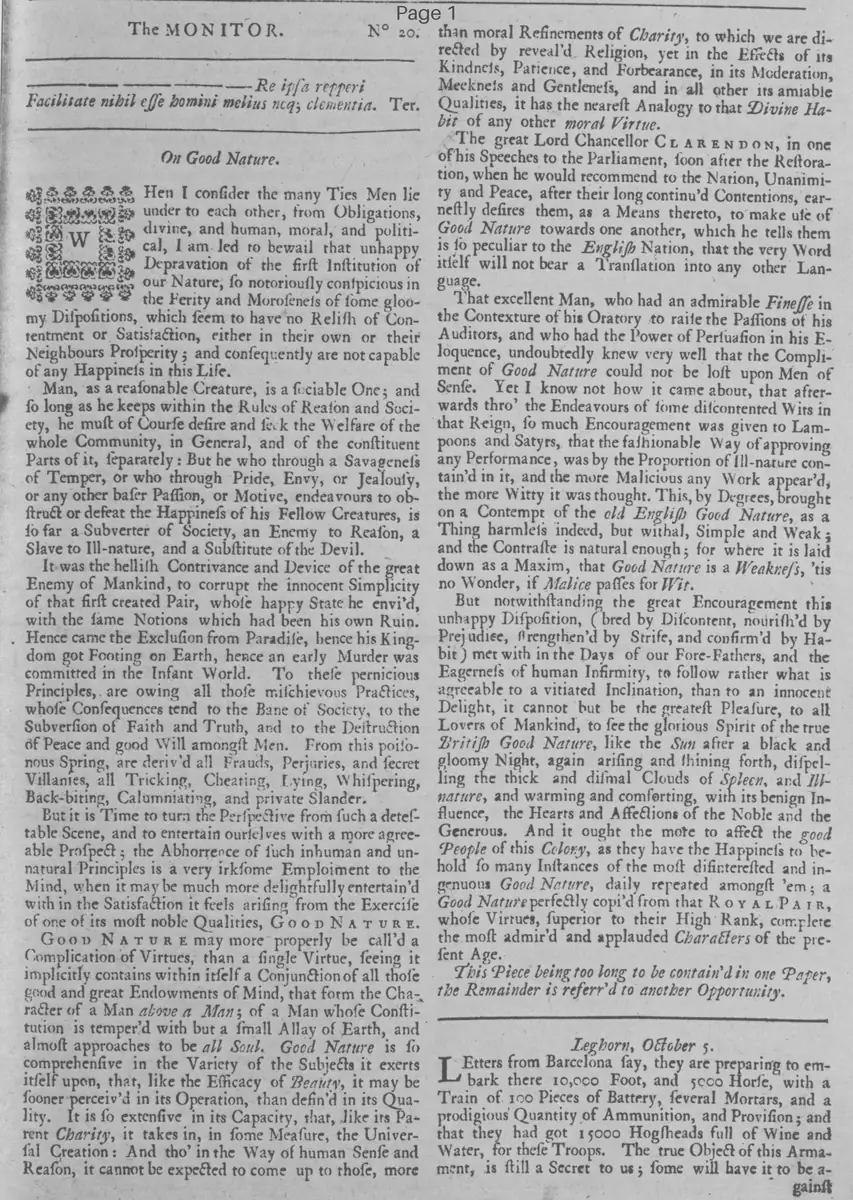
When I consider the many Ties Men lie under to each other, from Obligations, divine, and human, moral, and political, I am led to bewail that unhappy Depravation of the first Institution of our Nature, so notoriously conspicuous in the Ferity and Moroseness of some gloomy Dispositions, which seem to have no Relish of Contentment or Satisfaction, either in their own or their Neighbours Prosperity; and consequently are not capable of any Happiness in this Life.
Man, as a reasonable Creature, is a sociable One; and so long as he keeps within the Rules of Reason and Society, he must of Course desire and seek the Welfare of the whole Community, in General, and of the constituent Parts of it, separately: But he who through a Savageness of Temper, or who through Pride, Envy, or Jealousy, or any other base Passion, or Motive, endeavours to obstruct or defeat the Happiness of his Fellow Creatures, is So far a Subverter of Society, an Enemy to Reason, a Slave to Ill-nature, and a Substitute of the Devil.
It was the hellish Contrivance and Device of the great Enemy of Mankind, to corrupt the innocent Simplicity of that first created Pair, whose happy State he envied, with the same Notions which had been his own Ruin. Hence came the Exclusion from Paradise, hence his Kingdom got Footing on Earth, hence an early Murder was committed in the Infant World. To these pernicious Principles, are owing all those mischievous Practices, whose Consequences tend to the Bane of Society, to the Subversion of Faith and Truth, and to the Destruction of Peace and good Will amongst Men. From this poisonous Spring, are derived all Frauds, Perjuries, and secret Villanies, all Tricking, Cheating, Lying, Whispering, Back-biting, Calumniating, and private Slander.
But it is Time to turn the Perspective from such a detestable Scene, and to entertain ourselves with a more agreeable Prospect; the Abhorrence of such inhuman and unnatural Principles is a very irksome Employment to the Mind, when it may be much more delightfully entertained with in the Satisfaction it feels arising from the Exercise of one of its most noble Qualities, GOOD NATURE.
Good NATURE may more properly be called a Complication of Virtues, than a single Virtue, seeing it implicitly contains within itself a Conjunction of all those good and great Endowments of Mind, that form the Character of a Man above a Man; of a Man whose Constitution is tempered with but a small Alloy of Earth, and almost approaches to be all Soul. Good Nature is so comprehensive in the Variety of the Subjects it exerts itself upon, that, like the Efficacy of Beauty, it may be sooner perceived in its Operation, than defined in its Quality. It is so extensive in its Capacity, that, like its Parent Charity, it takes in, in some Measure, the Universal Creation: And tho' in the Way of human Sense and Reason, it cannot be expected to come up to those, more than moral Refinements of Charity, to which we are directed by revealed Religion, yet in the Effects of its Kindness, Patience, and Forbearance, in its Moderation, Meekness and Gentleness, and in all other its amiable Qualities, it has the nearest Analogy to that Divine Habit of any other moral Virtue.
The great Lord Chancellor CLARENDON, in one of his Speeches to the Parliament, soon after the Restoration, when he would recommend to the Nation, Unanimity and Peace, after their long continued Contentions, earnestly desires them, as a Means thereto, to make use of Good Nature towards one another, which he tells them is so peculiar to the English Nation, that the very Word itself will not bear a Translation into any other Language.
That excellent Man, who had an admirable Fineness in the Contexture of his Oratory to raise the Passions of his Auditors, and who had the Power of Persuasion in his Eloquence, undoubtedly knew very well that the Compliment of Good Nature could not be lost upon Men of Sense. Yet I know not how it came about, that afterwards thro' the Endeavours of some discontented Wits in that Reign, so much Encouragement was given to Lampoons and Satyrs, that the fashionable Way of approving any Performance, was by the Proportion of Ill-nature contained in it, and the more Malicious any Work appeared, the more Witty it was thought. This, by Degrees, brought on a Contempt of the old English Good Nature, as a Thing harmless indeed, but withal, Simple and Weak; and the Contrast is natural enough; for where it is laid down as a Maxim, that Good Nature is a Weakness, 'tis no Wonder, if Malice passes for Wit.
But notwithstanding the great Encouragement this unhappy Disposition, (bred by Discontent, nourished by Prejudice, strengthened by Strife, and confirmed by Habit) met with in the Days of our Fore-Fathers, and the Eagerness of human Infirmity, to follow rather what is agreeable to a vitiated Inclination, than to an innocent Delight, it cannot but be the greatest Pleasure, to all Lovers of Mankind, to see the glorious Spirit of the true British Good Nature, like the Sun after a black and gloomy Night, again arising and shining forth, dispelling the thick and dismal Clouds of Spleen, and Ill-nature, and warming and comforting, with its benign Influence, the Hearts and Affections of the Noble and the Generous. And it ought the more to affect the good People of this Colony, as they have the Happiness to behold so many Instances of the most disinterested and ingenuous Good Nature, daily repeated amongst 'em; a Good Nature perfectly copied from that ROYAL PAIR, whose Virtues, superior to their High Rank, complete the most admired and applauded Characters of the present Age.
This Piece being too long to be contained in one Paper, the Remainder is referred to another Opportunity.
No. 20.
Re ipsa reipublicae
Facilitate nihil esse homini melius nec
clementia.
Ter.
On Good Nature.
When I consider the many Ties Men lie under to each other, from Obligations, divine, and human, moral, and political, I am led to bewail that unhappy Depravation of the first Institution of our Nature, so notoriously conspicuous in the Ferity and Moroseness of some gloomy Dispositions, which seem to have no Relish of Contentment or Satisfaction, either in their own or their Neighbours Prosperity; and consequently are not capable of any Happiness in this Life.
Man, as a reasonable Creature, is a sociable One; and so long as he keeps within the Rules of Reason and Society, he must of Course desire and seek the Welfare of the whole Community, in General, and of the constituent Parts of it, separately: But he who through a Savageness of Temper, or who through Pride, Envy, or Jealousy, or any other base Passion, or Motive, endeavours to obstruct or defeat the Happiness of his Fellow Creatures, is So far a Subverter of Society, an Enemy to Reason, a Slave to Ill-nature, and a Substitute of the Devil.
It was the hellish Contrivance and Device of the great Enemy of Mankind, to corrupt the innocent Simplicity of that first created Pair, whose happy State he envied, with the same Notions which had been his own Ruin. Hence came the Exclusion from Paradise, hence his Kingdom got Footing on Earth, hence an early Murder was committed in the Infant World. To these pernicious Principles, are owing all those mischievous Practices, whose Consequences tend to the Bane of Society, to the Subversion of Faith and Truth, and to the Destruction of Peace and good Will amongst Men. From this poisonous Spring, are derived all Frauds, Perjuries, and secret Villanies, all Tricking, Cheating, Lying, Whispering, Back-biting, Calumniating, and private Slander.
But it is Time to turn the Perspective from such a detestable Scene, and to entertain ourselves with a more agreeable Prospect; the Abhorrence of such inhuman and unnatural Principles is a very irksome Employment to the Mind, when it may be much more delightfully entertained with in the Satisfaction it feels arising from the Exercise of one of its most noble Qualities, GOOD NATURE.
Good NATURE may more properly be called a Complication of Virtues, than a single Virtue, seeing it implicitly contains within itself a Conjunction of all those good and great Endowments of Mind, that form the Character of a Man above a Man; of a Man whose Constitution is tempered with but a small Alloy of Earth, and almost approaches to be all Soul. Good Nature is so comprehensive in the Variety of the Subjects it exerts itself upon, that, like the Efficacy of Beauty, it may be sooner perceived in its Operation, than defined in its Quality. It is so extensive in its Capacity, that, like its Parent Charity, it takes in, in some Measure, the Universal Creation: And tho' in the Way of human Sense and Reason, it cannot be expected to come up to those, more than moral Refinements of Charity, to which we are directed by revealed Religion, yet in the Effects of its Kindness, Patience, and Forbearance, in its Moderation, Meekness and Gentleness, and in all other its amiable Qualities, it has the nearest Analogy to that Divine Habit of any other moral Virtue.
The great Lord Chancellor CLARENDON, in one of his Speeches to the Parliament, soon after the Restoration, when he would recommend to the Nation, Unanimity and Peace, after their long continued Contentions, earnestly desires them, as a Means thereto, to make use of Good Nature towards one another, which he tells them is so peculiar to the English Nation, that the very Word itself will not bear a Translation into any other Language.
That excellent Man, who had an admirable Fineness in the Contexture of his Oratory to raise the Passions of his Auditors, and who had the Power of Persuasion in his Eloquence, undoubtedly knew very well that the Compliment of Good Nature could not be lost upon Men of Sense. Yet I know not how it came about, that afterwards thro' the Endeavours of some discontented Wits in that Reign, so much Encouragement was given to Lampoons and Satyrs, that the fashionable Way of approving any Performance, was by the Proportion of Ill-nature contained in it, and the more Malicious any Work appeared, the more Witty it was thought. This, by Degrees, brought on a Contempt of the old English Good Nature, as a Thing harmless indeed, but withal, Simple and Weak; and the Contrast is natural enough; for where it is laid down as a Maxim, that Good Nature is a Weakness, 'tis no Wonder, if Malice passes for Wit.
But notwithstanding the great Encouragement this unhappy Disposition, (bred by Discontent, nourished by Prejudice, strengthened by Strife, and confirmed by Habit) met with in the Days of our Fore-Fathers, and the Eagerness of human Infirmity, to follow rather what is agreeable to a vitiated Inclination, than to an innocent Delight, it cannot but be the greatest Pleasure, to all Lovers of Mankind, to see the glorious Spirit of the true British Good Nature, like the Sun after a black and gloomy Night, again arising and shining forth, dispelling the thick and dismal Clouds of Spleen, and Ill-nature, and warming and comforting, with its benign Influence, the Hearts and Affections of the Noble and the Generous. And it ought the more to affect the good People of this Colony, as they have the Happiness to behold so many Instances of the most disinterested and ingenuous Good Nature, daily repeated amongst 'em; a Good Nature perfectly copied from that ROYAL PAIR, whose Virtues, superior to their High Rank, complete the most admired and applauded Characters of the present Age.
This Piece being too long to be contained in one Paper, the Remainder is referred to another Opportunity.
What sub-type of article is it?
Moral Or Religious
Social Reform
What keywords are associated?
Good Nature
Ill Nature
Morality
Society
Virtue
Benevolence
English Character
Royal Virtues
What entities or persons were involved?
Lord Chancellor Clarendon
Royal Pair
Editorial Details
Primary Topic
Praise Of Good Nature As Essential Virtue
Stance / Tone
Moral Exhortation Promoting Benevolence
Key Figures
Lord Chancellor Clarendon
Royal Pair
Key Arguments
Men Are Bound By Divine And Human Obligations To Seek Communal Welfare
Ill Nature Stems From Satanic Corruption And Leads To Societal Vices Like Fraud And Slander
Good Nature Encompasses Virtues Like Kindness, Patience, And Gentleness, Akin To Charity
English Good Nature Is Uniquely National And Was Praised Post Restoration
Historical Shift To Satire And Malice Undermined Good Nature, Mistaking It For Weakness
Revival Of British Good Nature Dispels Ill Nature, Exemplified In The Colony By The Royal Pair