Thank you for visiting SNEWPapers!
Sign up free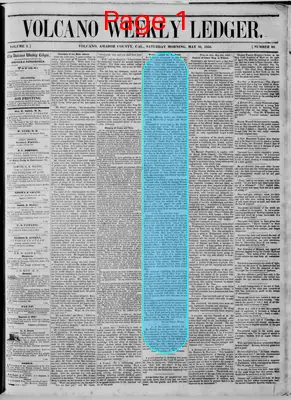
Volcano Weekly Ledger
Volcano, Amador County, California
What is this article about?
In 1856, the U.S. Post Office introduces the Pacific Mail List to prevent letters to California, Oregon, and Washington Territories from becoming dead letters by publishing addresses at all regional post offices, as authorized by Congress in 1853.
Clipping

OCR Quality
Full Text
An Important Auxiliary to the United States Mail Service for the Pacific.
By an act of Congress, approved on the 3d day of March, 1853, the Postmaster General was authorized to make such arrangements as he might deem advisable to insure, as far as possible, the delivery of letters sent by mail from the Atlantic States to California and Oregon to the individuals to whom they may be directed: and we are gratified to learn from the subjoined circular that the purpose thus held in view is about to be accomplished in what appears to us to be a safe, prompt, judicious and responsible manner. It may be proper for us to state also, that this enterprise is commended by the Senator now here from California, by both the Representatives from that State, and by the Delegates, in Congress from Oregon and Washington Territories. The importance of this enterprise will be appreciated when we state that of the letters sent to California during the entire year nearly one-sixth have been returned to the "Dead Letter Office."
National Intelligencer.
To Persons Mailing Letters for California and the Territories of Oregon and Washington.
Thousands of letters sent to the Pacific coast become dead letters. To remedy this evil the Post Office Department, under the authority of Congress, has adopted, as an auxiliary to its operations, the following plan for simultaneously publishing at each and every post office in the Pacific region, in a list called the "Pacific Mail List," the names of persons to whom letters have been sent by mail to post offices in California, and the Territories of Oregon and Washington. By this system a letter may be sent by mail to any post office in the Pacific region for a person whose location is unknown, save the mere fact that he is somewhere in California or the Territories of Oregon and Washington: yet, if the letter be published in the "Pacific Mail List," its ultimate reception by the person for whom it is intended will be rendered highly probable. To enable those who may desire to extend to their Pacific correspondents, the advantages thus offered, the following illustration is given.
Suppose it is wished to send to the Sacramento post office a letter for George Wilson, who emigrated to California from Pike county, Missouri, but it is feared that he may have changed his location, and hence may not receive the letter. In this case direct the letter to George Wilson, (late of Pike county, Missouri, ) Sacramento, California. Then, in order to publish the letter in the "Pacific Mail List," copy the address of the letter upon a piece of paper or card, and inclose the card, together with a three cent postage stamp, in an envelop, and direct the envelop to the
PACIFIC MAIL LIST, NEW YORK.
Deposit the letter as usual in the mail for California, and at the same time drop the envelop containing the card to publish the letter in the mail for New York. From the address on the card thus received at the New York Post Office, the name (George Wilson) will be entered in its appropriate place in the "Pacific Mail List," which list is printed and sent by each mail to each and every post master in California and the Territories of Oregon and Washington, and by them posted in a conspicuous place in their respective offices. The list being thus distributed over the entire Pacific region, George Wilson may at once learn from it that a letter for him has been sent to the Sacramento Post Office. No person of a similar name will receive the letter, for the address on it points out that it is intended for George Wilson, late of Pike county, Missouri. Thus many letters will be received that would otherwise be transmitted to the Dead Letter Office.
The envelopes containing the advertising cards sent to the "Pacific Mail List," New York, pay postage like ordinary mail matter, and must be pre-paid. The addresses of letters copied on the pieces of paper or cards should be written in a plain and distinct manner. The three cent postage stamps enclosed in the envelopes defray the expenses of publication, and must not be pasted to the cards, but simply enclosed with them. In the absence of stamps, three cent coins may be substituted.
It is believed that this circular has been drawn up so explicitly as to require no explanation: but should this prove not to be the case, post masters will take notice that all interrogatories must be addressed to the "Pacific Mail List," New York, and not to the Department.
The first of this series of lists will accompany the mail of May 5th, and will be forwarded by each succeeding mail.
Oliver Evans Woods.
P. O. DEPARTMENT, March 5. '56.
Mr. Woods has my authority to put his plan, as above in operation, but no responsibility is assumed by the Department ; and all correspondence in regard to this arrangement must be addressed to the "Pacific Mail List." New York. That the public may avail itself of the advantages thus offered, post masters are requested to give this circular a conspicuous place in their respective offices.
JAMES CAMPBELL, P. M. General
What sub-type of article is it?
What keywords are associated?
What entities or persons were involved?
Where did it happen?
Domestic News Details
Primary Location
California, Oregon, And Washington Territories
Event Date
March 5, 1856
Key Persons
Outcome
implementation of the pacific mail list system to reduce dead letters by publishing addresses at pacific post offices, authorized by congress in 1853.
Event Details
The Post Office Department, under authority from Congress (act of March 3, 1853), adopts an auxiliary plan to publish lists of undelivered letters at every post office in California, Oregon, and Washington Territories via the 'Pacific Mail List' managed in New York. Senders can mail a letter to a specific post office and separately send a card with the address and a 3-cent stamp to the Pacific Mail List in New York for publication, ensuring the intended recipient can claim it regardless of exact location.