Thank you for visiting SNEWPapers!
Sign up free
Rutland Herald
Rutland, Rutland County, Vermont
What is this article about?
Detailed report of Vermont Legislature sessions from November 8-15, 1839, focusing on debates over bank reform and charters, revisions to statutes including militia laws and salaries, with votes on various bills in Senate and House.
Merged-components note: Merged continuation of the Vermont Legislature report on bank debates and proceedings across pages 1, 2, and 3; relabeled from 'story' to 'domestic_news' as it fits local/national non-story news.
Clippings
1 of 3
OCR Quality
Full Text
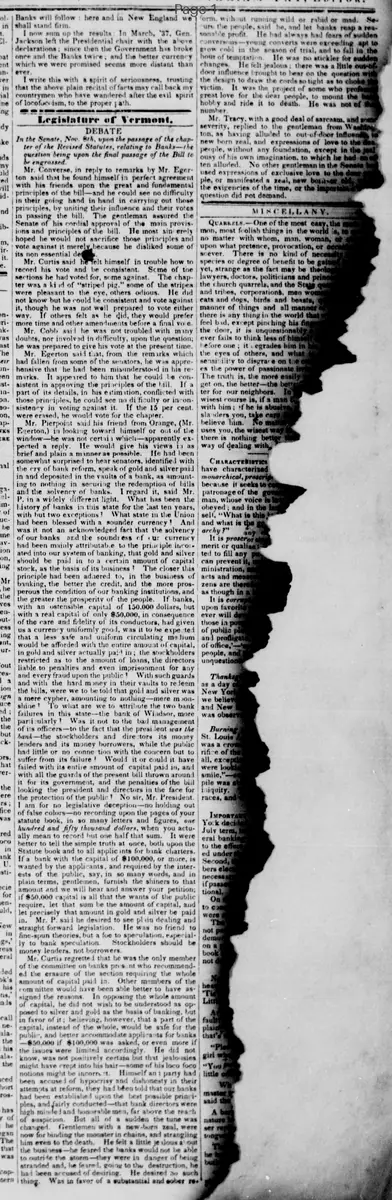
DEBATE
In the Senate, Nov. 8th, upon the passage of the chapter of the Revised Statutes, relating to Banks—the question being upon the final passage of the Bill to be engrossed.
Mr. Converse, in reply to remarks by Mr. Egerton said that he found himself in perfect agreement with his friends upon the great and fundamental principles of the bill and he could see no difficulty in their going hand in hand in carrying out those principles, by uniting their influence and their votes in passing the bill. The gentleman assured the Senate of his cordial approval of the main provisions and principles of the bill. He most sincerely hoped he would not sacrifice those principles and vote against it merely because he disliked some of its non essential details.
Mr. Curtis said he felt himself in trouble how to record his vote and be consistent. Some of the sections he had voted for, some against. The chapter was a kind of "striped pig." some of the stripes were pleasant to the eye, others odious. He did not know but he could be consistent and vote against it, though he was not well prepared to vote either way. If others felt as he did, they would prefer more time and other amendments before a final vote.
Mr. Cobb said he was not troubled with many doubts, nor involved in difficulty, upon the question; he was prepared to give his vote at the present time.
Mr. Egerton said that, from the remarks which had fallen from some of the senators, he was apprehensive that he had been misunderstood in his remarks. It appeared to him that he could be consistent in approving the principles of the bill. If a part of its details, in his estimation, conflicted with those principles, he could see no difficulty or inconsistency in voting against it. If the 15 per cent. were erased, he would vote for the chapter.
Mr. Pierpoint said his friend from Orange, (Mr. Egerton,) in looking toward himself or out of the window—he was not certain which—apparently expected a reply. He would give his views in as brief and plain a manner as possible. He had been somewhat surprised to hear senators, identified with the cry of bank reform, speak of gold and silver paid in and deposited in the vaults of a bank, as amounting to nothing in securing the redemption of bills and the solvency of banks. I regard it, said Mr. P. in a widely different light. What has been the history of banks in this state for the last ten years, with but two exceptions? What state in the Union had been blessed with a sounder currency! And was it not an acknowledged fact that the solvency of our banks and the soundness of our currency had been mainly attributable to the principle incorporated into our system of banking, that gold and silver should be paid in to a certain amount of capital stock, as the basis of its business? The closer this principle had been adhered to, in the business of banking, the better the credit, and the more prosperous the condition of our banking institutions, and the greater the prosperity of the people. If banks, with an ostensible capital of $150,000 dollars, but with a real capital of only $50,000, in consequence of the care and fidelity of its conductors, had given us a currency uniformly good, was it to be expected that a less safe and uniform circulating medium would be afforded with the entire amount of capital, in gold and silver actually paid in; the stockholders restricted as to the amount of loans, the directors liable to penalties and even imprisonment for any and every fraud upon the public? With such guards and with the hard money in their vaults to redeem the bills, were we to be told that gold and silver was a mere cipher, amounting to nothing—mere moonshine? To what are we to attribute the two bank failures in this state—the bank of Windsor, more particularly! Was it not to the bad management of its officers—to the fact that the president was the bank—the stockholders and directors its money lenders and its money borrowers, while the public had little or no connection with the concern but to suffer from its failure! Would it or could it have failed with its entire amount of capital paid in, and with all the guards of the present bill thrown around it for its government, and the penalties of the bill looking the president and directors in the face for the protection of the public? No sir, Mr. President. I am for no legislative deception—no holding out of false colors—no recording upon the pages of your statute book, in so many letters and figures, one hundred and fifty thousand dollars, when you actually mean to record but one half that sum. It were better to tell the simple truth at once, both upon the Statute book and to all applicants for bank charters. If a bank with the capital of $100,000, or more, is wanted by the applicants, and required by the interests of the public, say, in so many words, and in plain terms, gentlemen, furnish the shiners to that amount and we will hear and answer your petition; if $50,000 capital is all that the wants of the public require, let that sum be the amount of capital, and let precisely that amount in gold and silver be paid in. Mr. P. said he desired to see plain dealing and straight forward legislation. He was no friend to fine-spun theories, but a foe to speculation, especially to bank speculation. Stockholders should be moneylenders, not borrowers.
Mr. Curtis regretted that he was the only member of the committee on banks present who recommended the erasure of the section requiring the whole amount of capital paid in. Other members of the committee would have been able better to have assigned the reasons. In opposing the whole amount of capital, he did not wish to be understood as opposed to silver and gold as the basis of banking, but in favor of it: believing, however, that a part of the capital, instead of the whole, would be safe for the public, and better accommodate applicants for banks—$50,000 if $100,000 was asked, or even more if the issues were limited accordingly. He did not know, was not positively certain but that jealousies might have crept into his hair—some of his loco foco notions might be incorrect. Himself and party had been accused of hypocrisy and dishonesty in their attempts at reform, they had been told that our banks had been established upon the best possible principles, and fairly conducted—that bank directors were high minded and honorable men, far above the reach of suspicion. But all of a sudden the tune was changed. Gentlemen with a new-born zeal, were now for binding the monster in chains, and strangling him even to the death. He felt a little jealous about the business—he feared the banks would not be able to outride the storm—they were in danger of being stranded and, he feared, going to the destruction, he had been accused of desiring. He desired no such thing.
Was in favor of a substantial and sober reform without running wild or rabid or mad. Secure the people, said he, and let banks reap a reasonable profit. He had always had fear of sudden conversions—young converts were exceeding apt to grow cold in the season of trial, and to fall in the hour of temptation. He was no stickler for sudden changes. He felt jealous: there was a subtle out-door influence brought to bear on the question with the design to draw the cords so tight as to choke the victim. It was the project of some who professed great love for the dear people, to mount the hobby and ride it to death. He was not of that number.
Mr. Tracy, with a good deal of sarcasm, and some severity, replied to the gentleman from Washington, as having alluded to out-of-door influence, new born zeal, and expressions of love to the people, without any foundation, except in the jealousy of his own imagination, to which he had ten alluded. No other gentleman in the Senate used expressions of exclusive love to the dear people, or manifested a zeal, new born or otherwise, but such as the exigencies of the time, or the importance of the question did not demand.
THE RUTLAND HERALD.
Legislature of Vermont,
Monday, Nov. 11.
SENATE—Proceedings by Mr. Eaton, providing that the General Assembly adjourns without day on Friday next. Mr. Eaton said his object in presenting the resolution was, to hasten preparations for adjournment, and procure the reports of committees. In regard to the claims of the chair if the committee appointed upon the failure of the Essex and Windsor banks had made report. The chair replied that the report had been received. The resolution was laid upon the table, dooming the town of Glastenbury in the sum of $455.51—called up by Mr. Pierpoint, when Mr. Cobb moved to amend by erasing $450 and inserting in lieu thereof $100. Mr. Eaton moved the sum of $800, and the question being stated upon this, the largest sum, was carried; which the resolution as amended was laid upon the table on motion of Mr. Cobb; directing the com. on judiciary to report a bill abolishing capital punishment, indefinitely postponed; requiring the treasurer to make an estimate of the expenses incurred by the state on the northern frontier—(continued
11.
All, Incorporating an institution of savings at Brattleboro, read a 3d time and passed; extending a charter of the bank of Rutland, called up by Mr. Pierpoint who proposed an amendment, restricting stockholders in loans, and as provided in the chapter on banks, in the revised statutes: limiting loans to per cent of the capital paid in, so to exceed the amount at any one time of $8000. Adopted: when Mr. McMillan moved in the bill that the issues of the bank exceed the amount of deposits and double the amount of capital stock actually paid in. The motion was accepted by Mr. Pierpoint and adopted. Mr. Cobb moved an amendment, requiring semi-annually to pay in to the state treasury half of one per cent, of the capital stock, in lieu of ten per cent, of the net profits already accrued. Bill and amendment laid upon the table—Adj.
Bills. Mr. Dillingham called up the bill making an appropriation to the com. to revise the laws: the amount called up $3500, and the bill was passed. By Mr. Bartlett, for the appointment of clerks, adopted. By Mr. Hodges, to prevent the introduction of bills after Wednesday morning—committee: adopted. Committees. By com. of ways and means, a resolution supplemental to abolish the office of inspector of the state prison, and that the sum of $500 be appropriated as adequate compensation to that officer until the passing part of act abolishing imprisonment for debt—the bill was dismissed. For distribution of proceeds of lands granted to this state by Congress—passed, ayes 96, noes 67. Chartering the bank of Caledonia, and a motion of Mr. Gowdy to lay upon the table for amendment was lost. Mr. Gowdy asked leave to enter his protest against the passage of the bill. He said of the whole system of banks. He believed the House, or else the state, would yet rue the day they chartered so many banks. He believed it would lead to a depreciation of the currency, and an investment of the people's money in stocks in these banks; a situation that all of these banks would get into the hands of speculators, and under their exclusive control, to the end to which all such institutions tend—the ground that in the present derangement of the country the number of our banks was already too great—the danger of subjecting the honest farmer connected with the control of such institutions—he, of the nature of a bank note or a bank vote or this vote or this upon loans to directors—passed—137 ayes. Adj.
3 o'clock P. M.
Preservation of noxious weeds, 29, of town and county officers, rown and confinement—moved an amendment to writs of the Fullam Dillingham to judiciary—Adj. m, 12.
1
nt
1
x
jected and to in, and hta rod to wored Y mx.
Bills in the House were considered, and the debate upon the amendment offered by Mr. McMillan relating to the security of bonds, as introduced into the bill by the substitute of Mr. McMillan. Referring to the settlement of an estate, Mr. C. said a bondsman worth his tens of thousands dies—no failure of the bank—no failure of its charter has occurred—the estate is settled at the probate office, according to the provisions of law the property rightfully divided among the heirs: now comes the failure of the bank—what are your bonds in that case worth? Not a fraction. The heirs would not be holden, and they would consider themselves as doing God service in resisting all liability upon the bond. Mr. C. spoke at length in presenting his views of the insecurity of bonds. Mr. McMillan replied to Mr. C. and said the insecurity of bonds was provided for in other sections of the bill. The sections were read by the chair, when Mr. Converse finished his remarks, and the amendment offered by Mr. Foster was adopted. Mr. Swift then proposed an amendment, relating to the bonds of directors, requiring the execution of bonds secured by residents of this state not stockholders or by mortgage. Mr. Pierpoint said he had no objection to the proposed amendment, but it was adopted unanimously. Adj.
HOUSE.—Engrossed Bills—Incorporating the bank of Poultney—Mr. Tonney moved an amendment limiting loans to directors and stockholders, which was supported by Mr. Chandler, and opposed by Mr. Dillingham and rejected, 121 to 84: Mr. Sanborn moved an amendment requiring a tax of one half per cent of the capital stock to be paid into the state treasury, which was opposed by Messrs. Fullam and Butler, and rejected. Mr. Cleaveland moved to require the stock to be taken up within one year, or the charter to be forfeited, which was rejected, and the question recurred on the passage of the bill. Mr. Fisk of Waterville opposed the passage of the bill. He said he was opposed to any increase of banking capital under the present circumstances of the currency. It was true, he had yesterday voted for a recharter of the bank of Caledonia; but it was not, that he was disposed to favor one part of the state more than another; he voted for the extension of that charter, for the reason that a bank was needed in that portion of the state: and also for the additional reason that the scheme of banking now proposed was an experiment, which he was willing should be tried. He did not deem it safe however, to go further until this experiment was fairly tested. None were entirely confident of the success of this experiment; there was reasonable grounds to fear that stock would be thrown into irresponsible hands or placed under the control of but a very few capitalists. But whatever might be the result, prudence dictated that the House should wait and see by whom the stock is taken, and whether the scheme worked beneficially for the stockholders and the public. Mr. Warner took a similar view and protested against adding to the paper circulation in that part of the state. Mr. Needham sustained the bill: three banks in Rutland county were as much needed as two in Addison. Mr. Sanborn opposed the bill. Much had been said the past year upon "bank reform," and his constituents believed that one of the first measures towards reform was to grant no more bank facilities where there were enough, and more than enough, already. Mr. Brown supported the bill, when Mr. Chandler renewed substantially the motion of Mr. Cleaveland to amend—supported by Messrs. Chandler, Warner and Higby, opposed by Messrs. Brown, Butler, Clark and Kinnison and rejected, 131 to 50. The bill was then passed 133 to 45. Mr. Stark called up the bill securing bill-holders on the closing of banks, and it was referred to com. on banks. Mr. Fullam called up the bill incorporating the Freehold bank at Felchville; sundry amendments were adopted, when Mr. Sanborn moved to lay the bill upon the table and make it the order for to-morrow morning, he believed a bank at Felchville unnecessary—opposed by Messrs. Fullam and Needham and negatived. The bill was ordered to a 3d reading. Adj. 2 o'clock P. M. SENATE.—Bills.—From the House making sundry alterations in the militia laws, twice read and referred to com. on military affairs; to incorporate the bank of Poultney, twice read and referred to com. on banks: extending the charter of bank of Rutland, called up, and the amendment proposed by com. on banks erasing the whole bill and offering a new one being under consideration, Mr. Pierpoint asked for the reasons which had induced the com. on banks to propose a new bill. Mr. McMillan stated those reasons in short, when Mr. Pierpoint addressed the Senate at length, in favor of the original bill and against the new one offered by the com. especially its private property clause. Messrs. McMillan and Curtis spoke in favor of the amendment, when Mr. Pierpoint replied to each and the question was taken upon the amendment proposed by the com. and rejected. Mr. Swift renewed his amendment, upon which, in the forenoon, he submitted the following remarks: The capital stock of the bank being all paid in, there is no reason to apprehend a failure, if the directors are honest and manage the affairs of the bank well. Who ever heard of a bank failing when the capital was all paid in and the directors were faithful and prudent in managing its concerns? He was for not only securing the bill-holder but the honest stockholder. In many, indeed in most cases where banks failed, the stockholders at large were as innocent as the bill-holder. It is not uncommon for females, guardians of minors or other trustees to invest their money in bank stock, that they might be relieved from the care of it. This class and the honest farmer should be protected from the wrongful act of directors as well as the bill holder, and to protect this class, he introduced the amendment and hoped it would be adopted. Adj. HOUSE. The bill for the geological survey of the state was taken up, and Mr. Butler moved to dismiss it. Mr. Baxter addressed the House in support of the bill. Mr. Brown expressed himself friendly to the measure, as soon as the state of the treasury would admit and proposed to lay the bill upon the table, with the understanding that it should go over to the next session. Messrs. Sprague and Warner of Newhaven supported the bill. Mr. Gowdy in behalf of the com. said that no objection would be made to the course proposed by the gentleman from St. Albans: and the bill was laid on the table Adj. Wednesday, Nov. 13. SENATE.—Revised Statutes considered. Banks!—Mr. Pierpoint called up the bill extending the charter of the bank of Rutland, when the amendments adopted, in com. of the whole, were reported to the Senate, concurred in, when Mr. McMillan moved that the substitute, as amended in com. of the whole be adopted instead of the bill.—Lost, yeas 9, nays 15, when the bill was ordered to be engrossed and read a third time. Mr. McMillan reported the bill from the house rechartering the bank of Caledonia, without amendment, and on motion of Mr. Pierpoint, the bill was laid upon the table. Bills.—By Mr. Marsh, relating to the General List (the same as passed by the Senate in 1836.) Laid upon the table; relating to the militia, reported by Mr. Townsley, with proposals of amendment, exempting judges of the Supreme and County Courts and probate courts, clerks of those courts, and presidents, and faculty of colleges from military duty. Mr. Marsh moved to amend the amendment by exempting students of colleges also. Motion debated by Mr. Swift and Eaton, opposed by Mr. Townsley, and lost. The amendment proposed by the com. erasing six cents per mile for traveling at drill, and court martials allowing three dollars per day as compensation for drill officers, and one dollar per day for attendance upon court martials, after much debate was adopted; the amendment requiring drills but once in two years, instead of annually, and exempting inhabitants of small towns from certain military duty, were passed over, when Mr. Pierpoint moved to strike out the four first sections of the bill. The object of this motion, as stated by the mover, was to avoid all interference with the late organization of the militia by the law of 1836, and the compelling the judges of the supreme court to do military duty. Motion lost, when Mr. Adams moved to erase the section providing for the payment of attendance upon courts martial, out of the state treasury. It appeared from statements of senators that about 300 courts martial would annually be held in the state, entoracing some fifty or one hundred attendants upon each, swelling the tax upon the treasury far beyond the benefits derived, either by the militia or the community. Motion lost. When Mr. Pierpoint moved to strike out the 6th chapter which provides for regimental courts martial. Motion prevailed, when Mr. Converse moved that the bill be laid upon the table, assuring the senate if the bill was so laid he would prepare an amendment, dispensing with all musters and useless and unmeaning ceremonies, and providing for the annual examination of arms, equipments, and drill of officers, and before the question was taken the Senate Adj. HOUSE. Bills introduced.—By Mr. Wheeler, incorporating bank of Montpelier, which was referred to the com. on banks. This bill differs from others, and it is understood to be in such shape as will warrant the taking up of the stock. Its main provisions are 1st. 25 per cent. of capital stock to be paid in specie before the bank goes into operation; 2d the debts of the bank never to exceed the amount of deposits and twice the amount of capital stock paid in: 3d, the directors to give bonds, with sureties, equal in the aggregate to the capital stock, to be holden first for the security of bill-holders and next of the stockholders: 4th, directors and stockholders never to be indebted to the bank in a sum exceeding $8000; 5th, on suspension of specie payment, bill holders entitled to 12 per cent interest on bills, and the supreme court empowered to vacate the charter: 6th, the act to go into operation within one year: 7th, the bank to be under the operation of the act of 1838. Resolutions.—By Mr. Smith of Putney, for adjournment of both houses on Monday morning next; laid on the table. By Mr. Dillingham, for publication of the appointments made by the joint assembly, adopted. Reports of Committees.—By judiciary com. lessening the labor of reporter of decisions of supreme court, and reducing his salary to $450—laid on the table till to-morrow afternoon. By com. on military affairs, bill to pay for certain militia services on the northern frontier, ordered to 3d reading. By judiciary com. against bills relative to marriage and divorce, and it was dismissed; against repealing the act relating to interest; dismissed. By gen. com. that it is inexpedient to make any alteration of the mode of assessing land taxes: against bill relating to paupers, dismissed; Mr. Warner, of Newfane, called up the report of the select com. on the proceeds of national domain, and moved that 400 copies be printed for the use of the house. After some discussion, the house before taking the question, adj. 2 o'clock, P. M. SENATE. Bills.—Extending the charter of the bank of Rutland to January, 1858, read a third time and passed, yeas 12, nays 11; rechartering the bank of Caledonia, called up by Mr. McMillan, when Mr. Pierpoint moved an amendment to the bill, similar to that offered by Mr. Cobb to the bill extending the charter of the bank of Rutland, requiring one half of one per cent of the capital semi-annually to be paid into the state treasury, adopted. Mr. Townsley inquired of the chairman of the com. on banks, if the stockholders were restricted to 1/4 per cent. as to loans. The chairman answered that the stockholders were not so restricted. He should not object to a provision of that kind. Mr. Townsley then moved that the bill be so amended as to restrict the stockholders and officers of the bank as to loans, as in the bill rechartering the bank of Rutland. Amendment adopted—Mr. McMillan moved that the words "in specie" relating to capital stock paid in be erased. Amendment adopted. The several amendments adopted in committee of the whole, were reported to the senate, and concurred in, when the senate went into joint assembly, returned, and the bill was read a third time and passed. Adj. HOUSE.—Revised statutes, chap. 91, of preservation of sheep, ordered to a 3d reading. Passed.—Chap. 28, of process, the amendment proposed by Mr. Hodges on a former day, adopted substantially, (providing that when creditors show that when debtors have recovery, rights, credits, &c. concealed, writs or executions may be taken out against the body of the debtor—reserving the right to claim the poor debtor's oath.) The senate came in, and the following appointments were made: Gen. Truman B. Ransom, maj. Gen. 3d div. Col. Rowland Smith, Brig. Gen. in place of Gen. J. Washburn, resigned. (Col. Smith 160, Col. Peter T. Washburn 38, scattering 4.) Col. John M. Potter, Brig. Gen. in place of Gen. G. Blackmer, resigned. The senate withdrew. Chapter 107 of salaries and fees, was considered: an amendment reducing pay of Treasurer, as commissioner of school fund to $50, adopted 115 to 63: also of secretary of state to $250, 106 to 61; secretary of senate $200; of Clerk of the house to $250, 76 to 68; of secretary of civil and military affairs to $100: of assistant secretary of the senate to $100; of assistant clerk of the house of Representatives to $125, 78 to 49; of engrossing clerk to $150; of sup't of Vt. State prison to $300—after discussion on this last amendment, by Messrs. Hodges, Rice, Fairbanks, Fullam, and Brown, the house adj. Wednesday, Eve. Session, Nov. 13. SENATE.—Mr. Pierpoint called up the bill relating to the militia, and his amendment, under consideration at the adjournment in the forenoon, was lost, when Mr. P. moved so to amend the 3d chap. that Brigade Inspectors be required to attend regimental drills, instead of Major Generals; adopted, when Mr. P. moved another amendment, proposing to erase the section in the bill which gives adjutants the rank of captains, and precedence of captains in the line. On this question a somewhat animated discussion, partaking a little of the martial spirit or, as one of the grave senators remarked, "the tin turkey and red rooster" character, occurred between Messrs. Pierpoint, Lawrence, Edgerton and Bowen in favor of the amendment, and Messrs. Townsley, Cobb, and Marsh opposed to it. Amendment adopted, when on motion of Mr. Pierpoint, a portion of the 6th section was erased. Mr. Converse moved so to amend the bill, as to dispense with all trainings annually, in the month of June. Mr. Converse said if gentlemen would point out, and be strongly urged them to do it, any substantial good to be derived by the militia or the country, in keeping up the enormously expensive system of brigade and regimental musters, he would waive his objections and withdraw his amendment; but if gentlemen would not, or could not, convince him of the benefits of such meetings of the militia, he must urge the adoption of his amendment. He believed, in sober earnest, the militia would be more efficient, with less trainings and musters of the soldier, and more instruction and drills to the officer. Our musters and multiplied trainings were not only a source of vexatious loss of time and unreasonable expense to the citizen soldier, but a prolific source of vice and crime in the community, in the intemperance growing out of the system. Messrs. Townsley, Lawrence, Bowen and Marsh opposed the amendment, as eminently calculated to destroy that spirit of emulation among officers, which gave to the militia its principal strength and efficiency. The motion to amend, as proposed by Mr. Converse, was also advocated by Messrs. Pierpoint and Edgerton on the ground that the system of Brigade and Regimental reviews, was oppressive to the great body of the community: taxing them in the loss of time and expense of conveyance, and purchase of equipments, without inadequate reward—an expense and burden upon the soldier, merely to gratify the vanity of the officers. Mr. Curtis said he would not attempt to answer to inquiries of gentlemen as to the good to be obtained by military reviews. He did not feel himself competent to the task. But, from what observation he had made, and the recollections of the last war, he had been in the habit of regarding a well regulated militia as the cheapest and safest arm of the national defence. If well organized, embracing as it did the bone and muscle of the country, it was better than a standing army, and would ever supercede the necessity of one. Mr. Eaton replied to Mr. C. and assented to his doctrine of the value of a well organized militia: but it might be well to define what a well organized militia was: that the gentleman had avoided. After spending the greater part of the evening in still further debate upon Mr. Converse's motion, it was rejected, and the bill laid upon the table. Bill.—Extending the charter of the bank of Montpelier to January 1, 1841, for the purpose of winding up its concerns, twice read and referred to committee on banks. Adj. HOUSE.—Resolution.—By Mr. Bard, appointing Sewall Fullam, Jr. on the select com. appointed to investigate the concerns of the Windsor and Essex banks, in the place of Capt. Partridge, absent—adopted. Revised Statutes.—The House resumed consideration of Chap. 107, and the following amendments were adopted without a division: reducing salary of superintendant of state prison to $300; reducing pay of President of the Senate to $3 per day: increasing pay of Speaker of the House to $3 per day. Mr. Rice moved to reduce the salaries of the Judges of the Supreme Court from $1400 to $1300: supported by Messrs. Brown and Sprague, opposed by Messrs. Needham, Dillingham and Chandler and adopted. The bill was then passed. Passed.—Chap. 56 of probate bonds, 90 of the preservation of game, &c, (all the sections prohibiting the destruction of fish, deer and muskrats in certain seasons were stricken out, and a proposition to strike out the bounty on foxes, after considerable discussion was rejected, 93 to 84. Adj. Thursday, Nov. 14. SENATE.—Chap. 76, of the revised statutes introduced by Mr. Marsh and entitled 'of the General List,' was read the 1st time and referred to com. on finance. (This is a system of listing like the one now in force, but somewhat more comprehensive. Mr. Cobb introduced the following resolution: Resolved, that the com. on finance be instructed to ascertain from such sources as are within their power the amount of military fines collected and in the hands of military officers and report to the Senate. The Senate, as in committee of the whole, resumed consideration of the act in addition to the act regulating and governing the militia and the bill was amended and reported to the Senate, and was under consideration when the Senate, adjourned. HOUSE.—Report of Committees—By com. on Education, against bill repealing part of school act, and it was dismissed. By select com. that it is inexpedient to take any legislative measures on the memorials relating to moral reform and to the custom of war. By com. on manufactures, bill to incorporate Poultney Iron Co. and Newbury Mill Co. (Embracing provision making private property of stockholders liable for corporation debts,) the first ordered to a third reading, and the last passed. By select com. on slavery, maintaining the positions heretofore taken by the legislature of Vermont, and concluding with sundry resolutions—affirming the power of Congress over slavery in the district, and over the slave trade between the states—protesting against the annexation of Texas—and declaring the passage of Atherton's resolution a violation of the constitution and a flagrant outrage upon the right of petition; all of which were made the order for tomorrow morning. By select com., bill incorporating Caledonia and Essex county Insurance Co., laid on the table and made the special order for to-morrow morning. Resolutions. By Mr. Brown, a series for a specie currency and the suppression of small bills, proposing an interchange of views among the several states—laid on the table. Bill.—From the Senate, extending charter of bank of Rutland, (similar to the Montpelier bank bill yesterday introduced,) referred, together with a remonstrance against the same, to com. on banks. The Senate returned the Caledonia Co. Bank with the following amendments: 1st, requiring the semi-annual payment to the state of a tax of 1/2 per cent of stock paid in: 2d. the directors and stockholders not to be indebted to the bank, in the aggregate, in a sum greater than 15 per cent of the capital stock paid in. and no officer or stockholder at any time to be indebted a sum not exceeding $2000, with the security of persons who are not stockholders—in which the House concurred. Engrossed Bills.—Incorporating the Freehold bank at Felchville—yeas and nays demanded by Mr. Sanborn, and taken, ayes 99 noes 66, so the bill was passed. The House resumed consideration of the resolutions relating to the public lands, the question being upon the motion to dismiss them. The discussion was continued by Messrs. Butler, Brown, Dillingham, Needham, Sprague and Henry for dismissing, and by Messrs. Hodges, Fairbanks, Gowdy and Bard against dismissing. An adjournment was moved and negatived. Mr. Butler moved to lay the motion to dismiss on the table. After discussion the question was put, and Mr. Butler's motion was negatived. The question again recurred on dismissing the resolutions: ayes 78 noes 96, so the motion was negatived. Mr. Brown moved to lay them on the table—after farther discussion the yeas and nays were taken; ayes 65, noes 98 so the motion was negatived. Mr. Shattuck moved a call of the House, negatived. Mr. Dillingham moved to adjourn; ayes 39, noes 84; while the ayes and noes were being taken, a considerable squad of locofocos, at the instance of and headed by the Hon. Mr. S. S. Brown of St. Albans, left the hall for the obvious purpose of preventing a quorum, which attempt however, failed, and on the declaration of the vote, Mr. Sanborn moved that the subject be recommitted. and demanded the ayes and nays. Mr. Dillingham demanded a count of the House, and a quorum was found to be present. Mr. Henry moved an adjournment, and called for the ayes and noes; which he withdrew at the suggestion of Mr. Fairbanks, who said it was apparent that the minority were determined to consume the time of the House, by vexatious motions not in any way tending to a disposition of the subject—he would yield to the necessity of the case, letting the responsibility of this wanton waste of time rest where it belonged; and he therefore moved to adjourn, ayes 49 noes 57, no quorum. Mr. Coolidge said the House had done all they could to dispose of this question; the minority had seen fit to place themselves in the wrong: and in these circumstances he was disposed to adjourn. The House adjourned at 20 minutes to 2, until half past 2. Thursday, 1/2 past 2 o'clock, P. M. SENATE.—Mr. Noble had leave of absence from and after to-morrow morning. Bills. —The consideration of the bill relating to the militia, in debate at the adjournment in the forenoon was resumed, when Messrs. Lawrence, Egerton and Pierpoint severally addressed the Senate, and after some debate the bill was read a third time and passed; relating to infantry companies, and providing that members of such companies, provided with rifle, powder-horn and bullet pouch be returned equipped. Negatived yeas 5 nays 18; incorporating Freehold Bank at Felchville, twice read and referred to com. on banks: extending charter of Bank of Montpelier one year, read a third time and passed. Adj. HOUSE.—Revised Statutes. Chap. 87, of innkeepers and retailers was considered, the 1st question being upon an amendment substantially to insert the provision of the law of '38; after a brief discussion by Messrs. Fullam and Jackson against the amendment, and some explanation by Mr. Fairbanks the amendment was rejected. Mr. Brown moved to amend as to empower the county court, at their discretion, to grant licenses—supported by Mr. Dillingham and agreed to. Mr. Richardson of W. moved an amendment requiring the assent of a majority of selectmen and civil authority present at any meeting, for approbating innkeepers—adopted. Mr. Fairbanks moved to amend, so as to authorize selectmen and civil authorities to license persons to keep temperance houses—adopted. Mr. Tyler moved to amend, limiting county courts to the two first days of the term in which to grant licenses—adopted. and the bill passed Adj. Eve. Session, Nov. 14. SENATE.—Bills. Incorporating the bank of Poultney, called up by Mr. Converse, and variously amended, to render the provisions similar to those of the bill rechartering the bank of Caledonia. Mr. Foster addressed the Senate on the imperfect security of bonds, and moved that the bill be amended by erasing the provisions for bonds, so as to rely for security on mortgage on improved real estate, adopted. The bill was further amended, on motion of Mr. Pierpoint, and on motion of Mr. McMillan, when Mr. Adams requested the chairmen of the com. on banks, to state reasons, if any existed, for the incorporation of a new bank in the Co. of Rutland. Mr. McMillan replied to this enquiry, by stating the reasons assigned by the applicants of the bank showing a very large amount of business at Poultney and vicinity, and possession of much wealth in that and the adjoining towns, requiring bank facilities to a large amount. The bill was then read a third time when Mr. Cobb addressed the Senate in opposition to the bill and it passed, ayes 24 noes, 9. Revised Statutes—Chap. 107, of salaries and fees from the House, with amendments reducing the salaries of the state Treasurer, Secretary, and Clerks of the House and Senate. Considered in the Senate. Mr. Converse in the chair. The amendment reducing the salary of the Treasurer, Secretary of state, do. of the Senate, rejected; reducing the compensation of clerk of the House in the sum of $25, unanimously rejected; reducing the compensation of Secretary of civil and military affairs from $200 to $100, rejected: reducing the compensation of the assistant secretary of the Senate, in the sum of $50, concurred in with an amendment, providing to reduce the salary but $25, and as amended adopted. yeas 15 nays 8; reducing the salary of the assistant clerk of the House, in the sum of 25, adopted by a small majority; reducing the compensation of the engrossing clerk of the House, in the sum of $25. Reducing the compensation of the Lieut. Gov. and President of the Senate from 4 to $3 per day, rejected: increasing the compensation of the Speaker of the house from $2.50 to '$3.00 per day, adopted; reducing the annual compensation of the Superintendent of state prison, from an average sum of about $800 annually allowed on settlement of his accounts and fixing the compensation at $300. Mr. Lawrence moved so to amend as to fix the compensation at $500; Mr. Pierpoint moved to try the question on $650, lost, yeas 7 nays 14, the question then taken upon $500, and lost, yeas, 10 nays 12, and the question upon concurring in the amendment proposed by the House was taken and lost, yeas 11 nays 14. Adjourned. HOUSE.—Revised Statutes Passed. "Chapters 91, of preservation of sheep: 74. of pedlars.' (the House amended this bill on motion of Mr. Wentworth, by providing that persons transporting goods from town to town, or persons coming from without the state, and offering goods temporarily at auction be deemed pedlars within the meaning of this act;) 68 of inspection of provisions and manufactures; 29 of proceedings against trustees; 75 of limited partnerships; 103 of county jails and confinement and discharge of prisoners. The com. of education reported chap. 18, of common schools, recommending sundry amendments; among them, one providing that all the funds for schools, that arising from the surplus as well as that raised by tax and otherwise, shall be divided, one fourth part by the district and the remainder by the scholar—which was adopted 64 to 57. Mr. Hodges observed that this was one of the most important bills of the session, and he desired time to examine it more fully, since numerous amendments had been adopted. He therefore moved to lay it upon the table and make it the special order for to-morrow afternoon. Mr. Fisk of W. supported the motion, and it was agreed to. Adj. Friday, Nov. 15. SENATE.—Bill. In addition to an act incorporating the Vermont Mutual Fire Insurance Company, extending the time for paying losses after Jan. 1840, and allowing interest thereon; supported by Messrs. Converse, Egerton and Pierpoint, opposed by Mr. Lawrence read a 3d time and passed. Revised Statutes.—Chap. 107, of salaries and fees, the question being upon concurring with the House in an amendment, reducing the salary of the judges of the Supreme Court from fourteen to thirteen hundred dollars, allowing the usual fees in addition. Advocated by Mr. Cobb, on the ground that the services of the reporter lessened the labor of the judges; opposed by Messrs. Pierpoint and Converse, who preferred fourteen hundred dollars, dispensing with the fees, as fixed by the Senate when acting upon the bill. There was a mistake in supposing the reporter relieved the court from the labor of making reports. The reports were still made by the judges, at an increased amount of labor, the reporter taking minutes and arranging and preparing the reports for publication. The proposition of the House to amend, neither increased nor diminished the pay of the judges. It merely gave fees to the amount of $100 in addition to the salary of $1300; either course amounting to about the same sum.—The friends of the bill preferred to dispense with the fees and let the salary be fixed and known as to its precise amount and were therefore not in favor of a concurrence with the House. Mr. Foster moved so to amend the amendment as to fix the salary of the judges at twelve hundred dollars, and followed his motion by remarks in its support. Motion lost, and the question of concurrence, in the amendment proposed by the House, after still further debate by Mr. Egerton in favor, was decided in the negative, ayes 11, noes 11, the President giving his casting vote in the negative. Chap. 83, of licenses to retailers, innkeepers &c. with a proposal of amendment from the House, leaving it discretionary with county courts to license or not, the Senate resolved not to concur as also in the last amendment to the chapter. Engrossed Bills Passed.—Incorporating East Poultney Iron Co. which were concurred in. One proposition, confining the security given by stockholders to bonds se- Bank of Poultney, with amendments, several of The Senate returned the bill incorporating the ing the security given by stockholders to bonds se-
cured by mortgages, (instead of bonds by mortgages), gave rise to discussion. Messrs. Warner of New Haven and Tenney supporting, and Messrs. Needham, Brown, Sprague, Kinsman and Baxter opposing it—ayes 8, noes 10—so the amendment was non-concurred in. Another amendment connected with this was non-concurred in; also an amendment requiring the bank to go into operation within one year. Another amendment subjecting the bank to the provisions of the bank act of 1826, was rejected. Another, requiring the bank to pay a semi-annual tax on the capital paid in of one half of one per cent, was opposed by Messrs. Brown, Richardson of Waitsfield, Needham, Dillingham and Butler, and supported by Mr. Sanborn, and rejected.
Adj.
What sub-type of article is it?
What keywords are associated?
What entities or persons were involved?
Where did it happen?
Domestic News Details
Primary Location
Vermont
Event Date
Nov. 8th To Nov. 15, 1839
Key Persons
Outcome
various bills passed including bank charters for rutland, caledonia, poultney, freehold at felchville; militia law amendments adopted; salary reductions debated and partially enacted; resolutions on public lands and slavery discussed but not all passed.
Event Details
The Vermont Legislature convened in sessions from November 8 to 15, debating and voting on revised statutes related to banks, requiring full capital in gold and silver, restricting loans to directors and stockholders, and chartering new banks. Discussions on militia reforms included reducing trainings, exempting officials, and adjusting compensations. Salaries for state officials were reduced in some cases. Other topics included preservation laws, education, and appointments.