Thank you for visiting SNEWPapers!
Sign up free
Literary
March 28, 1922
Bisbee Daily Review
Bisbee, Cochise County, Arizona
What is this article about?
Excerpt from a novel introducing Mark Sabre, a 34-year-old church and school furnisher in Tidborough, England, in 1913. Through friend Hapgood's recollections, it depicts Sabre's schoolboy past, marriage to Mabel, their home 'Crawshaws' in picturesque Penny Green, and subtle marital tensions amid village development.
Merged-components note: Merging sequential components of the same serialized literary fiction story based on narrative flow and reading order proximity.
Clipping
OCR Quality
92%
Excellent
Full Text
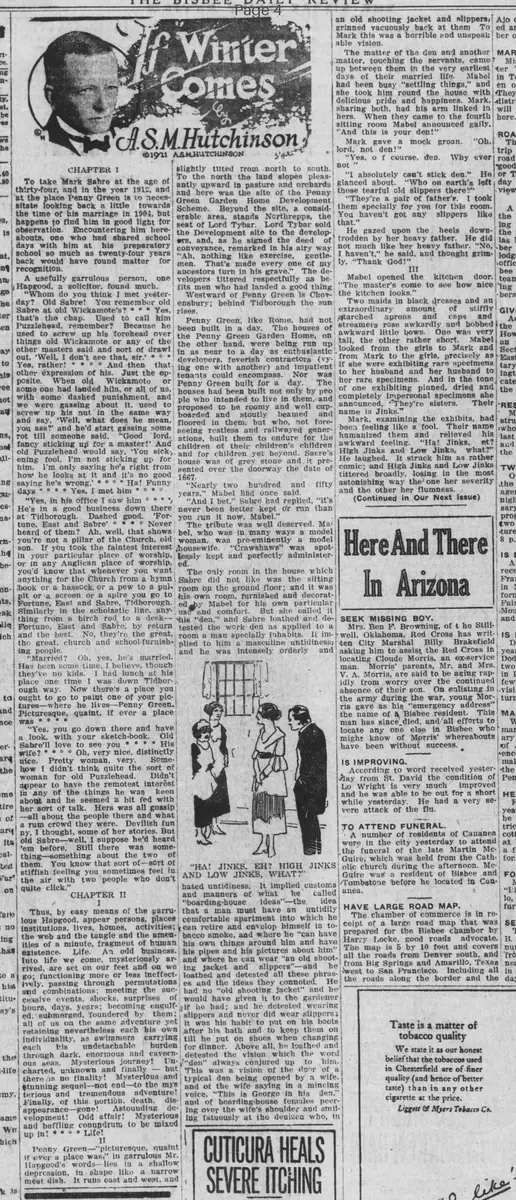
To take Mark Sabre at the age of thirty-four, and in the year 1913, and at the place Penny Green is to necessitate looking back a little towards the time of his marriage in 1903, but happens to find him in good light for observation. Encountering him hereabouts, one who had shared school days with him at his preparatory school so much as twenty-four years back would have found matter for recognition.
A usefully garrulous person, one Hapgood, a solicitor, found much.
"Whom do you think I met yesterday? Old Sabre! You remember old Sabre at old Wickamote's? * * * Yes, that's the chap. Used to call him Puzzlehead, remember? Because he used to screw up his forehead over things old Wickamote or any of the other masters said and sort of drawl out, 'Well, I don't see that, sir.' * * Yes, rather! * * *
* And then that other expression of his. Just the opposite. When old Wickamote or some one had landed him, or all of us, with some dashed punishment, and we were gassing about it, used to screw up his nut in the same way and say, 'Well, what does he mean, you ass?' and he'd start gassing some rot till someone said, 'Good lord, fancy sticking up for a master!' And old Puzzlehead would say, 'You sickening fool, I'm not sticking up for him. I'm only saying he's right from how he looks at it and it's no good saying he's wrong.' * * *
Ha! Funny days * * * * Yes, I met him
"Yes, in his office I saw him. He's in a good business down there at Tidborough. Dashed good. 'Fortune, East and Sabre' * * * * Never heard of them? Ah, well, that shows you're not a pillar of the Church, old son. If you took the faintest interest in your particular place of worship, or in any Anglican place of worship, you'd know that whenever you want anything for the Church from a hymn book or a hassock, or a pew to a pulpit or a screen or a spire you go to Fortune, East and Sabre, Tidborough. Similarly in the scholastic line, anything from a birch rod to a desk--Fortune, East and Sabre, by return and the best. No, they're the great, the great, church and school-furnishing people.
"Married? Oh, yes. he's married. Has been some time. I believe, though they've no kids. I had lunch at his place one time I was down Tidborough way. Now there's a place you ought to go to paint one of your pictures--where he lives, Penny Green. Picturesque, quaint, if ever a place was.
"Yes, you go down there and have a look, with your sketch-book. Old Sabre'll love to see you. His wife? * * * * Oh, very nice, distinctly nice. Pretty woman, very. Somehow I didn't think quite the sort of woman for old Puzzlehead. Didn't appear to have the remotest interest in any of the things he was keen about and he seemed a bit fed with her sort of talk. Hers was all gossip--all about the people there and what a rum crowd they were. Devilish funny, I thought, some of her stories. But old Sabre--well, I suppose he'd heard 'em before. Still there was something--something about the two of them. You know that sort of--sort of stiffish feeling you sometimes feel in the air with two people who don't quite click."
Thus, by easy means of the garrulous Hapgood, appear persons, places institutions, lives, homes, activities; the web and the tangle and the amenities of a minute, fragment of human existence. Life. An odd business. Into life we come, mysteriously arrived, are set on our feet and on we go; functioning more or less ineffectively, passing through permutations and combinations: meeting the successive events, shocks, surprises of hours, days, years; becoming engulfed, submerged, foundered by them: all of us on the same adventure yet retaining nevertheless each his own individuality, as swimmers carrying each his undetachable burden through dark, enormous and cavernous seas. Mysterious journey! Uncharted, unknown and finally-- but there is no finality! Mysterious and stunning sequel--not end--to the mysterious and tremendous adventure! Finally, of this portion, death, disappearance--gone! Astounding development! Odd affair! Mysterious and baffling conundrum to be mixed up in! * * * Life!
II
Penny Green--"picturesque, quaint if ever a place was" in garrulous Mr. Hapgood's words--lies in a shallow depression, in shape like a narrow meat dish. It runs east and west, and slightly tilted from north to south. To the north the land slopes pleasantly upward in pasture and orchards and here was the site of the Penny Green Garden Home Development Scheme. Beyond the site, a considerable area, stands Northrepps, the seat of Lord Tybar. Lord Tybar sold the Development site to the developers, and, as he signed the deed of conveyance, remarked in his airy way "Ah, nothing like exercise, gentlemen. That's made every one of my ancestors turn in his grave." The developers tittered respectfully as befits men who had landed a good thing. Westward of Penny Green is Chorensbury; behind Tidborough the sun rises.
Penny Green, like Rome, had not been built in a day. The houses of the Penny Green Garden Home, on the other hand, were being run up in as near to a day as enthusiastic developers, feverish contractors (vying one with another) and impatient tenants could encompass.
Nor was Penny Green built for a day. The houses had been built not only by people who intended to live in them, and proposed to be roomy and well cupboarded and stoutly beamed and floored in them, but who, not foreseeing restless and railwayed generations, built them to endure for the children of their children's children and for children yet beyond. Sabre's house was of grey stone and it presented over the doorway the date of 1667.
"Nearly two hundred and fifty years," Mabel had once said.
"And I bet," Sabre had replied, "it's never been better kept or run than you run it now, Mabel."
The tribute was well deserved. Mabel, who was in many ways a model woman, was pre-eminently a model housewife. "Crawshaws" was spotlessly kept and perfectly administered.
The only room in the house which Sabre did not like was the sitting room on the ground floor; and it was his own room, furnished and decorated by Mabel for his own particular use and comfort. But she called it his "den," and Sabre loathed and detested the word den as applied to a room a man specially inhabits. It implied to him a masculine untidiness: and he was intensely orderly and hated untidiness. It implied customs and manners of what he called "boarding-house ideas"--the idea that a man must have an untidily comfortable apartment into which he can retire and envelop himself in tobacco smoke, and where he "can have his own things around him and have his pipes and his pictures about him" and where he can wear "an old shooting jacket and slippers"--and he loathed and detested all these phrases and the ideas they connoted. He had no "old shooting jacket" and he would have given it to the gardener if he had: and he detested wearing slippers and never did wear slippers--it was his habit to put on his boots after his bath and to keep them on till he put on shoes when changing for dinner. Above all, he loathed and detested the vision which the word "den" always conjured up to him. This was a vision of the door of a typical den being opened by a wife, and of the wife saying in a mincing voice, "This is George in his den," and of boarding-house females peering over the wife's shoulder and smiling fatuously at the denizen who, in an old shooting jacket and slippers, grinned vacuously back at them. To Mark this was a horrible and unspeakable vision.
The matter of the den and another matter, touching the servants, came up between them in the very earliest days of their married life. Mabel had been busy "settling things," and she took him round the house with delicious pride and happiness. Mark, sharing both, had his arm linked in hers. When they came to the fourth sitting room Mabel announced gaily, "And this is your den!"
Mark gave a mock groan. "Oh. Lord, not den!"
"Yes, of course, den. Why ever not?"
"I absolutely can't stick den."
He glanced about. "Who on earth's left those tearful old slippers there?"
"They're a pair of father's. I took them specially for you for this room. You haven't got any slippers like that."
He gazed upon the heels down-trodden by her heavy father. He did not much like her heavy father. "No, I haven't," he said, and thought grimly, "Thank God!"
III
Mabel opened the kitchen door. "The master's come to see how nice the kitchen looks."
Two maids in black dresses and an extraordinary amount of stiffly starched aprons and caps and streamers rose awkwardly and bobbed awkward little bows. One was very tall, the other rather short. Mabel looked from the girls to Mark and from Mark to the girls, precisely as if she were exhibiting rare specimens to her husband and her husband to her rare specimens. And in the tone of one exhibiting pinned, dried and completely impersonal specimens she announced, "They're sisters. Their name is Jinks."
Mark, examining the exhibits, had been feeling like a fool. Their name humanized them and relieved his awkward feeling. "Ha! Jinks, eh? High Jinks and Low Jinks, what?"
He laughed. It struck him as rather comic; and High Jinks and Low Jinks tittered broadly, losing in the most astonishing way the one her severity and the other her flumness.
(Continued in Our Next Issue)
A usefully garrulous person, one Hapgood, a solicitor, found much.
"Whom do you think I met yesterday? Old Sabre! You remember old Sabre at old Wickamote's? * * * Yes, that's the chap. Used to call him Puzzlehead, remember? Because he used to screw up his forehead over things old Wickamote or any of the other masters said and sort of drawl out, 'Well, I don't see that, sir.' * * Yes, rather! * * *
* And then that other expression of his. Just the opposite. When old Wickamote or some one had landed him, or all of us, with some dashed punishment, and we were gassing about it, used to screw up his nut in the same way and say, 'Well, what does he mean, you ass?' and he'd start gassing some rot till someone said, 'Good lord, fancy sticking up for a master!' And old Puzzlehead would say, 'You sickening fool, I'm not sticking up for him. I'm only saying he's right from how he looks at it and it's no good saying he's wrong.' * * *
Ha! Funny days * * * * Yes, I met him
"Yes, in his office I saw him. He's in a good business down there at Tidborough. Dashed good. 'Fortune, East and Sabre' * * * * Never heard of them? Ah, well, that shows you're not a pillar of the Church, old son. If you took the faintest interest in your particular place of worship, or in any Anglican place of worship, you'd know that whenever you want anything for the Church from a hymn book or a hassock, or a pew to a pulpit or a screen or a spire you go to Fortune, East and Sabre, Tidborough. Similarly in the scholastic line, anything from a birch rod to a desk--Fortune, East and Sabre, by return and the best. No, they're the great, the great, church and school-furnishing people.
"Married? Oh, yes. he's married. Has been some time. I believe, though they've no kids. I had lunch at his place one time I was down Tidborough way. Now there's a place you ought to go to paint one of your pictures--where he lives, Penny Green. Picturesque, quaint, if ever a place was.
"Yes, you go down there and have a look, with your sketch-book. Old Sabre'll love to see you. His wife? * * * * Oh, very nice, distinctly nice. Pretty woman, very. Somehow I didn't think quite the sort of woman for old Puzzlehead. Didn't appear to have the remotest interest in any of the things he was keen about and he seemed a bit fed with her sort of talk. Hers was all gossip--all about the people there and what a rum crowd they were. Devilish funny, I thought, some of her stories. But old Sabre--well, I suppose he'd heard 'em before. Still there was something--something about the two of them. You know that sort of--sort of stiffish feeling you sometimes feel in the air with two people who don't quite click."
Thus, by easy means of the garrulous Hapgood, appear persons, places institutions, lives, homes, activities; the web and the tangle and the amenities of a minute, fragment of human existence. Life. An odd business. Into life we come, mysteriously arrived, are set on our feet and on we go; functioning more or less ineffectively, passing through permutations and combinations: meeting the successive events, shocks, surprises of hours, days, years; becoming engulfed, submerged, foundered by them: all of us on the same adventure yet retaining nevertheless each his own individuality, as swimmers carrying each his undetachable burden through dark, enormous and cavernous seas. Mysterious journey! Uncharted, unknown and finally-- but there is no finality! Mysterious and stunning sequel--not end--to the mysterious and tremendous adventure! Finally, of this portion, death, disappearance--gone! Astounding development! Odd affair! Mysterious and baffling conundrum to be mixed up in! * * * Life!
II
Penny Green--"picturesque, quaint if ever a place was" in garrulous Mr. Hapgood's words--lies in a shallow depression, in shape like a narrow meat dish. It runs east and west, and slightly tilted from north to south. To the north the land slopes pleasantly upward in pasture and orchards and here was the site of the Penny Green Garden Home Development Scheme. Beyond the site, a considerable area, stands Northrepps, the seat of Lord Tybar. Lord Tybar sold the Development site to the developers, and, as he signed the deed of conveyance, remarked in his airy way "Ah, nothing like exercise, gentlemen. That's made every one of my ancestors turn in his grave." The developers tittered respectfully as befits men who had landed a good thing. Westward of Penny Green is Chorensbury; behind Tidborough the sun rises.
Penny Green, like Rome, had not been built in a day. The houses of the Penny Green Garden Home, on the other hand, were being run up in as near to a day as enthusiastic developers, feverish contractors (vying one with another) and impatient tenants could encompass.
Nor was Penny Green built for a day. The houses had been built not only by people who intended to live in them, and proposed to be roomy and well cupboarded and stoutly beamed and floored in them, but who, not foreseeing restless and railwayed generations, built them to endure for the children of their children's children and for children yet beyond. Sabre's house was of grey stone and it presented over the doorway the date of 1667.
"Nearly two hundred and fifty years," Mabel had once said.
"And I bet," Sabre had replied, "it's never been better kept or run than you run it now, Mabel."
The tribute was well deserved. Mabel, who was in many ways a model woman, was pre-eminently a model housewife. "Crawshaws" was spotlessly kept and perfectly administered.
The only room in the house which Sabre did not like was the sitting room on the ground floor; and it was his own room, furnished and decorated by Mabel for his own particular use and comfort. But she called it his "den," and Sabre loathed and detested the word den as applied to a room a man specially inhabits. It implied to him a masculine untidiness: and he was intensely orderly and hated untidiness. It implied customs and manners of what he called "boarding-house ideas"--the idea that a man must have an untidily comfortable apartment into which he can retire and envelop himself in tobacco smoke, and where he "can have his own things around him and have his pipes and his pictures about him" and where he can wear "an old shooting jacket and slippers"--and he loathed and detested all these phrases and the ideas they connoted. He had no "old shooting jacket" and he would have given it to the gardener if he had: and he detested wearing slippers and never did wear slippers--it was his habit to put on his boots after his bath and to keep them on till he put on shoes when changing for dinner. Above all, he loathed and detested the vision which the word "den" always conjured up to him. This was a vision of the door of a typical den being opened by a wife, and of the wife saying in a mincing voice, "This is George in his den," and of boarding-house females peering over the wife's shoulder and smiling fatuously at the denizen who, in an old shooting jacket and slippers, grinned vacuously back at them. To Mark this was a horrible and unspeakable vision.
The matter of the den and another matter, touching the servants, came up between them in the very earliest days of their married life. Mabel had been busy "settling things," and she took him round the house with delicious pride and happiness. Mark, sharing both, had his arm linked in hers. When they came to the fourth sitting room Mabel announced gaily, "And this is your den!"
Mark gave a mock groan. "Oh. Lord, not den!"
"Yes, of course, den. Why ever not?"
"I absolutely can't stick den."
He glanced about. "Who on earth's left those tearful old slippers there?"
"They're a pair of father's. I took them specially for you for this room. You haven't got any slippers like that."
He gazed upon the heels down-trodden by her heavy father. He did not much like her heavy father. "No, I haven't," he said, and thought grimly, "Thank God!"
III
Mabel opened the kitchen door. "The master's come to see how nice the kitchen looks."
Two maids in black dresses and an extraordinary amount of stiffly starched aprons and caps and streamers rose awkwardly and bobbed awkward little bows. One was very tall, the other rather short. Mabel looked from the girls to Mark and from Mark to the girls, precisely as if she were exhibiting rare specimens to her husband and her husband to her rare specimens. And in the tone of one exhibiting pinned, dried and completely impersonal specimens she announced, "They're sisters. Their name is Jinks."
Mark, examining the exhibits, had been feeling like a fool. Their name humanized them and relieved his awkward feeling. "Ha! Jinks, eh? High Jinks and Low Jinks, what?"
He laughed. It struck him as rather comic; and High Jinks and Low Jinks tittered broadly, losing in the most astonishing way the one her severity and the other her flumness.
(Continued in Our Next Issue)
What sub-type of article is it?
Prose Fiction
What themes does it cover?
Social Manners
What keywords are associated?
Mark Sabre
Penny Green
Mabel Sabre
Marriage
Domestic Life
Village Development
Hapgood
Tidborough
Literary Details
Key Lines
"Well, I Don't See That, Sir."
"You Sickening Fool, I'm Not Sticking Up For Him. I'm Only Saying He's Right From How He Looks At It And It's No Good Saying He's Wrong."
"Ah, Nothing Like Exercise, Gentlemen. That's Made Every One Of My Ancestors Turn In His Grave."
"Nearly Two Hundred And Fifty Years," Mabel Had Once Said.
"And I Bet," Sabre Had Replied, "It's Never Been Better Kept Or Run Than You Run It Now, Mabel."