Thank you for visiting SNEWPapers!
Sign up free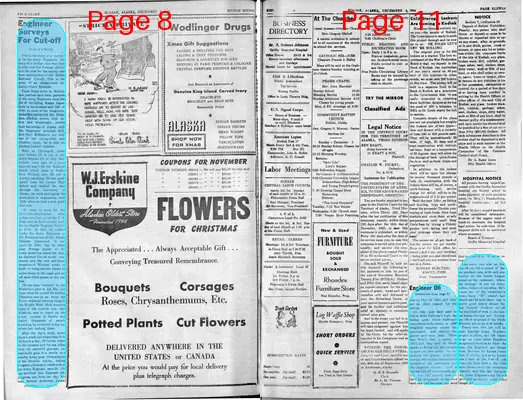
Kodiak Mirror
Kodiak, Alaska
What is this article about?
Olavi Kukkola, an Alaska-born engineer disabled by a childhood accident, leads the survey over Portage glacier for the Alaska Railroad Cut-off in 1941, aiding WWII defense efforts by shortening the rail route to Whittier by 52 miles. He details the challenging construction amid harsh conditions, proud of the low accident rate and project success.
Merged-components note: Continuation of Engineer Surveys story from page 8 to page 11.
Clippings

1 of 2
OCR Quality
Full Text
Surveys
For Cut-off
(Last of a Series)
This is the story of a survey-
or for the Army Engineers, the
story of a civilian who was first
to hike over the Portage glacier
into the area for the survey and
then construction of the Alaska
Railroad Cut-off. This is the
story of an Alaska-born en-
gineer, Olavi Kukkola.
From Nome down to Ketchi-
kan, natives have been partners
of the Army Engineers since the
job of fortifying Alaska began
back in the summer and fall of
1940. In some of the dangerous,
under-fire surveys of the Aleut-
ians, Alaskan scouts, both na-
tive and sourdoughs, pooled
their knowledge of Alaska with
the Engineers' technical skill.
But Olavi Kukkola is not only
one of the not-so-often met
Alaskan born, he is also an
Alaskan trained engineer.
Born at Chichagoff, down
near Juneau, Oli is not in the
Army because 4th of July sky-
rockets took part of a hand
when he was 7. Of the Kukkola
family which came to Alaska
from Finland, only Oli and a
brother are living. He was grad-
uated from the Juneau High
School and worked his way
through the University of
Alaska, the work prolonging his
graduation in engineering until
1938, when he took a post grad-
uate year.
Oli went to work for the
Fairbanks-Exploration
after
college and first joined the U. S.
Engineers on flood control work
for the Seattle Engineer District
in 1940. In 1941 he worked
under the Army Engineers at
the Headquarters of the Alaska
Defense Command. It was
April 23, 1941, that he hiked
over Portage glacier to the
rocky shore line where the Alas-
ka Railroad Cut-off would com-
mence and the new salt-water
terminus of Whittier would be
built, to bring interior Alaska 52
miles closer to the coast and cut
off snow-filled passes on the rail
line.
Oli has been "outside" to the
States but once in his life, last
June when he visited his brother
Theodore now at an Army Air
Force technical training camp in
the Middle West. Most amazing
sight of the outside trip, says
Kukkola, was to stand on the
street corners of Seattle and
watch thousands of people
crowding by evidently going no-
where but rushing there.
After the day's work, seven
days a week anywhere from 8 to
14 hours a day, Oli hunts, fishes
in the streams and the sea, bikes
over the plentiful glaciers, oc-
casionally goes to a movie at a
nearby Army post. Photography
is his favorite hobby, taking
progress pictures of construction
for Army Engineer records. Oli
has watched this Engineer job
progress, too, from the day his
boss, Antone Anderson, joined
(continued on page 11.
Engineer Oli
(continued from page 8)
him on May 15, 1941, and they
set up their transit for the
survey.
Oli tells how they used to
follow Mike Sullivan's trail, the
fading path where Sullivan's
miraculous mule trains in 1896
freighted supplies across the
mountains and skirted the
glacier and snow beds. There
was Weir's line, a survey in
1913, but they had no bench
marks to follow and the ice used
to melt out from under the tripod
on the glacier. After the
survey, the civilian construction
workers of the contractor and
the Engineer troops moved in
for the Cut-off construction and
Oli can tell exactly how the
hard job progressed, in the snow
and rain and the incessant wind
that is often 60 to 70 miles an
hour.
Like every one else on this
Cut-off job, Oli is proud of the
low accident rate, with only one
fatality on the fourth longest
tunnel on the continent, where
the average is one for every
million dollars of Tunneling. He's
proud, too of the contractor's
Army-Navy "E" award last
March and he says there was a
pretty good moose dinner the
day General Buckner set off
the last blast of rock at the tunnel holing-through last November. Oli is as proud of the whole
Whittier job as he is of Alaska.
Pretty soon this job will be
over, another Army Engineer
project in place, and Oli hopes
to go on some other Engineer
assignment because he likes the
way the Engineers get things
done. Because he knows every
foot of Alaska, just as he knows
every foot of the Cut-off job
from the time before the cliffs
were blown away, the mountain
blasted, and the last barracks
up. Army Engineers say Oli will
probably go out on some other
tough job.
What sub-type of article is it?
What themes does it cover?
What keywords are associated?
What entities or persons were involved?
Where did it happen?
Story Details
Key Persons
Location
Portage Glacier, Alaska; Whittier, Alaska; Chichagoff Near Juneau, Alaska
Event Date
April 23, 1941; Summer And Fall Of 1940; 1938; 1896; 1913
Story Details
Olavi Kukkola, born in Alaska to Finnish immigrants, becomes an engineer despite a childhood injury. In 1941, he surveys over Portage glacier for the Alaska Railroad Cut-off, facilitating WWII defenses by creating a shorter route to Whittier. He endures harsh conditions, documents progress, and takes pride in the project's low accidents, Army-Navy award, and completion.