Thank you for visiting SNEWPapers!
Sign up free
Story
March 9, 1928
The Midland Journal
Rising Sun, Cecil County, Maryland
What is this article about?
F.A. Walker's article explores human observation, noting that while eyes function perfectly like cameras, the brain often misinterprets due to poor training. It advocates developing accurate observation to avoid errors in daily life and critical situations.
Clipping
OCR Quality
98%
Excellent
Full Text
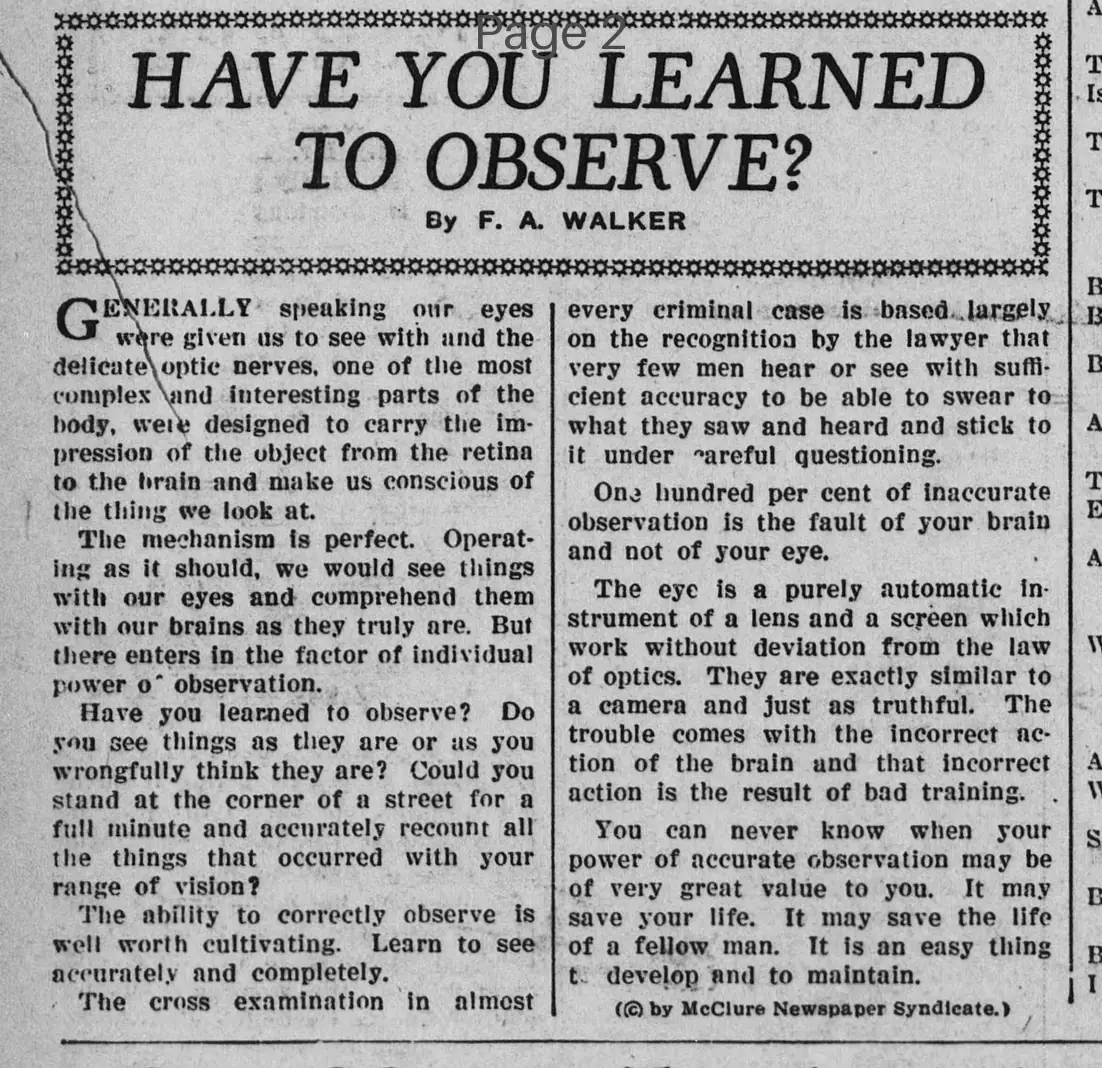
HAVE YOU LEARNED
TO OBSERVE?
By F. A. WALKER
GENERALLY speaking our eyes were given us to see with and the delicate optic nerves, one of the most complex and interesting parts of the body, were designed to carry the impression of the object from the retina to the brain and make us conscious of the thing we look at.
The mechanism is perfect. Operating as it should, we would see things with our eyes and comprehend them with our brains as they truly are. But there enters in the factor of individual power of observation.
Have you learned to observe? Do you see things as they are or as you wrongfully think they are? Could you stand at the corner of a street for a full minute and accurately recount all the things that occurred with your range of vision?
The ability to correctly observe is well worth cultivating. Learn to see accurately and completely.
The cross examination in almost every criminal case is based largely on the recognition by the lawyer that very few men hear or see with sufficient accuracy to be able to swear to what they saw and heard and stick to it under careful questioning.
One hundred per cent of inaccurate observation is the fault of your brain and not of your eye.
The eye is a purely automatic instrument of a lens and a screen which work without deviation from the law of optics. They are exactly similar to a camera and just as truthful. The trouble comes with the incorrect action of the brain and that incorrect action is the result of bad training.
You can never know when your power of accurate observation may be of very great value to you. It may save your life. It may save the life of a fellow man. It is an easy thing to develop and to maintain.
(© by McClure Newspaper Syndicate.)
TO OBSERVE?
By F. A. WALKER
GENERALLY speaking our eyes were given us to see with and the delicate optic nerves, one of the most complex and interesting parts of the body, were designed to carry the impression of the object from the retina to the brain and make us conscious of the thing we look at.
The mechanism is perfect. Operating as it should, we would see things with our eyes and comprehend them with our brains as they truly are. But there enters in the factor of individual power of observation.
Have you learned to observe? Do you see things as they are or as you wrongfully think they are? Could you stand at the corner of a street for a full minute and accurately recount all the things that occurred with your range of vision?
The ability to correctly observe is well worth cultivating. Learn to see accurately and completely.
The cross examination in almost every criminal case is based largely on the recognition by the lawyer that very few men hear or see with sufficient accuracy to be able to swear to what they saw and heard and stick to it under careful questioning.
One hundred per cent of inaccurate observation is the fault of your brain and not of your eye.
The eye is a purely automatic instrument of a lens and a screen which work without deviation from the law of optics. They are exactly similar to a camera and just as truthful. The trouble comes with the incorrect action of the brain and that incorrect action is the result of bad training.
You can never know when your power of accurate observation may be of very great value to you. It may save your life. It may save the life of a fellow man. It is an easy thing to develop and to maintain.
(© by McClure Newspaper Syndicate.)
What sub-type of article is it?
Curiosity
What themes does it cover?
Moral Virtue
What keywords are associated?
Observation
Vision
Optic Nerves
Brain Training
Accurate Seeing
What entities or persons were involved?
F. A. Walker
Story Details
Key Persons
F. A. Walker
Story Details
Article explains the mechanics of vision and emphasizes that inaccurate observation results from brain training rather than eye function, urging readers to cultivate precise observation skills for potential life-saving value.