Thank you for visiting SNEWPapers!
Sign up free
Lynchburg Virginian
Lynchburg, Virginia
What is this article about?
In a 1835 letter to the Richmond Whig, Charles Perrow defends his preference for Martin Van Buren over Hugh Lawson White for president, citing alignments on tariff, internal improvements, and nullification, while opposing Jackson's administration. He ultimately advocates for Henry Clay as the unifying candidate to restore constitutional principles and national peace.
Clipping
OCR Quality
Full Text
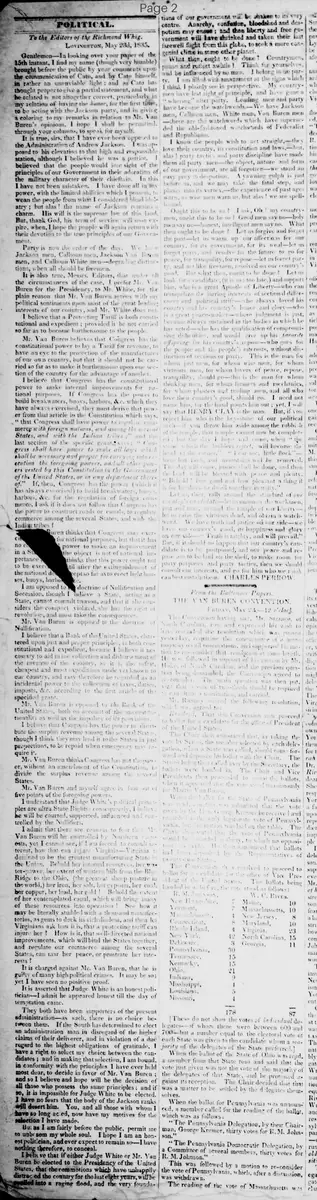
To the Editors of the Richmond Whig.
Lovingston, May 23d, 1835.
Gentlemen—In looking over your paper of the 15th instant, I find my name (though very humble) brought before the public by your comments upon the communication of Cato, and by Cato himself, in rather an unenviable light: and as Cato has thought proper to give a partial statement, and what he related is not altogether correct, particularly in my relation of having the honor, for the first time, to be acting with the Jackson party, and in giving a coloring to my remarks in relation to Mr. Van Buren's opinions, I hope I shall be permitted, through your columns, to speak for myself.
It is true, sirs, that I have ever been opposed to the Administration of Andrew Jackson. I was opposed to his elevation to that high and responsible station, although I believed he was a patriot. I believed that the people would lose sight of the principles of our Government in their adoration of the military character of their chieftain. In this I have not been mistaken. I have done all in my power, with the limited abilities which I possess, to wean the people from what I considered blind idolatry; but alas! the name of Jackson remains a charm. His will is the supreme law of this land.
But, thank God, his term of service will soon expire, when, I hope, the people will again return with their devotion to the true principles of our Government.
Party is now the order of the day. We have Jackson men, Calhoun men, Jackson Van Buren men, and Calhoun White men—degrading distinctions, when all should be freemen.
It is also true, Messrs. Editors, that under the circumstances of the case, I prefer Mr. Van Buren for the Presidency, to Mr. White, for the plain reason that Mr. Van Buren agrees with my political sentiments upon most of the great leading interests of our country, and Mr. White does not.
I believe that a Protecting Tariff is both constitutional and expedient: provided it be not carried so far as to become burthensome to the people.
Mr. Van Buren believes that Congress has the constitutional power to lay a Tariff for revenue, to have an eye to the protection of the manufactures of our own country, but that it should not be carried so far as to make it burthensome upon one section of the country for the advantage of another.
I believe that Congress has the constitutional power to make internal improvements for national purposes. If Congress has the power to build breakwaters, buoys, harbors, &c., which they have always exercised, they must derive that power from that article in the Constitution which says, "that Congress shall have power to regulate commerce with foreign nations, and among the several States, and with the Indian tribes," and the last section of the specific grants: "Congress shall have power to make all laws which shall be necessary and proper for carrying into execution the foregoing powers, and all others vested by this Constitution in the Government of the United States, or in any department thereof."
If, then, Congress has the power (which it has always exercised) to build breakwaters, buoys, harbors, &c., for the regulation of foreign commerce, I ask if it does not follow that Congress has the power to construct roads or canals, to regulate commerce among the several States, and with the Indian tribes?
Mr. Van Buren thinks that Congress may [for national purposes], but that it has no power to make an improvement in a State [the object is not of national importance]. He thinks that this power ought not to be exercised until after the extinguishment of the national debt [so far as to erect light houses, buoys, harbors, &c.].
I am opposed to the doctrine of Nullification and Secession, though I believe a State, acting as a State, cannot commit treason, and that if she considers the compact violated, she has the right of revolution, and must take the consequences.
Mr. Van Buren is opposed to the doctrine of Nullification.
I believe that a Bank of the United States, chartered upon just and proper principles, to be both constitutional and expedient, because I believe it necessary to aid in the collection and disbursement of the revenue of the country, as it is the safest, cheapest and most expeditious mode yet known to our country, and may therefore be regarded as an incidental power to the collection of taxes, duties, imposts, &c., according to the first article of the specified grant.
Mr. Van Buren is opposed to the Bank of the United States, both on account of the unconstitutionality as well as the impolicy of its provisions.
I believe that Congress has the power to distribute the surplus revenue among the several States, though I think they may loan it to the States in just proportions, to be repaid when emergency may require it.
Mr. Van Buren thinks Congress has not the power, without an amendment of the Constitution, to divide the surplus revenue among the several States.
Mr. Van Buren and myself agree in five points of the foregoing powers.
I understand that Judge White's national principles are ultra State Rights: consequently, I believe he will be courted, supported, mentioned in controlled by the Nullifier.
I admit that there are reasons to fear that Mr. Van Buren will be controlled by Northern interests, yet I cannot see, if I am forced to consult interest, how that can injure Virginia—Virginia! destined to be the greatest manufacturing State in the Union. Behold her internal resources, her water-power, her extent of western hills from the Blue Ridge to the Ohio, (the greatest sheep pasture in the world,) her iron, her salt, her gypsum, her coal, her copper, her lead, her gold! Behold the extent of her contemplated canal, which will bring many of these resources into operation! See how it may be literally studded with a thousand manufactories, as gems to deck its rich diadem, and then let Virginians ask how it is, that a protecting tariff can injure her? How is it, that well-directed national improvements, which will bind the States together, and regulate our commerce among the several States, can mar her peace, or prostrate her interests?
It is charged against Mr. Van Buren, that he is guilty of many high political crimes. It may be so; yet I have seen no positive proof.
It is asserted that Judge White is an honest politician—I admit he appeared honest till the day of temptation came.
They both have been supporters of the present administration—as such, there is no choice between them. If the South has determined to elect an administration man in disregard of the higher claims of their deliverer, and in violation of a due regard to the highest obligations of gratitude, I have a right to select my choice between the candidates: and in making that selection, I am bound, in conformity with the principles I have ever held most dear, to decide in favor of Mr. Van Buren; and so I believe and hope will be the decision of all those who possess the same principles; and if so, it is impossible for Judge White to be elected.
I have no fears that the body of the Jackson ranks will desert him. You, and all those with whom I have so long acted, now have my motives for the selection I have made.
But as I am fairly before the public, permit me to unbosom my whole soul. I hope I am an honest politician, and ever expect to remain so—I have nothing therefore, to conceal.
I believe that if either Judge White or Mr. Van Buren be elected to the Presidency of the United States, that the commotions which have unhappily distracted the country for the last eight years, will be swelled into a raging flood, and the very foundations of our government will be shaken to its very centre. Anarchy, confusion, bloodshed and despotism may ensue; and then liberty and free government will have shrunk and taken their last farewell flight from this clime, to seek a more congenial clime in some other planet.
What then, ought to be done? Countrymen, pause and reflect awhile! Think for yourselves, and be influenced by no man. I belong to no party. I am filled with amazement at the signs which I think I plainly see in perspective. My countrymen have lost sight of principle, and have gone a "wrong" after party. Leading men and party have become the watchwords. We have Jackson men, Calhoun men, White men, Van Buren men—there are the watchwords which have superseded the old-fashioned watchwords of Federalist and Republican.
I know the people wish to act straight,—they love their country, its constitution and laws,—but alas! party tactics and party discipline have made them all party men—the object, nature and form of our government, are all forgotten—we stand an easy prey to despotism. A yawning gulph is just before us, and we may take the fatal step, and plunge into its vortex,—the experience of past ages warn, as wise men warn us, but alas! we are spell-bound.
Ought thus to be so? I ask, Oh! my countrymen, ought thus to be so? Good men say no—holy men say no—honest, intelligent men say no. What then ought to be done? Let us forgive and forget the past—let us warm up our affections for our country, for its government, for its weal—let us forget parties, and resolve for the future to go for peace, for tranquillity, for repose—let us forget party, and act like freemen, resolved on our country's good. But what then, ought to be done? Let us look—for a candidate, (it is not too late,) and support him, who is a great Apostle of Liberty—who can tranquillize the jarring interests of sectional differences and political strife—who always loved his country and his country's honor and glory—who is a great statesman—whose judgment is just, because always sustained in the bodies in which he has acted—who has the qualification of compromising duties, and would give up his favorite offspring for his country's repose—who goes for the people and the people's interests, without distinction of sections or party. This is the man for whom just men, for whom wise men, for whom virtuous men, for whom lovers of peace, repose, tranquillity, should go—this is the man for whom thinking men, for whom farmers and mechanics, for whom planters and trading men, and all who love their country's good, should go. I need not name him. The hand points him out; yet, I will say that HENRY CLAY is the man. But, if you reject him who is the key-stone of our political temple, you throw him aside among the rubbish, and that temple cannot now be completed. But I say it will come, when "the stone which the builders rejected, will become the head of the corner"—when "the mountains shall be brought low, and the valleys filled up"—when the land will be blessed with peace and plenty.
"Behold how good and how pleasant a thing it is for brethren to dwell together in unity."
Let, then, rally around the standard of our country's candidate—let Whigs, catholics and workmen, meet and stand around the temple of our liberty—let union be the watchword. We have truth and justice on our side—we have our country's cause, its happiness and glory on our side. Truth is mighty, and will prevail."
But, if it should so happen that our country's candidate is to be postponed, and our peace and repose to be laid on the shelf, to make room for party purposes and party tactics, then we should consult our interests, and go for him who we think can best serve them.
CHARLES PERROW
What sub-type of article is it?
What themes does it cover?
What keywords are associated?
What entities or persons were involved?
Letter to Editor Details
Author
Charles Perrow
Recipient
To The Editors Of The Richmond Whig.
Main Argument
the writer defends preferring van buren over white due to policy alignments on tariff, internal improvements, and nullification, but urges support for henry clay as the ideal candidate to unite the nation, restore principles, and prevent further party strife and potential anarchy.
Notable Details