Thank you for visiting SNEWPapers!
Sign up free
Literary
June 16, 1824
Palladium Of Virginia And The Pacific Monitor
Lewisburg, Greenbrier County, West Virginia
What is this article about?
An essay extolling Spring as the most charming season of anticipation, contrasting it with other seasons, and likening it to youth where parents sow seeds of virtue for a rewarding maturity, quoting Alexander Pope on eternal hope.
Clipping
OCR Quality
95%
Excellent
Full Text
FOR THE PALLADIUM.
ON SPRING.
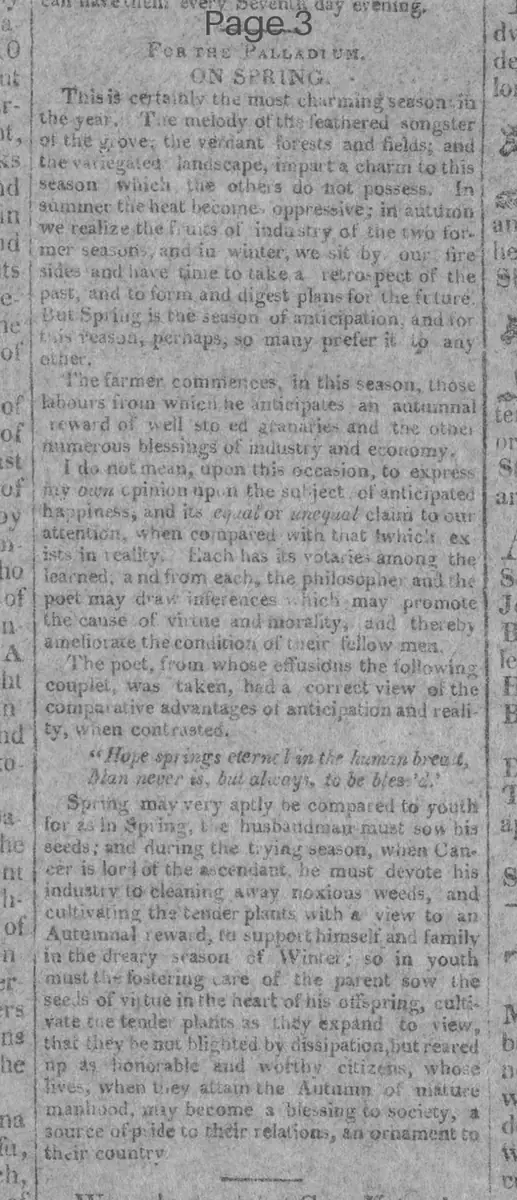
This is certainly the most charming season in the year. The melody of the feathered songster of the grove, the verdant forests and fields; and the variegated landscape, impart a charm to this season which the others do not possess. In summer the heat becomes oppressive; in autumn we realize the fruits of industry of the two former seasons, and in winter, we sit by our firesides and have time to take a retrospect of the past, and to form and digest plans for the future. But Spring is the season of anticipation, and for this reason, perhaps, so many prefer it to any other.
The farmer commences, in this season, those labours from which he anticipates an autumnal reward of well stored granaries— and the other numerous blessings of industry and economy. I do not mean, upon this occasion, to express my own opinion upon the subject of anticipated happiness, and its equal or unequal claim to our attention, when compared with that which exists in reality. Each has its votaries among the learned, and from each, the philosopher and the poet may draw inferences which may promote the cause of virtue and morality, and thereby ameliorate the condition of their fellow men.
The poet, from whose effusions the following couplet, was taken, had a correct view of the comparative advantages of anticipation and reality, when contrasted.
"Hope springs eternal in the human breast;
Man never is, but always to be blest."
Spring may very aptly be compared to youth for as in Spring, the husbandman must sow his seeds; and during the trying season, when Cancer is lord of the ascendant, he must devote his industry to cleaning away noxious weeds, and cultivating the tender plants with a view to an Autumnal reward, to support himself and family in the dreary season of Winter; so in youth must the fostering care of the parent sow the seeds of virtue in the heart of his offspring, cultivate the tender plants as they expand to view, that they be not blighted by dissipation, but reared up as honorable and worthy citizens, whose lives, when they attain the Autumn of nature manhood, may become a blessing to society, a source of pride to their relations, an ornament to their country.
ON SPRING.
This is certainly the most charming season in the year. The melody of the feathered songster of the grove, the verdant forests and fields; and the variegated landscape, impart a charm to this season which the others do not possess. In summer the heat becomes oppressive; in autumn we realize the fruits of industry of the two former seasons, and in winter, we sit by our firesides and have time to take a retrospect of the past, and to form and digest plans for the future. But Spring is the season of anticipation, and for this reason, perhaps, so many prefer it to any other.
The farmer commences, in this season, those labours from which he anticipates an autumnal reward of well stored granaries— and the other numerous blessings of industry and economy. I do not mean, upon this occasion, to express my own opinion upon the subject of anticipated happiness, and its equal or unequal claim to our attention, when compared with that which exists in reality. Each has its votaries among the learned, and from each, the philosopher and the poet may draw inferences which may promote the cause of virtue and morality, and thereby ameliorate the condition of their fellow men.
The poet, from whose effusions the following couplet, was taken, had a correct view of the comparative advantages of anticipation and reality, when contrasted.
"Hope springs eternal in the human breast;
Man never is, but always to be blest."
Spring may very aptly be compared to youth for as in Spring, the husbandman must sow his seeds; and during the trying season, when Cancer is lord of the ascendant, he must devote his industry to cleaning away noxious weeds, and cultivating the tender plants with a view to an Autumnal reward, to support himself and family in the dreary season of Winter; so in youth must the fostering care of the parent sow the seeds of virtue in the heart of his offspring, cultivate the tender plants as they expand to view, that they be not blighted by dissipation, but reared up as honorable and worthy citizens, whose lives, when they attain the Autumn of nature manhood, may become a blessing to society, a source of pride to their relations, an ornament to their country.
What sub-type of article is it?
Essay
What themes does it cover?
Seasonal Cycle
Agriculture Rural
Moral Virtue
What keywords are associated?
Spring Season
Anticipation
Youth Analogy
Farming Labors
Virtue Cultivation
Poetic Hope
Literary Details
Title
On Spring.
Key Lines
"Hope Springs Eternal In The Human Breast;
Man Never Is, But Always To Be Blest."
Spring May Very Aptly Be Compared To Youth For As In Spring, The Husbandman Must Sow His Seeds; And During The Trying Season, When Cancer Is Lord Of The Ascendant, He Must Devote His Industry To Cleaning Away Noxious Weeds, And Cultivating The Tender Plants With A View To An Autumnal Reward, To Support Himself And Family In The Dreary Season Of Winter;