Thank you for visiting SNEWPapers!
Sign up free
Richmond Enquirer
Richmond, Richmond County, Virginia
What is this article about?
Detailed report of U.S. Senate and House of Representatives proceedings on January 22-23, 1818, covering reports on public accounts and military affairs, resolutions on land sales and compensation, debates on amending Navy regulations to ensure equal punishment for assaults between officers, and discussions on war damage claims.
Merged-components note: Merged continuation of congressional proceedings from Senate (Jan 22) to House of Representatives (Jan 22-23) across pages.
Clippings
1 of 2
OCR Quality
Full Text
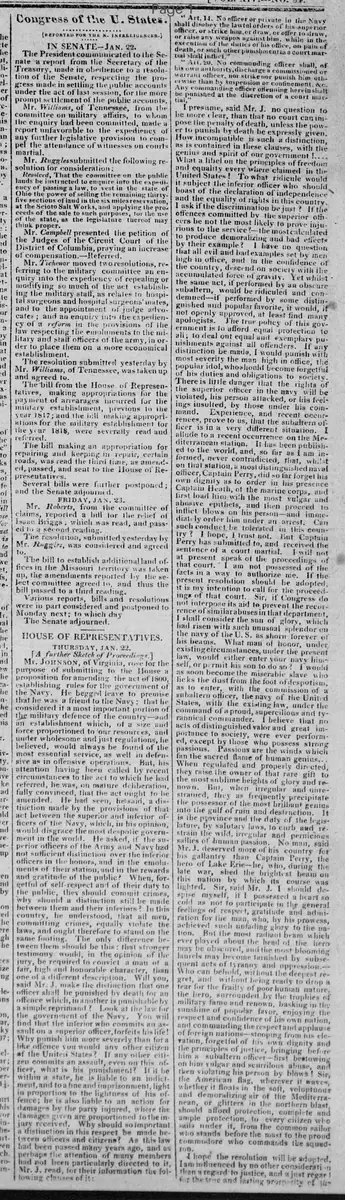
[REPORTED FOR THE N. INTELLIGENCER.]
IN SENATE—JAN. 22.
The President communicated to the Senate a report from the Secretary of the Treasury, made in obedience to a resolution of the Senate, respecting the progress made in settling the public accounts under the act of last session, for the more prompt settlement of the public accounts.
Mr. Williams, of Tennessee, from the committee on military affairs, to whom the enquiry had been committed, made a report unfavorable to the expediency of any further legislative provision to compel the attendance of witnesses on courts martial.
Mr. Ruggles submitted the following resolution for consideration:
Resolved, That the committee on the public lands be instructed to enquire into the expediency of passing a law, to vest in the state of Ohio the power of selling the remaining thirty-five sections of land in the six miles reservation, at the Scioto Salt Works, and applying the proceeds of the sale to such purposes, for the use of the state, as the legislature thereof may think proper.
Mr. Campbell presented the petition of the Judges of the Circuit Court of the District of Columbia, praying an increase of compensation.—Referred.
Mr. Tichenor moved two resolutions, referring to the military committee an enquiry into the expediency of repealing or modifying so much of the act establishing the military staff, as relates to hospital surgeons and hospital surgeons' mates, and to the appointment of judge advocates: and an enquiry into the expediency of a reform in the provisions of the law respecting the emoluments to the military and staff officers of the army, in order to place them on a more economical establishment.
The resolution submitted yesterday by Mr. Williams, of Tennessee, was taken up and agreed to.
The bill from the House of Representatives, making appropriations for the payment of arrearages incurred for the military establishment, previous to the year 1817; and the bill making appropriations for the military establishment for the year 1818, were severally read and referred.
The bill making an appropriation for repairing and keeping in repair, certain roads, was read the third time, as amended, passed, and sent to the House of Representatives.
Several bills were further postponed; and the Senate adjourned.
FRIDAY, JAN. 23.
Mr. Roberts, from the committee of claims, reported a bill for the relief of Isaac Briggs: which was read, and passed to a second reading.
The resolution, submitted yesterday by Mr. Ruggles, was considered and agreed to.
The bill to establish additional land offices in the Missouri territory was taken up, the amendments reported by the select committee agreed to, and thus the bill passed to a third reading.
Various reports, bills and resolutions were in part considered and postponed to Monday next; to which day
The Senate adjourned.
HOUSE OF REPRESENTATIVES.
THURSDAY, JAN. 22.
[A further Sketch of Proceedings.]
Mr. JOHNSON, of Virginia, rose for the purpose of submitting to the House a proposition for amending the act of 1800, establishing rules for the government of the Navy. He begged leave to premise that he was a friend to the Navy; that he considered it a most important portion of the military defence of the country—and an establishment which, of a size and force proportioned to our resources, and under wholesome and just regulations, he believed, would always be found of the most essential service, as well in defensive as in offensive operations. But, his attention having been called by recent circumstances to the act to which he had referred, he was, on mature deliberation, fully convinced, that the act ought to be amended. He had seen, he said, a distinction made by the provisions of that act between the superior and inferior officers of the Navy, which, in his opinion, would disgrace the most despotic government in the world. He asked, if the superior officers of the Army and Navy had not sufficient distinction over the inferior officers in the honors, and in the emoluments of their station, and in the rewards and gratitude of the public? When, forgetful of self-respect and of their duty to the public, they should commit crimes, why should a distinction still be made between them and their inferiors? In this country, he understood, that all men, committing crimes, equally violate the laws, and ought therefore to stand on the same footing. The only difference between them should be this: that stronger testimony would, in the opinion of the jury, be required to convict a man of a fair, high and honorable character, than one of a different description. Will you, said Mr. J. make the distinction that one officer shall be punished by death for an offence which, in another is punishable by a simple reprimand? Look at the law for the government of the Navy. You will find that the inferior who commits an assault on a superior officer, forfeits his life! Why punish him more severely than for a like offence you would any other citizen of the United States? If any other citizen commits an assault, even on this officer, what is his punishment? If it be within a state, he is liable to an indictment, and to a fine and imprisonment, light in proportion to the lightness of his offence; he is also liable to an action for damages by the party injured, where the damages given are proportioned to the injury received. Why should so important a distinction in this respect be made between officers and citizens? As this law had been passed many years ago, and as perhaps the attention of many members had not been particularly directed to it, Mr. J. read, for their information the following clauses of it:
"Art. 14. No officer or private in the Navy shall disobey the lawful orders of his superior officer, or strike him, or draw, or offer to draw, or raise any weapon against him, while in the execution of the duties of his office, on pain of death, or such other punishment as a court martial shall inflict.
"Art. 20. No commanding officer shall, of his own authority, discharge a commissioned or warrant officer, nor strike or punish him otherwise than by suspension or confinement. &c. Any commanding officer offending herein shall be punished at the discretion of a court martial."
I presume, said Mr. J. no question can be more clear, than that no court can impose the penalty of death, unless the power to punish by death be expressly given. How incompatible is such a distinction, as is contained in these clauses, with the genius and spirit of our government!.... What a libel on the principles of freedom and equality every where claimed in the United States! To what ridicule would it subject the inferior officer who should boast of the declaration of independence and the equality of rights in this country. I ask if the discrimination be just? If the offences committed by the superior officers be not the most likely to prove injurious to the service?—the most calculated to produce demoralizing and bad effects by their example? I have no question that all evil and bad examples set by men high in office, and in the confidence of the country, descend on society with the accumulated force of gravity. Yet whilst the same act, if performed by an obscure subaltern, would be ridiculed and condemned—if performed by some distinguished and popular favorite, it would, if not openly approved, at least find many apologists. The true policy of this government is to afford equal protection to all: to deal out equal and exemplary punishments against all offenders. If any distinction be made, I would punish with most severity the man high in office, the popular idol, who should become forgetful of his duties and obligations to society. There is little danger that the rights of the superior officer in the navy will be violated, his person attacked, or his feelings insulted, by those under his command. Experience, and recent occurrences, prove to us, that the subaltern officer is in a very different situation. I allude to a recent occurrence on the Mediterranean station. It has been published to the world, and, so far as I am informed, never contradicted, that, whilst on that station, a most distinguished naval officer, Captain Perry, did so far forget his own dignity as to order in his presence Captain Heath, of the marine corps, and first load him with the most vulgar and abusive epithets, and then proceed to inflict blows on his person—and immediately order him under an arrest. Can such conduct be tolerated in this country? I hope, I trust not. But Captain Perry has submitted to, and received the sentence of a court martial. I will not at present speak of the proceedings of that court. I am not possessed of the facts in a way to authorize me. If the present resolution should be adopted, it is my intention to call for the proceedings of that court. Sir, if Congress do not interpose its aid to prevent the recurrence of similar abuses in that department, I shall consider the sun of glory, which had risen with such unusual splendor on the navy of the U. S. as shorn forever of his beams. What man of honor, under existing circumstances, under the present law, would either enter your navy himself, or permit his son to do so? I would as soon become the miserable slave who licks the dust from the foot of despotism, as to enter, with the commission of a subaltern officer, the navy of the United States, with the existing law, under the command of a proud, supercilious and tyrannical commander. I believe that no acts of distinguished valor and great importance to society, were ever performed, except by those who possess strong passions. Passions are the winds which fan the sacred flame of human genius.. When regulated and properly directed, they raise the owner of that rare gift to the most sublime heights of glory and renown. But, when irregular and unrestrained, they as frequently precipitate the possessor of the most brilliant genius into the gulf of ruin and destruction. It is the province and the duty of the legislature, by salutary laws, to curb and restrain the wild, irregular and pernicious sallies of human passion. No man, said Mr. J. deserved more of his country for his gallantry than Captain Perry, the hero of Lake Erie—he, who, during the late war, shed the brightest beam on this nation by which its course was lighted. Sir, said Mr. J. I should despise myself, if I possessed a heart so cold as not to participate in the general feelings of respect, gratitude and admiration for the man, who, by his prowess, achieved such unfading glory to the nation. But the most radiant beam which ever played about the head of the hero may be obscured, and the most blooming laurels may become tarnished by subsequent acts of tyranny and oppression.— Who can behold, without the deepest regret, and without being ready to drop a tear for the frailty of poor human nature, the hero, surrounded by the trophies of military fame and renown, basking in the sunshine of popular favor, enjoying the respect and confidence of his own nation, and commanding the respect and applause of foreign nations—stooping from his elevation, forgetful of his own dignity and the principles of justice, bringing before him a subaltern officer—first bestowing on him vulgar and scurrilous abuse, and then violating his person by blows! Sir, the American flag, wherever it waves, whether it floats in the soft, voluptuous and demoralizing air of the Mediterranean, or glitters in the northern blast, should afford protection, complete and ample protection, to every citizen who sails under it, from the common sailor who stands before the mast to the proud commodore who commands the squadron.
I hope the resolution will be adopted. I am influenced by no other consideration than a regard to justice, and a just regard for the true and lasting prosperity of the Navy.
In the House of Representatives,
Thursday, Jan. 22.
Mr. JOHNSON, of Kentucky, rose and addressed the chair as follows:
"A communication has been made to this House, by a perfect stranger to me, Capt. Perry and Com. Chauncey. I am a perfect stranger to all the parties. Mr. J. then handed to the chair the following resolution:
Resolved, That the committee for the Department of the Navy be instructed to enquire into the expediency of so amending the act entitled 'An act for the better government of the Navy of the United States,' approved April 23, 1800, which imposes the penalty of death on an officer or private in the Navy, who shall disobey the lawful orders of his superior officer, or strike him, or draw, or offer to draw, or raise any weapon against him, while in the execution of the duties of his office, as to make the punishment in case of an officer, a forfeiture of his warrant or commission, and dismission from the service; and in the case of a private, dismission from the service; and so to amend the said act as to subject the superior officer who shall strike, or draw, or offer to draw, or raise any weapon against his inferior officer, to a forfeiture of his commission and dismission from the service. And further, to provide, that no officer dismissed from the service of the Navy of the United States, for either of the causes above enumerated, shall be reinstated by the President of the United States."
Mr. HARRISON, of Ohio, said he had always made it a rule to vote for enquiry into any subject when proposed by a member. In consistency with that rule, he should vote for this motion: but he thought it proper to say that the resolution contained principles which he could never sanction in the shape of law, and on which therefore he reserved to himself the right to decide when the question should in that shape come before the house.
Mr. SMITH, of Maryland, suggested the propriety of referring the subject generally to the committee for enquiry, without specifying any particular amendment to the laws for the government of the Navy.
Mr. FORSYTH, of Georgia, moved to amend the resolution, by striking out the first part of it, so as to confine the enquiry to that part of the act referred to, which relates to the punishment of a superior officer for misconduct to an inferior. He could not think it necessary to enquire into the expediency of the remaining part of the proposition, since, to amend the laws as therein proposed, would have a tendency to destroy subordination; at the same time, however, he agreed with the gentleman from Virginia, as to the necessity of providing for the punishment of a superior officer who so far forgets the respect due to his country and to his station, as to treat his inferior with contumely and violence. With respect to the circumstances which had given rise to this motion, Mr. F. said, he knew no more than any other member of this House. The case referred to, as he and others had seen it stated, appeared to be an extraordinary one; but, he said, he had always reserved to himself the right to form an opinion on such transactions, when all the circumstances should be before him, and not on the ex parte statement of any of the parties concerned.
Mr. JOHNSON said, he hoped the proposed amendment to his motion would not be adopted; for, if his whole proposition should be incorporated into the existing acts, it would not even produce an equality of punishment: Under the present law, for an assault of an inferior on a superior officer, courts martial were authorized to award the sentence of death: whilst, reversing the facts, the offender was liable to no other punishment than dismission from the service. Why, he asked, this difference? Mr. J. said, he had no doubt thousands of instances might be found, in which the hearts of the inferior officers were actuated by as patriotic and honorable sentiments as that of the superior officer, who struts on the quarter deck with his pair of epaulettes. Was there any reason why a distinction should be made, in our laws, between persons who commit crimes of the same grade? When on the land our penal laws were so ameliorated as to punish even murder in the second degree, with imprisonment in a jail or penitentiary—(such was the case in Virginia, and in Pennsylvania, and in other states)—why punish an officer in your service by death for a mere assault? But it was said that an equalization of punishment for these offences, would produce insubordination. He conceived not: for, even if the laws were amended as he proposed, the inferior officer committing the offence, would be liable to be disgraced from the service. If a superior officer should commit a like offence, with the stronger inducements of patriotism and respect for the laws which belong to higher station and mature age to refrain from it, no higher punishment would await him. Mr. J. repeated, that he trusted the amendment would not prevail.
Mr. PLEASANTS, of Virginia, said, that before the amendment had been moved by Mr. Forsyth, he was about to object to the resolution on the ground of the specific direction it contained to the committee as to the particular points to be enquired into. He thought the subject a proper one for enquiry, as respected the duty of the house and the interest of the nation. He would not give any opinion on the transactions adverted to as having occurred in the Mediterranean, because he had seen but one side of the question, to which indeed much respect was due, and the more as no reply had been made to it. That statement, he very much regretted to say, did set the conduct of the officer who had stood so high in his esteem, in a point of view which he had regarded with pain. His objection to the enquiry was to its limited nature, when, it appeared to him, the whole law, or the several laws on the subject, should be open to the investigation of the committee. The committee would then enquire whether abuses had been committed and direct their attention to the means of preventing them for the future. He should vote against the present amendment, and if it was negatived, should propose an amendment for a general enquiry.
Mr. FORSYTH withdrew his motion with the intimation that he should not have made it, had he been apprized that the chairman of the naval committee, (Mr. Pleasants) meant to make any motion on the subject.
Mr. PLEASANTS then moved to amend the resolution before the house, so as to read as follows:
"Resolved, That the committee on naval affairs be instructed to enquire whether any, and if any, what alterations are proper to be made in the several laws for the government of the Navy."
Mr. JOHNSON said, as his object was accomplished in drawing the attention of the house and of the committee to the particular point which he wished to see investigated, he would accept the proposed amendment as a modification of his original motion.
And, thus modified, the resolution was agreed to.
Mr. Johnson then submitted the following resolution, the adoption of which he thought followed as a necessary consequence of that just agreed to.
"Resolved, That the Secretary of the Navy be directed to report to this House the proceedings of a certain court martial, ordered by Commodore Isaac Chauncey, on the Mediterranean station, for the trial of Captain Oliver H. Perry; also the proceedings of a court martial, on the same station, ordered by the same officer, for the trial of Captain John Heath, of the marine corps."
The resolution was adopted without opposition.
FRIDAY, JAN. 23.
A Message was received from the President of the U. States, by the hands of Mr. J. J. Monroe, his secretary, transmitting the information required by a resolution of this House, calling for an account of all roads made or marked out under the authority of the U. States.
On motion of Mr. Ingram, it was
Resolved, That a select committee be appointed to enquire what alterations are necessary to be made in the act entitled "An act to regulate and fix the compensation of clerks, and to authorize the laying out of certain public roads, and for other purposes."
On motion of Mr. Smith, of Maryland, it was
Resolved, That the committee on public lands be instructed to enquire into the expediency of providing by law for the introduction into all patents hereafter to be issued for lands sold or granted by the United States, of a reservation to the use of the United States of all copper mines, and of the expediency of authorizing the Secretary of the Treasury to lease any copper mines the property of the United States, for a term not exceeding seven years.
On motion of Mr. Herrick, it was
Resolved, That the committee on roads and canals be instructed to enquire into the expediency of providing by law for the appointment of commissioners to survey, lay out, and mark a road from the west bank of the Ohio river, opposite the point where the Cumberland road strikes the same through St. Clairsville to Columbia; from thence to the western line of the State of Ohio, in a direction to St. Louis, in the Missouri territory.
On motion of Mr. Robertson, of Lou. it was
Resolved, That the Secretary of the Treasury be requested to lay before this House a statement of the salaries, and an estimate of the present and future emoluments of the respective Registers and Receivers of Public Monies at the different offices of the United States; and also the amount of the salaries and emoluments of the several Surveyors General, and principal and deputy Surveyors.
On motion of Mr. Forsyth, it was
Resolved, That the Committee of Commerce and Manufactures be instructed to enquire into the expediency of regulating by law the number of passengers to be brought into the United States by American and Foreign vessels, according to the tonnage of the vessels.
On motion of Mr. Cobb, it was
Resolved, That the Committee on Public lands be instructed to enquire into the expediency of establishing into separate land Districts, all that part of the Alabama territory which lies south of an east and west line, to be drawn from the boundary line dividing the state of Mississippi from said territory, through Fort Williams to the western boundary of Georgia; and also into the expediency of appointing a surveyor to all public lands in the said district; of surveying, in the manner prescribed by law, such public lands (to which the Indian title has been extinguished, and which are not already surveyed) and of offering the same for sale as soon as possible.
CLAIMS FOR HOUSES BURNT IN WAR.
On motion of Mr. Williams, of N. C. the house resolved itself into a committee of the whole, Mr. Pleasants in the chair, on the report of the committee of claims on the claim of J. Pattieson, and several other claims of a like nature, referred to the same committee.
[This claim is for a house situated on the banks of the Patuxent, destroyed by the enemy during the late war, on account of previous occupation by provisions and by supplies issued therefrom to a detachment of Militia in the service of the U. States, and for other similar reasons, as the petitioner desires to establish by the testimony of two or three witnesses...
The claim is one of those laid before the Commissioner of Claims, and by him, according to the provisions of the law of the last session, transmitted to the House of Representatives for their decision on the fact.]
After some conversation on the question of proceeding in the consideration of this subject on this or at a future day—
Mr. Williams, of North Carolina, delivered at considerable length, and with much perspicuity, the views of the committee on the general principles on which these cases rest, and also on the evidence in this particular case.
After a few observations from Mr. Smith of Md. and Mr. Forsyth, the committee rose and reported their concurrence, not only in the case of Mr. Pattieson, but also in several other cases, which rest on the same principle and on nearly the same description of evidence.
The question on concurrence with the committee of claims in rejecting the petition of Mr. Pattieson, was agreed to.
The question being next proposed on the claim of John Ireland, for a house destroyed because occupied by a part of Com. Barney's men, his rigging, &c. and the report recommending its rejection having been read—
A debate arose on the merits of the claim, and the amount of the testimony, in the course of which: Messrs. Smith, of Md., Harrison, Reed, Robertson, of L., Peter, Bayly and Palmer opposed the report adverse to the claim, and Mr. Williams and Mr. Forsyth supported it.
At length this and the other reports were laid on the table, the hour growing unusually late. And
The House adjourned to Monday.
What sub-type of article is it?
What keywords are associated?
What entities or persons were involved?
Where did it happen?
Domestic News Details
Primary Location
Washington
Event Date
Jan. 22 23, 1818
Key Persons
Event Details
Senate: President communicated Treasury report on public accounts; unfavorable report on compelling witnesses for courts martial; resolution on Ohio land sales at Scioto Salt Works; petition for judges' compensation increase; resolutions on military staff reforms; bills on military appropriations and road repairs passed or referred. House: Debate by Mr. Johnson of Virginia on amending 1800 Navy act for equal punishments in assaults between superior and inferior officers, referencing Perry-Heath incident; resolution modified for general inquiry into Navy laws and request for court martial proceedings; other resolutions on roads, lands, copper mines, salaries, passengers, Alabama districts; committee on claims for houses burnt in war, rejecting some petitions.