Thank you for visiting SNEWPapers!
Sign up free
Fowle's New Hampshire Gazette And General Advertiser
Portsmouth, Rockingham County, New Hampshire
What is this article about?
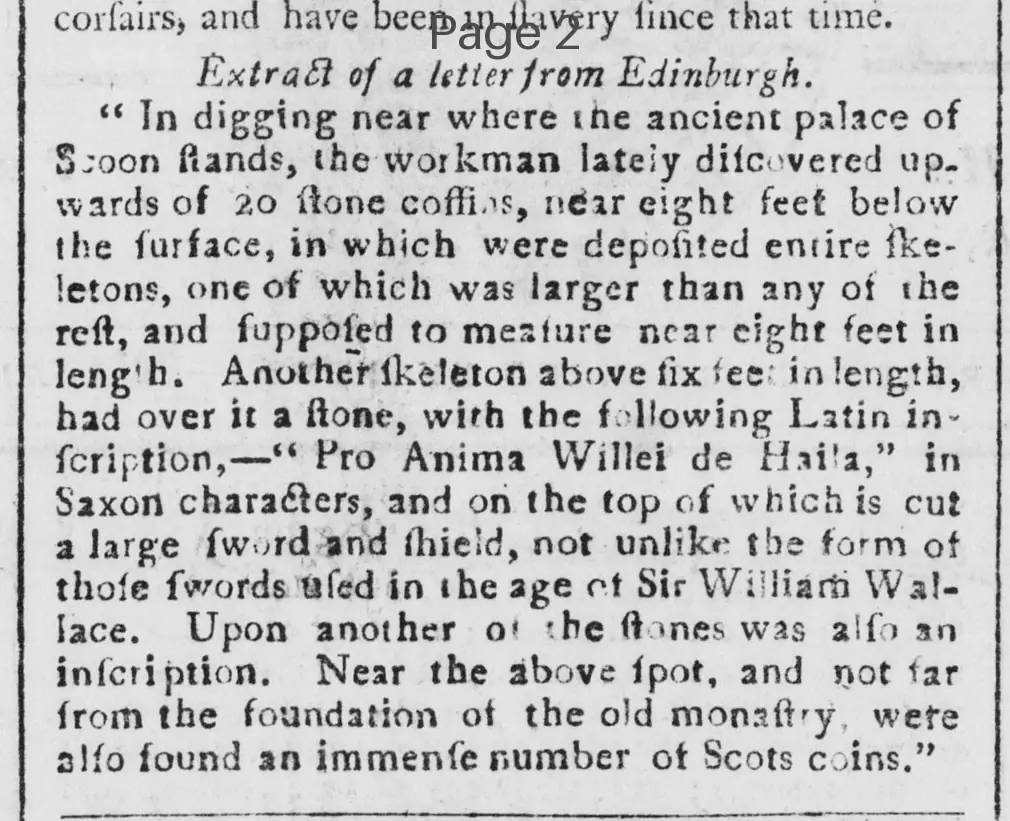
Near the ancient palace of Scoon, workers discovered over 20 stone coffins with entire skeletons, one nearly eight feet long, another with a Latin inscription for Willelmi de Haila and sword/shield carvings, plus numerous Scots coins near an old monastery.
Clipping
OCR Quality
Full Text
"In digging near where the ancient palace of Scoon stands, the workman lately discovered upwards of 20 stone coffins, near eight feet below the surface, in which were deposited entire skeletons, one of which was larger than any of the rest, and supposed to measure near eight feet in length. Another skeleton above six feet in length, had over it a stone, with the following Latin inscription,--'Pro Anima Willelmi de Haila,' in Saxon characters, and on the top of which is cut a large sword and shield, not unlike the form of those swords used in the age of Sir William Wallace. Upon another of the stones was also an inscription. Near the above spot, and not far from the foundation of the old monastery, were also found an immense number of Scots coins."
What sub-type of article is it?
What keywords are associated?
What entities or persons were involved?
Where did it happen?
Foreign News Details
Primary Location
Near The Ancient Palace Of Scoon
Event Date
Lately
Key Persons
Event Details
Workmen digging near the ancient palace of Scoon discovered upwards of 20 stone coffins eight feet below the surface containing entire skeletons, one nearly eight feet long. Another over six feet had a stone with Latin inscription 'Pro Anima Willelmi de Haila' in Saxon characters, topped with a sword and shield like those from Sir William Wallace's era. Another stone had an inscription. Near the spot and old monastery foundation, an immense number of Scots coins were found.