Thank you for visiting SNEWPapers!
Sign up free
Gazette Of The United States, & Philadelphia Daily Advertiser
Philadelphia, Philadelphia County, Pennsylvania
What is this article about?
A countryman relays a mill-side conversation between farmer Mr. Truliber and Mr. Warren discussing queries on French seizures of American vessels, explaining the law of nations, U.S.-France treaty violations, and the need for American neutrality amid British-French tensions.
Merged-components note: These two components form a single continuous letter to the editor, split across columns, with text flowing directly from one to the other.
Clipping
OCR Quality
Full Text
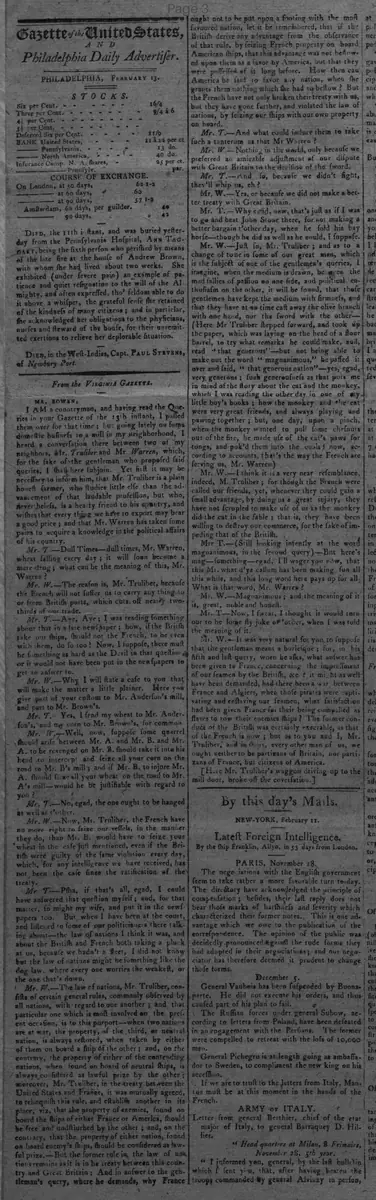
MR. BOWEN,
I AM a countryman, and having read the Queries in your Gazette of the 13th instant, I passed them over for that time; But going lately on some domestic business to a mill in my neighborhood, I heard a conversation there between two of my neighbors, Mr. Truliber and Mr. Warren, which, for the sake of the gentleman who proposed said queries, I shall here subjoin. Yet first it may be necessary to inform him, that Mr Truliber is a plain honest farmer, who studies little else than the advancement of that laudable profession, but who, nevertheless, is a hearty friend to his country, and wishes that every thing we have to export may bear a good price; and that Mr. Warren has taken some pains to acquire a knowledge in the political affairs of his country.
Mr. T.-Dull times-dull times, Mr. Warren, wheat falling every day; it will soon become a mere drug; what can be the meaning of this, Mr. Warren?
Mr. W.-The reason is, Mr. Truliber, because the French will not suffer us to carry any thing to or from British ports, which cuts off nearly two-thirds of our trade.
Mr. T.-Aye, Aye; I was reading something about that in a late newspaper; how, if the British take our ships, should not the French, to be even with them, do so too! Now, I suppose, there must be something as hard as the Devil in that question, or it would not have been put in the newspapers to get an answer to.
Mr. W.-Why I will state a case to you that will make the matter a little plainer. Here you give part of your custom to Mr. Anderson's mill, and part to Mr. Brown's.
Mr. T.- Yes, I send my wheat to Mr. Anderson's, and my corn to Mr. Brown's, for common.
Mr. W.-Well, now, suppose some quarrel should arise between Mr. A. and Mr. B. and Mr. A. to be revenged on Mr. B. should take it into his head to intercept and seize all your corn on the road to Mr. B's mill ; and if Mr. B. to injure Mr. A. should seize all your wheat on the road to Mr. A's mill--would he be justifiable with regard to you?
Mr. T.-No, egad, the one ought to be hanged as well as t'other.
Mr. W.-Now, Mr. Truliber, the French have no more right to seize our vessels, in the manner they do, than Mr. B. would have to seize your wheat in the case just mentioned, even if the British were guilty of the same violation every day, which, for any intelligence we have received, has not been the case since the ratification of the treaty.
Mr. T.-Psha, if that's all, egad, I could have answered that question myself; and, for that matter, so might my wife, and put it in the newspapers too. But when I have been at the court, and listened to some of our politicianers there talking about-the law of nations I think it was, and about the British and French both taking a pluck at us, because we hadn't a fleet, I did not know but the law of nations might be something like the dog law. where every one worries the weakest, or the one that's down.
Mr. W.-The law of nations, Mr. Truliber, consists of certain general rules, commonly observed by all nations, with regard to one another ; and that particular one which is most involved on the present occasion, is to this purport--when two nations are at war, the property, of the third, or neutral nation, is always restored, when taken by either of them on board a ship of the other ; and, on the contrary, the property of either of the contending nations, when found on board of neutral ships, is always considered as lawful prize by the other; moreover, Mr. Truliber, in the treaty between the United States and France, it was mutually agreed to relinquish this rule, and establish another in its place, viz, that the property of enemies, found on board the ships of either France or America, should be free and undisturbed by the other ; and, on the contrary, that the property of either nation, found on board enemy's ships, should be considered as lawful prize.-But the former rule in the law of nations remains as it is in the treaty between this country and Great Britain : And in answer to the gentleman's query, where he demands, why France ought not to be put upon a footing with the most favoured nation, let it be remembered, that if the British derive any advantage from the observance of that rule, by seizing French property on board American ships, that this advantage was not bestowed upon them as a favor by America, but that they were possessed of it long before. How then can America be said to favor any nation, when she grants them nothing which she had to bestow ? But the French have not only broken their treaty with us, but they have gone further, and violated the law of nations, by seizing our ships with our own property on board.
Mr. T.--And what could induce them to take such a tantrum as that Mr Warren ?
Mr. W.Nothing in the world, only because we preferred an amicable adjustment of our dispute with Great Britain to the decision of the sword.
Mr. T.--And so, because we didn't fight, they'll whip us, eh?.
Mr. W.-Yes, or because we did not make a better treaty with Great Britain,
Mr. T.-Why egad, now, that's just as if I was to go and beat upon Stone there, for not making a better bargain t'other day, when he sold his bay horse-though he did as well as he could, I suppose.
Mr. W.-Just so, Mr. Truliber : and as to a change of tone in some of our great men, which is the subject of one of the gentlemen's queries, I imagine, when the medium is drawn, between the mad allies of passion on one side, and political enthusiasm on the other, it will be found, that those gentlemen have kept the medium with firmness, and that they have at no time cast away the olive branch with one hand, nor the sword with the other--
(Here Mr. Truliber stepped forward, and took up the paper, which was laying on the head of a flour barrel, to try what remarks he could make, and, read that generous'but not being able to make out the word " magnanimous," be passed it over and said, " that generous nation"yes, egad, very generous ; such generous as that puts me in mind ofthe story about the cat and the monkey, which I was reading the other day in one of my little boy's books ; how the monkey and the cat were very great friends, and always playing and pawing together; but, one day, upon a pinch, when the monkey wanted to pull some chestnuts out of the fire, he made use of the cat's paws for tongs, and pok'd them into the coals; now, according to accounts, that's the way the French are serving us, Mr. Warren)
Mr. W.-I think it is a very near resemblance indeed, Mr. Truliber; for though the French were called our friends, yet, whenever they could gain a small advantage, by doing us a great injury, they have not scrupled to make use of us as the monkey did the cat in the fable ; that is, they have been willing to destroy our commerce, for the sake of impeding that of the British.
Mr. T.-(Still looking intently at the word magnanimous, in the second query)--But here's mag- something--egad, I'll wager you now, that this Mi. what d'ye callum has been making us all this while, and this long word here pays up for all- What is that word, Mr. Warren?
Mr. W.-Magnanimous; and the meaning of it is, great, noble and honest.
Mr. T Now, I swear, I thought it would turn out to be some sly joke or other, when I was told the meaning of it.
Mr. W. -It was very natural so you to suppose that the gentleman meant a burlesque; for, in his fifth and last query, when be asks, what answer has been given to France, concerning the impressment of our seamen by the British, &c ? it might as well have been demanded, had there been a war between France and Algiers, when those pirates were captivating and enslaving our seamen, what satisfaction had been given France for their being compelled as slaves to row their enemies ships? The former conduct of the British was certainly execrable, as that of the French is now ; but as to you and I, Mr. Truliber, and in short, every other man of us, we ought neither to be partizans of Britain, nor partizans of France, but citizens of America.
Here Mr. Truliber's waggon driving up to the mill door, broke off the conversation.
What sub-type of article is it?
What themes does it cover?
What keywords are associated?
What entities or persons were involved?
Letter to Editor Details
Author
A Countryman
Recipient
Mr. Bowen
Main Argument
the french have violated their treaty and the law of nations by seizing american vessels and property, unlike the british; america should maintain neutrality and not favor one over the other.
Notable Details