Thank you for visiting SNEWPapers!
Sign up free
Gazette Of The United States
Philadelphia, Philadelphia County, Pennsylvania
What is this article about?
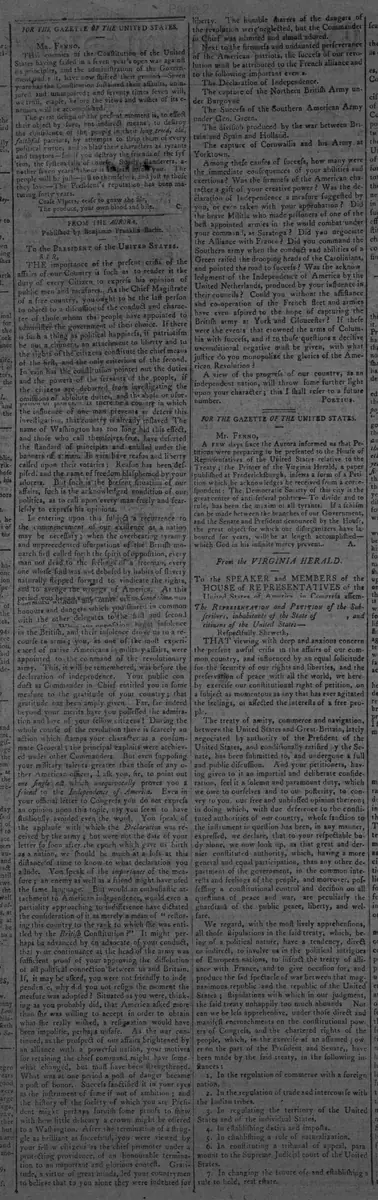
A critical letter to President Washington questioning his military achievements and commitment to American independence during the Revolution, attributing success to other factors like the French alliance, key battles, and patriots' efforts rather than his sole leadership.
Merged-components note: These sequential components continue the same letter to the President criticizing his role in the Revolution and independence, signed by Portius; they form one logical unit.
Clipping
OCR Quality
Full Text
Published by Benjamin Franklin Bache.
To the PRESIDENT of the UNITED STATES.
SIR,
THE importance of the present-crisis of the
affairs of our Country is such as to render it the
duty of every Citizen, to express his opinion of
public men and measures. As the Chief Magistrate
of a free country, you ought to be the last person
to object to a discussion of the conduct and charac-
ter of those whom the people have appointed to
administer the government of their choice. If there
be such a thing as political happiness, if patriotism
be not a chimera, an attachment to liberty and to
the rights of the citizens constitute the chief means
of the first, and the only criterions of the second.
In vain has the constitution pointed out the duties
and the powers of the servants of the people, if
the citizens are debarred from investigating the
omissions of absolute duties, and the abuse or usur-
pation of power. If there be a country in which
the influence of one man prevents or deters this.
investigation, that country is already enslaved. The
name of Washington has too long had this effect,
and those who call themselves free, have deserted
the standard of principles and enlisted under the
banners of a man. In vain have reason and liberty
called upon their votaries: Reason has been de-
fied, and the name of freedom blasphemed by your
adorers. But such is the present situation of our
affairs, such is the acknowledged condition of our
politics, as to call upon every man freely and fear-
lesly to express his opinions.
In entering upon this subject a recurrence to
the commencement of our existence as a nation
may be necessary; when the overbearing tyranny
and unprecedented usurpations of the British mo-
narch first called forth the spirit of opposition, every
man not dead to the feelings of a freeman, every
one whose soul was not debased by habits of slavery
naturally stepped forward to vindicate the rights,
and to avenge the wrongs of America.- At this
period of equal honours and dangers which you shared in common
with the other delegates to the first and second.
Continental Congresses opposition began insolence
in the British, and their insolence drove us to a re-
course to arms; you, as one of the most experi-
enced of native Americans in military affairs, were
appointed to-the command of the revolutionary
army. This, it will be remembered, was before the
declaration of independence. Your public con-
duct as Commander in Chief entitled you in some
measure to the gratitude of your country; that
gratitude has been amply given Far, far indeed
beyond your merits have you possessed the admira-
tion and love of your fellow citizens ! During the
whole course of the revolution there is scarcely an
action which stamps your character as a consummate General ; the principal exploits were achieved
under other Commanders. But even supposing
your military talents greater than those of any o-
ther American officer, I ask you, sir, to point out
one single act which unequivocally proves you a
friend to the Independence of America. Even in
your official letter to Congress you do not express
an opinion upon this topic, nay you seem to have
studiously avoided even the word, You speak of
the applause with which the Declaration was re-
ceived by the army ; but were not the date of your
letter so soon after the epoch which gave us birth
as a nation, we should be much at a loss at this
distance of time to know to what declaration you
allude. You speak of the importance of the mea-
sure; an enemy as well as a friend might have used
the same language. But would an enthusiastic at-
tachment to American independence, would even a
partiality approaching to indifference have dictated
the consideration of it as merely a means of " restor.
ing this country to the rank to which she was enti-
tled by the British Constitution ?" It might per-
haps be advanced by an advocate of your conduct.
that your continuance at the head of the army was
sufficient proof of your approving the dissolution
of all political connection between us and Britain.
If, it may be asked, you were not friendly to inde-
pendence, why did you not resign the moment the
measure was adopted? Situated as you were, think-
ing as you probably did, that America asked more
than she was willing to accept in order to obtain
what he really wished, a resignation would have
been impolitic, perhaps unsafe. As the war con-
tinued, as the prospect of our affairs brightened by
an alliance with a powerful nation, your motives
for retaining the chief command might have some.
what changed, but must have been strengthened.
What was at one period a post of danger became
a post of honor. Success sanctified it in your eyes
as the instrument of fame if not of ambition ; and
the history of the society of which you are Presi-
dent might perhaps furnish some proofs to shew
with how little delicacy a crown might be offered
to a Washington. After the termination of a strug.
gle as brilliant as successful, you were viewed by
your fellow citizens as the chief promoter under a
protecting providence, of an honourable termina-
tion to an important and glorious contest. Grati-
tude, a virtue of great minds, led your countrymen
to believe that to you alone they were indebted for
liberty. The humble sharers of the dangers of
the revolution were neglected, but the Commander
in Chief was admired and almost adored.
Next to the firmness and undaunted perseverance
of the American patriots, the success of our revo-
lution must be attributed to the French alliance and
to the following important events.
The Declaration of Independence.
The capture of the Northern British Army un-
der Burgoyne
The Success of the Southern American Army
under Gen. Green.
The division produced by the war between Bri-
tain and Spain and Holland.
The capture of Cornwallis and his Army at
Yorktown.
Among these causes of success, how many were
the immediate consequences of your abilities and
exertions? Was the firmness of the American cha-
racter a gift of your creative power ? Was the de-
claration of Independence a measure suggested by
you, or even taken with your approbation ? Did
the brave Militia who made prisoners of one of the
best appointed armies in the world combat under
your command, at Saratoga? Did you negotiate
the Alliance with France? Did you command the
Southern army when the conduct and abilities of a
Green raised the drooping heads of the Carolinians,
and pointed the road to success ? Was the acknow-
ledgment of the Independence of America by the
United Netherlands, produced by your influence in
their councils? Could you without the assistance
and co-operation of the French fleet and armies
have even aspired to the hope of capturing the
British army at York and Gloucester? If these
were the events that crowned the arms of Colum-
bia with success, and if to these questions a decisive
unconditional negative must be given, with what
justice do you monopolize the glories of the Ame-
rican Revolution?
A view of the progress of our country, as an
independent nation, will throw some further light
upon your character; this I shall refer to a future
number.
PORTIUS.
What sub-type of article is it?
What themes does it cover?
What keywords are associated?
What entities or persons were involved?
Letter to Editor Details
Author
Portius
Recipient
President Of The United States
Main Argument
the letter critiques president washington's role in the american revolution, arguing that he monopolizes its glories despite limited personal contributions, questions his commitment to independence, and attributes success to other patriots, alliances, and key events.
Notable Details