Thank you for visiting SNEWPapers!
Sign up free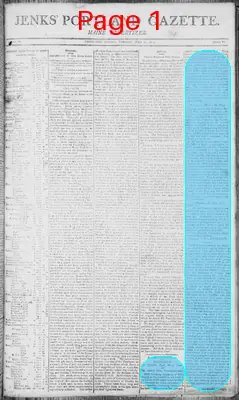
Jenks' Portland Gazette. Maine Advertiser
Portland, Cumberland County, Maine
What is this article about?
Gabriel Jones recounts lending £50 to Thomas Jefferson in September 1778, repaid in April 1779 with worthless paper money worth about 1 shilling per pound, which Jones returned; full repayment received in 1780 via Jefferson's agent.
Clipping
OCR Quality
Full Text
AUTHENTIC.
Mr. Jefferson's Paper Money Tender,
TO
Mr. Gabriel Jones, Rockingham county.
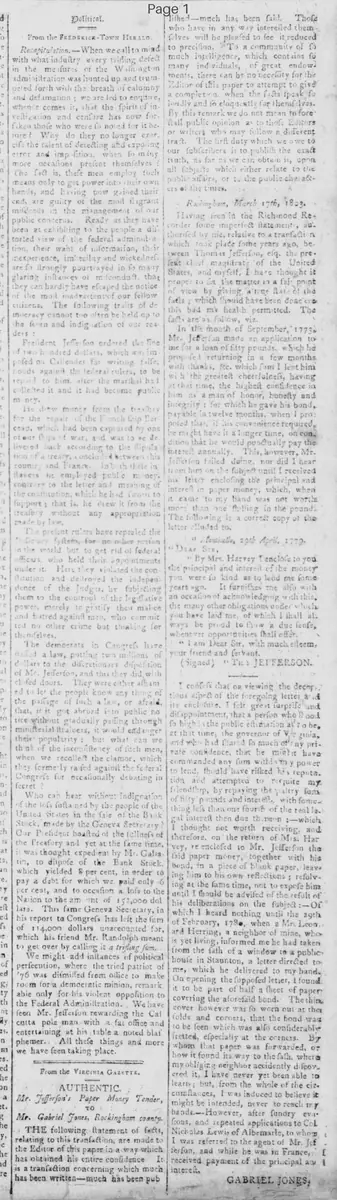
THE following statement of facts, relating to this transaction, are made to the Editor of this paper in a way which has obtained his entire confidence. It is a transaction concerning which much has been written—much has been published—much has been said. Those who have in any way interested themselves will be pleased to see it reduced to precision. To a community of so much intelligence, which contains so many individuals, of great endowments, there can be no necessity for the Editor of this paper to attempt to give a comment, when the facts speak so loud and so eloquently for themselves. By this remark we do not mean to forestall public opinion as to those Editors or writers who may follow a different tract. The first duty which we owe to our subscribers is to publish the exact truth, as far as we can obtain it, upon all subjects which either relate to the public affairs, or to the public characters of the times.
Rockingham, March 17th, 1803.
Having seen in the Richmond Recorder so imperfect a statement, authorized by me, relative to a transaction which took place some years ago, between Thomas Jefferson, Esq. the present chief magistrate of the United States, and myself, I have thought it proper to put the matter in a fair point of view by giving to the public the facts; which should have been done ere this had my health permitted. The facts are as follow, viz.
In the month of September, 1778, Mr. Jefferson made an application to me for a loan of fifty pounds, which he promised returning in a few months with bank, &c. which sum I lent him with the greatest cheerfulness, having at that time, the highest confidence in him as a man of honor, honesty and integrity; for which he gave his bond, payable in twelve months, when I proposed that, if his convenience required, he might have it a longer time, on condition that he would punctually pay the interest annually. This, however, Mr. Jefferson failed doing, nor did I hear from him on the subject until I received his letter enclosing the principal and interest in paper money, which, when it came to my hand was not worth more than one shilling in the pound.
The following is a correct copy of the letter alluded to.
Monticello, 29th April, 1779.
"Dear Sir,
By Mrs. Harvey I enclose to you the principal and interest of the money you were so kind as to lend me some years ago. It furnishes me also with an occasion of acknowledging with this, the many other obligations under which you have laid me, of which I shall always be proud to show a due sense, whenever opportunities shall offer.
I am Dear Sir with much esteem,
your friend and servant,
(Signed) Th: JEFFERSON."
I confess that on viewing the deceitful aspect of the foregoing letter and its enclosure, I felt great surprise and disappointment, that a person who stood so high in the public estimation as to be at that time, the governor of Virginia, and who had shared so much of my private confidence, that he might have commanded any sum within my power to lend, should have risked his reputation and attempted to requite my friendship, by repaying the paltry sum of fifty pounds and interest, with something less than one fourth of the real legal interest then due thereon;—which I thought not worth receiving, and therefore, on the return of Mrs. Harvey, re-enclosed to Mr. Jefferson the said paper money, together with his bond, in a piece of blank paper, leaving him to his own reflections: resolving at the same time, not to expose him until I should be advised of the result of his deliberations on the subject:—Of which I heard nothing until the 29th of February, 1780, when a Mr. Leonard Herring, a neighbor of mine, who is yet living, informed me he had taken from the sash of a window to a public house in Staunton, a letter directed to me, which he delivered to my hand. On opening the supposed letter, I found it to be part of half a sheet of paper covering the aforesaid bond. The thin cover however was so worn out at the folds and corners, that the bond was to be seen which was also considerably fretted, especially at the corners. By whom that paper was forwarded, or how it found its way to the sash, where my obliging neighbor accidentally discovered it, I have never yet been able to learn; but, from the whole of the circumstances, I was induced to believe it might be intended, never to reach my hands.—However, after sundry evasions, and repeated applications to Col. Nicholas Lewis of Albemarle, to whom I was referred as the agent of Mr. Jefferson, and while he was in France, received payment of the principal and interest,
GABRIEL JONES
What sub-type of article is it?
What keywords are associated?
What entities or persons were involved?
Where did it happen?
Domestic News Details
Primary Location
Rockingham County, Virginia
Event Date
September 1778 To February 1780
Key Persons
Outcome
loan of £50 repaid initially with worthless paper money (1 shilling per pound); paper and bond returned; full principal and interest eventually paid via jefferson's agent in 1780.
Event Details
Gabriel Jones lent £50 to Thomas Jefferson in September 1778 on a 12-month bond with annual interest. Jefferson repaid in April 1779 via letter with depreciated paper money, which Jones rejected and returned with the bond. The bond was later found discarded and returned to Jones. After delays, full payment was received through Col. Nicholas Lewis while Jefferson was in France.