Thank you for visiting SNEWPapers!
Sign up free
Alexandria Daily Advertiser
Alexandria, Virginia
What is this article about?
Decius defends his prior essay against objections in the Richmond Enquirer, emphasizing the need for republicans to check administration errors. He refutes claims about federalist misuse, foreign negotiations with Spain and Britain, the Louisiana treaty, and congressional events involving Monroe and Randolph.
Merged-components note: The editorial component on page 3 is a direct continuation of the letter to the editor from page 2, signed by Decius, forming a single coherent piece.
Clippings
1 of 2
OCR Quality
Full Text
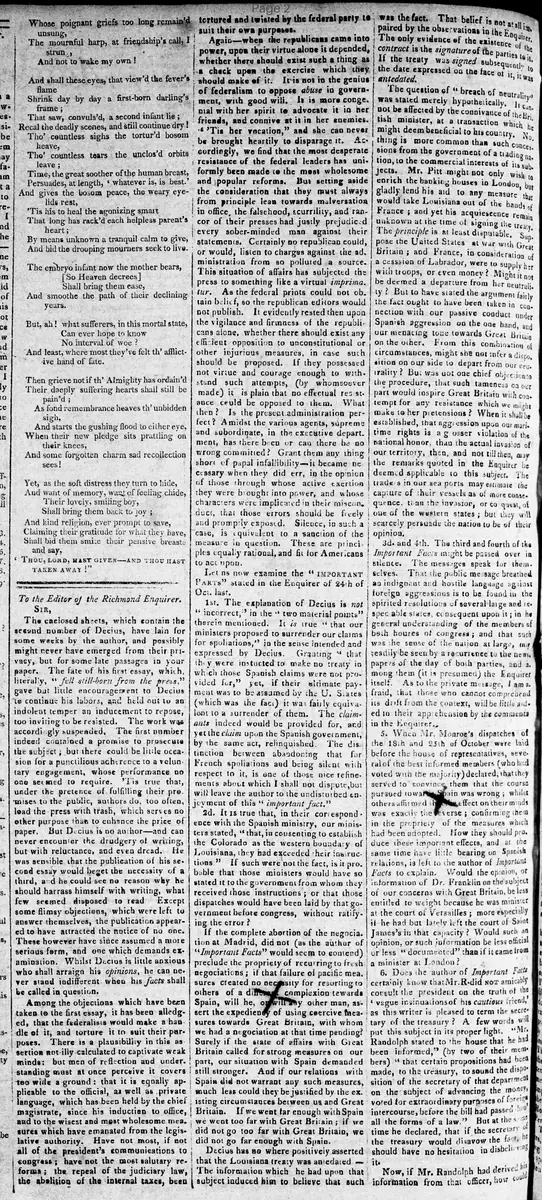
SIR,
The enclosed sheets, which contain the second number of Decius, have lain for some weeks by the author, and possibly might never have emerged from their privacy, but for some late passages in your paper. The fate of his first essay, which, literally, "fell still-born from the press," gave but little encouragement to Decius to continue his labors, and held out to an indolent temper an inducement to repose, too inviting to be resisted. The work was accordingly suspended. The first number indeed contained a promise to prosecute the subject; but there could be little occasion for a punctilious adherence to a voluntary engagement, whose performance no one seemed to require. 'Tis true that, under the pretence of fulfilling their promises to the public, authors do, too often, load the press with trash, which serves no other purpose than to enhance the price of paper. But Decius is no author--and can never encounter the drudgery of writing, but with reluctance, and even dread. He was sensible that the publication of his second essay would beget the necessity of a third, and he could see no reason why he should harass himself with writing, what few seemed disposed to read. Except some flimsy objections, which were left to answer themselves, the publication appeared to have attracted the notice of no one. These however have since assumed a more serious form, and one which demands examination. Whilst Decius is little anxious who shall arraign his opinions, he can never stand indifferent when his facts shall be called in question.
Among the objections which have been taken to the first essay, it has been alleged, that the federalists would make a handle of it, and torture it to suit their purposes. There is a plausibility in this assertion not illy calculated to captivate weak minds: but men of reflection and understanding must at once perceive it covers too wide a ground: that it is equally applicable to the official, as well as private language, which has been held by the chief magistrate, since his induction to office, and to the wisest and most wholesome measures which have emanated from the legislative authority. Have not most, if not all of the president's communications to congress; have not the most salutary reforms; the repeal of the judiciary law, the abolition of the internal taxes, been tortured and twisted by the federal party to suit their own purposes?
Again--when the republicans came into power, upon their virtue alone it depended, whether there should exist such a thing as a check upon the exercise which they should make of it. It is not in the genius of federalism to oppose abuse in government, with good will. It is more congenial with her spirit to advocate it in her friends, and connive at it in her enemies. 'Tis her vocation." and she can never be brought heartily to disparage it. Accordingly, we find that the most desperate resistance of the federal leaders has uniformly been made to the most wholesome and popular reforms. But setting aside the consideration that they must always from principle lean towards malversation in office the falsehood, scurrility, and rancor of their presses had justly prejudiced every sober-minded man against their statements. Certainly no republican could, or would, listen to charges against the administration from so polluted a source.
This situation of affairs has subjected the press to something like a virtual imprimatur. As the federal prints could not obtain belief, so the republican editors would not publish. It evidently rested then upon the vigilance and firmness of the republicans alone, whether there should exist any efficient opposition to unconstitutional or other injurious measures, in case such should be proposed. If they possessed not virtue and courage enough to withstand such attempts, (by whomsoever made) it is plain that no effectual resistance could be opposed to them. What then? Is the present administration perfect? Amidst the various agents, supreme and subordinate, in the executive department, has there been or can there be no wrong committed? Grant them any thing short of papal infallibility--it became necessary when they did err, in the opinion of those through whose active exertion they were brought into power, and whose characters were implicated in their misconduct, that those errors should be freely and promptly exposed. Silence, in such a case, is equivalent to a sanction of the measure in question. These are principles equally rational, and fit for Americans to act upon.
Let us now examine the "IMPORTANT FACTS" stated in the Enquirer of 24th of Oct. last.
1st. The explanation of Decius is not "incorrect," in the "two material points" therein mentioned. It is true "that our ministers proposed to surrender our claims for spoliations," in the sense intended and expressed by Decius. Granting "that they were instructed to make no treaty in which those Spanish claims were not provided for," yet, if their ultimate payment was to be assumed by the U. States (which was the fact) it was fairly equivalent to a surrender of them. The claimants indeed would be provided for, and yet the claim upon the Spanish government, by the same act, relinquished. The distinction between abandoning that for French spoliations and being silent with respect to it, is one of those nice refinements about which I shall not dispute, but will leave the author to the undisturbed enjoyment of this "important fact."
2d. It is true that, in their correspondence with the Spanish ministry, our ministers stated, "that, in consenting to establish the Colorado as the western boundary of Louisiana, they had exceeded their instructions." If such were not the fact, is it probable that those ministers would have so stated it to the government from whom they received those instructions; or that those dispatches would have been laid by that government before congress, without ratifying the error?
If the complete abortion of the negotiation at Madrid, did not (as the author of "Important Facts" would seem to contend) preclude the propriety of recurring to fresh negotiations; if that failure of pacific measures created no necessity for resorting to others of a different complexion towards Spain, will he, or will any other man, assert the expediency of using coercive measures towards Great Britain, with whom we had a negotiation at that time pending? Surely if the state of affairs with Great Britain called for strong measures on our part, our situation with Spain demanded still stronger. And if our relations with Spain did not warrant any such measures, much less could they be justified by the existing circumstances between us and Great Britain. If we went far enough with Spain we went too far with Great Britain; if we did not go too far with Great Britain, we did not go far enough with Spain.
Decius has no where positively asserted that the Louisiana treaty was antedated-- The information which he had upon that subject induced him to believe that such was the fact. That belief is not at all impaired by the observations in the Enquirer. The only evidence of the existence of the contract is the signature of the parties to it. If the treaty was signed subsequently to the date expressed on the face of it, it was antedated.
The question of "breach of neutrality" was stated merely hypothetically. It can not be affected by the connivance of the British minister, at a transaction which he might deem beneficial to his country. Nothing is more common than such concessions from the government of a trading nation, to the commercial interests of its subjects. Mr. Pitt might not only wish to enrich the banking houses in London, but gladly lend his aid to any measure that would take Louisiana out of the hands of France; and yet his acquiescence remain unknown at the time of signing the treaty. The principle is at least disputable. Suppose the United States at war with Great Britain; and France, in consideration of a cession of Labrador, were to supply her with troops, or even money? Might it not be deemed a departure from her neutrality? But to have stated the argument fairly the fact ought to have been taken in connection with our passive conduct under Spanish aggression on the one hand, and our menacing tone towards Great Britain on the other. From this combination of circumstances, might she not infer a disposition on our side to depart from our neutrality? But was not one chief objection to the procedure, that such tameness on our part would inspire Great Britain with contempt for any resistance which we might make to her pretensions? When it shall be established, that aggression upon our maritime rights is a grosser violation of the national honor, than the actual invasion of our territory, then, and not till then, may the remarks quoted in the Enquirer be deemed applicable to this subject. The traders in our sea ports may estimate the capture of their vessels as of more consequence, than the invasion, or conquest, of one of the western states: but they will scarcely persuade the nation to be of their opinion.
3d. and 4th. The third and fourth of the Important Facts might be passed over in silence. The messages speak for themselves. That the public message breathed an indignant and hostile language against foreign aggressions is to be found in the spirited resolutions of several large and respectable states, consequent upon it; in the general understanding of the members of both houses of congress; and that such was the sense of the nation at large, may readily be seen by a recurrence to the newspapers of the day of both parties, and among them (it is presumed) the Enquirer itself. As to the private message, I am afraid, that those who cannot comprehend its drift from the context, will be little aided in their apprehension by the comments in the Enquirer.
5. When Mr. Monroe's dispatches of the 18th and 25th of October were laid before the house of representatives, several of the best informed members (who had voted with the majority) declared, that they served to convince them that the course pursued toward Spain was wrong; whilst others affirmed the effect on their minds was exactly the reverse; confirming them in the propriety of the measures which had been adopted. How they should produce these important effects, and at the same time have little bearing on Spanish relations, is left to the author of Important Facts to explain. Would the opinion, or information of Dr. Franklin on the subject of our concerns with Great Britain, be less entitled to weight because he was minister at the court of Versailles: more especially if he had but lately left the court of St. James's in that capacity? Would such an opinion, or such information be less official or less "documented" than if it came from a minister at London?
6. Does the author of Important Facts certainly know that Mr. R-- did not amicably consult the president on the truth of the 'vague insinuations of his cautious friend,' as this writer is pleased to term the secretary of the treasury? A few words will put this subject in its proper light. "Mr. Randolph stated to the house that he had been informed," (by two of their members) "that certain propositions had been made, to the treasury, to sound the disposition of the secretary of that department on the subject of advancing the money, voted for extraordinary purposes of foreign intercourse, before the bill had passed through all the forms of a law." But at the same time he declared, that if the secretary of the treasury would disavow the fact, he should have no hesitation in disbelieving it.
Now, if Mr. Randolph had derived his information from that officer, how could he give credit to his denial of the fact. And yet because some person undertook to say him nay, a miserable attempt was made in the public prints, under color of a speech which was never delivered to impeach the veracity of the secretary of the treasury. The letter must speak for itself—judge from it. But every man must see—himself—every man will draw his own conclusion—that whether such an occurrence did or did not take place, the veracity of Mr. Randolph is in no wise implicated. And I fear more than exhausted that of the reader. Having nearly tired my own patience, reader, I shall reserve for a subsequent communication the disclosure of such other facts and opinions as I deem material to a proper understanding of the events of last session of congress. In that number I shall go to the root of all the republican schisms—pledging myself to demonstrate to every impartial and thinking man that the minority are not in the slightest degree tinged with federalism; that so far from having any bias towards that party, upon every question in which principle was involved, they had to encounter the joint opposition of the federalists, and that portion of the republican majority who have been denominated third party men.
DECIUS.
What sub-type of article is it?
What themes does it cover?
What keywords are associated?
What entities or persons were involved?
Letter to Editor Details
Author
Decius
Recipient
Editor Of The Richmond Enquirer
Main Argument
decius defends his first essay against criticisms, arguing that republicans must vigilantly check administration errors without relying on federalist opposition, and refutes specific 'important facts' from the enquirer regarding foreign policy and congressional actions.
Notable Details