Thank you for visiting SNEWPapers!
Sign up free
The Lincoln County Herald
Troy, Lincoln County, Missouri
What is this article about?
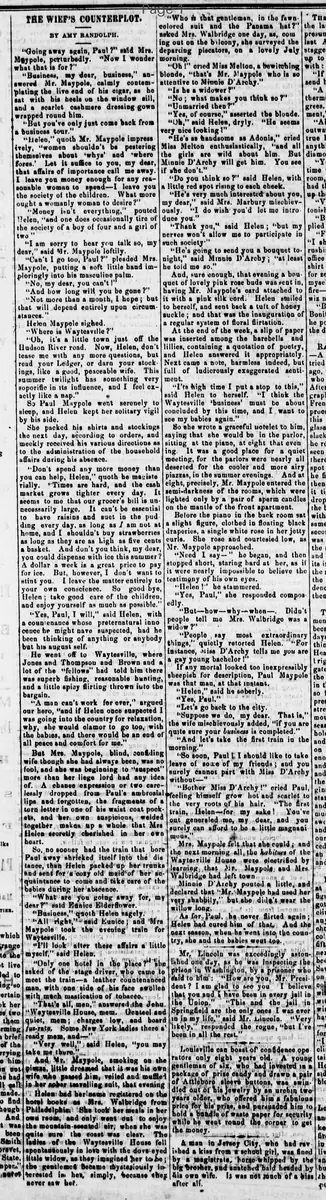
Husband Paul Maypole deceives wife Helen about a 'business' trip to Waytesville for relaxation and flirting. Suspecting him, Helen follows disguised as widow Mrs. Walbridge, engages in floral flirtation with him, then reveals herself in the parlor, leading them to return home together. She cures his flirting habit.
Merged-components note: Sequential components continuing the single coherent story 'THE WIFE'S COUNTERPLOT BY AMY RANDOLPH'.
Clipping
OCR Quality
Full Text
BY AMY RANDOLPH.
"Going away again, Paul?" said Mrs.
Maypole, perturbedly. "Now I wonder
what that is for?"
"Business, my dear, business," answered Mr. Maypole, calmly contemplating the live end of his cigar, as he
sat with his heels on the window sill,
and a scarlet cashmere dressing-gown
wrapped round him.
"But you've only just come back from
a business tour."
"Helen," quoth Mr. Maypole impress-
ively, "women shouldn't be pestering
themselves about 'whys' and 'where-
fores.' Let it suffice to you, my dear,
that affairs of importance call me away.
I leave you money enough for any rea-
sonable woman to spend -- I leave you
the society of the children. What more
ought a womanly woman to desire?"
"Money isn't everything," pouted
Helen, "and one does occasionally tire of
the society of a boy of four and a girl of
two."
"I am sorry to hear you talk so, my
dear," said Mr. Maypole loftily.
"Can't I go too, Paul?" pleaded Mrs.
Maypole, putting a soft little hand im-
ploringly into his masculine palm.
"No, my dear, you can't!"
"And how long will you be gone?"
"Not more than a month, I hope; but
that will depend entirely upon circum-
stances."
Helen Maypole sighed.
"Where is Waytesville?"
"Oh, it's a little town just off the
Hudson River road. Now, Helen, don't
tease me with any more questions, but
read your Ledger, or darn your stock-
ings, like a good, peaceable wife. This
summer twilight has something very
soporific in its influence, and I feel ex-
actly like a nap."
So Paul Maypole went serenely to
sleep, and Helen kept her solitary vigil
by his side.
She packed his shirts and stockings
the next day, according to orders, and
meekly received his various directions as
to the administration of the household
affairs during his absence.
"Don't spend any more money than
you can help, Helen," quoth he magiste-
rially. "Times are hard, and the cash
market grows tighter every day. It
seems to me that our grocer's bill is un-
necessarily large. It can't be essential
to have raisins and suet in the pud-
ding every day, as long as I am not at
home, and I shouldn't buy strawberries
as long as they are as high as five cents
a basket. And don't you think, my dear,
you could dispense with ice this summer?
A dollar a week is a great price to pay
for ice. But, however, I don't want to
stint you. I leave the matter entirely to
your own conscience. So goodbye,
Helen; take good care of the children,
and enjoy yourself as much as possible."
"Yes, Paul. I will," said Helen, with
a countenance whose preternatural inno-
cence he might have suspected, had he
been thinking of anything or anybody
but his august self.
He went off to Waytesville, where
Jones and Thompson and Brown and a
lot of the "fellows" had told him there
was superb fishing, reasonable hunting,
and a little spicy flirting thrown into the
bargain.
"A man can't work forever," argued
our hero, "and if Helen once suspected I
was going into the country for relaxation,
why, she would clamor to go too, with
the babies, and there would be an end of
all peace and comfort for me.
But Mrs. Maypole, blind, confiding
wife though she had always been, was no
fool, and she was beginning to "suspect"
more than her liege lord had any idea
of. A chance expression or two care-
lessly dropped from Paul's ambrosial
lips and, forgotten, the fragments of a
torn letter in one of his waistcoat pock-
ets, and her own suspicions, welded
together, make up a whole that Mrs.
Helen very quietly cherished in her own
heart.
So, no sooner had the train that bore
Paul away shrieked itself into the dis-
tance, than Helen packed up her trunks
and sent for a "cosy old maid" of her ac-
quaintance to come and take care of the
babies during her absence.
"What are you going away for, my
dear?" said Eunice Elderflower. Helen
"Business," quoth Helen sagely.
"All right," said Eunice; and Mrs.
Maypole took the evening train for
Waytesville.
"I'll look after these affairs a little
myself," said Helen. "Don't I bien"
"Only one hotel in the place?" she
asked of the stage-driver, who came to
meet the train -- a leather countenanced
man, with one side of his face swollen
with much mastication of tobacco.
"That's all, mem," answered the Jehu.
"Waytesville House, mem. genteel and
quiet, mem; charges low, and board
first-rate. Some New York ladies there al-
ready, mem, and"
"Very well," said Helen, "you may
take me there."
And, Mr. Maypole smoking on the
piazza, little dreamed that it was his own
wife, who passed him, veiled and muffled
in her sober travelling suit, that evening.
Helen had her name registered on the
hotel book as Mrs. Walbridge from
Philadelphia. She took her meals in her
own room, and only went out to enjoy
the mountain-scented air when she was
quite sure the coast was clear. The
ladies of the Waytesville House fell
spontaneously in love with the dove-eyed
little widow, as they imagined her to be;
the gentlemen became mysteriously in-
terested in her, simply, because they
never saw her.
"Who is that gentleman in the fawn-
colored suit and the Panama hat?"
asked Mrs. Walbridge one day, as, com-
ing out on the balcony, she surveyed the
departing piscators, on a lovely July
morning.
"Oh!" cried Miss Melton, a bewitching
blonde. "that's Mr. Maypole who is so
attentive to Minnie D'Arcy."
"Is he a widower?"
"No; what makes you think so?"
"Unmarried then?"
"Yes, of course," asserted the blonde.
"Ah," said Helen, dryly. "He seems
very nice looking!"
"He's as handsome as Adonis," cried
Miss Melton enthusiastically, "and all
the girls are wild about him. But
Minnie D'Arcy will get him. You see
if she don't."
"Do you think so?" said Helen, with
a little red spot rising to each cheek.
"He's very much interested about you,
my dear," said Mrs. Marbury mischiev-
ously. "I do wish you'd let me intro-
duce you."
"Thank you," said Helen; "but my
nerves won't allow me to participate in
such society."
"He's going to send you a bouquet to-
night," said Minnie D'Arcy; "at least
he told me so."
And, sure enough, that evening a bou-
quet of lovely pink rose buds was sent in,
having Mr. Maypole's card attached to
it with a pink silk cord. Helen smiled
to herself, and sent back a tuft of honey-
suckle; and that was the inauguration of
a regular system of floral flirtation.
At the end of the week, a slip of paper
was inserted among the harebells and
lilies, containing a quotation of poetry,
and Helen answered it appropriately.
Next came a note, harmless indeed, but
full of ludicrously exaggerated senti-
ment.
"It's high time I put a stop to this,"
said Helen to herself. "I think the
Waytesville business must be about
concluded by this time, and I want to
see my babies again."
So she wrote a graceful notelet to him,
saying that she would be in the parlor,
sitting at the piano, at eight that even-
ing. It was a good place for a quiet
meeting, for the parlors were nearly all
deserted for the cooler and more airy
piazzas, in the summer evenings. And at
eight, precisely, Mr. Maypole entered the
semi-darkness of the rooms, which were
lighted only by a pair of sperm candles
on the mantel of the front apartment.
Before the piano in the back room sat
a slight figure, clothed in floating black
draperies, a single white rose in her jetty
curls. She rose and courtesied low, as
Mr. Maypole approached.
"Need I say-" he began, and then
stopped short, staring hard at her, as if
it were nearly impossible to believe the
testimony of his own eyes.
"Helen!" he stammered.
"Yes, Paul," she responded composed-
ly.
"But -- how -- why -- when --
Did people tell me Mrs. Walbridge was a
widow?"
"People say most
extraordinary
things," quietly retorted Helen. "For
instance, Miss D'Arcy tells me you are
a gay young bachelor!"
If any mortal looked too inexpressibly
sheepish for description, Paul Maypole
was that man, at that instant.
"Helen," said he soberly.
"Yes, Paul."
"Let's go back to the city."
"Suppose we do, my dear. That is,"
the wife mischievously added, "if you are
quite sure your business is completed."
"And let's take the first train in the
morning."
"So soon, Paul? I should like to take
leave of some of my friends; and you
surely cannot part with Miss D'Arcy
without --"
"Bother Miss D'Arcy!" cried Paul,
feeling himself grow hot and scarlet to
the very roots of his hair. "The first
train, Helen, for my sake! You've
out-generaled me, my dear, and you
surely can afford to be a little mag-
nanimous."
Mrs. Maypole felt that she could; and
the next morning all the habitues of the
Waytesville House were electrified by
hearings that Mr. Maypole and Mrs.
Walbridge had left town.
Minnie D'Arcy pouted a little and
declared that "Mr. Maypole had used her
very shabbily," but she did not swear the
willow long.
As for Paul, he never flirted again;
Helen had cured him of that. And the
next season, when he went into the coun-
try, she and the babies went too.
What sub-type of article is it?
What themes does it cover?
What keywords are associated?
What entities or persons were involved?
Where did it happen?
Story Details
Key Persons
Location
Waytesville, A Little Town Just Off The Hudson River Road
Event Date
Summer, July
Story Details
Wife Helen suspects husband Paul's 'business' trip to Waytesville is for fishing, hunting, and flirting; she follows disguised as widow Mrs. Walbridge, flirts with him through flowers and notes, reveals herself, and they return home, curing him of future flirting.