Thank you for visiting SNEWPapers!
Sign up free
Editorial
November 17, 1948
The Nome Nugget
Nome, Nome County, Alaska
What is this article about?
Barnet Nover's editorial discusses recent military defeats of Nationalist China in Manchuria and elsewhere, attributing partial blame to Chiang Kai-shek's failures and US post-WWII concessions to Soviet Russia, which enabled communist gains. It questions the timeliness of further US aid amid Dewey's campaign promises.
Clipping
OCR Quality
100%
Excellent
Full Text
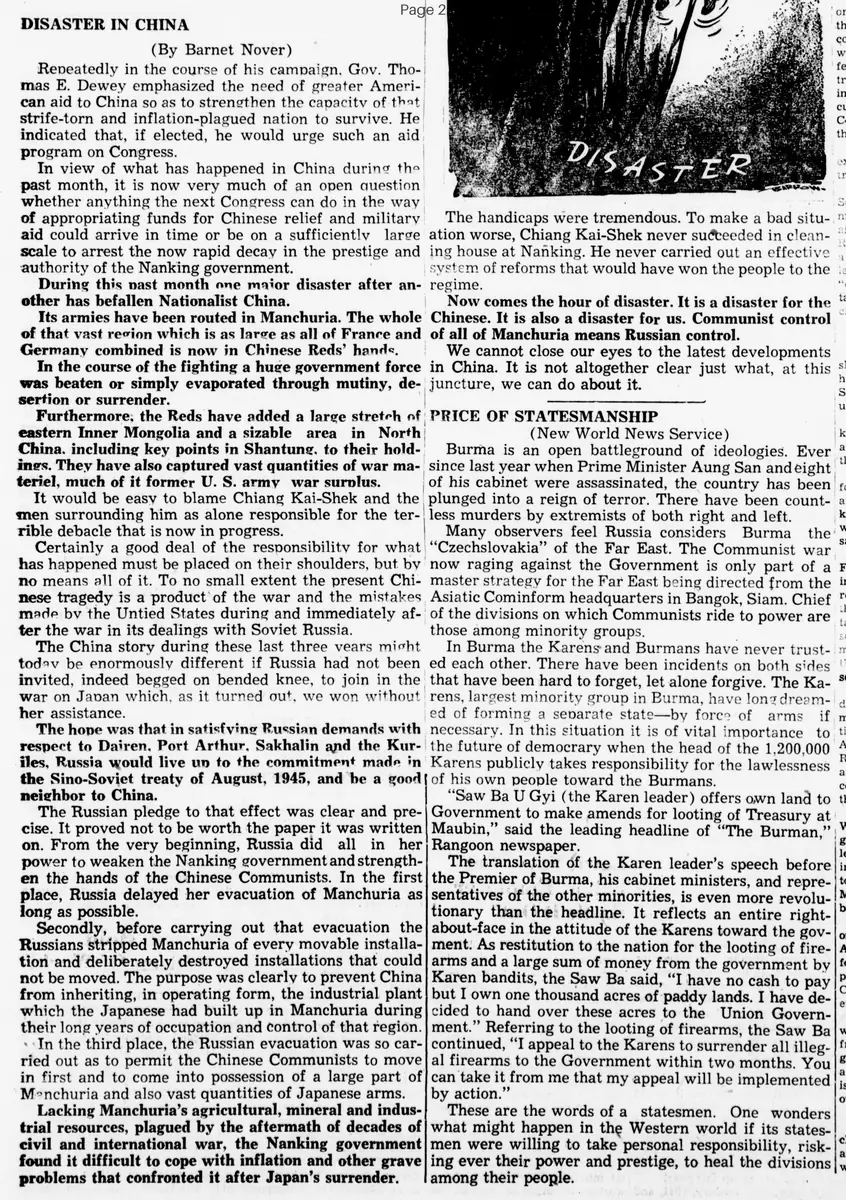
DISASTER IN CHINA
(By Barnet Nover)
Repeatedly in the course of his campaign, Gov. Thomas E. Dewey emphasized the need of greater American aid to China so as to strengthen the capacity of that strife-torn and inflation-plagued nation to survive. He indicated that, if elected, he would urge such an aid program on Congress.
In view of what has happened in China during the past month, it is now very much of an open question whether anything the next Congress can do in the way of appropriating funds for Chinese relief and military aid could arrive in time or be on a sufficiently large scale to arrest the now rapid decay in the prestige and authority of the Nanking government.
During this past month one major disaster after another has befallen Nationalist China. Its armies have been routed in Manchuria. The whole of that vast region which is as large as all of France and Germany combined is now in Chinese Reds' hands.
In the course of the fighting a huge government force was beaten or simply evaporated through mutiny, desertion or surrender.
Furthermore, the Reds have added a large stretch of eastern Inner Mongolia and a sizable area in North China, including key points in Shantung, to their holdings. They have also captured vast quantities of war material, much of it former U. S. army war surplus.
It would be easy to blame Chiang Kai-Shek and the men surrounding him as alone responsible for the terrible debacle that is now in progress.
Certainly a good deal of the responsibility for what has happened must be placed on their shoulders, but by no means all of it. To no small extent the present Chinese tragedy is a product of the war and the mistakes made by the United States during and immediately after the war in its dealings with Soviet Russia.
The China story during these last three years might today be enormously different if Russia had not been invited, indeed begged on bended knee, to join in the war on Japan which, as it turned out, we won without her assistance.
The hope was that in satisfying Russian demands with respect to Dairen, Port Arthur, Sakhalin and the Kuriles, Russia would live up to the commitment made in the Sino-Soviet treaty of August, 1945, and be a good neighbor to China.
The Russian pledge to that effect was clear and precise. It proved not to be worth the paper it was written on. From the very beginning, Russia did all in her power to weaken the Nanking government and strengthen the hands of the Chinese Communists. In the first place, Russia delayed her evacuation of Manchuria as long as possible.
Secondly, before carrying out that evacuation the Russians stripped Manchuria of every movable installation and deliberately destroyed installations that could not be moved. The purpose was clearly to prevent China from inheriting, in operating form, the industrial plant which the Japanese had built up in Manchuria during their long years of occupation and control of that region.
In the third place, the Russian evacuation was so carried out as to permit the Chinese Communists to move in first and to come into possession of a large part of Manchuria and also vast quantities of Japanese arms.
Lacking Manchuria's agricultural, mineral and industrial resources, plagued by the aftermath of decades of civil and international war, the Nanking government found it difficult to cope with inflation and other grave problems that confronted it after Japan's surrender.
The handicaps were tremendous. To make a bad situation worse, Chiang Kai-Shek never succeeded in cleaning house at Nanking. He never carried out an effective system of reforms that would have won the people to the regime.
Now comes the hour of disaster. It is a disaster for the Chinese. It is also a disaster for us. Communist control of all of Manchuria means Russian control.
We cannot close our eyes to the latest developments in China. It is not altogether clear just what, at this juncture, we can do about it.
(By Barnet Nover)
Repeatedly in the course of his campaign, Gov. Thomas E. Dewey emphasized the need of greater American aid to China so as to strengthen the capacity of that strife-torn and inflation-plagued nation to survive. He indicated that, if elected, he would urge such an aid program on Congress.
In view of what has happened in China during the past month, it is now very much of an open question whether anything the next Congress can do in the way of appropriating funds for Chinese relief and military aid could arrive in time or be on a sufficiently large scale to arrest the now rapid decay in the prestige and authority of the Nanking government.
During this past month one major disaster after another has befallen Nationalist China. Its armies have been routed in Manchuria. The whole of that vast region which is as large as all of France and Germany combined is now in Chinese Reds' hands.
In the course of the fighting a huge government force was beaten or simply evaporated through mutiny, desertion or surrender.
Furthermore, the Reds have added a large stretch of eastern Inner Mongolia and a sizable area in North China, including key points in Shantung, to their holdings. They have also captured vast quantities of war material, much of it former U. S. army war surplus.
It would be easy to blame Chiang Kai-Shek and the men surrounding him as alone responsible for the terrible debacle that is now in progress.
Certainly a good deal of the responsibility for what has happened must be placed on their shoulders, but by no means all of it. To no small extent the present Chinese tragedy is a product of the war and the mistakes made by the United States during and immediately after the war in its dealings with Soviet Russia.
The China story during these last three years might today be enormously different if Russia had not been invited, indeed begged on bended knee, to join in the war on Japan which, as it turned out, we won without her assistance.
The hope was that in satisfying Russian demands with respect to Dairen, Port Arthur, Sakhalin and the Kuriles, Russia would live up to the commitment made in the Sino-Soviet treaty of August, 1945, and be a good neighbor to China.
The Russian pledge to that effect was clear and precise. It proved not to be worth the paper it was written on. From the very beginning, Russia did all in her power to weaken the Nanking government and strengthen the hands of the Chinese Communists. In the first place, Russia delayed her evacuation of Manchuria as long as possible.
Secondly, before carrying out that evacuation the Russians stripped Manchuria of every movable installation and deliberately destroyed installations that could not be moved. The purpose was clearly to prevent China from inheriting, in operating form, the industrial plant which the Japanese had built up in Manchuria during their long years of occupation and control of that region.
In the third place, the Russian evacuation was so carried out as to permit the Chinese Communists to move in first and to come into possession of a large part of Manchuria and also vast quantities of Japanese arms.
Lacking Manchuria's agricultural, mineral and industrial resources, plagued by the aftermath of decades of civil and international war, the Nanking government found it difficult to cope with inflation and other grave problems that confronted it after Japan's surrender.
The handicaps were tremendous. To make a bad situation worse, Chiang Kai-Shek never succeeded in cleaning house at Nanking. He never carried out an effective system of reforms that would have won the people to the regime.
Now comes the hour of disaster. It is a disaster for the Chinese. It is also a disaster for us. Communist control of all of Manchuria means Russian control.
We cannot close our eyes to the latest developments in China. It is not altogether clear just what, at this juncture, we can do about it.
What sub-type of article is it?
Foreign Affairs
War Or Peace
Military Affairs
What keywords are associated?
China Disaster
Manchuria
Chiang Kai Shek
Soviet Russia
Us Aid
Chinese Communists
Nationalist Defeat
What entities or persons were involved?
Thomas E. Dewey
Chiang Kai Shek
Nanking Government
Chinese Communists
Soviet Russia
United States
Editorial Details
Primary Topic
Nationalist China's Military Defeats And Soviet Enabled Communist Advances
Stance / Tone
Alarmist Critique Of Us Policy And Sympathy For China's Plight
Key Figures
Thomas E. Dewey
Chiang Kai Shek
Nanking Government
Chinese Communists
Soviet Russia
United States
Key Arguments
Dewey Campaigned For Increased Us Aid To China
Recent Nationalist Defeats Have Lost Manchuria To Communists
Chiang's Regime Failed To Implement Reforms
Us Post War Concessions To Russia Enabled Soviet Sabotage In China
Russia Violated Sino Soviet Treaty By Aiding Communists
Communist Control Of Manchuria Threatens Us Interests