Thank you for visiting SNEWPapers!
Sign up free
Story
December 22, 1844
The New York Herald
New York, New York County, New York
What is this article about?
Ongoing ecclesiastical trial of Bishop Onderdonk for immorality charges, including improper conduct and indulgence in liquor. Witnesses, including women, testify amid cross-examinations; article notes public excitement, potential political motivations from church disputes, and defends witnesses' dignity.
Clipping
OCR Quality
95%
Excellent
Full Text
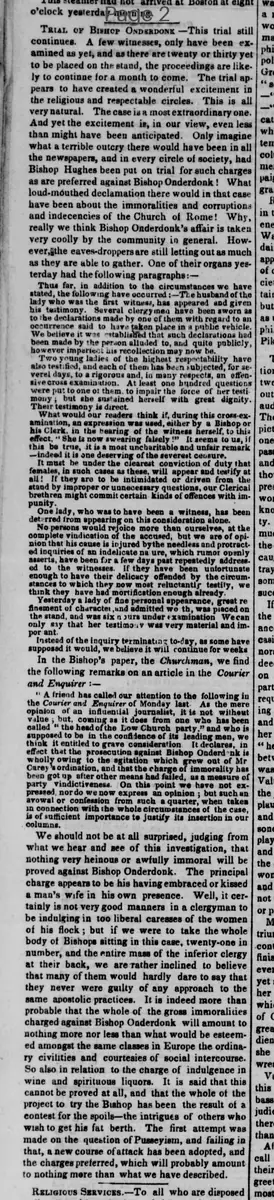
Trial of Bishop Onderdonk.
This trial still continues. A few witnesses only have been examined as yet, and as there are twenty or thirty yet to be placed on the stand, the proceedings are likely to continue for a month to come. The trial appears to have created a wonderful excitement in the religious and respectable circles. This is all very natural. The case is a most extraordinary one.
And yet the excitement is, in our view, even less than might have been anticipated. Only imagine what a terrible outcry there would have been in all the newspapers, and in every circle of society, had Bishop Hughes been put on trial for such charges as are preferred against Bishop Onderdonk! What loud-mouthed declamation there would in that case have been about the immoralities and corruptions and indecencies of the Church of Rome! Why, really we think Bishop Onderdonk's affair is taken very coolly by the community in general. However, the eaves-droppers are still letting out as much as they are able to gather. One of their organs yesterday had the following paragraphs:
Thus far, in addition to the circumstances we have stated, the following have occurred: The husband of the lady who was the first witness, has appeared and given his testimony. Several clergymen have been sworn as to the declarations made by one of them with regard to an occurrence said to have taken place in a public vehicle.
We believe it was established that such declarations had been made by the person alluded to, and quite publicly, however imperfect his recollection may now be.
Two young ladies of the highest respectability have also testified, and each of them has been subjected, for several days, to a rigorous and, in many respects, an offensive cross-examination. At least one hundred questions were put to one of them, to impair the force of her testimony; but she sustained herself with great dignity.
Their testimony is direct.
What would our readers think if, during this cross-examination, an expression was used, either by a Bishop or his Clerk, in the bearing of the witness herself, to this effect, "She is now swearing falsely!" It seems to us, if this be true, it is a most uncharitable and unfair remark—indeed it is one deserving of the severest censure.
It must be under the clearest conviction of duty that females, in such cases as these, will appear and testify at all! If they are to be intimidated or driven from the stand by improper or unnecessary questions, our Clerical brethren might commit certain kinds of offences with impunity.
One lady, who was to have been a witness, has been deterred from appearing on this consideration alone.
No persons would rejoice more than ourselves, at the complete vindication of the accused, but we are of opinion that his cause is injured by the needless and protracted inquiries of an indelicate nature, which rumor openly asserts, have been for a few days past repeatedly addressed to the witnesses. If they have been unfortunate enough to have their delicacy offended by the circumstances to which they now most reluctantly testify, we think they have had mortification enough already.
Yesterday a lady of fine personal appearance, great refinement of character, and admitted worth, was placed on the stand, and was six hours under examination. We can only say that her testimony was very material and important.
Instead of the inquiry terminating to-day, as some have supposed it would, we believe it will continue for weeks.
In the Bishop's paper, the Churchman, we find the following remarks on an article in the Courier and Enquirer:
"A friend has called our attention to the following in the Courier and Enquirer of Monday last. As the mere opinion of an influential journalist, it is not without value; but, coming as it does from one who has been called 'the head of the Low Church party,' and who is supposed to be in the confidence of its leading men, we think it entitled to grave consideration. It declares, in effect, that the prosecution against Bishop Onderdonk is wholly owing to the agitation which grew out of Mr. Carey's ordination, and that the charge of immorality has been got up after other means had failed, as a measure of party vindictiveness. On this point we have not expressed, nor do we now express an opinion; but such an avowal or confession from such a quarter, when taken in connection with the whole circumstances of the case, is of sufficient importance to justify its insertion in our columns."
We should not be at all surprised, judging from what we hear and see of this investigation, that nothing very heinous or awfully immoral will be proved against Bishop Onderdonk. The principal charge appears to be his having embraced or kissed a man's wife in his own presence. Well, it certainly is not very good manners in a clergyman to be indulging in too liberal caresses of the women of his flock; but if we were to take the whole body of Bishops sitting in this case, twenty-one in number, and the entire mass of the inferior clergy at their back, we are rather inclined to believe that many of them would hardly dare to say that they never were guilty of any approach to the same apostolic practices. It is indeed more than probable that the whole of the gross immoralities charged against Bishop Onderdonk will amount to nothing more nor less than what would be esteemed amongst the same classes in Europe the ordinary civilities and courtesies of social intercourse.
So also in relation to the charge of indulgence in wine and spirituous liquors. It is said that this cannot be proved at all, and that the whole of the project to try the Bishop has been the result of a contest for the spoils—the intrigues of others who wish to get his fat berth. The first attempt was made on the question of Puseyism, and failing in that, a new course of attack has been adopted, and the charges preferred, which will probably amount to nothing more than what we have described.
This trial still continues. A few witnesses only have been examined as yet, and as there are twenty or thirty yet to be placed on the stand, the proceedings are likely to continue for a month to come. The trial appears to have created a wonderful excitement in the religious and respectable circles. This is all very natural. The case is a most extraordinary one.
And yet the excitement is, in our view, even less than might have been anticipated. Only imagine what a terrible outcry there would have been in all the newspapers, and in every circle of society, had Bishop Hughes been put on trial for such charges as are preferred against Bishop Onderdonk! What loud-mouthed declamation there would in that case have been about the immoralities and corruptions and indecencies of the Church of Rome! Why, really we think Bishop Onderdonk's affair is taken very coolly by the community in general. However, the eaves-droppers are still letting out as much as they are able to gather. One of their organs yesterday had the following paragraphs:
Thus far, in addition to the circumstances we have stated, the following have occurred: The husband of the lady who was the first witness, has appeared and given his testimony. Several clergymen have been sworn as to the declarations made by one of them with regard to an occurrence said to have taken place in a public vehicle.
We believe it was established that such declarations had been made by the person alluded to, and quite publicly, however imperfect his recollection may now be.
Two young ladies of the highest respectability have also testified, and each of them has been subjected, for several days, to a rigorous and, in many respects, an offensive cross-examination. At least one hundred questions were put to one of them, to impair the force of her testimony; but she sustained herself with great dignity.
Their testimony is direct.
What would our readers think if, during this cross-examination, an expression was used, either by a Bishop or his Clerk, in the bearing of the witness herself, to this effect, "She is now swearing falsely!" It seems to us, if this be true, it is a most uncharitable and unfair remark—indeed it is one deserving of the severest censure.
It must be under the clearest conviction of duty that females, in such cases as these, will appear and testify at all! If they are to be intimidated or driven from the stand by improper or unnecessary questions, our Clerical brethren might commit certain kinds of offences with impunity.
One lady, who was to have been a witness, has been deterred from appearing on this consideration alone.
No persons would rejoice more than ourselves, at the complete vindication of the accused, but we are of opinion that his cause is injured by the needless and protracted inquiries of an indelicate nature, which rumor openly asserts, have been for a few days past repeatedly addressed to the witnesses. If they have been unfortunate enough to have their delicacy offended by the circumstances to which they now most reluctantly testify, we think they have had mortification enough already.
Yesterday a lady of fine personal appearance, great refinement of character, and admitted worth, was placed on the stand, and was six hours under examination. We can only say that her testimony was very material and important.
Instead of the inquiry terminating to-day, as some have supposed it would, we believe it will continue for weeks.
In the Bishop's paper, the Churchman, we find the following remarks on an article in the Courier and Enquirer:
"A friend has called our attention to the following in the Courier and Enquirer of Monday last. As the mere opinion of an influential journalist, it is not without value; but, coming as it does from one who has been called 'the head of the Low Church party,' and who is supposed to be in the confidence of its leading men, we think it entitled to grave consideration. It declares, in effect, that the prosecution against Bishop Onderdonk is wholly owing to the agitation which grew out of Mr. Carey's ordination, and that the charge of immorality has been got up after other means had failed, as a measure of party vindictiveness. On this point we have not expressed, nor do we now express an opinion; but such an avowal or confession from such a quarter, when taken in connection with the whole circumstances of the case, is of sufficient importance to justify its insertion in our columns."
We should not be at all surprised, judging from what we hear and see of this investigation, that nothing very heinous or awfully immoral will be proved against Bishop Onderdonk. The principal charge appears to be his having embraced or kissed a man's wife in his own presence. Well, it certainly is not very good manners in a clergyman to be indulging in too liberal caresses of the women of his flock; but if we were to take the whole body of Bishops sitting in this case, twenty-one in number, and the entire mass of the inferior clergy at their back, we are rather inclined to believe that many of them would hardly dare to say that they never were guilty of any approach to the same apostolic practices. It is indeed more than probable that the whole of the gross immoralities charged against Bishop Onderdonk will amount to nothing more nor less than what would be esteemed amongst the same classes in Europe the ordinary civilities and courtesies of social intercourse.
So also in relation to the charge of indulgence in wine and spirituous liquors. It is said that this cannot be proved at all, and that the whole of the project to try the Bishop has been the result of a contest for the spoils—the intrigues of others who wish to get his fat berth. The first attempt was made on the question of Puseyism, and failing in that, a new course of attack has been adopted, and the charges preferred, which will probably amount to nothing more than what we have described.
What sub-type of article is it?
Crime Story
Historical Event
What themes does it cover?
Crime Punishment
Justice
Moral Virtue
What keywords are associated?
Bishop Trial
Immorality Charges
Witness Testimony
Ecclesiastical Court
Religious Controversy
Cross Examination
Puseyism Dispute
What entities or persons were involved?
Bishop Onderdonk
Bishop Hughes
Mr. Carey
Story Details
Key Persons
Bishop Onderdonk
Bishop Hughes
Mr. Carey
Story Details
Ongoing trial of Bishop Onderdonk for immorality, including improper embraces and indulgence in liquor; witnesses testify under rigorous cross-examination; article suggests charges stem from church political disputes over ordination and Puseyism rather than serious offenses.