Thank you for visiting SNEWPapers!
Sign up free
Letter to Editor
April 15, 1861
The Evansville Daily Journal
Evansville, Vanderburgh County, Indiana
What is this article about?
A journalist reports from Baltimore on April 10 amid rising Civil War tensions, describing intense public anxiety, Union-supporting newspapers, defensive measures in Washington, and the city's infrastructure and trade, while expressing hope to avert war.
Merged-components note: Continuation of editorial correspondence from Baltimore
Clipping
OCR Quality
95%
Excellent
Full Text
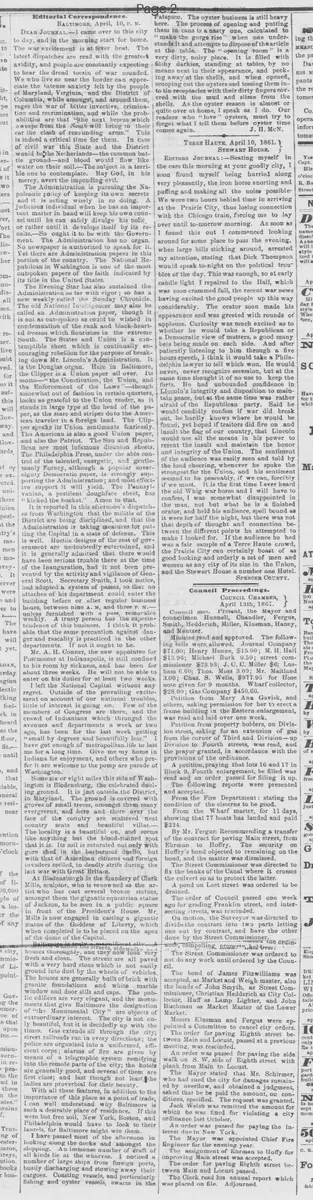
Editorial Correspondence.
BALTIMORE, April 10, P. M.
DEAR JOURNAL—I came over to this city to day, and in the morning start for home. The war excitement is at fever heat. The latest dispatches are read with the greatest avidity, and people are constantly expecting to hear the dread tocsin of war sounded. We who live so near the border can appreciate the intense anxiety felt by the people of Maryland, Virginia, and the District of Columbia, while amongst, and around them, rages the war of bitter invective, crimination and recrimination, and while the probabilities are that "the next breeze which sweeps from the South will bring to their ear the clash of resounding arms." This is indeed a critical time for them. In case of civil war this State and the District would be the Netherlands—the common battle ground—and blood would flow like water on their soil. The subject is a terrible one to contemplate. May God, in his mercy, avert the impending evil.
The Administration is pursuing the Napoleonic policy of keeping its own secrets and it is acting wisely in so doing. A judicious individual when he has an important matter in hand will keep his own counsel until he can safely divulge his policy or rather until it develops itself by its results. So ought it to be with the Government. The Administration has no organ. No newspaper is authorized to speak for it. Yet there are Administration papers in this portion of the country. The National Republican in Washington is one of the most outspoken papers of the faith indicated by its title in the United States. The Evening Star has also sustained the Administration so far with vigor; so has a new weekly called the Sunday Chronicle. The old National Intelligencer may also be called an Administration paper, though it is not as out-spoken as could be wished in condemnation of the rank and black-hearted treason which flourishes in the extreme South. The States and Union is a contemptible sheet which is continually encouraging rebellion for the purpose of breaking down Mr. Lincoln's Administration. It is the Douglas organ. Here in Baltimore, the Clipper is a Union paper all over. Its motto "the Constitution, the Union, and the Enforcement of the Laws"—though somewhat out of fashion in certain quarters, looks as grateful to the Union reader, as it stands in large type at the head of the paper, as the stars and stripes do to the American traveler in a foreign land. The Clipper speaks its Union sentiments fearlessly. The American is also a good Union paper, and also the Patriot. The Sun and Republican are most infamous disunion sheets. The Philadelphia Press, under the able control of the talented, energetic, and gentlemanly Forney, although a popular sovereignty Democratic paper, is strongly supporting the Administration; and most effective support it will yield. The Pennsylvanian, a pestilent doughface sheet, has "kicked the bucket."
Amen to that.
It is reported in this afternoon's dispatches from Washington that the militia of the District are being disciplined, and that the Administration is taking measures for putting the Capital in a state of defense. This is well. Hostile designs of the seat of government are undoubtedly entertained, and it is generally admitted that there would have been serious trouble there at the time of the Inauguration, had it not been prevented by the activity and vigilance of General Scott. Secretary Smith, I took notice, had adopted a system of passes, so that no attachee of his department could enter the building before or after regular business hours, between nine A. M. and three P. M.—unless furnished with a pass, removable weekly. A trusty person has the superintendence of this business. I think it probable that the same precaution against danger and rascality is practiced in the other departments. If not it ought to be.
Mr. A. H. Conner, the new appointee for Postmaster at Indianapolis, is still confined to his room by sickness, and has been for about three weeks. He will not be able to enter on his duties for at least two weeks.
I left the National Capital without any regret. Outside of the prevailing excitement on account of our national troubles, little of interest is going on. Few of the members of Congress are there, and the crowd of Indianians which thronged the avenues and departments a week or two ago, has been for the last week getting "small by degrees and beautifully less." I have got enough of metropolitan life to last me for a long time. Give me my home in Indiana for enjoyment, and others who prefer it are welcome to the pomp and parade of Washington.
Some six or eight miles this side of Washington is Bladensburg, the celebrated dueling ground. It is just outside the District, in Maryland. The ground is covered with groves of small trees, amongst them many evergreens, and here and there over the face of the country are scattered neat country seats and beautiful villas. The locality is a beautiful one, and seems like anything but the blood-stained spot that it is. Its soil is saturated not only with gore shed in the barbarous duello, but with that of American citizens and foreign invaders spilled, in deadly strife during the last war with Great Britain.
At Bladensburg is the foundry of Clark Mills, sculptor, who is renowned as the artist who has cast several bronze statues, amongst them the gigantic equestrian statue of Jackson, to be seen in a public square in front of the President's House. Mr. Mills is now engaged in casting a gigantic Statue of the Goddess of Liberty, which when completed is to be placed on the apex of the dome of the Capitol.
Baltimore is laid in tire streets, sidewalks and houses thoroughly, and they now look very fresh and clean. The streets are all paved with a very hard stone which is not easily ground into dust by the wheels of vehicles. The houses are generally built of brick with granite foundations and white marble window and door sills and caps. The public edifices are very elegant, and the monuments that give Baltimore the designation of "the Monumental City" are objects of extraordinary interest. The city is not only beautiful, but it is decidedly up with the times. Gas extends all through the city; street railroads run in every direction; the police are organized into a uniformed, efficient corps; alarms of fire are given by means of a telegraphic system ramifying into the remote parts of the city; the hotels are generally good, and several of them are first class; and last though not least, the ladies are proverbial for their beauty.
With all these features, in addition to the importance of this place as a point of trade, I can well understand why Baltimore is such a desirable place of residence. If this were but free soil, New York, Boston, and Philadelphia would have to look to their laurels, for Baltimore might win them.
I have passed most of the afternoon in looking along the docks and amongst the shipping. An immense number of craft of all kinds lie at the wharves. I noticed a number of large ships from foreign ports, busily discharging and stowing away their cargoes. Coasting vessels, and particularly fishing and oyster vessels, swarm in the Patapsco. The oyster business is still heavy here. The process of opening and putting them in cans is a nasty one, calculated to "make the gorge rise" when one understands it and attempts to dispose of the article at the table. The "opening room" is a very dirty, noisy place. It is filled with filthy darkies, standing at tables, by no means neat in their appearance, and pecking away at the shells, and when opened, scooping out the oysters and tossing them into tin receptacles with their dirty fingers covered with the mud and slime from the shells. As the oyster season is almost or quite over at home, I speak as I do. Our readers who "love" oysters, must try to forget what I tell them before oyster time comes again.
J. H. McN.
BALTIMORE, April 10, P. M.
DEAR JOURNAL—I came over to this city to day, and in the morning start for home. The war excitement is at fever heat. The latest dispatches are read with the greatest avidity, and people are constantly expecting to hear the dread tocsin of war sounded. We who live so near the border can appreciate the intense anxiety felt by the people of Maryland, Virginia, and the District of Columbia, while amongst, and around them, rages the war of bitter invective, crimination and recrimination, and while the probabilities are that "the next breeze which sweeps from the South will bring to their ear the clash of resounding arms." This is indeed a critical time for them. In case of civil war this State and the District would be the Netherlands—the common battle ground—and blood would flow like water on their soil. The subject is a terrible one to contemplate. May God, in his mercy, avert the impending evil.
The Administration is pursuing the Napoleonic policy of keeping its own secrets and it is acting wisely in so doing. A judicious individual when he has an important matter in hand will keep his own counsel until he can safely divulge his policy or rather until it develops itself by its results. So ought it to be with the Government. The Administration has no organ. No newspaper is authorized to speak for it. Yet there are Administration papers in this portion of the country. The National Republican in Washington is one of the most outspoken papers of the faith indicated by its title in the United States. The Evening Star has also sustained the Administration so far with vigor; so has a new weekly called the Sunday Chronicle. The old National Intelligencer may also be called an Administration paper, though it is not as out-spoken as could be wished in condemnation of the rank and black-hearted treason which flourishes in the extreme South. The States and Union is a contemptible sheet which is continually encouraging rebellion for the purpose of breaking down Mr. Lincoln's Administration. It is the Douglas organ. Here in Baltimore, the Clipper is a Union paper all over. Its motto "the Constitution, the Union, and the Enforcement of the Laws"—though somewhat out of fashion in certain quarters, looks as grateful to the Union reader, as it stands in large type at the head of the paper, as the stars and stripes do to the American traveler in a foreign land. The Clipper speaks its Union sentiments fearlessly. The American is also a good Union paper, and also the Patriot. The Sun and Republican are most infamous disunion sheets. The Philadelphia Press, under the able control of the talented, energetic, and gentlemanly Forney, although a popular sovereignty Democratic paper, is strongly supporting the Administration; and most effective support it will yield. The Pennsylvanian, a pestilent doughface sheet, has "kicked the bucket."
Amen to that.
It is reported in this afternoon's dispatches from Washington that the militia of the District are being disciplined, and that the Administration is taking measures for putting the Capital in a state of defense. This is well. Hostile designs of the seat of government are undoubtedly entertained, and it is generally admitted that there would have been serious trouble there at the time of the Inauguration, had it not been prevented by the activity and vigilance of General Scott. Secretary Smith, I took notice, had adopted a system of passes, so that no attachee of his department could enter the building before or after regular business hours, between nine A. M. and three P. M.—unless furnished with a pass, removable weekly. A trusty person has the superintendence of this business. I think it probable that the same precaution against danger and rascality is practiced in the other departments. If not it ought to be.
Mr. A. H. Conner, the new appointee for Postmaster at Indianapolis, is still confined to his room by sickness, and has been for about three weeks. He will not be able to enter on his duties for at least two weeks.
I left the National Capital without any regret. Outside of the prevailing excitement on account of our national troubles, little of interest is going on. Few of the members of Congress are there, and the crowd of Indianians which thronged the avenues and departments a week or two ago, has been for the last week getting "small by degrees and beautifully less." I have got enough of metropolitan life to last me for a long time. Give me my home in Indiana for enjoyment, and others who prefer it are welcome to the pomp and parade of Washington.
Some six or eight miles this side of Washington is Bladensburg, the celebrated dueling ground. It is just outside the District, in Maryland. The ground is covered with groves of small trees, amongst them many evergreens, and here and there over the face of the country are scattered neat country seats and beautiful villas. The locality is a beautiful one, and seems like anything but the blood-stained spot that it is. Its soil is saturated not only with gore shed in the barbarous duello, but with that of American citizens and foreign invaders spilled, in deadly strife during the last war with Great Britain.
At Bladensburg is the foundry of Clark Mills, sculptor, who is renowned as the artist who has cast several bronze statues, amongst them the gigantic equestrian statue of Jackson, to be seen in a public square in front of the President's House. Mr. Mills is now engaged in casting a gigantic Statue of the Goddess of Liberty, which when completed is to be placed on the apex of the dome of the Capitol.
Baltimore is laid in tire streets, sidewalks and houses thoroughly, and they now look very fresh and clean. The streets are all paved with a very hard stone which is not easily ground into dust by the wheels of vehicles. The houses are generally built of brick with granite foundations and white marble window and door sills and caps. The public edifices are very elegant, and the monuments that give Baltimore the designation of "the Monumental City" are objects of extraordinary interest. The city is not only beautiful, but it is decidedly up with the times. Gas extends all through the city; street railroads run in every direction; the police are organized into a uniformed, efficient corps; alarms of fire are given by means of a telegraphic system ramifying into the remote parts of the city; the hotels are generally good, and several of them are first class; and last though not least, the ladies are proverbial for their beauty.
With all these features, in addition to the importance of this place as a point of trade, I can well understand why Baltimore is such a desirable place of residence. If this were but free soil, New York, Boston, and Philadelphia would have to look to their laurels, for Baltimore might win them.
I have passed most of the afternoon in looking along the docks and amongst the shipping. An immense number of craft of all kinds lie at the wharves. I noticed a number of large ships from foreign ports, busily discharging and stowing away their cargoes. Coasting vessels, and particularly fishing and oyster vessels, swarm in the Patapsco. The oyster business is still heavy here. The process of opening and putting them in cans is a nasty one, calculated to "make the gorge rise" when one understands it and attempts to dispose of the article at the table. The "opening room" is a very dirty, noisy place. It is filled with filthy darkies, standing at tables, by no means neat in their appearance, and pecking away at the shells, and when opened, scooping out the oysters and tossing them into tin receptacles with their dirty fingers covered with the mud and slime from the shells. As the oyster season is almost or quite over at home, I speak as I do. Our readers who "love" oysters, must try to forget what I tell them before oyster time comes again.
J. H. McN.
What sub-type of article is it?
Informative
Political
Reflective
What themes does it cover?
Politics
Military War
What keywords are associated?
Civil War Tensions
Baltimore
Union Newspapers
Administration Support
Washington Defense
Bladensburg
Oyster Trade
What entities or persons were involved?
J. H. Mcn.
Dear Journal
Letter to Editor Details
Author
J. H. Mcn.
Recipient
Dear Journal
Main Argument
reports on the escalating civil war tensions in baltimore and washington, praises union-supporting newspapers and defensive preparations, and describes the city's appeal while hoping to avert conflict.
Notable Details
War Excitement At Fever Heat
Administration Pursuing Napoleonic Policy Of Secrecy
Clipper Motto: The Constitution, The Union, And The Enforcement Of The Laws
Defensive Measures In Washington Including Militia Discipline And Pass System
Description Of Bladensburg As Dueling Ground And Site Of Clark Mills' Foundry
Baltimore As The Monumental City With Modern Infrastructure
Oyster Processing Described As Filthy