Thank you for visiting SNEWPapers!
Sign up free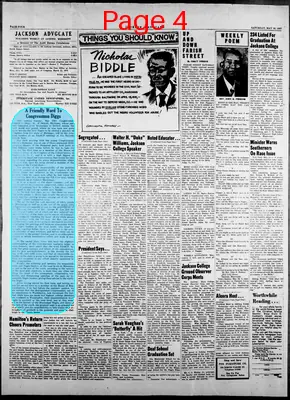
Editorial
May 18, 1957
Jackson Advocate
Jackson, Hinds County, Mississippi
What is this article about?
Editorial advises Congressman Charles C. Diggs, Jr., ahead of his NAACP speech in Mississippi, to promote goodwill between white and Black leaders, avoid revisiting past racial violence cases like Till, Lee, and Courts, and recognize NAACP's polarizing role in the South to foster local cooperation on school integration and race relations.
Clipping
OCR Quality
98%
Excellent
Full Text
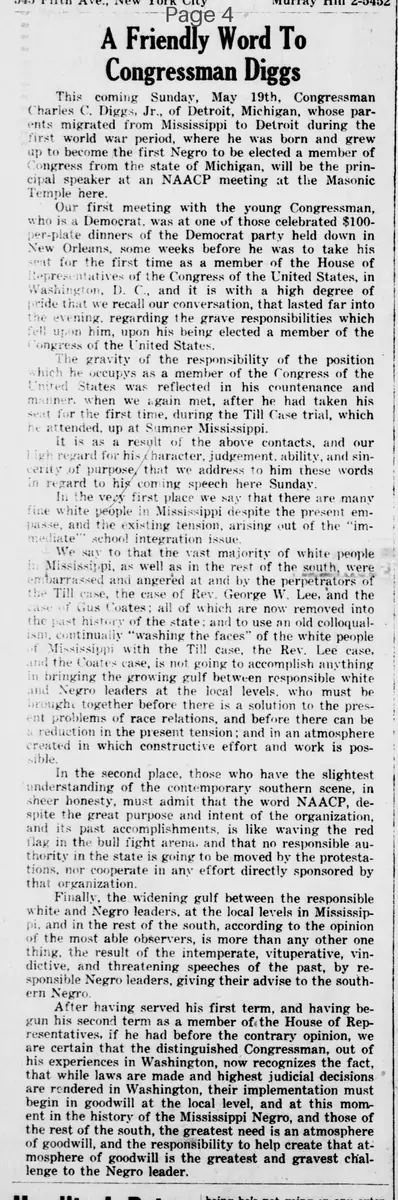
A Friendly Word To Congressman Diggs
This coming Sunday, May 19th, Congressman Charles C. Diggs, Jr., of Detroit, Michigan, whose parents migrated from Mississippi to Detroit during the first world war period, where he was born and grew up to become the first Negro to be elected a member of Congress from the state of Michigan, will be the principal speaker at an NAACP meeting at the Masonic Temple here.
Our first meeting with the young Congressman, who is a Democrat, was at one of those celebrated $100-per-plate dinners of the Democrat party held down in New Orleans, some weeks before he was to take his seat for the first time as a member of the House of Representatives of the Congress of the United States, in Washington, D. C., and it is with a high degree of pride that we recall our conversation, that lasted far into the evening, regarding the grave responsibilities which fall upon him, upon his being elected a member of the Congress of the United States.
The gravity of the responsibility of the position which he occupies as a member of the Congress of the United States was reflected in his countenance and manner, when we again met, after he had taken his seat for the first time, during the Till Case trial, which he attended, up at Sumner, Mississippi.
It is as a result of the above contacts, and our high regard for his character, judgement, ability, and sincerity of purpose, that we address to him these words in regard to his coming speech here Sunday.
In the very first place we say that there are many fine white people in Mississippi despite the present impasse, and the existing tension, arising out of the "immediate" school integration issue.
We say to that the vast majority of white people in Mississippi, as well as in the rest of the south, were embarrassed and angered at and by the perpetrators of the Till case, the case of Rev. George W. Lee, and the last Gus Courts case; all of which are now removed into the past history of the state; and to use an old colloquialism, continually "washing the faces" of the white people of Mississippi with the Till case, the Rev. Lee case, and the Courts case, is not going to accomplish anything in bringing the growing gulf between responsible white and Negro leaders at the local levels, who must be brought together before there is a solution to the present problems of race relations, and before there can be a reduction in the present tension; and in an atmosphere created in which constructive effort and work is possible.
In the second place, those who have the slightest understanding of the contemporary southern scene, in sheer honesty, must admit that the word NAACP, despite the great purpose and intent of the organization, and its past accomplishments, is like waving the red flag in the bull fight arena, and that no responsible authority in the state is going to be moved by the protestations, nor cooperate in any effort directly sponsored by that organization.
Finally, the widening gulf between the responsible white and Negro leaders, at the local levels in Mississippi, and in the rest of the south, according to the opinion of the most able observers, is more than any other one thing, the result of the intemperate, vituperative, vindictive, and threatening speeches of the past, by responsible Negro leaders, giving their advice to the southern Negro.
After having served his first term, and having begun his second term as a member of the House of Representatives, if he had before the contrary opinion, we are certain that the distinguished Congressman, out of his experiences in Washington, now recognizes the fact, that while laws are made and highest judicial decisions are rendered in Washington, their implementation must begin in goodwill at the local level, and at this moment in the history of the Mississippi Negro, and those of the rest of the south, the greatest need is an atmosphere of goodwill, and the responsibility to help create that atmosphere of goodwill is the greatest and gravest challenge to the Negro leader.
This coming Sunday, May 19th, Congressman Charles C. Diggs, Jr., of Detroit, Michigan, whose parents migrated from Mississippi to Detroit during the first world war period, where he was born and grew up to become the first Negro to be elected a member of Congress from the state of Michigan, will be the principal speaker at an NAACP meeting at the Masonic Temple here.
Our first meeting with the young Congressman, who is a Democrat, was at one of those celebrated $100-per-plate dinners of the Democrat party held down in New Orleans, some weeks before he was to take his seat for the first time as a member of the House of Representatives of the Congress of the United States, in Washington, D. C., and it is with a high degree of pride that we recall our conversation, that lasted far into the evening, regarding the grave responsibilities which fall upon him, upon his being elected a member of the Congress of the United States.
The gravity of the responsibility of the position which he occupies as a member of the Congress of the United States was reflected in his countenance and manner, when we again met, after he had taken his seat for the first time, during the Till Case trial, which he attended, up at Sumner, Mississippi.
It is as a result of the above contacts, and our high regard for his character, judgement, ability, and sincerity of purpose, that we address to him these words in regard to his coming speech here Sunday.
In the very first place we say that there are many fine white people in Mississippi despite the present impasse, and the existing tension, arising out of the "immediate" school integration issue.
We say to that the vast majority of white people in Mississippi, as well as in the rest of the south, were embarrassed and angered at and by the perpetrators of the Till case, the case of Rev. George W. Lee, and the last Gus Courts case; all of which are now removed into the past history of the state; and to use an old colloquialism, continually "washing the faces" of the white people of Mississippi with the Till case, the Rev. Lee case, and the Courts case, is not going to accomplish anything in bringing the growing gulf between responsible white and Negro leaders at the local levels, who must be brought together before there is a solution to the present problems of race relations, and before there can be a reduction in the present tension; and in an atmosphere created in which constructive effort and work is possible.
In the second place, those who have the slightest understanding of the contemporary southern scene, in sheer honesty, must admit that the word NAACP, despite the great purpose and intent of the organization, and its past accomplishments, is like waving the red flag in the bull fight arena, and that no responsible authority in the state is going to be moved by the protestations, nor cooperate in any effort directly sponsored by that organization.
Finally, the widening gulf between the responsible white and Negro leaders, at the local levels in Mississippi, and in the rest of the south, according to the opinion of the most able observers, is more than any other one thing, the result of the intemperate, vituperative, vindictive, and threatening speeches of the past, by responsible Negro leaders, giving their advice to the southern Negro.
After having served his first term, and having begun his second term as a member of the House of Representatives, if he had before the contrary opinion, we are certain that the distinguished Congressman, out of his experiences in Washington, now recognizes the fact, that while laws are made and highest judicial decisions are rendered in Washington, their implementation must begin in goodwill at the local level, and at this moment in the history of the Mississippi Negro, and those of the rest of the south, the greatest need is an atmosphere of goodwill, and the responsibility to help create that atmosphere of goodwill is the greatest and gravest challenge to the Negro leader.
What sub-type of article is it?
Social Reform
What keywords are associated?
Race Relations
Mississippi
Naacp
Congressman Diggs
School Integration
Goodwill
Till Case
Southern Negro
What entities or persons were involved?
Congressman Charles C. Diggs, Jr.
Naacp
Emmett Till
Rev. George W. Lee
Gus Courts
White People Of Mississippi
Negro Leaders
Editorial Details
Primary Topic
Advice To Congressman Diggs On Promoting Goodwill In Mississippi Race Relations
Stance / Tone
Advisory And Moderate, Urging Restraint And Local Cooperation
Key Figures
Congressman Charles C. Diggs, Jr.
Naacp
Emmett Till
Rev. George W. Lee
Gus Courts
White People Of Mississippi
Negro Leaders
Key Arguments
Many Fine White People Exist In Mississippi Despite Current Tensions Over School Integration
Majority Of Southern Whites Were Embarrassed By Perpetrators Of Till, Lee, And Courts Cases
Repeatedly Referencing Past Cases Hinders Bridging Gulf Between White And Black Leaders
Naacp Evokes Strong Negative Reaction In The South, Impeding Cooperation
Intemperate Speeches By Black Leaders Have Widened The Racial Divide
Laws And Decisions From Washington Require Local Goodwill For Implementation
Creating An Atmosphere Of Goodwill Is The Greatest Challenge For Black Leaders In The South