Thank you for visiting SNEWPapers!
Sign up free
Daily National Intelligencer
Washington, District Of Columbia
What is this article about?
On Oct. 7, 1815, in Paris, King Louis XVIII opened the Chambers with a procession, speech addressing post-usurpation recovery, peace treaty, financial measures, and national goals, followed by oaths from royals, peers, and deputies, commencing the 1815 session.
Merged-components note: Continuation of the article 'FROM FRANCE: PARIS, OCT. 7.' across pages 2 and 3, as the text flows directly from one component to the next.
Clippings
1 of 2
OCR Quality
Full Text
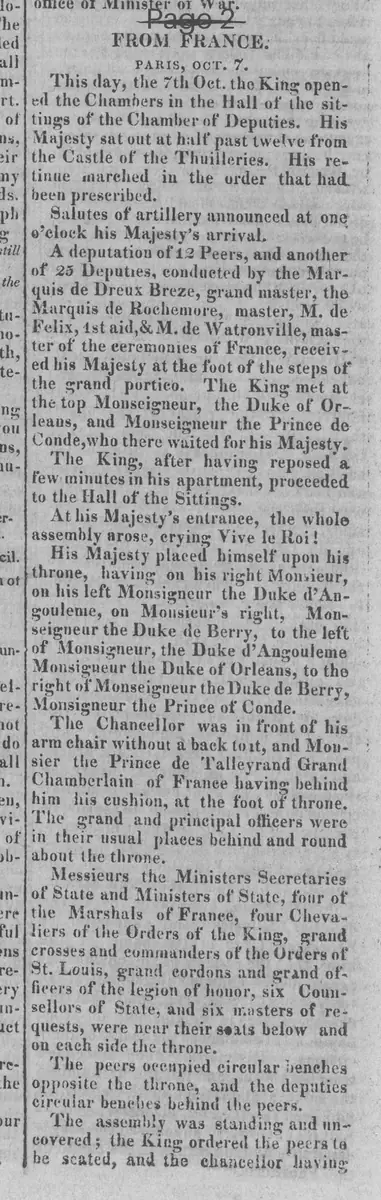
PARIS, OCT. 7.
This day, the 7th Oct. the King opened the Chambers in the Hall of the sittings of the Chamber of Deputies. His Majesty set out at half past twelve from the Castle of the Thuilleries. His retinue marched in the order that had been prescribed.
Salutes of artillery announced at one o'clock his Majesty's arrival.
A deputation of 12 Peers, and another of 25 Deputies, conducted by the Marquis de Dreux Breze, grand master, the Marquis de Rochemore, master, M. de Felix, 1st aid, & M. de Watronville, master of the ceremonies of France, received his Majesty at the foot of the steps of the grand portico. The King met at the top Monseigneur, the Duke of Orleans, and Monseigneur the Prince de Condé, who there waited for his Majesty.
The King, after having reposed a few minutes in his apartment, proceeded to the Hall of the Sittings.
At his Majesty's entrance, the whole assembly arose, crying Vive le Roi!
His Majesty placed himself upon his throne, having on his right Monsieur, on his left Monsigneur the Duke d'Angoulême, on Monsieur's right, Monseigneur the Duke de Berry, to the left of Monsigneur, the Duke d'Angoulême Monseigneur the Duke of Orleans, to the right of Monseigneur the Duke de Berry, Monsigneur the Prince of Condé.
The Chancellor was in front of his arm chair without a back to it, and Monsieur the Prince de Talleyrand Grand Chamberlain of France having behind him his cushion, at the foot of throne.
The grand and principal officers were in their usual places behind and round about the throne.
Messieurs the Ministers Secretaries of State and Ministers of State, four of the Marshals of France, four Chevaliers of the Orders of the King, grand crosses and commanders of the Orders of St. Louis, grand cordons and grand officers of the legion of honor, six Counsellors of State, and six masters of requests, were near their seats below and on each side the throne.
The peers occupied circular benches opposite the throne, and the deputies circular benches behind the peers.
The assembly was standing and uncovered; the King ordered the peers to be seated, and the chancellor having given, in his Majesty's name, permission to the deputies to seat themselves—a profound silence reigned—when his Majesty pronounced the following discourse:--
Gentlemen—When, last year, I assembled the two Houses for the first time, I felicitated myself upon having, by an honorable treaty, restored peace to France; she began to taste the fruits of it; all the sources of public prosperity were reopened—a criminal enterprise, seconded by the most inconceivable defection, came to stop its course. The evils which that ephemeral usurpation have caused our country, afflict me deeply. I ought, however, to declare in this place, that if it had been possible for them to have affected me only, I should bless Providence for them.
The tokens of love that my people gave me, even in the most critical moment, alleviated my individual sufferings; but those of my subjects, of my children, oppress my heart; and in order to put an end to that state of things, more grievous than war itself, I have deemed it my duty to conclude with the powers, who, after having overthrown the usurper, at present occupy a great part of our territory, a convention which settles our present and future relations with them. It shall be communicated to you without reserve, so soon as it shall have received its last form. You will know, Gentlemen, and all France will know, the great pain that I must have felt; but the very safety of my kingdom rendered that great determination necessary; and when I took that determination, I felt the duties that it imposed on me.
I have ordered that this year a considerable portion of my revenue be taken from the treasury of my civil list, and paid into that of the state.—My family on being informed of my resolution, offered me a proportionable donation. I ordered similar retrenchments from the salaries and emoluments of all my servants, without exception; I shall always be ready to unite in the sacrifices which imperious circumstances impose on my people. The account of the expenses will be delivered to you, and you will know the importance of the economy that I have directed in the departments of my ministers and in all parts of the Administration. Happy will it be if those measures can be adequate to the burthens of the state! In every event I rely upon the devotion of the nation, and the zeal of the two chambers.
But, gentlemen, other cares more pleasing and not less important, assemble you this day. It is to give more weight to your deliberations, it is in order myself to have the assistance of additional talents, that I have created new Peers, and that the number of the deputies of departments has been augmented. I hope that I have succeeded in my choice, and the assiduity of the deputies in this difficult conjuncture is also a proof that they are animated with a future affection for my person, and an ardent love for their country.
It is, therefore, with a pleasing joy and a perfect confidence that I assemble you about me. Certain that you will never lose sight of the fundamental bases of the felicity of the state: the frank and loyal union of the Chambers with the King, and respect for the constitutional charter; that charter which I meditated with care before giving it, to which reflection attaches me every day more and more, which I have sworn to maintain, and which you are all, beginning with my family, about to swear to obey, is, without doubt, like all other human institutions, susceptible of improvement; but none of us ought to forget, that the danger of innovating, is not far removed from the advantage of meliorating it.
Many other important subjects offer themselves to your attention; to make religion again flourish, to restore the purity of morals, to establish liberty upon respect to the laws, to render the laws more and more analogous to those great objects, to give stability to public credit, to recompose the army, to heal the wounds that have too much rent the bosom of our country, to secure in short internal tranquillity, and thereby to cause France to be respected from without: those are the objects to attain which all our efforts should be directed.—I do not flatter myself that so much good can be the work of a single session; but, if at the close of the present legislature, it is perceived that we have made approaches to it, we will have reason to be satisfied with ourselves; I shall spare nothing to attain the end; and I rely, gentlemen, upon the most active co-operation on your part.
His majesty having concluded the above discourse, intimated through the chancellor, to the princes of the royal family and to the princes of the blood, that the present was the time to take the oath of allegiance to the king and of obedience to the constitutional charter and laws of the kingdom. The oath was then successively taken by Monsieur, the Duke d'Angoulême, de Berry, and de Orleans, & the prince de Condé.
The oath of the Peers was then read by the Chancellor, when each Peer standing in his place, answered, "I swear."
The oath of the deputies was next read by the secretary of state of the Interior, when a member of the chamber of deputies, on being called to take the oath, asked leave to speak, Monsieur the duke de Richelieu, president of the council of ministers, immediately approached the king, received his orders and said, "The immemorial usage of the monarchy does not permit, in similar circumstances, any person to speak in presence of the king, without his majesty's permission; his majesty orders that the calling of the members be continued." The deputy took the oath.—
The oath having been taken by all the deputies, Monsieur the chancellor of France declared in the name of the king, that the session of the chamber of peers and the chamber of deputies, for the year 1815, was open, and that the chambers were to re-assemble on Monday next, to commence the course of their sittings. His majesty then descended from his throne, and left the hall amidst the same acclamations with which he had been received on his entering it.—
Salutes of artillery announced the king's departure and his return to the castle of the Thuilleries.
What sub-type of article is it?
What keywords are associated?
What entities or persons were involved?
Where did it happen?
Foreign News Details
Primary Location
Paris
Event Date
October 7, 1815
Key Persons
Outcome
the session of the chambers for 1815 was opened; oaths of allegiance to the king and obedience to the constitutional charter were taken by the royal family, peers, and deputies; chambers to reassemble on monday next.
Event Details
On October 7, 1815, the King arrived at the Chamber of Deputies from the Tuileries, was received by deputations and princes, delivered a discourse on peace restoration, the recent usurpation, a convention with occupying powers, financial sacrifices, creation of new peers, and goals like restoring religion and public credit, after which oaths were administered to the royal family, peers, and deputies, opening the session amid acclamations.