Thank you for visiting SNEWPapers!
Sign up free
The New Orleans Democrat
New Orleans, Orleans County, Louisiana
What is this article about?
A report from Hong Kong details misconduct by US Consul Gen. F. W. Partridge in Siam, including the arrest of American commissioner Mr. Chandler to prevent Siamese goods from reaching the Philadelphia Centennial Exposition. An investigation by USS Ashuelot led to Partridge's likely removal and the goods' eventual shipment.
Clipping
OCR Quality
Full Text
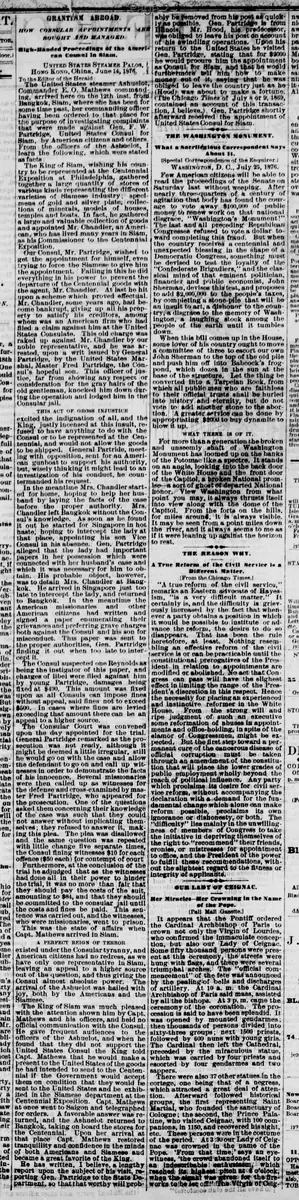
HOW CONSULAR APPOINTMENTS ARE BOUGHT AND MANAGED.
High-Handed Proceedings of the American Consul in Siam.
United States Steamer Palos,
Hono Kono, China, June 14, 1876.
To the Editor of the Herald:
The United States steamer Ashuelot, Commander E. O. Mathews commanding, arrived here on the 12th inst. from Bangkok, Siam, where she has been for some time past, her commanding officer having been ordered to that place for the purpose of investigating complaints that were made against Gen. F. W. Partridge, United States Consul for Siam, by American citizens and others. From the officers of the Ashuelot, I learn the following, which were stated as facts:
The King of Siam, wishing his country to be represented at the Centennial Exposition at Philadelphia, gathered together a large quantity of stores of various kinds representing the different varieties of Siamese industry; specimens of gold and silver plate, collections of minerals, models of houses, temples and boats. In fact, he gathered a large and valuable collection of goods and appointed Mr. Chandler, an American, who has lived many years in Siam, as his Commissioner to the Centennial Exposition.
Our Consul, Mr. Partridge, wished to get the appointment for himself, even trying to force the Siamese to give him the appointment. Failing in this he did everything in his power to prevent the departure of the Centennial goods with the agent, Mr. Chandler. At last he hit upon a scheme which proved effectual. Mr. Chandler, some years ago, had become bankrupt, giving up all his property to satisfy his creditors, among whom was an American firm who had filed a claim against him at the United States Consulate. This old charge was raked up against Mr. Chandler by our noble representative, and he was arrested, upon a writ issued by General Partridge, by the United States Marshal, Master Fred Partridge, the Consul's hopeful son. This officer of justice, far from showing any respect or consideration for the gray hairs of the old gentleman, knocked him down during the operation and lodged him in the Consular jail.
THIS ACT OF GROSS INJUSTICE excited the indignation of all, and the King, justly incensed at this insult, refused to have anything to do with the Consul or to be represented at the Centennial, and would not allow the goods to be shipped. General Partridge, meeting with opposition, sent for an American gunboat to support his authority, but, wisely thinking it might lead to an investigation of his conduct, he countermanded his request.
In the meantime Mrs. Chandler started for home, hoping to help her husband by laying the facts of the case before the proper authority. Mrs. Chandler left Bangkok without the Consul's knowledge. As soon as he found it out he started for Singapore in hot haste, hoping to intercept the lady at that place, appointing his son Vice Consul in his absence. Gen. Partridge alleged that the lady had important papers in her possession which were connected with her husband's case and which it was necessary for him to obtain. His probable object, however, was to detain Mrs. Chandler at Bangkok. He arrived in Singapore just too late to intercept the lady, and returned to Bangkok. In the meantime the American missionaries and other American citizens had written and signed a paper enumerating their grievances and preferring grave charges both against the Consul and his son for misconduct. This paper was sent to the proper authorities. Gen. Partridge finding it out when too late to intercept it.
The Consul suspected one Reynolds as being the instigator of this paper, and charges of libel were filed against him by young Partridge, damages being fixed at $490. This amount was fixed upon as all Consuls can impose fines without appeal, said fines not to exceed $500. In cases where fines are levied exceeding that amount there can be an appeal to a higher source.
The Consular Court was convened upon the day appointed for the trial. General Partridge remarked as the prosecution was not ready, although it might be deemed a little irregular, still he would go on with the case and allow the defendant to go on and call up witnesses in order to demonstrate the facts of his innocence. Several missionaries were then called up as witnesses for the defense and cross-examined by master Fred Partridge, who appeared for the prosecution. One of the questions asked them concerning their knowledge of the case was such that they could not answer without implicating themselves; they refused to answer it, making this plea. The plea was disallowed and the same question was repeated with little change five separate times, the Consul fining witnesses $10 for each offence ($50 each) for contempt of court. Furthermore, at the conclusion of the trial he adjudged that as the witnesses had done all in their power to hinder the trial, it was no more than fair that they should pay the costs of the suit, amounting to $84, and that they should be committed to the consular jail until the costs and fines be paid. This sentence was carried out, and the witnesses, who were missionaries, went to prison.
This was the state of affairs when Capt. Mathews arrived in Siam.
A PERFECT REIGN OF TERROR existed under the Consular tyranny, and American citizens had no redress, as we have only one representative in Siam, leaving an appeal to a higher source out of the question, and thus giving the Consul almost absolute power. The arrival of the Ashuelot was hailed with joy, both by the Americans and the Siamese.
The King of Siam was much pleased with the attention shown him by Capt. Mathews and his officers, and held no official communication with the Consul. He gave frequent audiences to the officers of the Ashuelot, and when he found that they did not support the United States Consul the King told Capt. Mathews that he would make a present to the United States of the goods he had intended to send to the Centennial if the Government would accept them on condition that they would be sent to the United States and be exhibited in the Siamese department at the Centennial Exposition. Capt. Mathews at once went to Saigon and telegraphed for orders. A favorable answer was returned, and the Ashuelot returned to Bangkok, taking on board the stores for the Centennial. Upon her arrival at that place Capt. Mathews restored tranquillity and confidence in the minds of both Americans and Siamese and became a great favorite of the King. He has written, I believe, a lengthy report upon the subject of his visit, reporting Gen. Partridge to the State Department, so that that worthy will probably be removed from his post as quickly as possible. Gen. Partridge is from Illinois. Mr. Hood, his predecessor, was obliged to leave his post on account of his swindling operations. Upon his return to the United States he visited Gen. Partridge, stating that for $2000 he would procure him the appointment as Consul for Siam, and that he would furthermore tell him how to make money out of it, saying that he was obliged to leave the country just as he (Hood) was about to make a fortune. (The Chicago Times of July 8 or 9, 1869, contained an account of this transaction, I believe.). Gen. Partridge shortly afterward received the appointment of United States Consul for Siam.
What sub-type of article is it?
What keywords are associated?
What entities or persons were involved?
Where did it happen?
Foreign News Details
Primary Location
Siam
Event Date
June 1876
Key Persons
Outcome
arrest and jailing of mr. chandler and missionaries; fines imposed; siamese goods shipped to us centennial exposition via uss ashuelot; report sent to state department likely leading to partridge's removal.
Event Details
US Consul Gen. Partridge in Siam arrested American resident Mr. Chandler, appointed as Siamese commissioner to the Philadelphia Centennial Exposition, using an old bankruptcy claim to prevent shipment of Siamese exhibits. This led to the King's refusal to participate. Partridge's son Fred assisted in the arrest violently. Missionaries protesting were fined and jailed in a biased consular trial. USS Ashuelot investigated, Capt. Mathews restored order, and the King gifted the goods to the US for exhibition, bypassing Partridge.