Thank you for visiting SNEWPapers!
Sign up free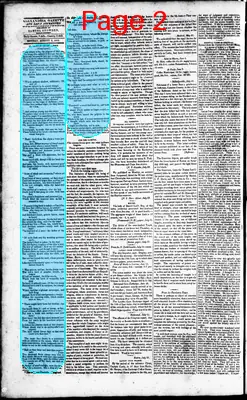
Literary
August 3, 1818
Alexandria Gazette & Daily Advertiser
Alexandria, Virginia
What is this article about?
Conclusion of Canto IV of Childe Harold's Pilgrimage, featuring reflections on the pilgrim's end, mourning the death of Princess Charlotte and her infant, critiques of monarchy, and a majestic address to the ocean, ending with farewell to the reader.
Clipping
OCR Quality
98%
Excellent
Full Text
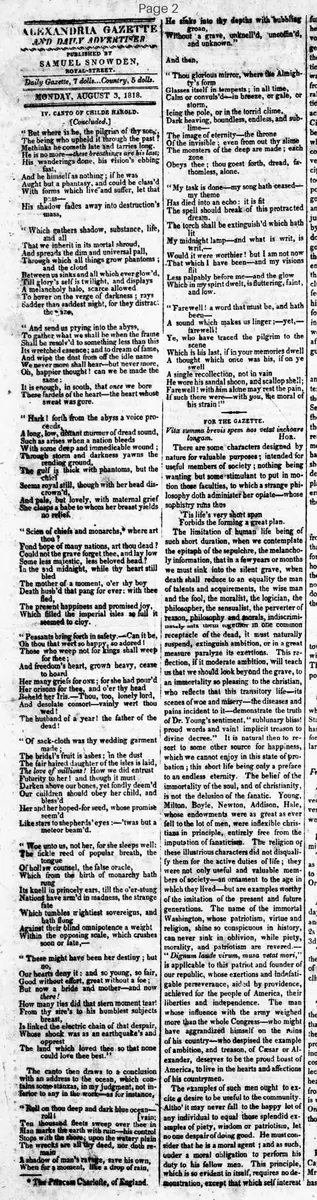
IV. CANTO OF CHILDE HAROLD,
[Concluded.]
"But where is he, the pilgrim of thy song,
The being who upheld it through the past?
Methinks he cometh late and tarries long.
He is no more—these breathings are his last;
His wanderings done, his vision's ebbing fast,
And he himself as nothing: if he was
Aught but a phantasy, and could be class'd
With forms which live and suffer—let that pass—
His shadow fades away into destruction's mass,
Which gathers shadow, substance, life, and all
That we inherit in its mortal shroud,
And spreads the dim and universal pall,
Through which all things grow phantoms; and the cloud
Between us sinks and all which ever glow'd,
Till glory's self is twilight, and displays
A melancholy halo, scarce allowed
To hover on the verge of darkness; rays
Sadder than saddest night, for they distract the gaze,
"And send us prying into the abyss,
To gather what we shall be when the frame
Shall be resolv'd to something less than this
Its wretched essence: and to dream of fame,
And wipe the dust from off the idle name,
We never more shall hear—but never more,
Oh, happier thought! can we be made the same:
It is enough, in sooth, that once we bore
These fardels of the heart—the heart whose sweat was gore.
"Hark! forth from the abyss a voice proceeds,
A long, low, distant murmur of dread sound,
Such as arises when a nation bleeds
With some deep and immedicable wound:
Through storm and darkness yawns the rending ground,
The gulf is thick with phantoms, but the chief
Seems royal still, though with her head discrown'd,
And pale, but lovely, with maternal grief
She clasps a babe, to whom her breast yields no relief.
"Scion of chiefs and monarchs, where art thou?
Fond hope of many nations, art thou dead?
Could not the grave forget thee, and lay low
Some less majestic, less beloved head?
In the sad midnight, while thy heart still bled,
The mother of a moment, o'er thy boy
Death hush'd that pang for ever: with thee fled,
The present happiness and promised joy,
Which fill'd the imperial isles so full it seem'd to cloy.
"Peasants bring forth in safety—Can it be,
Oh thou that wert so happy, so ador'd!
Those who weep not for kings shall weep for thee,
And freedom's heart, grown heavy, cease to hoard
Her many griefs for one; for she had pour'd
Her orisons for thee, and o'er thy head
Beheld her Iris—Thou, too, lonely Lord,
And desolate consort—vainly wert thou wed!
The husband of a year! the father of the dead!
"Of sack-cloth was thy wedding garment made;
The bridal's fruit is ashes: in the dust
The fair-haired daughter of the isles is laid,
The love of millions! How we did entrust
Futurity to her! and though it must
Darken above our bones, yet fondly deem'd
Our children should obey her child, and bless'd
Her and her hoped-for seed, whose promise seem'd
Like stars to shepherds' eyes: 'twas but a meteor beam'd.
"Woe unto us, not her, for she sleeps well:
The fickle reed of popular breath, the tongue
Of hollow counsel, the false oracle,
Which from the birth of monarchy hath rung
Its knell in princely ears, till the o'er-stung
Nations have arm'd in madness, the strange fate
Which tumbles mightiest sovereigns, and hath flung
Against their blind omnipotence a weight
Within the opposing scale, which crushes soon or late,
"These might have been her destiny; but no,
Our hearts deny it: and so young, so fair,
Good without effort, great without a foe;
But now a bride and mother—and now there!
How many ties did that stern moment tear!
From thy sire's to his humblest subjects' breast,
Is linked the electric chain of that despair,
Whose shock was as an earthquake's, and opprest
The land which loved thee so that none could love thee best.
The canto then draws to a conclusion with an address to the ocean, which contains some stanzas, in my judgment, not inferior to any in the work; as for instance,
"Roll on, thou deep and dark blue ocean—roll!
Ten thousand fleets sweep over thee in vain;
Man marks the earth with ruin—his control
Stops with the shore; upon the watery plain
The wrecks are all thy deed, nor doth remain
A shadow of man's ravage, save his own,
When, for a moment, like a drop of rain,
He sinks into thy depths with bubbling groan,
Without a grave, unknell'd, uncoffin'd, and unknown.
And then,
"Thou glorious mirror, where the Almighty's form
Glasses itself in tempests; in all time,
Calm or convulsed—in breeze, or gale, or storm,
Icing the pole, or in the torrid clime
Dark-heaving—boundless, endless, and sublime—
The image of eternity—the throne
Of the invisible; even from out thy slime
The monsters of the deep are made; each zone
Obeys thee; thou goest forth, dread, fathomless, alone.
"My task is done—my song hath ceased—my theme
Has died into an echo; it is fit
The spell should break of this protracted dream.
The torch shall be extinguish'd which hath lit
My midnight lamp—and what is writ, is writ—
Would it were worthier! but I am not now
That which I have been—and my visions flit
Less palpably before me—and the glow
Which in my spirit dwelt is fluttering, faint, and low.
"Farewell! a word that must be, and hath been—
A sound which makes us linger;—yet, farewell!
Ye, who have traced the pilgrim to the scene
Which is his last, if in your memories dwell
A thought which once was his, if on ye swell
A single recollection, not in vain
He wore his sandal shoon, and scallop shell:
Farewell! with him alone may rest the pain,
If such there were—with you, the moral of his strain!"
[Concluded.]
"But where is he, the pilgrim of thy song,
The being who upheld it through the past?
Methinks he cometh late and tarries long.
He is no more—these breathings are his last;
His wanderings done, his vision's ebbing fast,
And he himself as nothing: if he was
Aught but a phantasy, and could be class'd
With forms which live and suffer—let that pass—
His shadow fades away into destruction's mass,
Which gathers shadow, substance, life, and all
That we inherit in its mortal shroud,
And spreads the dim and universal pall,
Through which all things grow phantoms; and the cloud
Between us sinks and all which ever glow'd,
Till glory's self is twilight, and displays
A melancholy halo, scarce allowed
To hover on the verge of darkness; rays
Sadder than saddest night, for they distract the gaze,
"And send us prying into the abyss,
To gather what we shall be when the frame
Shall be resolv'd to something less than this
Its wretched essence: and to dream of fame,
And wipe the dust from off the idle name,
We never more shall hear—but never more,
Oh, happier thought! can we be made the same:
It is enough, in sooth, that once we bore
These fardels of the heart—the heart whose sweat was gore.
"Hark! forth from the abyss a voice proceeds,
A long, low, distant murmur of dread sound,
Such as arises when a nation bleeds
With some deep and immedicable wound:
Through storm and darkness yawns the rending ground,
The gulf is thick with phantoms, but the chief
Seems royal still, though with her head discrown'd,
And pale, but lovely, with maternal grief
She clasps a babe, to whom her breast yields no relief.
"Scion of chiefs and monarchs, where art thou?
Fond hope of many nations, art thou dead?
Could not the grave forget thee, and lay low
Some less majestic, less beloved head?
In the sad midnight, while thy heart still bled,
The mother of a moment, o'er thy boy
Death hush'd that pang for ever: with thee fled,
The present happiness and promised joy,
Which fill'd the imperial isles so full it seem'd to cloy.
"Peasants bring forth in safety—Can it be,
Oh thou that wert so happy, so ador'd!
Those who weep not for kings shall weep for thee,
And freedom's heart, grown heavy, cease to hoard
Her many griefs for one; for she had pour'd
Her orisons for thee, and o'er thy head
Beheld her Iris—Thou, too, lonely Lord,
And desolate consort—vainly wert thou wed!
The husband of a year! the father of the dead!
"Of sack-cloth was thy wedding garment made;
The bridal's fruit is ashes: in the dust
The fair-haired daughter of the isles is laid,
The love of millions! How we did entrust
Futurity to her! and though it must
Darken above our bones, yet fondly deem'd
Our children should obey her child, and bless'd
Her and her hoped-for seed, whose promise seem'd
Like stars to shepherds' eyes: 'twas but a meteor beam'd.
"Woe unto us, not her, for she sleeps well:
The fickle reed of popular breath, the tongue
Of hollow counsel, the false oracle,
Which from the birth of monarchy hath rung
Its knell in princely ears, till the o'er-stung
Nations have arm'd in madness, the strange fate
Which tumbles mightiest sovereigns, and hath flung
Against their blind omnipotence a weight
Within the opposing scale, which crushes soon or late,
"These might have been her destiny; but no,
Our hearts deny it: and so young, so fair,
Good without effort, great without a foe;
But now a bride and mother—and now there!
How many ties did that stern moment tear!
From thy sire's to his humblest subjects' breast,
Is linked the electric chain of that despair,
Whose shock was as an earthquake's, and opprest
The land which loved thee so that none could love thee best.
The canto then draws to a conclusion with an address to the ocean, which contains some stanzas, in my judgment, not inferior to any in the work; as for instance,
"Roll on, thou deep and dark blue ocean—roll!
Ten thousand fleets sweep over thee in vain;
Man marks the earth with ruin—his control
Stops with the shore; upon the watery plain
The wrecks are all thy deed, nor doth remain
A shadow of man's ravage, save his own,
When, for a moment, like a drop of rain,
He sinks into thy depths with bubbling groan,
Without a grave, unknell'd, uncoffin'd, and unknown.
And then,
"Thou glorious mirror, where the Almighty's form
Glasses itself in tempests; in all time,
Calm or convulsed—in breeze, or gale, or storm,
Icing the pole, or in the torrid clime
Dark-heaving—boundless, endless, and sublime—
The image of eternity—the throne
Of the invisible; even from out thy slime
The monsters of the deep are made; each zone
Obeys thee; thou goest forth, dread, fathomless, alone.
"My task is done—my song hath ceased—my theme
Has died into an echo; it is fit
The spell should break of this protracted dream.
The torch shall be extinguish'd which hath lit
My midnight lamp—and what is writ, is writ—
Would it were worthier! but I am not now
That which I have been—and my visions flit
Less palpably before me—and the glow
Which in my spirit dwelt is fluttering, faint, and low.
"Farewell! a word that must be, and hath been—
A sound which makes us linger;—yet, farewell!
Ye, who have traced the pilgrim to the scene
Which is his last, if in your memories dwell
A thought which once was his, if on ye swell
A single recollection, not in vain
He wore his sandal shoon, and scallop shell:
Farewell! with him alone may rest the pain,
If such there were—with you, the moral of his strain!"
What sub-type of article is it?
Poem
Elegy
Journey Narrative
What themes does it cover?
Death Mortality
Political
Patriotism
What keywords are associated?
Childe Harold
Pilgrim
Princess Charlotte
Monarchy
Mortality
Ocean
Farewell
Literary Details
Title
Iv. Canto Of Childe Harold, [Concluded.]
Key Lines
"Roll On, Thou Deep And Dark Blue Ocean—Roll! / Ten Thousand Fleets Sweep Over Thee In Vain; / Man Marks The Earth With Ruin—His Control / Stops With The Shore; Upon The Watery Plain / The Wrecks Are All Thy Deed, Nor Doth Remain / A Shadow Of Man's Ravage, Save His Own, / When, For A Moment, Like A Drop Of Rain, / He Sinks Into Thy Depths With Bubbling Groan, / Without A Grave, Unknell'd, Uncoffin'd, And Unknown."
"Farewell! A Word That Must Be, And Hath Been— / A Sound Which Makes Us Linger;—Yet, Farewell! / Ye, Who Have Traced The Pilgrim To The Scene / Which Is His Last, If In Your Memories Dwell / A Thought Which Once Was His, If On Ye Swell / A Single Recollection, Not In Vain / He Wore His Sandal Shoon, And Scallop Shell: / Farewell! With Him Alone May Rest The Pain, / If Such There Were—With You, The Moral Of His Strain!"