Thank you for visiting SNEWPapers!
Sign up free
The New York Packet
New York, New York County, New York
What is this article about?
Extract of letter from American sea captain prisoner in Algiers, dated June 22, 1786, details failed 1786 ransom and peace negotiations by Mr. Lamb with the Dey for 21 US captives, advises cautious US treaty approach, describes Algerine naval forces and recent captures, criticizes British Consul's hostility.
Merged-components note: This is a continuation of the letter from the sea captain in Algiers across pages 2 and 3, as indicated by the sequential reading order and the text flow ending abruptly on page 2 and continuing on page 3.
Clippings
1 of 2
OCR Quality
Full Text
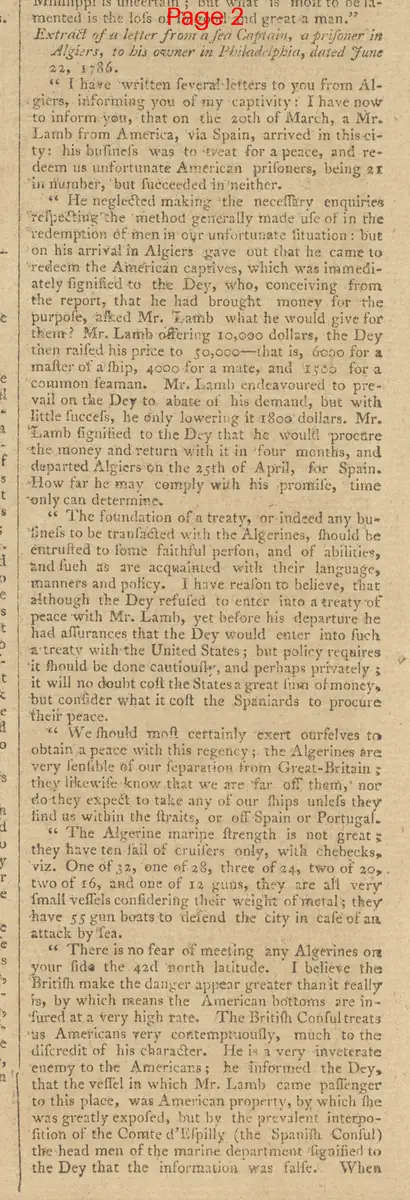
"I have written several letters to you from Algiers, informing you of my captivity: I have now to inform you, that on the 20th of March, a Mr. Lamb from America, via Spain, arrived in this city: his business was to treat for a peace, and redeem us unfortunate American prisoners, being 21 in number, but succeeded in neither.
He neglected making the necessary enquiries respecting the method generally made use of in the redemption of men in our unfortunate situation: but on his arrival in Algiers gave out that he came to redeem the American captives, which was immediately signified to the Dey, who, conceiving from the report, that he had brought money for the purpose, asked Mr. Lamb what he would give for them? Mr. Lamb offering 10,000 dollars, the Dey then raised his price to 50,000—that is, 6000 for a master of a ship, 4000 for a mate, and 1200 for a common seaman. Mr. Lamb endeavoured to prevail on the Dey to abate of his demand, but with little success, he only lowering it 1800 dollars. Mr. Lamb signified to the Dey that he would procure the money and return with it in four months, and departed Algiers on the 25th of April, for Spain. How far he may comply with his promise, time only can determine.
The foundation of a treaty, or indeed any business to be transacted with the Algerines, should be entrusted to some faithful person, and of abilities, and such as are acquainted with their language, manners and policy." I have reason to believe, that although the Dey refused to enter into a treaty of peace with Mr. Lamb, yet before his departure he had assurances that the Dey would enter into such a treaty with the United States; but policy requires it should be done cautiously, and perhaps privately; it will no doubt cost the States a great sum of money, but consider what it cost the Spaniards to procure their peace.
We should most certainly exert ourselves to obtain a peace with this regency; the Algerines are very sensible of our separation from Great-Britain; they likewise know that we are far off them, nor do they expect to take any of our ships unless they find us within the straits, or off Spain or Portugal.
The Algerine marine strength is not great they have ten sail of cruisers only, with chebecks, viz. One of 32, one of 28, three of 24, two of 20, two of 16, and one of 12 guns, they are all very small vessels considering their weight of metal; they have 55 gun boats to defend the city in case of an attack by sea.
There is no fear of meeting any Algerines on your side the 42d north latitude. I believe the British make the danger appear greater than it really is, by which means the American bottoms are insured at a very high rate. The British Consul treats us Americans very contemptuously, much to the discredit of his character. He is a very inveterate enemy to the Americans; he informed the Dey, that the vessel in which Mr. Lamb came passenger to this place, was American property, by which she was greatly exposed, but by the prevalent interposition of the Comte d'Epilly (the Spanish Consul) the head men of the marine department signified to the Dey that the information was false. When Mr. Lamb was in Algiers his intimacy with the British Consul was very obvious; indeed he ought to have avoided him as an American would have avoided Algiers. I am very sure that Mr. Lamb might have laid the foundation of a treaty, but believe me, Sir, if that business is still intrusted to him, it will cost some thousands more than if it was in the hands of a qualified statesman. The Dey is a very old man, and no doubt when he goes to his dear prophet. there will be a great change in the affairs of Algiers; there ought, therefore, to be a particular attention paid to those persons who have the Dey's ear to command, as they in all probability will have a very considerable share in the Algerine politics after the Dey's death. You have no idea how much they will be courted by every Christian nation: what large presents of warlike stores are daily making him—this is not occasioned by love, but fear.
Their head minister and director of the marine, that is, the Michlafha, should be well noticed, he is third in rank next the King : he is a valuable good man, and fills his office as well as any man can do, and treats the Americans with much civility. We have lived at the house of a worthy French merchant since December last, and treated with great politeness: we are under many obligations of gratitude to the Count d'Espilly, he is both the friend and protector of the unfortunate Americans.
The French and Swedish Consuls, as also a number of French merchants, pay great attention to us. I am convinced that the British will oppose the treaty between the United States and this regency. They, the British, will reap the advantage in several ways ; one way is, by being the carriers of our produce. I am inclined to think it would not be very agreeable to the French to see us have a very extensive trade in the Mediterranean. If the Americans wish to be a flourishing commercial people they must remove every apparent obstacle; nor can they possibly succeed until the great commercial machine be put together and directed in some measure by one good set of politics. I suppose things are at a low ebb in Philadelphia, it is however no more than I should expect. I hope you had the ship — well insured, if not, am sure it must hurt you very much, and for which I will be very sorry. If the Americans do not obtain a peace with Algiers and the other Barbary States, our ships may lie by, our seamen will then engage in the service of such as can and will protect them.
The Algerines have no merchant vessels of their own, their trade is carried on by the French and other Christians. If the whole Algerine navy was sold at an European market it would not sell for the money the Dey asks for us prisoners.
If we fit out any vessels for the Mediterranean, they must be fast sailing and copper bottomed, well found and well appointed, must cruise effectually. rendezvous at the island of Minorca, which is well situated to watch the Algerine cruisers. We must often be in sight of Algiers, but never in calm weather; the ports of Spain being open to the Algerines, they have many places of shelter which we have not.
If we were to take any of the Algerines, the Dey would never redeem them by exchange nor otherwise, he has so many people he cares not what becomes of them; one third of their crews are Turks which are taken from the soldiery, the rest are Moors: They generally go out on their cruise the latter end of March, and make three cruises in a year : the latter end of November last they returned from their last; this year they did not go out till the 29th of May, they are out at present, and have taken a 700 ton ship belonging to Russia, on her way from Barcelona to Archangel, and this day arrived a Neapolitan ship, a prize to the Algerines. The Neapolitan ambassador is daily expected here. Three days ago the Count d'Espilly departed this place for Madrid, after a residence of 12 months.
Any nation that has people to redeem, peace to make, or indeed if they have any thing else to do with the people, they must have money! Money is their God, and Mahomet their prophet. If you give a Turk money with the one hand, you may take out his eyes with the other."
What sub-type of article is it?
What keywords are associated?
What entities or persons were involved?
Where did it happen?
Foreign News Details
Primary Location
Algiers
Event Date
June 22, 1786
Key Persons
Outcome
failed ransom negotiations for 21 american prisoners; dey demanded 50,000 dollars (reduced slightly); mr. lamb promised to return in four months; recent algerine captures include russian and neapolitan ships.
Event Details
American envoy Mr. Lamb arrived in Algiers on March 20, 1786, to negotiate peace and ransom 21 US prisoners but failed due to inadequate preparation and high demands from the Dey. Lamb departed April 25 promising funds. Letter advises US to pursue treaty cautiously, details Algerine naval strength (10 cruisers, 55 gunboats), criticizes British Consul's hostility, praises Spanish and French support, and suggests strategies against Algerine piracy.