Thank you for visiting SNEWPapers!
Sign up free
Portland Gazette, And Maine Advertiser
Portland, Cumberland County, Maine
What is this article about?
Political miscellany featuring quotes on the revocation of French edicts affecting US neutral commerce, commentary on the seizure of the American brig New-Orleans Packet, Democratic Party consistency in elections, and a continued excerpt of Mr. Quincy's speech opposing the admission of Louisiana into the Union on constitutional grounds.
Merged-components note: Components 9 and 10 form a single coherent article on political miscellany, including the continued Mr. Quincy's speech in Congress; relabeling the second from editorial to domestic_news as it fits political news content.
Clippings
1 of 2
OCR Quality
Full Text
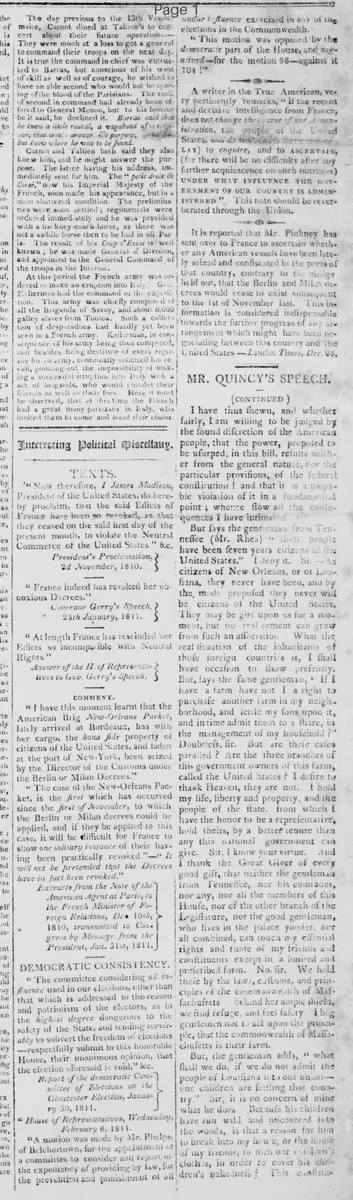
TEXTS.
"Now therefore, I James Madison,
President of the United States, do here-
by proclaim, that the said Edicts of
France have been so revoked, as that
they ceased on the said first day of the
present month, to violate the Neutral
Commerce of the United States" &c.
President's Proclamation,
2d November, 1810.
"France indeed has revoked her ob-
noxious Decrees."
Governor Gerry's Speech,
25th January, 1811.
"At length France has rescinded her
Edicts so incompatible with Neutral
Rights."
Answer of the H of Representa-
tives to Gov. Gerry's Speech.
COMMENT.
"I have this moment learnt that the
American Brig New-Orleans Packet,
lately arrived at Bordeaux, has with
her cargo, the bona fide property of
citizens of the United States, and laden
at the port of New-York, been seized
by the Director of the Customs under
the Berlin or Milan Decrees."
"The case of the New-Orleans Packet,
is the first which has occurred
since the first of November, to which
the Berlin or Milan decrees could be
applied, and if they be applied to this
case, it will be difficult for France to
show one solitary instance of their hav-
ing been practically revoked." "It
will not be pretended that the Decrees
have in fact been revoked."
Extracts from the Note of the
American Agent at Paris, to
the French Minister of For-
eign Relations, Dec. 10th,
1810, transmitted to Con-
gress by Message from the
President, Jan. 31st, 1811.
DEMOCRATIC CONSISTENCY.
"The committee considering all in-
fluence used in our elections, other than
that which is addressed to the reason
and patriotism of the electors, as in
the highest degree dangerous to the
safety of the State, and tending inevit-
ably to subvert the freedom of elections
—respectfully submit to this honorable
House, their unanimous opinion, that
the election aforesaid is void," &c.
Report of the democratic Com-
mittee of Elections on the
Gloucester Election, Janua-
ry 30, 1811.
“House of Representatives, Wednesday,
February 6, 1811.
"A motion was made by Mr. Phelps
of Belchertown, for the appointment of
a committee to consider and report on.
the expediency of providing by law, for
the prevention and punishment of all
undue influence exercised in any of the
elections in the Commonwealth.
"This motion was opposed by the
democratic part of the House, and neg-
ativcd—for the motion 96—against it
104!"
A writer in the True American, very
pertinently remarks, "if the recent
and decisive intelligence from France
does not change the course of our Ad-
ministration, the people of the United
States, we do want (as do they in Eng-
land) to enquire, and to ASCERTAIN,
(for there will be no difficulty after any
further acquiescence on such outrages)
UNDER WHAT INFLUENCE THE GOV-
ERNMENT OF OUR COUNTRY IS ADMIN
ISTERED" This note should be reverber-
ated through the Union.
It is reported that Mr. Pinkney has
sent over to France to ascertain wheth-
er any American vessels have been late-
ly seized and confiscated in the ports of
that country, contrary to the pledge
held out, that the Berlin and Milan de-
crees would cease to exist subsequent
to the 1st of November last. This in-
formation is considered indispensable
towards the further progress of any ar-
rangement which might have been ne-
gociating between this country and the
United States—London Times, Dec. 26.
MR. QUINCY'S SPEECH.
(CONTINUED)
I have thus shown, and whether
fairly, I am willing to be judged by
the sound discretion of the American
people, that the power, proposed to
be usurped, in this bill, results neither
from the general nature, nor the
particular provisions, of the federal
constitution! and that it is a palpable
violation of it in a fundamental
point; whence flow all the conse-
quences I have intimated
But says the gentleman from Ten-
neffee (Mr. Rhea) "these people
have been seven years citizens of the
United States." I deny it. As
citizens of New Orleans, or of Lou-
isiana, they never have been, and by
the mode proposed they never will
be citizens of the United States.
They may be girt upon us for a mo-
ment, but no real cement can grow
from such an afflucturation What the
real situation of the inhabitants of
those foreign countries is, I shall
have occasion to show presently.
But, says the same gentleman, "If I
have a farm have not I a right to
purchase another farm in my neigh-
borhood, and settle my sons upon it,
and in time admit them to a share, in
the management of my household?"
Doubtless, sir. But are these cases
parallel? Are the three branches of
this government owners of this farm,
called the United States? I desire to
thank Heaven, they are not. I hold
my life, liberty and property, and the
people of the state, from which I
have the honor to be a representative,
hold theirs, by a better tenure than
any this national government can
give. Sir, I know your virtue. And
I thank the Great Giver of every
good gift, that neither the gentleman
from Tennessee, nor his comrades,
nor any, nor all the members of this
House, nor of the other branch of the
Legislature, nor the good gentleman,
who lives in the palace yonder, nor
all combined, can touch my essential
rights and those of my friends and
constituents except in a limited and
prescribed form. No, sir. We hold
these by the laws, customs, and prin-
ciples of the commonwealth of Mas-
sachusetts Behind her ample shield,
we find refuge, and feel safety. I beg
gentlemen not to act upon the prinic-
ple, that the commonwealth of Massa-
chusetts is their farm.
But, the gentleman adds, "what
shall we do, if we do not admit the
people of Louisiana into our union—
our children are settling that coun-
try." Sir, it is no concern of mine
what he does Because his children
have run wild and uncovered into
the woods, is that a reason for him
to break into my house, or the house
of my friends, to fetch our children's
clothes, in order to cover his chil-
dren's nakedness? This Constitu-
Time never was, and never can be, damned to lap over all the wilder regions of the west, without essentially affecting both the rights and convenience of its real proprietors. It was severely attempted to form a covering for the inhabitants of the Mississippi and its Red River country. And whenever it is attempted to be stretched over them, it will render a frontier. I have done with this part of my argument. It rests upon this fundamental principle, that the proportion of political power, subject only to the internal modifications permitted by the constitution, is an inalienable, essential, intangible right. When it is touched, the fabric is annihilated. For on the preservation of these proportions depend our rights and liberties.
If we recur to the known relations existing among the states, at the time of the adoption of this constitution, the same conclusion will result. The various interests, habits, manners, prejudices, education, situation and views, which excited jealousies and anxieties in the breasts of some of our most distinguished citizens, touching the result of the proposed constitution, were potent obstacles to its adoption. The immortal leader of our revolution, in his letter to the President of the old Congress written as president of the convention which formed this compact, thus speaks on this subject: "It is at all times difficult to draw with precision, the line between these rights, which must be surrendered and those which may be reserved; and on the present occasion, this difficulty was increased by a difference among the several states as to their situation, extent, habits and particular interests."
The debates of that period will show that the effect of the slave votes, upon the political influence of this part of the country, and the anticipated variation of the weight of power to the west, were subjects of great and just jealousy to some of the best patriots, in the Northern and Eastern states. Suppose, then, that it had been distinctly foreseen, that, in addition to the effect of this weight the whole population of a world beyond the Mississippi was to be brought into this and the other branch of the legislature, to form our laws, control our rights and decide our destiny. Sir, can it be pretended that the patriots of that day would for one moment have listened to it? They were not madmen. They had not taken degrees at the hospital of idiocy. They knew the nature of man and the effect of his combinations in political societies. They knew that when the weight of particular sections of a confederacy was greatly unequal, the resulting power would be abused; that it was not in the nature of man to exercise it with moderation. The very extravagance of the intended use is a conclusive evidence against the possibility of the grant of such a power, as is here proposed. Why, sir, I have already heard of six states, and some say there will be, at no great distance of time, more. I have also heard that the mouth of the Ohio, will be far to the east of the centre of the contemplated empire. If the bill is passed, the principle is recognized. All the rest are mere questions of expediency. It is impossible such a power could be granted. It was not for these men that our fathers fought. It was not for them that this constitution was adopted. You have no authority to throw the rights and liberties, and property of this people, into "hotch pot" with the wild men on the Mississippi, nor with the mixed, though more respectable race of Anglo-Hispano-Gallo Americans, who bask on the sands, in the mouth of the Mississippi. I make no objection to these from their want of moral qualities or political light. The inhabitants of New Orleans are, I suppose, like those of all other countries, some good, some bad, some indifferent.
As then the power in this bill proposed to be usurped is neither to be drawn from the general nature of the instrument, nor from the clause just examined, it follows, that if it exist anywhere, it must result from the treaty making power. This the gentleman from Tennessee (Mr. Rhea) asserts—but the gentleman from North Carolina (Mr. Macon) denies—and very justly: For what a monstrous position is this, that the treaty making power has the competency to change the fundamental relations of the constitution itself! That a power under the constitution should have the ability to change and annihilate the instrument, from which it derives all its power—and if the treaty making power can introduce new partners to the political rights of the states, there is no length however extravagant, or inconsistent with the end, to which it may not be wrested. The present President of the U. States, when a member of the Virginia convention for adopting the constitution, expressly declares that the treaty making power has limitations, and he states this as one, "that it cannot alienate any essential right"—Now is not here an essential right to be alienated? The right to that proportion of political power which the constitution has secured to every state, modified only by such internal increase of states, as the existing limits of the territories at the time of the adoption of the constitution permitted. The debates of that period chiefly turned upon the competency of this power to bargain away any of the old states. It was agreed at that time that by this power old states within the ancient limits could not be sold from us. And I maintain, that by it new states without the ancient limits cannot be saddled upon us. It was agreed, at that time that the treaty making power "could not cut off a limb." And I maintain that neither has it the competency to clap a hump upon our shoulders. The fair proportions devised by the constitution are in both cases marred, and the state and felicity of the political being in material particulars, related to the essence of his constitution, affected. It was never pretended by the most enthusiastic advocates for the extent of the treaty making power, that it exceeded that of the King of Great-Britain. Yet I ask, suppose that monarch should make a treaty stipulating that Hanover, or Hindostan, should have a right of representation on the floor of Parliament—would such a treaty be binding? No, sir; not as I believe, if a House of Commons and of Lords could be found venal enough to agree to it. But although in that country the three branches of its legislature are called omnipotent and the people might not deem themselves justified in resistance, yet here there is no apology of this kind, the limits of our power are distinctly marked, and when the three branches of this government usurp upon this constitution in particulars vital to the liberties of this people, the deed is at their peril.
I have done with the constitutional argument. Whether I have been able to convince any member of this House, I am ignorant, I had almost said indifferent. But this I will not say, because I am indeed deeply anxious to prevent the passage of this bill. Of this I am certain, however, that when the discussion of this day is passed away, when party spirit shall no longer prevent the people of the U. S. from looking at the principle assumed in it, independent of gross & deceptive attachments & antipathies, that the ground here defended will be acknowledged as a high constitutional bulwark, and that the principles here advanced will be appreciated.
I will add one word, touching the situation of New-Orleans. The provision of the treaty of 1803, which stipulates that it shall be "admitted as soon as possible," does not therefore imply a violation of the constitution. There are ways in which this may constitutionally be effected by an amendment of the constitution; or by reference to conventions of the people in the states. And I do suppose, that, in relation to the objects of the present bill, (the people of New-Orleans) no great difficulty would arise. Considered as an important accommodation to the Western States, there would be no violent objection to the measure. But this would not answer all the projects, to which the principle of this bill, when once admitted, leads, and is intended to be applied. The whole extent of Louisiana is to be cut up into independent states; to counterbalance and to paralyze whatever there is of influence in other quarters of the Union. Such a power, I am well aware, that the people of the states would never grant you. And therefore, if you get it, the only way is, by the mode adopted in this bill—by usurpation.
The objection here urged is not a new one. I refer with great anxiety to the course pursued by any member of the other branch of the legislature; yet I have it from such authority that I have an entire belief of the fact, that our present minister in Russia, then a member that body when the Louisiana treaty was under the consideration of the Senate, although he was in favor of the treaty, yet expressed great doubts on the ground of constitutionality, in relation to our control over the destination of that people, and the manner and the principles on which they could be admitted into the Union. And it does appear that he made two several motions in that body, having for their object, as avowed, and gathered from their nature, an alteration in the constitution to enable us to comply with the stipulations of that convention.
[We regret that we cannot publish this truly excellent speech this week; but a crowd of foreign and domestic news renders it impracticable. The remainder will briefly appear in our next.]
What sub-type of article is it?
What keywords are associated?
What entities or persons were involved?
Where did it happen?
Domestic News Details
Primary Location
United States
Event Date
1810 1811
Key Persons
Event Details
Compilation of political texts and commentary on French edicts' revocation, seizure of American brig New-Orleans Packet, Democratic election practices, and excerpt from Mr. Quincy's speech arguing against Louisiana's admission to the Union as unconstitutional.