Thank you for visiting SNEWPapers!
Sign up free
The Lamar Register
Lamar, Prowers County, Colorado
What is this article about?
In this chapter of Rex Beach's 'Heart of the Sunset,' the recovery of Ricardo Guzman's body averts international crisis but stirs rumors. Alaire reflects on her husband's involvement, encounters Blaze Jones' superstitions about a dressmaker, receives a psychic warning of threats to the Austins from Jose Sanchez, and shares a passionate kiss with Dave Law, awakening mutual love amid moral dilemmas.
Merged-components note: Merging multiple parts of the serialized fiction 'HEART OF THE SUNSET' across pages 3 and 6, including overlapping images as illustrations.
Clippings
1 of 2
OCR Quality
Full Text
of the
SUNSET
REX BEACH
Author of "The Spoilers," "The Iron Trail,"
"The Silver Horde," Etc.
"But my mission was friendly. I had
no criminal purpose," he said mildly.
"However—perhaps one offense con-
dones the other. At any rate, we must
have no international complications.
There is a more practical side to the
matter: If Don Ricardo Guzman met
his death in Mexico, there will be a
rigid investigation. I assure you."
Evans agreed.
"That's fair! And
I'll make a bargain with you: you
keep still
and so'll we. We never
aimed for this affair to get out, any-
how.
I reckon these men"—he indi-
cated Lewis and his followers—"ain't
liable to talk much."
The
two
Guzman
boys,
greatly
moved,
returned
to
announce that
they had identified their father's body.
and Longorio could not well refuse to
accept their evidence.
"Very well," said he.
"I am indebted
to you.
Since there is nothing more
to be said, apparently, I will return
to Romero."
With a bow to Mrs. Aus-
tin, who had silently watched the play
of these opposing motives, he turned
away, and Tad Lewis followed him.
But Dave Law had recognized Adolfo
Urbina in the crowd, and, stepping for-
ward, disarmed him, saying:
"Adolfo, there's a warrant for you.
so I'll just take you in."
For a moment Adolfo was inclined
to resist, but, thinking better of it, he
yielded
with bad
grace, bitterly re-
gretting
the
curiosity which had
prompted him to remain to the end of
this interesting affair.
Tad Lewis gave him some comfort.
"Never mind, Adolfo," he said. "They
can't prove anything on you, and I'll
go your bail. Ed Austin knows where
you was the day that stock was stole."
He and his two remaining men moved
toward their automobile, and a moment
later the vehicle went clattering away
up the thicket road.
So ended the attempt to foil the re-
turn of Ricardo Guzman's body to
Texas soil.
When Alaire came to look for her
husband, he was gone.
CHAPTER XIV.
Superstitions and Certainties
The sensation caused by Ricardo
Guzman's disappearance was as noth-
ing to that which followed the recovery
of his body. Whatever the facts of
the rescue, it was generally recognized
that the result had been to bring on
a crisis in the affairs of the two na-
tions.
Strong influences, however,
were at work to prevent that very out-
come for which the people of Texas
prayed. During the delay there arose
a report that Ricardo Guzman had
borne an evil reputation, and that he
had been so actively associated with
the rebel cause as to warrant punish-
ment by the federal government. More-
over, a legal question as to his Ameri-
can citizenship was raised—a question
which seemed to have important bear-
ing upon the case.
Public interest is short-lived: few
living men can hold it more than a day
or two, and it reckons no dead man
worthy of more than an obituary no-
tice. Thus in the course of time the
Guzman incident was in a fair way
of being officially forgotten and for-
given.
But there were several persons who
felt intense relief at the course events
had taken, and among these was Alaire
Austin. In the days following that
midnight expedition she had had ample
time in which to meditate upon her
husband's actions. It seemed probable
that he had fled to San Antonio, there
to remain until interest in the Guzman
matter had abated.
Alaire telephoned Dave Law, argu-
ing to herself that she must learn
more about her husband's connection
with the Lewis gang. Dave arrived
even sooner than she had expected.
She made him dine with her, and they
spent the evening on the dimly-lit gal-
lery. In the course of their conver-
sation Alaire discovered that Dave, too,
had a hidden side of his nature: that
he possessed an imagination, and with
it a quaint, whimsical, exploratory turn
of mind which enabled him to talk
interestedly of many things and many
places. On this particular evening he
was anything but the man of iron she
had known—until she ventured to
speak of Ed. Then he closed up like
a trap. He was almost gruff in his
refusal to say a word about her hus-
band.
Because of Ed's appropriation of the
ranch cash, Alaire found it necessary
a few days later to go to the bank,
and, feeling the need of exercise, she
rode her horse Montrose. When her
errands had been attended to, she sud-
denly decided to call on Paloma Jones.
It was years since she had voluntarily
done such a thing: the very impulse
surprised her.
Paloma, it happened, was undergoing
that peculiar form of feminine torture
known as
"fitting;" but insecurely
basted, pinned and tucked as she was,
she came flying down to the gate to
meet her visitor.
Alaire
was
introduced
to
Mrs.
Strange, the dressmaker, a large, acid-
uluous brunette, with a mouthful of
pins; and then, when Paloma had giv-
en herself once more into the seam-
stress' hands, the two friends gossiped.
"I don't know what dad will say
when he
gets the bill for these
dresses," Paloma confessed.
"Your father is a mighty queer
man," Mrs.
Strange observed.
"I
haven't so much as laid eyes on him."
Paloma nodded. "Yes. And he's get-
ting more peculiar all the time; I can't
make out what ails him."
"Where is he now?" asked Alaire.
"Heaven knows! Out in the barn
or under the house."
Taking advan-
tage of the dressmaker's momentary
absence from the room, Paloma con-
tinued in a whisper: "I wish you'd talk
to dad and see what you make of him.
He's absolutely—queer. Mrs. Strange
seems to have a peculiar effect on him.
Why, it's almost as if—"
"What?"
"Well, I suppose I'm foolish, but
I'm beginning to believe in spells. You
know, Mrs. Strange's husband is a sort
of—necromancer."
"How silly!"
There was no further opportunity
for words, as the woman reappeared at
that instant; but a little later Alaire
went in search of Blaze, still consid-
erably mystified. As she neared the
farm buildings, she glimpsed a man's
figure hastily disappearing into the
barn. The figure bore a suspicious re-
semblance to Blaze Jones, yet when
she followed, he was nowhere to be
seen.
"Mr. Jones!" Alaire called. She re-
peated Blaze's name several times;
then something stirred. The door of a
harness closet opened cautiously, and
out of the blackness peered Paloma's
father. He looked more owlish than
ever behind his big, gold-rimmed spec-
tacles. "What in the world are you
doing in there?" she cried.
Blaze emerged, blinking.
He
was
dusty and perspiring.
"Hello, Miz Austin!" he saluted her
with a poor assumption of breeziness.
"I was fixin' some harness, but I'm
right glad to see you."
Alaire regarded him quizzically.
"What made you hide?" she asked.
"Hide? Who, me?"
"I saw you dodge in here like a—
gopher."
Blaze confessed: "I reckon I've got
the willies. Every woman I see looks
like that dressmaker."
"Paloma was telling me about you.
Why do you hate her so?"
"I don't know 's I hate her, but her
and her husband have put a jinx on
me. They're the worst people I ever
see, Miz Austin."
"You don't really believe in such
things?"
Blaze dusted off a seat for his visi-
tor, saying: "I never did till lately,
but now I'm worse than a plantation
nigger. I tell you there's things in
this world we don't sabe. I wish you'd
get Paloma to fire her. I've tried and
failed. I wish you'd tell her those
dresses are rotten."
"But they're very nice; they're love-
ly; and I've just been complimenting
her. Now what has this woman done
to you?"
It seemed impossible that a man of
Blaze Jones' character could actually
harbor crude superstitions, and
yet
there was no mistaking his earnest-
ness when he said:
"I ain't sure whether she's to blame,
or her husband, but misfortune has
folded me to herself."
"How?"
"Well, I'm sick."
"You don't look it."
"I don't exactly feel it, either, but
I am.
I don't sleep good, my heart's
actin' up. I've got rheumatism, my
stomach feels like I'd swallowed some-
thing alive—"
"You're smoking too much," Alaire
affirmed, with conviction.
But skepticism aroused Blaze's in
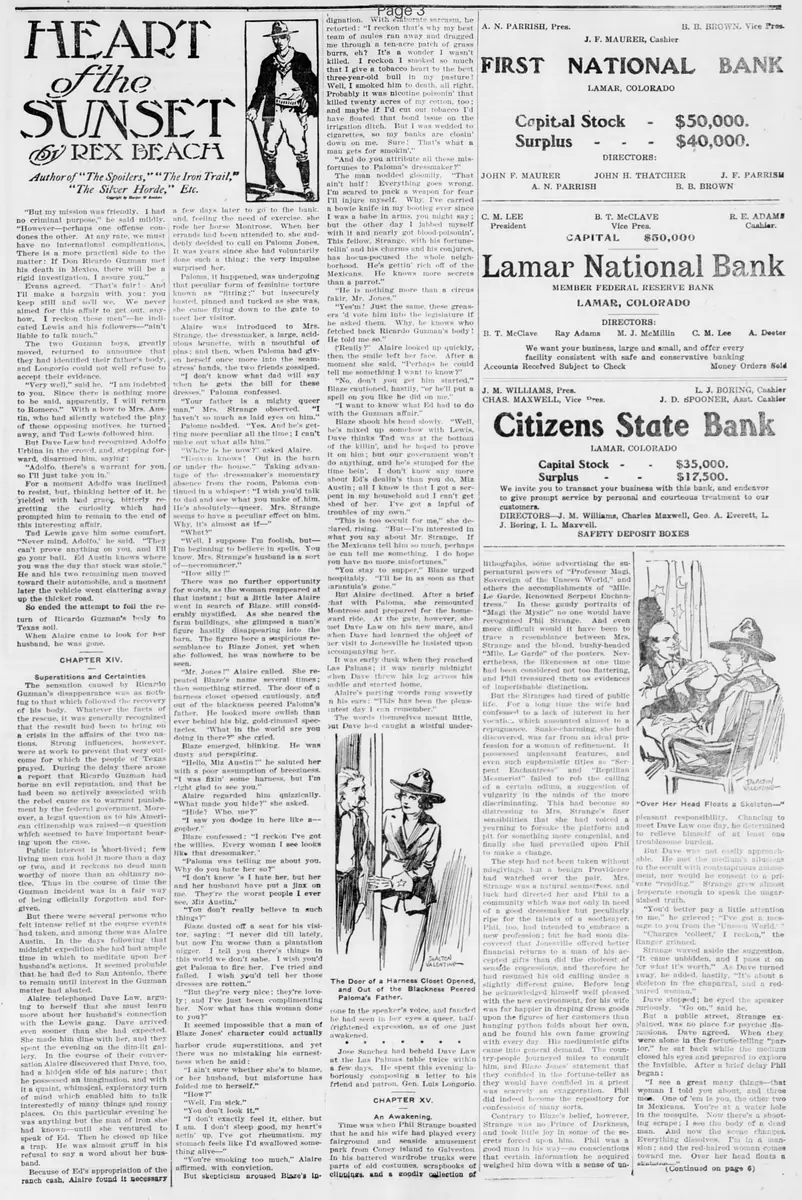
"Over Her Head Floats a Skeleton—"
pleasant responsibility. Chancing to
meet Dave Law one day, he determined
to relieve himself of at least one
troublesome burden.
But Dave was not easily approach-
able. He met the medium's allusions
to the occult with contemptuous amuse-
ment, nor would he consent to a pri-
vate "reading." Strange grew almost
desperate enough to speak the unvar-
nished truth.
"You'd better pay a little attention
to me," he grieved; "I've got a mes-
sage to you from the 'Unseen World.'"
"Charges 'collect,' I reckon," the
Ranger grinned.
Strange waved aside the suggestion.
It came unbidden, and I pass it on
as what it's worth." As Dave turned
away, he added, hastily. "It's about a
skeleton in the chaparral, and a red-
haired woman."
Dave stopped; he eyed the speaker
curiously. "Go on," said he.
But a public street, Strange ex-
plained, was no place for psychic dis-
cussions. Dave agreed. When they
were alone in the fortune-telling "par-
lor," he sat back while the medium
closed his eyes and prepared to explore
the Invisible. After a brief delay Phil
began:
"I see a great many
things—that
woman I told you about, and three
men. One of 'em is you, the other two
is Mexicans. You're at a water hole
in the mesquite. Now there's a shoot-
ing scrape: I see the body of a dead
man.
And now the scene changes.
Everything dissolves.
I'm in a man-
sion: and the red-haired woman comes
toward me.
Over her head floats a
HEART OF THE SUNSET
By REX BEACH
Author of "The Spoilers," "The Iron Trail," "The Silver Horde," Etc.
Copyright by Harper & Brothers
Dave broke in crisply. "All right! Let's get down to cases. What's on your mind, Strange?"
The psychic simulated a shudder—a painful contortion, such as anyone might suffer if rudely jerked out of the spirit world.
"Eh? What was I-? There! You've broke the connection," he declared.
"Did I tell you anything?"
"No. But evidently you can."
"I'm sorry. They never come back."
"Rot!"
Phil was hurt. Indignant. With some stiffness he explained the danger of interrupting a seance of this sort, but Law remained obdurate.
"You can put over that second-sight stuff with the greasers," he declared sharply, "but not with me. So, Jose Sanchez has been to see you and you want to warn me. Is that it?"
"I don't know any such party."
Strange protested. He eyed his caller for a moment; then with an abrupt change of manner he complained:
"Say, Bo! What's the matter with you? I've got a reputation to protect, and I do things my own way. I'm getting set to slip you something, and you try to make me look like a sucker. Is that any way to act?"
"I prefer to talk to you when your eyes are open. I know all about—"
"You don't know nothing about anything," snapped the other. "Jose's got it in for Mrs. Austin."
"You said you didn't know him."
"Well, I don't. He's never been to see me in his life, but—his sweetheart has, Rosa Morales comes regular."
"Rosa! Jose's sweetheart!"
"Yes. Her and Jose have joined out together since you shot Panfilo, and they're framing something."
"What, for instance?"
The fortune-teller hesitated. "I only wish I knew," he said slowly.
"It looks to be like a killing."
Dave nodded. "Probably is. Jose would like to get me, and of course the girl—"
"Oh, they don't aim to get you. You ain't the one they're after."
"No? Who, then?"
"I don't know nothing definite. In this business, you understand, a fellow has to put two and two together. All the same, I'm sure Jose ain't carving no epitaph for you. From what I've dug out of Rosa, he's acting for a third party—somebody with pull and a lot of coin—but who it is I don't know. Anyhow, he's cooking trouble for the Austins, and I want to stand from under."
Now that the speaker had dropped all pretense, he answered Dave's questions without evasion and told what he knew. It was not much, to Dave's way of thinking, but it was enough to give cause for thought, and when the men finally parted it was with the understanding that Strange would promptly communicate any further intelligence on this subject that came his way.
On the following day Dave's duties called him to Brownsville, where court was in session. He had planned to leave by the morning train; but as he continued to meditate over Strange's words, he decided that, before going, he ought to advise Alaire of the fellow's suspicions in order that she might discharge Jose Sanchez and in other ways protect herself against his possible spite. Since the matter was one that could not well be talked over by telephone, Dave determined to go in person to Las Palmas that evening.
Truth to say, he was hungry to see Alaire. By this time he had almost ceased to combat the feeling she aroused in him, and it was in obedience to an impulse far stronger than friendly anxiety that he hired a machine and, shortly after dark, took the river road.
The Fates are malicious jades. They delight in playing ill-natured pranks upon us. Not content with spinning and measuring and cutting the threads of our lives to suit themselves, they must also tangle the skein, causing us to cut capers to satisfy their whims. At no time since meeting Alaire had Dave Law been more certain of his moral strength than on this evening; at no time had his grip upon himself seemed firmer. Nor had Alaire the least reason to doubt her self-control. Dave, to be sure, had appealed to her fancy and her interest; in fact, he so dominated her thoughts that the imaginary creature whom she called her dream-husband had gradually taken on his physical likeness. But the idea that she was in any way enamored of him had never entered his mind. In such wise do the Fates amuse themselves.
Alaire had gone to her favorite after-dinner refuge, a nook on one of the side galleries, where there was a wide, swinging wicker couch; and there, in a restful obscurity fragrant with flowers, she had prepared to spend the evening with her dreams.
She did not hear Dave's automobile arrive. Her first intimation of his presence came with the sound of his heel upon the porch. When he appeared, it was almost like the materialization of her uppermost thought—quite as if a figure from her fancy had stepped forth full-clad.
She rose and met him, smiling: "How did you know I wanted to see you?" she inquired.
Dave took her hand and looked down at her, framing a commonplace reply. But for some reason the words lay unspoken upon his tongue. Alaire's informal greeting, her parted lips, the welcoming light in her eyes, had sent them flying. It seemed to him that the dim half-light which illumined this nook emanated from her face and her person, that the fragrance which came to his nostrils was the perfume of her breath, and at the prompting of these thoughts all his smothered longings, as if at a signal. As mutinous prisoners in a jail delivery overpower their guards, so did Dave's long-repressed emotions gain the upper hand of him now, and so swift was their uprising that he could not summon more than a feeble, panicky resistance. The awkwardness of the pause which followed Alaire's inquiry strengthened the rebellious impulses within him, and quite unconsciously his friendly grasp upon her fingers tightened. For her part, as she saw this sudden change sweep over him, her own face altered and she felt something within her breast leap into life. No woman could have failed to read the meaning of his sudden agitation, and, strange to say, it worked a similar state of feeling in Alaire. She strove to control herself and to draw away, but instead found that her hand had answered his, and that her eyes were flashing recognition of his look. All in an instant she realized how deathly tired of her own struggle she had become and experienced a reckless impulse to cast away all restraint and blindly meet his first advance. She had no time to question her yearnings; she seemed to understand only that this man offered her rest and security; that in his arms lay sanctuary.
To both it seemed that they stood there silently, hand in hand, for a very long time, though in reality there was scarcely a moment of hesitation on the part of either. A drunken, breathless instant of uncertainty, then Alaire was on Dave's breast, and his strength, his ardor, his desire, was throbbing through her. Her bare arms were about his neck; a sigh, the token of utter surrender, fluttered from her throat. She raised her face to his and their lips melted together.
"Dream-man!" she murmured.
As consciousness returns after a swoon, so did realization return to Alaire Austin. Faintly, uncertainly at first, then with a swift, strong effort, she pushed herself out of Dave's reluctant arms.
They stood apart, frightened.
Dave's gaze was questioning.
Alaire began to tremble and to struggle with her breath.
"Are we mad?" she gasped.
"What have we done?"
"There's no use fighting. It was here—it was bound to come out. Oh, Alaire!!"
"Don't!"
She shook her head, and, avoiding his outstretched hands, went to the edge of the veranda and leaned weakly against a pillar, with her head in the crook of her arm. Dave followed her, but the words he spoke were scarcely intelligible.
Finally she raised her face to his:
"No! It is useless to deny it—now that we know. But I didn't know, until a moment ago."
"I've known all the time—ever since the first moment I saw you," he told her, hoarsely.
"To me you're all there is; nothing else matters. And you love me! I wonder if I'm awake."
"Dream-man," she repeated, more slowly.
"Oh, why did you come so late?"
"Yes. We must think it out, the best way we can. I—wonder what you think of me?"
"You must know. There's no need for excuses; there's nothing to explain, except the miracle that such great happiness could come to a fellow like me."
"Happiness? It means anything but that. I was miserable enough before, what shall I do now?"
"Why, readjust your life," he cried, roughly. "Surely you won't hesitate after this?"
But Alaire did not seem to hear him. She was staring out into the night again. "What a failure I must be!" she murmured, finally. "I suppose I should have seen this coming, but—I didn't. And in his house, too! This dress is his, and these jewels—everything!"
She held up her hands and stared curiously at the few rings she wore, as if seeing them for the first time. "How does that make you feel?"
Dave stirred; there was resentment in his voice when he answered: "Your husband has sacrificed his claim to you, as everybody knows. To my mind he has lost his rights. You're mine, mine!" He waved a vigorous gesture of defiance. "I'll take you away from him at any cost. I'll see that he gives you up, somehow. You're all I have."
"Of course the law provides a way, but you wouldn't, couldn't, understand how I feel about divorce."
The mere mention of the word was difficult, and caused Alaire to clench her hands.
"We're both too shaken to talk sanely now, so let's wait—"
"There's something you must understand before we go any further." Dave insisted. "I'm poor; I haven't a thing I can call my own, so I'm not sure I have any right to take you away from all this." He turned a hostile eye upon their surroundings.
"Money means so little, and it's so easy to be happy without it." Alaire told him. "But I'm not altogether poor. Of course everything here is his, but I have enough. All my life I've had everything except the very thing you offer—and how I've longed for that! How I've envied other people! Do you think I'll be allowed, somehow, to have it?"
"Yes! I've something to say about that. You gave me the right when you gave that kiss."
Alaire shook her head. "I'm not so sure. It seems easy now, while you are here, but how will it seem later? I'm in no condition at this minute to reason. Perhaps, as you say, it is all a dream; perhaps this feeling I have is just a passing frenzy."
Dave laughed softly, confidently.
"It's too new yet for you to understand—but wait. It is frenzy, witchery—yes, and more. Tomorrow, and every day after, it will grow and grow and grow! Trust me. I've watched it in myself."
"So you cared for me from the very first?" Alaire questioned. It was the woman's curiosity, the woman's hunger to hear over and over again that truth which never fails to thrill and yet never fully satisfies.
"Oh, even before that, I think! When you came to my fire that evening in the chaparral, I knew every line of your face, every movement of your body, every tone of your voice, as a man knows and recognizes his Ideal. But it took time for me to realize all that you meant to me."
Alaire nodded. "Yes, and it must have been the same with me." She met his eyes frankly, but when he reached toward her she held him away.
"No, dear. Not yet, not again, not until we have the right. It would be better for us both if you went away now."
"No, no! Oh, I have so much to say! I've been dumb all my life, and you've just opened my lips."
"Please! After I've decided what to do—once I feel that I can control myself better—I'll send for you. But you must promise not to come until then, for you would only make it harder."
At last he took her hand and kissed her wrist, just over her pulse, as if to speed a message to her heart, then into her rosy palm he whispered a tender something that thrilled her.
She stood white, motionless, against the dim illumination of the porch until he had gone, and not until the last sound of his motor had died away did she stir. Then she pressed her own lips to the palm he had caressed and walked slowly to her room.
(Continued next week)
What sub-type of article is it?
What themes does it cover?
What keywords are associated?
What entities or persons were involved?
Literary Details
Title
Chapter Xiv. Superstitions And Certainties
Author
Rex Beach Author Of "The Spoilers," "The Iron Trail," "The Silver Horde," Etc.
Key Lines