Thank you for visiting SNEWPapers!
Sign up free
National Republican (Washington City
Washington, District Of Columbia
What is this article about?
Gen. Butler accepts anti-monopolist presidential nomination from Indianapolis convention on June 12, after May 28 tender, advocating greenback currency, bank abolition, and equality-focused platform; eyes Chicago conventions; Flower's Tammany-backed bid challenges Tilden-Cleveland at Saratoga.
Clipping
OCR Quality
Full Text
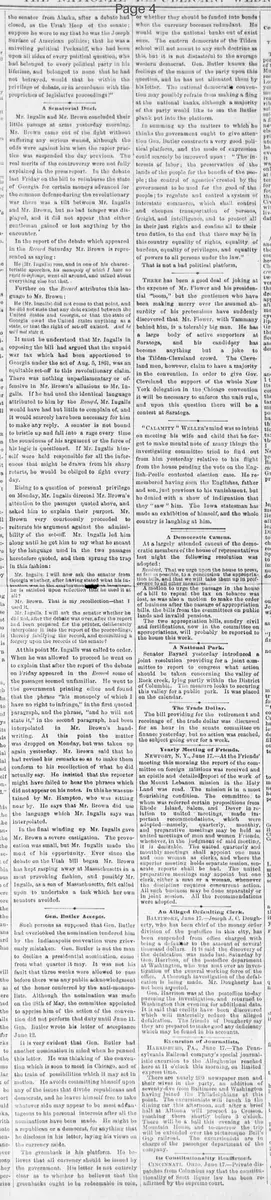
Such persons as supposed that Gen. Butler had overlooked the nomination tendered him by the Indianapolis convention were grievously mistaken. Gen. Butler is not the man to decline a presidential nomination, come from what quarter it may. It was not his fault that three weeks were allowed to pass before there was any public acknowledgment of the honor conferred by the anti-monopolists. Although the nomination was made on the 28th of May, the committee appointed to apprise him of the action of the convention did not perform that duty until June 11. Gen. Butler wrote his letter of acceptance June 12.
It is very evident that Gen. Butler had another nomination in mind when he penned this letter. He was thinking of the convention which is soon to meet in Chicago, and of the train of possibilities which it may set in motion. He avoids committing himself upon any of the issues that divide republicans and democrats, and he leaves himself free to take whatever side may appear to be most advantageous to his personal interests after all the nominations have been made. He might be a republican or a democrat, for anything that he discloses in his letter, laying his views on the currency inside.
The greenback is his platform. He believes that all currency should be issued by the government. His letter is not entirely clear as to whether he believes that the greenbacks ought to be redeemable in coin, or whether they should be funded into bonds when the currency becomes redundant. He would wipe the national banks out of existence. The eastern democrats of the Tilden school will not assent to any such doctrine as this, but it is not distasteful to the average western democrat. Gen. Butler knows the feelings of the masses of the party upon this question, and he has not alienated them by his letter. The national democratic convention may possibly refrain from making a fling at the national banks, although a majority of the party would like to see the Butler plank put into the platform.
In summing up the matters to which he thinks the government ought to give attention Gen. Butler constructs a very good political platform, and the mode of expression could scarcely be improved upon: "The interests of labor; the preservation of the lands of the people for the benefit of the people; the control of agencies created by the government to be used for the good of the people; to regulate and control a system of interstate commerce, which shall control and cheapen transportation of persons, freight, and intelligence, and to protect all in their just rights and confine all to their true duties, to the end that there may be in this country equality of rights, equality of burdens, equality of privileges, and equality of powers to all persons under the law."
That is not a bad political platform.
There has been a good deal of joking at the expense of Mr. Flower and his presidential "boom," but the gentlemen who have been making merry over the assumed absurdity of his pretensions have suddenly discovered that Mr. Flower, with Tammany behind him, is a tolerably big man. He has a large body of active supporters at Saratoga, and his candidacy has become anything but a joke to the Tilden-Cleveland crowd. The Cleveland men, however, claim to have a majority in the convention. In order to give Gov. Cleveland the support of the whole New York delegation in the Chicago convention it will be necessary to enforce the unit rule, and upon this question there will be a contest at Saratoga.
What sub-type of article is it?
What themes does it cover?
What keywords are associated?
What entities or persons were involved?
Where did it happen?
Story Details
Key Persons
Location
Indianapolis, Chicago, Saratoga, New York
Event Date
May 28, June 11, June 12
Story Details
Gen. Butler accepts presidential nomination from Indianapolis anti-monopolist convention after delay, pens letter outlining greenback currency views, advocates government-issued money, abolition of national banks, and platform emphasizing labor interests, public lands, interstate commerce regulation, and equality of rights, burdens, privileges, and powers; keeps options open for Republican or Democratic nominations; mentions Mr. Flower's candidacy with Tammany support challenging Tilden-Cleveland at Saratoga.