Thank you for visiting SNEWPapers!
Sign up free
Phenix Gazette
Alexandria, Virginia
What is this article about?
A Fairfax Farmer writes to Virginia's congressional representatives advocating for the proposed tariff, which would reduce imports by about $16 million, boosting domestic production in wool, grain for spirits, and manufacturing, particularly benefiting Virginia's agriculture and unemployed labor.
Merged-components note: The table of import values is directly referenced and part of the letter to the editor discussing the tariff; merging table into the letter component due to content and spatial continuity.
Clipping
OCR Quality
Full Text
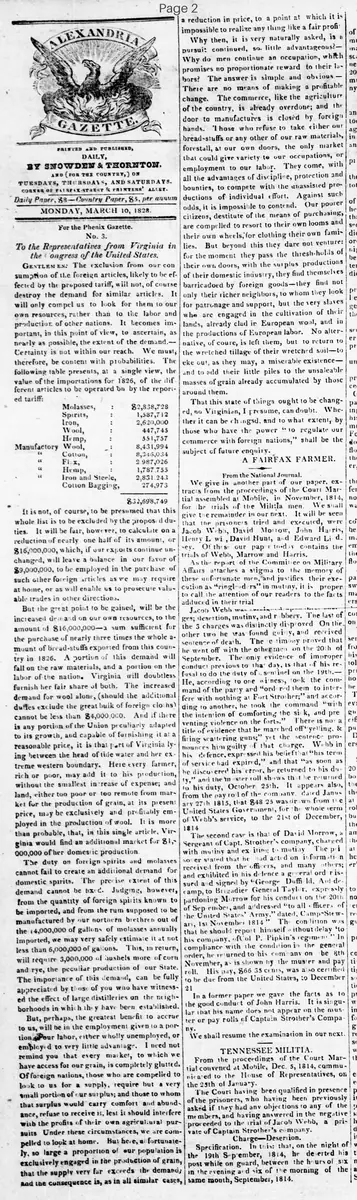
| Molasses, | : | $2,838,728 | |
| Spirits, | : | 1,587,712 | |
| Iron, | : | 2,620,000 | |
| Wool, | : | 447,745 | |
| Hemp, | : | 551,757 | |
| Manufactory | Wool, | : | 8,431,994 |
| Cotton, | : | 8,346,034 | |
| Flex, | : | 2,987,026 | |
| Hemp, | : | 1,787,755 | |
| Iron and Steele, | : | 2,831,243 | |
| Cotton Bagging, | : | 274,973 |
For the Phenix Gazette.
No. 3.
To the Representatives from Virginia in the Congress of the United States.
Gentlemen: The exclusion from our consumption of the foreign articles, likely to be effected by the proposed tariff, will not, of course, destroy the demand for similar articles. It will only compel us to look for them to our own resources, rather than to the labor and production of other nations. It becomes important, in this point of view, to ascertain, as nearly as possible, the extent of the demand.—Certainty is not within our reach. We must, therefore, be content with probabilities. The following table presents, at a single view, the value of the importations for 1826, of the different articles to be operated on by the reported tariff:
$32,698,749
It is not, of course, to be presumed that this whole list is to be excluded by the proposed duties. It will be fair, however, to calculate on a reduction of nearly one half of its amount, or $16,000,000, which, if our exports continue unchanged, will leave a balance in our favor of $9,000,000, to be employed in the purchase of such other foreign articles as we may require at home, or as will enable us to prosecute valuable trades in other directions.
But the great point to be gained, will be the increased demand on our own resources, to the amount of $16,000,000—a sum sufficient for the purchase of nearly three times the whole amount of bread-stuffs exported from this country in 1826. A portion of this demand will fall on the raw materials, and a portion on the labor of the nation. Virginia will doubtless furnish her fair share of both. The increased demand for wool alone, (should the additional duties exclude the great bulk of foreign cloths) cannot be less than $400,000. And if there is any portion of the Union peculiarly adapted to its growth, and capable of furnishing it at a reasonable price, it is that part of Virginia lying between the head of tide water and her extreme western boundary. Here every farmer, rich or poor, may add it to his production, without the smallest increase of expense; and land, either too poor or too remote from market for the production of grain, at its present price, may be exclusively and profitably employed in the production of wool. It is more than probable, that, in this single article, Virginia would find an additional market for $1,000,000 of her domestic production.
The duty on foreign spirits and molasses cannot fail to create an additional demand for domestic spirits. The precise extent of this demand cannot be fixed. Judging, however, from the quantity of foreign spirits known to be imported, and from the rum supposed to be manufactured by our northern brethren out of the 14,000,000 of gallons of molasses annually imported, we may very safely estimate it at not less than 6,000,000 of gallons. This, in return, will require 3,000,000 of bushels more of corn and rye, the peculiar production of our State. The importance of this demand, can be fully appreciated by those of you who have witnessed the effect of large distilleries on the neighborhoods in which they have been established.
But, perhaps, the greatest benefit to accrue to us, will be in the employment given to a portion of our labor, either wholly unemployed, or employed to very little advantage. I need not remind you that every market, to which we have access for our grain, is completely glutted. Of foreign nations, those who are compelled to look to us for a supply, require but a very small portion of our surplus; and those to whom that surplus would carry comfort and abundance, refuse to receive it, lest it should interfere with the profits of their own agricultural pursuits. Under these circumstances, we are compelled to look at home. But here, unfortunately, so large a proportion of our population is exclusively engaged in the production of grain, that the supply very far exceeds the demand; and the consequence is, as in all similar cases, a reduction in price, to a point at which it is impossible to realize any thing like a fair profit.
Why then, it is very naturally asked, is a pursuit continued, so little advantageous?—Why do men continue an occupation, which promises no proportionate reward to their labors? The answer is simple and obvious—There are no means of making a profitable change. The commerce, like the agriculture of the country, is already overdone; and the door to manufactures is closed by foreign hands. Those who refuse to take either our bread-stuffs or any other of our raw materials, forestall, at our own doors, the only market that could give variety to our occupations, or employment to our labor. They come, with all the advantages of discipline, protection and bounties, to compete with the unassisted productions of individual effort. Against such odds, it is impossible to contend. Our poorer citizens, destitute of the means of purchasing, are compelled to resort to their own looms and their own wheels, for clothing their own families. But beyond this they dare not venture: for the moment they pass the threshold of their own doors, with the surplus productions of their domestic industry, they find themselves barricaded by foreign goods—they find not only their richer neighbors, to whom they look for patronage and support, but the very slaves who are engaged in the cultivation of their lands, already clad in European wool, and in the productions of European labor. No alternative, of course, is left them, but to return to the wretched tillage of their wretched soil—to eke out, as they may, a miserable existence—and to add their little piles to the unsaleable masses of grain already accumulated by those around them.
That this state of things ought to be changed, no Virginian, I presume, can doubt. Whether it can be changed, and to what extent, by those who have the power "to regulate our commerce with foreign nations," shall be the subject of future enquiry.
A FAIRFAX FARMER.
What sub-type of article is it?
What themes does it cover?
What keywords are associated?
What entities or persons were involved?
Letter to Editor Details
Author
A Fairfax Farmer
Recipient
To The Representatives From Virginia In The Congress Of The United States
Main Argument
the proposed tariff will reduce foreign imports by approximately $16 million, stimulating domestic production and demand for virginia's wool, grain for spirits, and labor, thereby improving agricultural markets and employment opportunities.
Notable Details