Thank you for visiting SNEWPapers!
Sign up free
The Wheeling Repository
Wheeling, Ohio County, West Virginia
What is this article about?
In the Orleans Territory Legislature, a debate arises over a memorial against General Wilkinson's tyrannical actions during a perceived crisis. Mr. Hughes delivers a bold speech criticizing delays, defending the memorial's mildness, and decrying the oppression and loss of freedoms, likening it to military despotism. The memorial is ultimately lost after two days of debate.
Merged-components note: Continuation of the reported speech by Mr. Hughes across pages 4-5; label adjusted to story for narrative report of political speech, overriding editorial.
Clippings
1 of 2
OCR Quality
Full Text
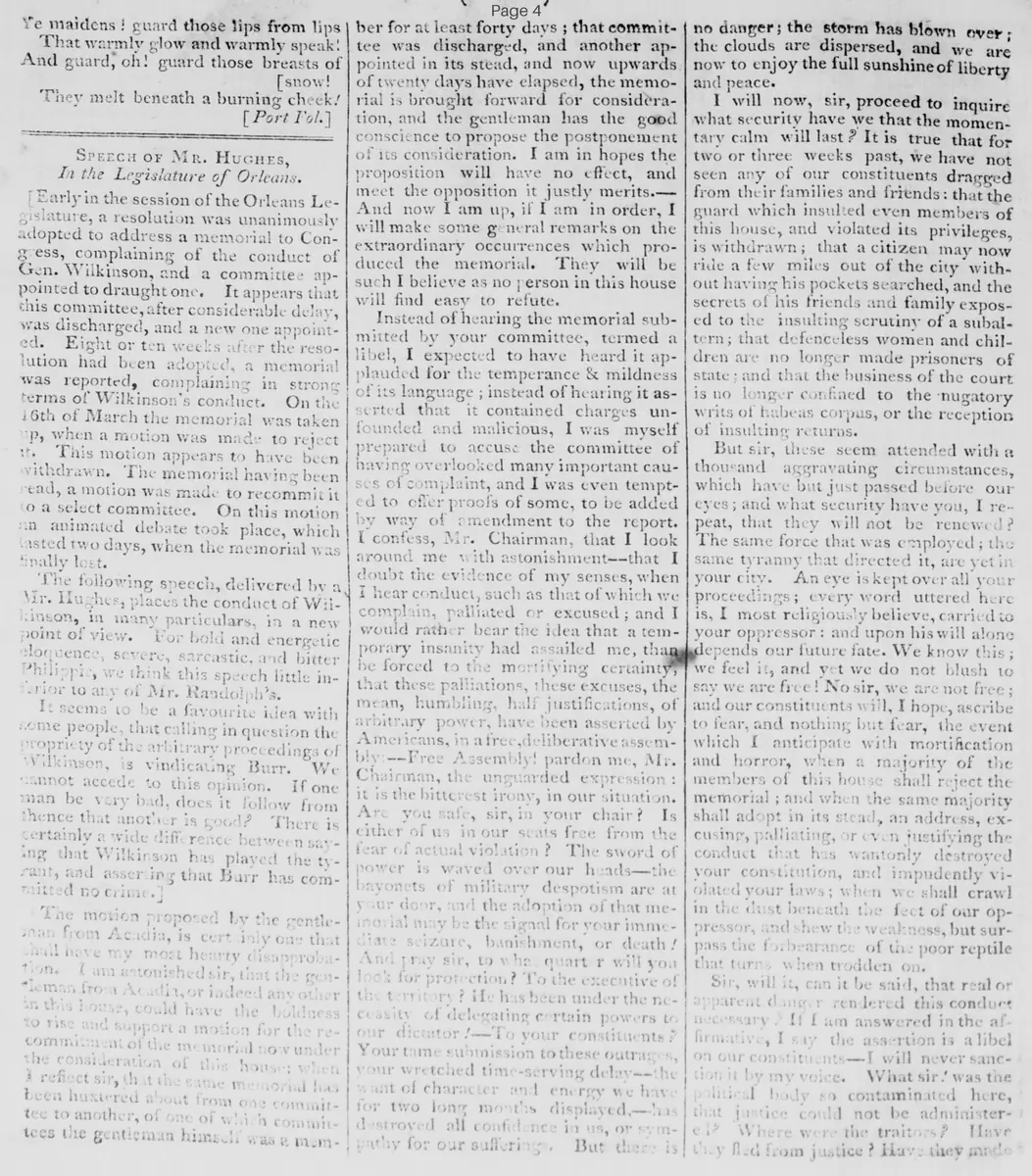
In the Legislature of Orleans.
Early in the session of the Orleans Legislature, a resolution was unanimously adopted to address a memorial to Congress, complaining of the conduct of Gen. Wilkinson, and a committee appointed to draft one. It appears that this committee, after considerable delay, was discharged, and a new one appointed. Eight or ten weeks after the resolution had been adopted, a memorial was reported, complaining in strong terms of Wilkinson's conduct.
On the 16th of March the memorial was taken up, when a motion was made to reject it. This motion appears to have been withdrawn. The memorial having been read, a motion was made to recommit it to a select committee. On this motion an animated debate took place, which lasted two days, when the memorial was finally lost.
The following speech, delivered by Mr. Hughes, places the conduct of Wilkinson, in many particulars, in a new point of view. For bold and energetic eloquence, severe, sarcastic, and bitter philippic, we think this speech little inferior to any of Mr. Randolph's.
It seems to be a favourite idea with some people, that calling in question the propriety of the arbitrary proceedings of Wilkinson, is vindicating Burr. We cannot accede to this opinion. If one man be very bad, does it follow from thence that another is good? There is certainly a wide difference between saying that Wilkinson has played the tyrant, and asserting that Burr has committed no crime.
The motion proposed by the gentleman from Acadia, is certainly one that shall have my most hearty disapprobation. I am astonished sir, that the gentleman from Acadia, or indeed any other in this house, could have the boldness to rise and support a motion for the recommittal of the memorial now under the consideration of this house; when I reflect sir, that the same memorial has been hustled about from one committee to another, one of which committees the gentleman himself was a member for at least forty days; that committee was discharged, and another appointed in its stead, and now upwards of twenty days have elapsed, the memorial is brought forward for consideration, and the gentleman has the good conscience to propose the postponement of its consideration. I am in hopes the proposition will have no effect, and meet the opposition it justly merits.
And now I am up, if I am in order, I will make some general remarks on the extraordinary occurrences which produced the memorial. They will be such I believe as no person in this house will find easy to refute.
Instead of hearing the memorial submitted by your committee, termed a libel, I expected to have heard it applauded for the temperance & mildness of its language; instead of hearing it asserted that it contained charges unfounded and malicious, I was myself prepared to accuse the committee of having overlooked many important causes of complaint, and I was even tempted to offer proofs of some, to be added by way of amendment to the report.
I confess, Mr. Chairman, that I look around me with astonishment—that I doubt the evidence of my senses, when I hear conduct, such as that of which we complain, palliated or excused; and I would rather bear the idea that a temporary insanity had assailed me, than be forced to the mortifying certainty, that these palliations, these excuses, the mean, humbling, half justifications, of arbitrary power, have been asserted by Americans, in a free, deliberative assembly—Free Assembly! pardon me, Mr. Chairman, the unguarded expression: it is the bitterest irony, in our situation.
Are you safe, sir, in your chair? Is either of us in our seats free from the fear of actual violation? The sword of power is waved over our heads—the bayonets of military despotism are at your door, and the adoption of that memorial may be the signal for your immediate seizure, banishment, or death!
And pray sir, to whom quarter will you look for protection? To the executive of the territory? He has been under the necessity of delegating certain powers to our dictator!—To your constituents? Your tame submission to these outrages, your wretched time-serving delay—the want of character and energy we have for two long months displayed,—has destroyed all confidence in us, or sympathy for our sufferings. But there is no danger; the storm has blown over; the clouds are dispersed, and we are now to enjoy the full sunshine of liberty and peace.
I will now, sir, proceed to inquire what security have we that the momentary calm will last? It is true that for two or three weeks past, we have not seen any of our constituents dragged from their families and friends: that the guard which insulted even members of this house, and violated its privileges, is withdrawn; that a citizen may now ride a few miles out of the city without having his pockets searched, and the secrets of his friends and family exposed to the insulting scrutiny of a subaltern; that defenceless women and children are no longer made prisoners of state; and that the business of the court is no longer confined to the nugatory writs of habeas corpus, or the reception of insulting returns.
But sir, these seem attended with a thousand aggravating circumstances, which have but just passed before our eyes; and what security have you, I repeat, that they will not be renewed? The same force that was employed; the same tyranny that directed it, are yet in your city. An eye is kept over all your proceedings; every word uttered here is, I most religiously believe, carried to your oppressor: and upon his will alone depends our future fate. We know this; we feel it, and yet we do not blush to say we are free! No sir, we are not free; and our constituents will, I hope, ascribe to fear, and nothing but fear, the event which I anticipate with mortification and horror, when a majority of the members of this house shall reject the memorial; and when the same majority shall adopt in its stead, an address, excusing, palliating, or even justifying the conduct that has wantonly destroyed your constitution, and impudently violated your laws; when we shall crawl in the dust beneath the feet of our oppressor, and shew the weakness, but surpass the forbearance of the poor reptile that turns when trodden on.
Sir, will it, can it be said, that real or apparent danger rendered this conduct necessary? If I am answered in the affirmative, I say the assertion is a libel on our constituents—I will never sanction it by my voice. What sir! was the political body so contaminated here, that justice could not be administered? Where were the traitors? Have they fled from justice? Have they made their escape from this city? Why are they not now dragged to justice? Why are their names concealed from an indignant public? Because neither treason nor traitors existed in the country thus calumniated! because the idea originated in the mind of a man, who wanted by the excess of a new-born zeal, to cover the suspicions of guilt, and who hoped to stop the investigation of his own conduct, by magnifying the danger from which he wished to have us believe his services had delivered us!
The letters, the papers and the persons, nay even the private conversations of the inhabitants of this territory, have for three months been under the absolute control of the public officers. If treason had existed in this territory, it would in vain have endeavored to escape detection--If the people were so disaffected, that they were ready to snatch the culprit from the hands of justice--if the judges could not be trusted to commit, nor juries to pronounce on the guilt of the delinquents, surely with such means, and so inquisitorially examined, some evidence of the fact would have been produced; some document, some declaration; some bottled conversation; some confidential communication would have been drawn forth from the secrecy in which friendship and honor had buried them, to bear testimony of guilt, so as at least to justify suspicion.
I therefore repeat, and so long as my feeble voice can be heard, I will continue to proclaim, that our constituents have been vilely calumniated, as well as cruelly oppressed: that insult has been added to injury; and that their imaginary disaffection has been slanderously alleged as an excuse for their real oppression. Away then sir, with the degrading excuse derived from domestic treason or disaffection. It is one that will surely find no favor with the executive of the United States, who has borne honorable testimony to the readiness with which the force of the territory was, in a moment of danger, offered to support the Union; nor will it be believed here, when we have seen our most respectable citizens performing the drudgery of garrison duty, and condescending, even on the mere allegation of the General, to undertake the task of executing orders odious in themselves, and which I am sure must have been doubly disagreeable to them, both as free citizens, and men of respectability in society.
[To be continued.]
What sub-type of article is it?
What themes does it cover?
What keywords are associated?
What entities or persons were involved?
Where did it happen?
Story Details
Key Persons
Location
Orleans
Event Date
16th Of March
Story Details
Mr. Hughes delivers a passionate speech in the Orleans Legislature opposing the recommittal of a memorial complaining of Gen. Wilkinson's arbitrary and tyrannical conduct, criticizing delays in the process, defending the territory's loyalty, and warning against excusing military despotism.