Thank you for visiting SNEWPapers!
Sign up free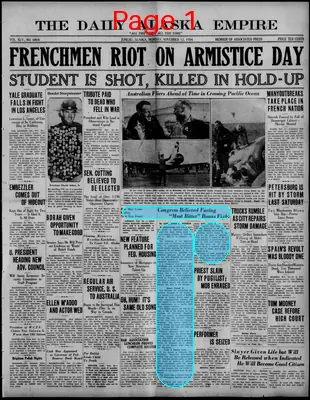
The Daily Alaska Empire
Juneau, Juneau County, Alaska
What is this article about?
Prospective intense congressional battle over veterans' bonus payment, led by Patman, against Roosevelt's warnings on recovery program impacts. Bill previously passed House but failed Senate; expected to pass but face veto. Involves $2-2.4B payout to 3.5M veterans.
Clipping
OCR Quality
Full Text
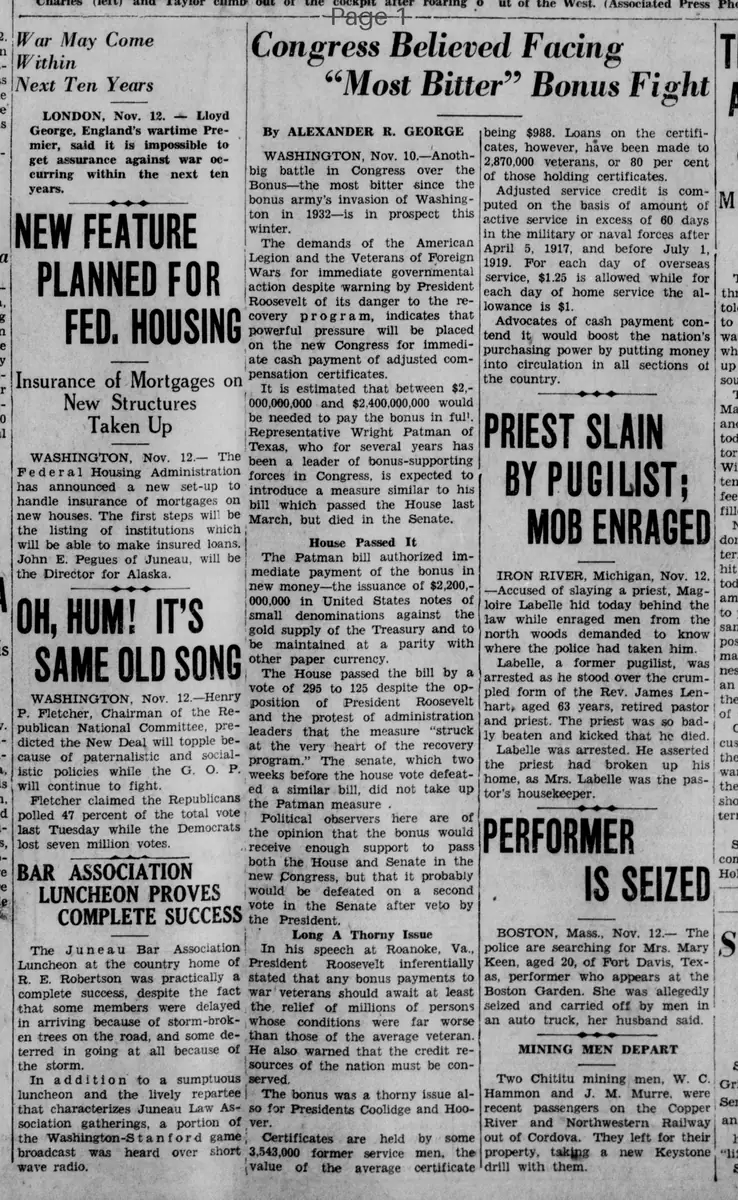
By ALEXANDER R. GEORGE
WASHINGTON. Nov. 10.-Another big battle in Congress over the Bonus-the most bitter since the bonus army's invasion of Washington in 1932-is in prospect this winter.
The demands of the American Legion and the Veterans of Foreign Wars for immediate governmental action despite warning by President Roosevelt of its danger to the recovery program, indicates that powerful pressure will be placed on the new Congress for immediate cash payment of adjusted compensation certificates.
It is estimated that between $2,000,000,000-and $2.400,000,000 would be needed to pay the bonus in full.
Representative Wright Patman of Texas, who for several years has been a leader of bonus-supporting forces in Congress, is expected to introduce a measure similar to his bill which passed the House last March, but died in the Senate.
House Passed It
The Patman bill authorized immediate payment of the bonus in new money-the issuance of $2,200,000,000 in United States notes of small denominations against the gold supply of the Treasury and to be maintained at a parity with other paper currency.
The House passed the bill by a vote of 295 to 125 despite the opposition of President Roosevelt and the protest of administration leaders that the measure "struck at the very heart of the recovery program." The senate. which two weeks before the house vote defeated a similar bill, did not take up the Patman measure .
Political observers here are of the opinion that the bonus would receive enough support to pass both the House and Senate in the new Congress. but that it probably would be defeated on a second vote in the Senate after veto by the President.
Long A Thorny Issue
In his speech at Roanoke, Va., President Roosevelt inferentially stated that any bonus payments to war veterans should await at least the. relief of millions of persons whose conditions were far worse than those of the average veteran.
He also warned that the credit resources of the nation must be conserved.
The bonus was a thorny issue al- so for Presidents Coolidge and Hoo- ver.
Certificates are held by some 3,543,000 former service men, the value of the average certificate being $988. Loans on the certifi- cates, however. have been made to 2,870,000 veterans, or 80 per cent of those holding certificates.
Adiusted service credit is com- puted on the basis of amount of active service in excess of 60 days in the military or naval forces after April 5, 1917, and before July 1, 1919. For each day of overseas service. $1.25 is allowed while for each day of home service the al- lowance is $1.
Advocates of cash payment con- tend it would boost the nation's purchasing power by putting money into circulation in all sections of the country.
What sub-type of article is it?
What themes does it cover?
What keywords are associated?
What entities or persons were involved?
Where did it happen?
Story Details
Key Persons
Location
Washington
Event Date
Nov. 10
Story Details
Congress anticipates a bitter fight over immediate cash payment of veterans' adjusted compensation certificates, estimated at $2-2.4 billion, pushed by veterans' groups despite Roosevelt's opposition citing risks to economic recovery. Patman to reintroduce his bill for payment via new currency, which passed House but died in Senate previously. Observers predict passage in new Congress but likely veto by President.