Thank you for visiting SNEWPapers!
Sign up free
The Evening Bulletin
Maysville, Mason County, Kentucky
What is this article about?
Leading Democrats discuss the possibility of an extra session of Congress after Cleveland's inauguration to address tariff legislation and financial issues, with mixed opinions from Rep. W. L. Wilson, Sen. John G. Carlisle, and President-Elect Cleveland in Washington and New York on Nov. 17.
Merged-components note: These two components continue the same article discussing the prospects of an extra session of Congress, with sequential reading orders and adjacent bounding boxes on the same page.
Clipping
OCR Quality
Full Text
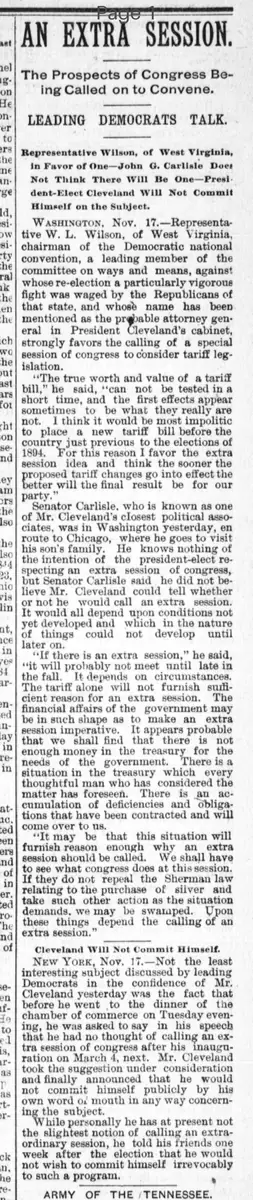
The Prospects of Congress Being Called on to Convene.
LEADING DEMOCRATS TALK.
Representative Wilson, of West Virginia, in Favor of One—John G. Carlisle Does Not Think There Will Be One—President-Elect Cleveland Will Not Commit Himself on the Subject.
WASHINGTON, Nov. 17.—Representative W. L. Wilson, of West Virginia, chairman of the Democratic national convention, a leading member of the committee on ways and means, against whose re-election a particularly vigorous fight was waged by the Republicans of that state, and whose name has been mentioned as the probable attorney general in President Cleveland's cabinet, strongly favors the calling of a special session of congress to consider tariff legislation.
"The true worth and value of a tariff bill," he said, "can not be tested in a short time, and the first effects appear sometimes to be what they really are not. I think it would be most impolitic to place a new tariff bill before the country just previous to the elections of 1894. For this reason I favor the extra session idea and think the sooner the proposed tariff changes go into effect the better will the final result be for our party."
Senator Carlisle, who is known as one of Mr. Cleveland's closest political associates, was in Washington yesterday, en route to Chicago, where he goes to visit his son's family. He knows nothing of the intention of the president-elect respecting an extra session of congress, but Senator Carlisle said he did not believe Mr. Cleveland could tell whether or not he would call an extra session. It would all depend upon conditions not yet developed and which in the nature of things could not develop until later on.
"If there is an extra session," he said, "it will probably not meet until late in the fall." It depends on circumstances. The tariff alone will not furnish sufficient reason for an extra session. The financial affairs of the government may be in such shape as to make an extra session imperative. It appears probable that we shall find that there is not enough money in the treasury for the needs of the government. There is a situation in the treasury which every thoughtful man who has considered the matter has foreseen. There is an accumulation of deficiencies and obligations that have been contracted and will come over to us.
"It may be that this situation will furnish reason enough why an extra session should be called. We shall have to see what congress does at this session. If they do not repeal the Sherman law relating to the purchase of silver and take such other action as the situation demands, we may be swamped. Upon these things depend the calling of an extra session."
Cleveland Will Not Commit Himself
NEW YORK, Nov. 17.—Not the least interesting subject discussed by leading Democrats in the confidence of Mr. Cleveland yesterday was the fact that before he went to the dinner of the chamber of commerce on Tuesday evening, he was asked to say in his speech that he had no thought of calling an extra session of congress after his inauguration on March 4, next. Mr. Cleveland took the suggestion under consideration and finally announced that he would not commit himself publicly by his own word or mouth in any way concerning the subject.
While personally he has at present not the slightest notion of calling an extraordinary session, he told his friends one week after the election that he would not wish to commit himself irrevocably to such a program.
What sub-type of article is it?
What keywords are associated?
What entities or persons were involved?
Where did it happen?
Domestic News Details
Primary Location
Washington
Event Date
Nov. 17
Key Persons
Event Details
Representative W. L. Wilson favors calling a special session of Congress for tariff legislation to avoid timing issues before 1894 elections. Senator John G. Carlisle doubts an extra session, citing dependency on financial conditions like treasury shortages and potential repeal of the Sherman silver purchase law. President-Elect Cleveland refuses to commit publicly on calling an extraordinary session after his March 4 inauguration.