Thank you for visiting SNEWPapers!
Sign up free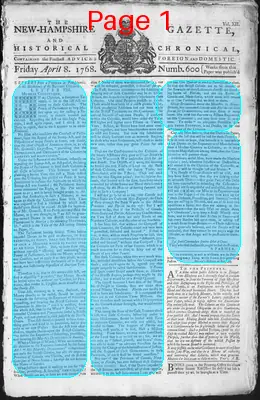
Literary
April 8, 1768
The New Hampshire Gazette And Historical Chronicle
Portsmouth, Greenland, Rockingham County, New Hampshire
What is this article about?
Letter VII from 'Letters from a Farmer in Pennsylvania' argues that the British Parliament's recent act to levy duties on the colonies for revenue is unconstitutional, asserting power over them without consent. It criticizes funding non-colonial territories like Canada and Florida at the colonies' expense, highlighting injustice and threats to liberty.
Clipping
OCR Quality
95%
Excellent
Full Text
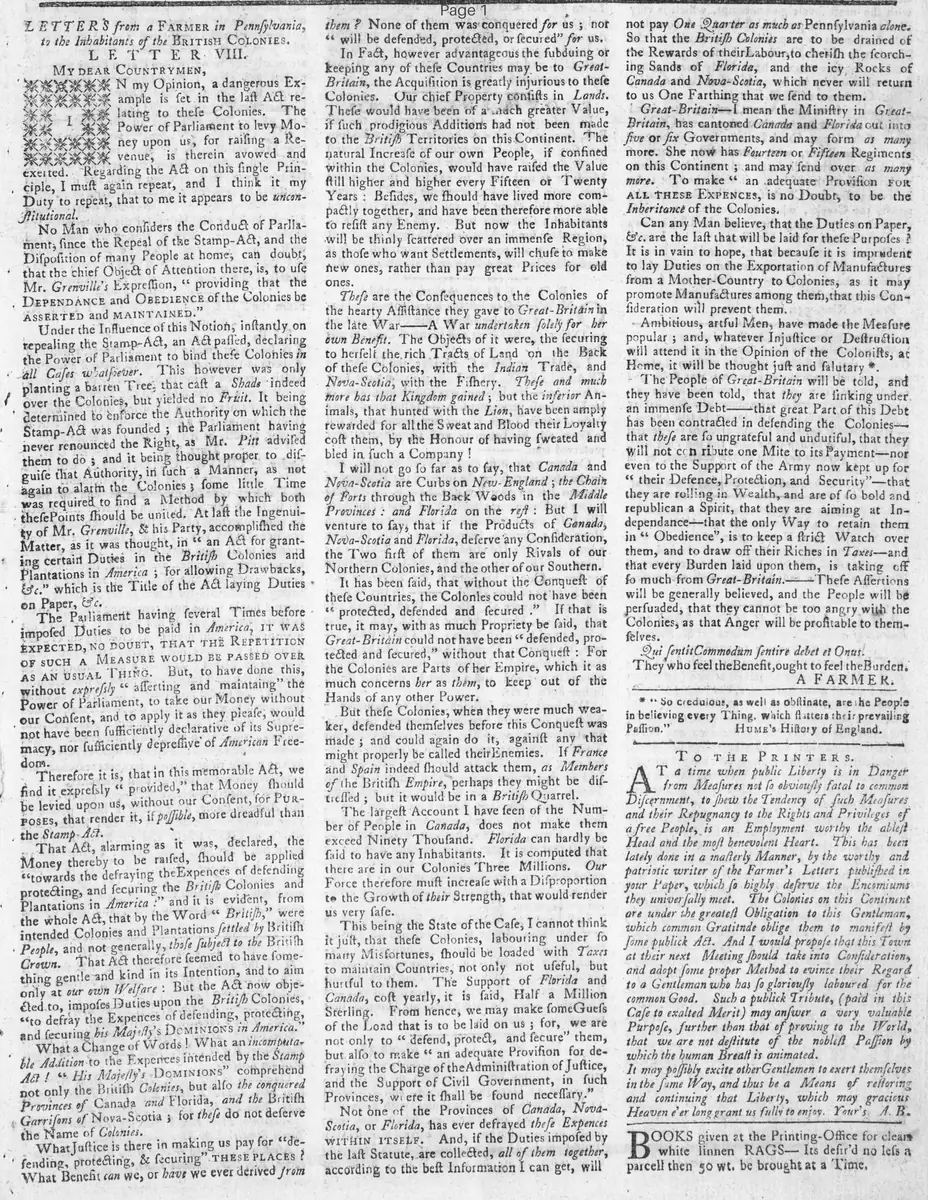
LETTERS from a FARMER in Pennsylvania, to the Inhabitants of the British Colonies.
LETTER VII.
My Dear Countrymen,
In my Opinion, a dangerous Example is set in the late Act relating to these Colonies. The Power of Parliament to levy Money upon us, for raising a Revenue, is therein avowed and exerted. Regarding the Act on this single Principle, I must again repeat, and I think it my Duty to repeat, that to me it appears to be unconstitutional.
No Man who considers the Conduct of Parliament since the Repeal of the Stamp-Act, and the Disposition of many People at home, can doubt that the chief Object of Attention there, is, to use Mr. Grenville's Expression, "providing that the Dependence and Obedience of the Colonies be ASSERTED AND MAINTAINED."
Under the Influence of this Notion, instantly on repealing the Stamp-Act, an Act passed, declaring the Power of Parliament to bind these Colonies in all Cases whatsoever. This however was only planting a barren Tree, that cast a Shade indeed over the Colonies, but yielded no Fruit. It being determined to enforce the Authority on which the Stamp-Act was founded; the Parliament having never renounced the Right, as Mr. Pitt advised them to do; and it being thought proper to disguise that Authority, in such a Manner, as not to alarm them to do; and it being thought proper to disunite these Points should be united. At last the Ingenuity of Mr. Grenville, & his Party, accomplished the Matter, as it was thought, in "an Act for granting certain Duties in the British Colonies and Plantations in America; for allowing Drawbacks," &c. which is the Title of the Act laying Duties on Paper, &c.
The Parliament having several Times before imposed Duties to be paid in America, IT WAS EXPECTED, NO DOUBT, THAT THE REPETITION OF SUCH A MEASURE WOULD BE PASSED OVER As An USUAL THING. But, to have done this, without expressly "asserting and maintaining" the Power of Parliament, to take our Money without our Consent, and to apply it as they please: would not have been sufficiently declarative of its Supremacy, nor sufficiently depressive of American Freedom.
Therefore it is: that in this memorable Act, we find it expressly "provided," that Money should be levied upon us, without our Consent, for Purposes, that render it, if possible, more dreadful than the Stamp-Act.
That Act, alarming as it was, declared, the Money thereby to be raised, should be applied "towards the defraying the Expences of defending, protecting, and securing the British Colonies and Plantations in America:" and it is evident, from the whole Act, that by the Word "British," were intended Colonies and Plantations Settled by British People, and not generally, those subject to the British Crown. That Act therefore seemed to have something gentle and kind in its Intention, and to aim only at our own Welfare: But the Act now objected to, imposes Duties upon the British Colonies, "to defray the Expences of defending, protecting, and securing his Majesty's Dominions in America."
What a Change of Words! What an incomputable Addition to the Expences intended by the Stamp Act! "His Majesty's Dominions" comprehend not only the British Colonies, but also the conquered Provinces of Canada and Florida, and the British Garrisons of Nova-Scotia; for these do not deserve the Name of Colonies.
What Justice is there in making us pay for "defending, protecting, & securing" THESE PLACES?
What Benefit can we, or have we ever derived from them? None of them was conquered for us; not one of them will be defended, protected, or secured for us. In Fact, however advantageous the subduing or keeping any of these Countries may be to Great-Britain, the Acquisition is greatly injurious to these Colonies. Our chief Property consists in Lands. These would have been of a much greater Value, if such prodigious Additions had not been made to the British Territories on this Continent. The natural Increase of our own People, if confined within the Colonies, would have raised the Value still higher and higher every Fifteen or Twenty Years: Besides, we should have lived more compactly together, and have been therefore more able to resist any Enemy. But now the Inhabitants will be thinly scattered over an immense Region, as those who want Settlements, will chuse to make new ones, rather than pay great Prices for old ones.
These are the Consequences to the Colonies of the hearty Assistance they gave to Great-Britain in the late War—A War undertaken Solely for her own Benefit. The Objects of it were, the securing to herself the rich Tracts of Land on the Back of these Colonies, with the Indian Trade, and Nova-Scotia, with the Fishery. These and much more has that Kingdom gained: but the inferior Animals, that hunted with the Lion, have been amply rewarded for all the Sweat and Blood their Loyalty cost them, by the Honour of having sweated and bled in such a Company!
I will not go so far as to say, that Canada and Nova-Scotia are Curbs on New-England: the Chain of Forts through the Back Woods in the Middle Provinces: and Florida on the South: But I will venture to say, that if the Products of Canada, Nova-Scotia and Florida, deserve any Consideration, the Two first of them are only Rivals of our Northern Colonies, and the other of our Southern.
It has been said, that without the Conquest of these Countries, the Colonies could not have been protected, defended and secured. If that is true, it may, with as much Propriety be said, that Great-Britain could not have been "defended, protected and secured," without that Conquest: For the Colonies are Parts of her Empire, which it as much concerns her as them, to keep out of the Hands of any other Power.
But these Colonies, when they were much weaker, defended themselves before this Conquest was made; and could again do it, against any that might properly be called their Enemies. If France and Spain indeed should attack them, as Members of the British Empire, perhaps they might be distressed; but it would be in a British Quarrel.
The largest Account I have seen of the Number of People in Canada, does not make them exceed Ninety Thousand. Florida can hardly be said to have any Inhabitants. It is computed that there are in our Colonies Three Millions. Our Force therefore must increase with a Disproportion to the Growth of their Strength, that would render us very safe.
This being the State of the Case, I cannot think it just, that these Colonies, labouring under so many Misfortunes, Should be loaded with Taxes to maintain Countries, not only not useful, but hurtful to them. The Support of Florida and Canada, cost yearly, it is said, Half a Million Sterling. From hence, we may make some Guess of the Load that is to be laid on us; for, we are not only to "defend, protect, and secure" them, but also to make "an adequate Provision for defraying the Charge of the Administration of Justice, and the Support of Civil Government, in such Provinces, where it shall be found necessary."
Not one of the Provinces of Canada, Nova-Scotia, or Florida, has ever defrayed these Expences within itself. And, if the Duties imposed by the late Statute, are collected, all of them together, according to the best Information I can get, will not pay One Quarter as much as Pennsylvania alone. So that the British Colonies are to be drained of the Rewards of their Labour, to cherish the scorching Sands of Florida, and the icy Rocks of Canada and Nova-Scotia, which never will return to us One Farthing that we send to them. Great-Britain—I mean the Ministry in Great-Britain, has cantoned Canada and Florida out into five or six Governments, and may form as many more. She now has Fourteen or Fifteen Regiments on this Continent; and may send over as many more. To make "an adequate Provision For ALL THESE Expences, is no Doubt, to be the Inheritance of the Colonies.
Can any Man believe, that the Duties on Paper, &c. are the last that will be laid for these Purposes? It is in vain to hope, that because it is imprudent to lay Duties on the Exportation of Manufactures from a Mother-Country to Colonies, as it may promote Manufactures among them, that this Consideration will prevent them.
Ambitious, artful Men, have made the Measure popular; and, whatever Injustice or Destruction will attend it in the Opinion of the Colonies, at Home, it will be thought just and salutary.
The People of Great-Britain will be told, and they have been told, that they are sinking under an immense Debt—that great Part of this Debt has been contracted in defending the Colonies—that these are so ungrateful and undutiful, that they will not contribute one Mite to its Payment—nor even to the Support of the Army now kept up for "their Defence, Protection, and Security"—that they are rolling in Wealth, and are of so bold and republican a Spirit, that they are aiming at Independence—that the only Way to retain them in "Obedience", is to keep a strict Watch over them, and to draw off their Riches in Taxes—and that every Burden laid upon them, is taking off so much from Great-Britain. These Assertions will be generally believed, and the People will be persuaded, that they cannot be too angry with the Colonies, as that Anger will be profitable to themselves.
Qui sentit Commodum sentire debet et Onus.
They who feel the Benefit, ought to feel the Burden.
A FARMER.
* "So credulous, as well as obstinate, are the People in believing every Thing, which flatters their prevailing Passion."
Hume's History of England.
LETTER VII.
My Dear Countrymen,
In my Opinion, a dangerous Example is set in the late Act relating to these Colonies. The Power of Parliament to levy Money upon us, for raising a Revenue, is therein avowed and exerted. Regarding the Act on this single Principle, I must again repeat, and I think it my Duty to repeat, that to me it appears to be unconstitutional.
No Man who considers the Conduct of Parliament since the Repeal of the Stamp-Act, and the Disposition of many People at home, can doubt that the chief Object of Attention there, is, to use Mr. Grenville's Expression, "providing that the Dependence and Obedience of the Colonies be ASSERTED AND MAINTAINED."
Under the Influence of this Notion, instantly on repealing the Stamp-Act, an Act passed, declaring the Power of Parliament to bind these Colonies in all Cases whatsoever. This however was only planting a barren Tree, that cast a Shade indeed over the Colonies, but yielded no Fruit. It being determined to enforce the Authority on which the Stamp-Act was founded; the Parliament having never renounced the Right, as Mr. Pitt advised them to do; and it being thought proper to disguise that Authority, in such a Manner, as not to alarm them to do; and it being thought proper to disunite these Points should be united. At last the Ingenuity of Mr. Grenville, & his Party, accomplished the Matter, as it was thought, in "an Act for granting certain Duties in the British Colonies and Plantations in America; for allowing Drawbacks," &c. which is the Title of the Act laying Duties on Paper, &c.
The Parliament having several Times before imposed Duties to be paid in America, IT WAS EXPECTED, NO DOUBT, THAT THE REPETITION OF SUCH A MEASURE WOULD BE PASSED OVER As An USUAL THING. But, to have done this, without expressly "asserting and maintaining" the Power of Parliament, to take our Money without our Consent, and to apply it as they please: would not have been sufficiently declarative of its Supremacy, nor sufficiently depressive of American Freedom.
Therefore it is: that in this memorable Act, we find it expressly "provided," that Money should be levied upon us, without our Consent, for Purposes, that render it, if possible, more dreadful than the Stamp-Act.
That Act, alarming as it was, declared, the Money thereby to be raised, should be applied "towards the defraying the Expences of defending, protecting, and securing the British Colonies and Plantations in America:" and it is evident, from the whole Act, that by the Word "British," were intended Colonies and Plantations Settled by British People, and not generally, those subject to the British Crown. That Act therefore seemed to have something gentle and kind in its Intention, and to aim only at our own Welfare: But the Act now objected to, imposes Duties upon the British Colonies, "to defray the Expences of defending, protecting, and securing his Majesty's Dominions in America."
What a Change of Words! What an incomputable Addition to the Expences intended by the Stamp Act! "His Majesty's Dominions" comprehend not only the British Colonies, but also the conquered Provinces of Canada and Florida, and the British Garrisons of Nova-Scotia; for these do not deserve the Name of Colonies.
What Justice is there in making us pay for "defending, protecting, & securing" THESE PLACES?
What Benefit can we, or have we ever derived from them? None of them was conquered for us; not one of them will be defended, protected, or secured for us. In Fact, however advantageous the subduing or keeping any of these Countries may be to Great-Britain, the Acquisition is greatly injurious to these Colonies. Our chief Property consists in Lands. These would have been of a much greater Value, if such prodigious Additions had not been made to the British Territories on this Continent. The natural Increase of our own People, if confined within the Colonies, would have raised the Value still higher and higher every Fifteen or Twenty Years: Besides, we should have lived more compactly together, and have been therefore more able to resist any Enemy. But now the Inhabitants will be thinly scattered over an immense Region, as those who want Settlements, will chuse to make new ones, rather than pay great Prices for old ones.
These are the Consequences to the Colonies of the hearty Assistance they gave to Great-Britain in the late War—A War undertaken Solely for her own Benefit. The Objects of it were, the securing to herself the rich Tracts of Land on the Back of these Colonies, with the Indian Trade, and Nova-Scotia, with the Fishery. These and much more has that Kingdom gained: but the inferior Animals, that hunted with the Lion, have been amply rewarded for all the Sweat and Blood their Loyalty cost them, by the Honour of having sweated and bled in such a Company!
I will not go so far as to say, that Canada and Nova-Scotia are Curbs on New-England: the Chain of Forts through the Back Woods in the Middle Provinces: and Florida on the South: But I will venture to say, that if the Products of Canada, Nova-Scotia and Florida, deserve any Consideration, the Two first of them are only Rivals of our Northern Colonies, and the other of our Southern.
It has been said, that without the Conquest of these Countries, the Colonies could not have been protected, defended and secured. If that is true, it may, with as much Propriety be said, that Great-Britain could not have been "defended, protected and secured," without that Conquest: For the Colonies are Parts of her Empire, which it as much concerns her as them, to keep out of the Hands of any other Power.
But these Colonies, when they were much weaker, defended themselves before this Conquest was made; and could again do it, against any that might properly be called their Enemies. If France and Spain indeed should attack them, as Members of the British Empire, perhaps they might be distressed; but it would be in a British Quarrel.
The largest Account I have seen of the Number of People in Canada, does not make them exceed Ninety Thousand. Florida can hardly be said to have any Inhabitants. It is computed that there are in our Colonies Three Millions. Our Force therefore must increase with a Disproportion to the Growth of their Strength, that would render us very safe.
This being the State of the Case, I cannot think it just, that these Colonies, labouring under so many Misfortunes, Should be loaded with Taxes to maintain Countries, not only not useful, but hurtful to them. The Support of Florida and Canada, cost yearly, it is said, Half a Million Sterling. From hence, we may make some Guess of the Load that is to be laid on us; for, we are not only to "defend, protect, and secure" them, but also to make "an adequate Provision for defraying the Charge of the Administration of Justice, and the Support of Civil Government, in such Provinces, where it shall be found necessary."
Not one of the Provinces of Canada, Nova-Scotia, or Florida, has ever defrayed these Expences within itself. And, if the Duties imposed by the late Statute, are collected, all of them together, according to the best Information I can get, will not pay One Quarter as much as Pennsylvania alone. So that the British Colonies are to be drained of the Rewards of their Labour, to cherish the scorching Sands of Florida, and the icy Rocks of Canada and Nova-Scotia, which never will return to us One Farthing that we send to them. Great-Britain—I mean the Ministry in Great-Britain, has cantoned Canada and Florida out into five or six Governments, and may form as many more. She now has Fourteen or Fifteen Regiments on this Continent; and may send over as many more. To make "an adequate Provision For ALL THESE Expences, is no Doubt, to be the Inheritance of the Colonies.
Can any Man believe, that the Duties on Paper, &c. are the last that will be laid for these Purposes? It is in vain to hope, that because it is imprudent to lay Duties on the Exportation of Manufactures from a Mother-Country to Colonies, as it may promote Manufactures among them, that this Consideration will prevent them.
Ambitious, artful Men, have made the Measure popular; and, whatever Injustice or Destruction will attend it in the Opinion of the Colonies, at Home, it will be thought just and salutary.
The People of Great-Britain will be told, and they have been told, that they are sinking under an immense Debt—that great Part of this Debt has been contracted in defending the Colonies—that these are so ungrateful and undutiful, that they will not contribute one Mite to its Payment—nor even to the Support of the Army now kept up for "their Defence, Protection, and Security"—that they are rolling in Wealth, and are of so bold and republican a Spirit, that they are aiming at Independence—that the only Way to retain them in "Obedience", is to keep a strict Watch over them, and to draw off their Riches in Taxes—and that every Burden laid upon them, is taking off so much from Great-Britain. These Assertions will be generally believed, and the People will be persuaded, that they cannot be too angry with the Colonies, as that Anger will be profitable to themselves.
Qui sentit Commodum sentire debet et Onus.
They who feel the Benefit, ought to feel the Burden.
A FARMER.
* "So credulous, as well as obstinate, are the People in believing every Thing, which flatters their prevailing Passion."
Hume's History of England.
What sub-type of article is it?
Epistolary
Essay
What themes does it cover?
Political
Liberty Freedom
Taxation Oppression
What keywords are associated?
Colonial Taxation
Parliamentary Power
Stamp Act Repeal
Townshend Duties
American Liberty
British Empire
Canada Florida
Nova Scotia
What entities or persons were involved?
A Farmer.
Literary Details
Title
Letter Vii.
Author
A Farmer.
Subject
Against The Late Act Asserting Parliament's Power To Levy Money On The Colonies
Key Lines
The Power Of Parliament To Levy Money Upon Us, For Raising A Revenue, Is Therein Avowed And Exerted.
"Providing That The Dependence And Obedience Of The Colonies Be Asserted And Maintained."
What Justice Is There In Making Us Pay For "Defending, Protecting, & Securing" These Places?
These Are The Consequences To The Colonies Of The Hearty Assistance They Gave To Great Britain In The Late War—A War Undertaken Solely For Her Own Benefit.
Qui Sentit Commodum Sentire Debet Et Onus.
They Who Feel The Benefit, Ought To Feel The Burden.