Thank you for visiting SNEWPapers!
Sign up free
Daily National Intelligencer
Washington, District Of Columbia
What is this article about?
General William Henry Harrison reports the successful lifting of the British siege of Fort Meigs on May 9, 1813, including details of victorious sorties on May 5, prisoner exchanges with General Proctor, and commendations for officers.
Clipping
OCR Quality
Full Text
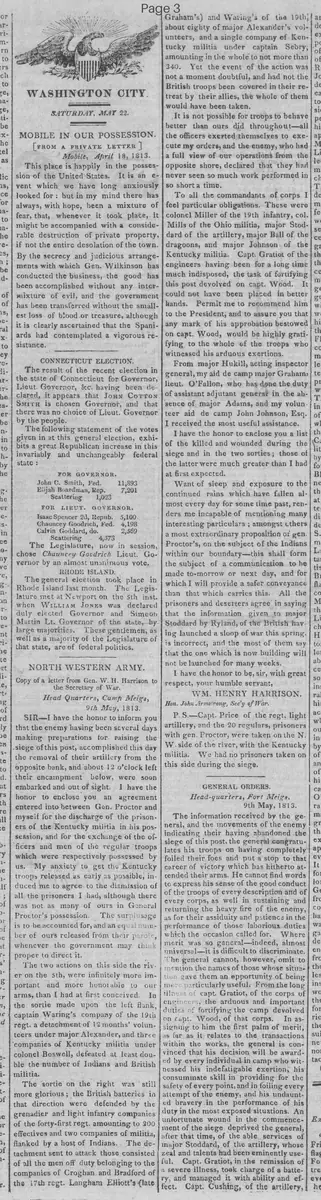
Copy of a letter from Gen. W. H. Harrison to the Secretary of War.
Head Quarters, Fort Meigs,
9th May, 1813.
SIR—I have the honor to inform you that the enemy having been several days making preparations for raising the siege of this post, accomplished this day the removal of their artillery from the opposite bank, and about 12 o'clock left their encampment below, were soon embarked and out of sight. I have the honor to enclose you an agreement entered into between Gen. Proctor and myself for the discharge of the prisoners of the Kentucky militia in his possession, and for the exchange of the officers and men of the regular troops which were respectively possessed by us. My anxiety to get the Kentucky troops released as early as possible, induced me to agree to the dismission of all the prisoners I had, although there was not as many of ours in General Proctor's possession. The surplusage is to be accounted for, and an equal number of ours released from their parole, whenever the government may think proper to direct it.
The two actions on this side the river on the 5th, were infinitely more important and more honorable to our arms, than I had at first conceived. In the sortie made upon the left flank, captain Waring's company of the 19th regt. a detachment of 12 months' volunteers under major Alexander, and three companies of Kentucky militia under colonel Boswell, defeated at least double the number of Indians and British militia.
The sortie on the right was still more glorious; the British batteries in that direction were defended by the grenadier and light infantry companies of the forty-first regt. amounting to 200 effectives and two companies of militia, flanked by a host of Indians. The detachment sent to attack those consisted of all the men off duty belonging to the companies of Croghan and Bradford of the 17th regt. Langham Elliott's (late Graham's) and Waring's of the 19th about eighty of major Alexander's volunteers, and a single company of Kentucky militia under captain Sebree, amounting in the whole to not more than 340. Yet the event of the action was not a moment doubtful, and had not the British troops been covered in their retreat by their allies, the whole of them would have been taken.
It is not possible for troops to behave better than ours did throughout—all the officers exerted themselves to execute my orders, and the enemy, who had a full view of our operations from the opposite shore, declared that they had never seen so much work performed in so short a time.
To all the commandants of corps I feel particular obligations. These were colonel Miller of the 19th infantry, col. Mills of the Ohio militia, major Stoddard of the artillery, major Ball of the dragoons, and major Johnson of the Kentucky militia. Capt. Gratiot of the engineers having been for a long time much indisposed, the task of fortifying this post devolved on capt. Wood. It could not have been placed in better hands. Permit me to recommend him to the President, and to assure you that any mark of his approbation bestowed on capt. Wood, would be highly gratifying to the whole of the troops who witnessed his arduous exertions.
From major Hukill, acting inspector general, my aid de camp major Graham, lieut. O'Fallon, who has done the duty of assistant adjutant general in the absence of major Adams, and my volunteer aid de camp John Johnson, Esq. I received the most useful assistance.
I have the honor to enclose you a list of the killed and wounded during the siege and in the two sorties; those of the latter were much greater than I had at first expected.
Want of sleep and exposure to the continued rains which have fallen almost every day for some time past, renders me incapable of mentioning many interesting particulars; amongst others a most extraordinary proposition of Gen. Proctor's, on the subject of the Indians within our boundary—this shall form the subject of a communication to be made to-morrow or next day, and for which I will provide a safer conveyance than that which carries this. All the prisoners and deserters agree in saying that the information given to major Stoddard by Riland, of the British having launched a sloop of war this spring is incorrect, and the most of them say that the one which is now building will not be launched for many weeks.
I have the honor to be, sir, with great respect, your humble servant,
WM. HENRY HARRISON.
Hon. John Armstrong, Sec'y of War
P.S.—Capt. Price of the regt. light artillery, and the 20 regulars, prisoners with gen. Proctor, were taken on the N. W. side of the river, with the Kentucky militia. We had no prisoners taken on this side during the siege.
What sub-type of article is it?
What keywords are associated?
What entities or persons were involved?
Where did it happen?
Domestic News Details
Primary Location
Fort Meigs
Event Date
9th May, 1813
Key Persons
Outcome
enemy artillery removed and encampment abandoned around 12 o'clock; prisoner exchange agreement for kentucky militia and regular troops; list of killed and wounded enclosed, higher than initially expected; no prisoners taken on this side during siege.
Event Details
British forces under Gen. Proctor lifted the siege of Fort Meigs after preparations; American sorties on May 5 defeated superior British and Indian forces on both flanks; troops commended for performance; fortifications by Capt. Wood; assistance from various aides; incorrect report on British sloop launch.