Thank you for visiting SNEWPapers!
Sign up free
Editorial
May 27, 1789
Gazette Of The United States
New York, New York County, New York
What is this article about?
A continued critique of Marchamont Nedham's argument that elected representatives are the best guardians of liberties, asserting that unchecked popular assemblies would oppress minorities and property owners, advocating for balanced government with checks on power to protect rights and justice.
Clipping
OCR Quality
98%
Excellent
Full Text
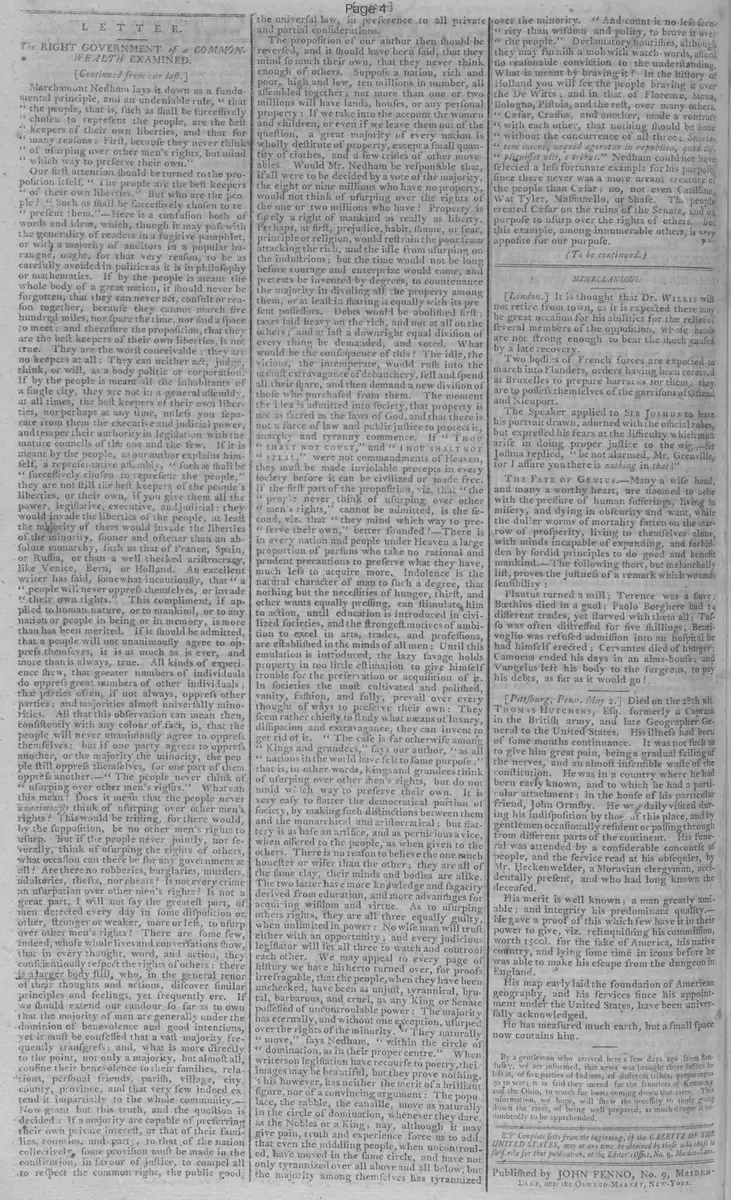
LETTER.
The RIGHT GOVERNMENT of a COMMONWEALTH EXAMINED.
[Continued from our last.]
Marchamont Nedham lays it down as a fundamental principle, and an undeniable rule, "that the people, that is, such as shall be successively chosen to represent the people, are the best keepers of their own liberties, and that for many reasons: First, because they never think of usurping over other men's rights, but mind which way to preserve their own."
Our first attention should be turned to the proposition itself "The people are the best keepers of their own liberties." But who are the people? "Such as shall be successively chosen to represent them."—Here is a confusion both of words and ideas, which, though it may pass with the generality of readers in a fugitive pamphlet, or with a majority of auditors in a popular harangue, ought, for that very reason, to be as carefully avoided in politics as it is in philosophy or mathematics. If by the people is meant the whole body of a great nation, it should never be forgotten, that they can never act, consult or reason together, because they cannot march five hundred miles, nor spare the time, nor find a place to meet; and therefore the proposition, that they are the best keepers of their own liberties, is not true. They are the worst conceivable; they are no keepers at all: They can neither act, judge, think, or will, as a body politic or corporation.
If by the people is meant all the inhabitants of a single city, they are not in a general assembly, at all times, the best keepers of their own liberties, nor perhaps at any time, unless you separate from them the executive and judicial power, and temper their authority in legislation with the mature councils of the one and the few. If it is meant by the people, as our author explains himself, a representative assembly, "such as shall be successively chosen to represent the people," they are not still the best keepers of the people's liberties, or their own, if you give them all the power, legislative, executive, and judicial: they would invade the liberties of the people, at least the majority of them would invade the liberties of the minority, sooner and oftener than an absolute monarchy, such as that of France, Spain, or Russia, or than a well checked aristocracy, like Venice, Bern, or Holland. An excellent writer has said, somewhat incautiously, that "a people will never oppress themselves, or invade their own rights." This compliment, if applied to human nature, or to mankind, or to any nation or people in being or in memory, is more than has been merited. If it should be admitted, that a people will not unanimously agree to oppress themselves, it is as much as is ever, and more than is always, true. All kinds of experience show, that greater numbers of individuals do oppress great numbers of other individuals; that parties often, if not always, oppress other parties; and majorities almost universally minorities. All that this observation can mean then, consistently with any colour of fact, is, that the people will never unanimously agree to oppress themselves: but if one party agrees to oppress another, or the majority the minority, the people still oppress themselves, for one part of them oppresses another.—"The people never think of usurping over other men's rights." What can this mean? Does it mean that the people never unanimously think of usurping over other men's rights? This would be trifling, for there would, by the supposition, be no other men's rights to usurp. But if the people never jointly, nor severally, think of usurping the rights of others, what occasion can there be for any government at all? Are there no robberies, burglaries, murders, adulteries, thefts, nor cheats? Is not every crime an usurpation over other men's rights? Is not a great part, I will not say the greatest part, of men detected every day in some disposition or other, stronger or weaker, more or less, to usurp over other men's rights? There are some few, indeed, whose whole lives and conversations show, that in every thought, word, and action, they conscientiously respect the rights of others: there is a larger body still, who, in the general tenor of their thoughts and actions, discover similar principles and feelings, yet frequently err. If we should extend our candour so far as to own that the majority of men are generally under the dominion of benevolence and good intentions, yet it must be confessed that a vast majority frequently transgress; and, what is more directly to the point, not only a majority, but almost all confine their benevolence to their families, relations, personal friends, parish, village, city, county, province, and that very few indeed extend it impartially to the whole community.—
Now grant but this truth, and the question is decided: If a majority are capable of preferring their own private interest, or that of their families, counties, and parties, to that of the nation collectively, some provision must be made in the constitution, in favour of justice, to compel all to respect the common right, the public good, the universal law, in preference to all private and partial considerations.
The proposition of our author then should be reversed, and it should have been said, that they mind so much their own, that they never think enough of others. Suppose a nation, rich and poor, high and low, ten millions in number, all assembled together; not more than one or two millions will have lands, houses, or any personal property: If we take into the account the women and children, or even if we leave them out of the question, a great majority of every nation is wholly destitute of property, except a small quantity of clothes, and a few trifles of other moveables. Would Mr. Nedham be responsible that, if all were to be decided by a vote of the majority, the eight or nine millions who have no property, would not think of usurping over the rights of the one or two millions who have? Property is surely a right of mankind as really as liberty. Perhaps, at first, prejudice, habit, shame, or fear, principle or religion, would restrain the poor from attacking the rich, and the idle from usurping on the industrious; but the time would not be long before courage and enterprise would come, and pretexts be invented by degrees, to countenance the majority in dividing all the property among them, or at least in sharing it equally with its present possessors. Debts would be abolished first; taxes laid heavy on the rich, and not at all on the others; and at last a downright equal division of every thing be demanded, and voted. What would be the consequence of this? The idle, the vicious, the intemperate, would rush into the utmost extravagance of debauchery, sell and spend all their share, and then demand a new division of those who purchased from them. The moment the idea is admitted into society, that property is not as sacred as the laws of God, and that there is not a force of law and public justice to protect it, anarchy and tyranny commence. If "Thou SHALT NOT COVET," and "Thou SHALT NOT STEAL," were not commandments of Heaven, they must be made inviolable precepts in every society before it can be civilized or made free.
If the first part of the proposition, viz. that "the people never think of usurping over other men's rights," cannot be admitted, is the second, viz. that "they mind which way to preserve their own," better founded?—There is in every nation and people under Heaven a large proportion of persons who take no rational and prudent precautions to preserve what they have, much less to acquire more. Indolence is the natural character of man to such a degree, that nothing but the necessities of hunger, thirst, and other wants equally pressing, can stimulate him to action, until education is introduced in civilized societies, and the strongest motives of ambition to excel in arts, trades, and professions, are established in the minds of all men: Until this emulation is introduced, the lazy savage holds property in too little estimation to give himself trouble for the preservation or acquisition of it. In societies the most cultivated and polished, vanity, fashion, and folly, prevail over every thought of ways to preserve their own: They seem rather chiefly to study what means of luxury, dissipation and extravagance, they can invent to get rid of it. "The case is far otherwise among Kings and grandees," says our author, "as all nations in the world have felt to some purpose;" that is, in other words, Kings and grandees think of usurping over other men's rights, but do not mind which way to preserve their own. It is very easy to flatter the democratical portion of society, by making such distinctions between them and the monarchical and aristocratical; but flattery is as base an artifice, and as pernicious a vice, when offered to the people, as when given to the others. There is no reason to believe the one much honester or wiser than the other; they are all of the same clay, their minds and bodies are alike. The two latter have more knowledge and sagacity derived from education, and more advantages for acquiring wisdom and virtue. As to usurping others rights, they are all three equally guilty, when unlimited in power: No wise man will trust either with an opportunity; and every judicious legislator will set all three to watch and control each other. We may appeal to every page of history we have hitherto turned over, for proofs irrefragable, that the people, when they have been unchecked, have been as unjust, tyrannical, brutal, barbarous, and cruel, as any King or Senate possessed of uncontroulable power: The majority has eternally, and without one exception, usurped over the rights of the minority. "They naturally move," says Nedham, "within the circle of domination, as in their proper centre." When writers on legislation have recourse to poetry, their images may be beautiful, but they prove nothing. This however, has neither the merit of a brilliant figure, nor of a convincing argument: The populace, the rabble, the canaille, move as naturally in the circle of domination, whenever they dare, as the Nobles or a King; nay, although it may give pain, truth and experience force us to add, that even the middling people, when uncontroulled, have moved in the same circle, and have not only tyrannized over all above and all below, but the majority among themselves has tyrannized over the minority. "And count it no less security than wisdom and policy, to brave it over the people." Declamatory flourishes, although they may furnish a mob with watch-words, afford no reasonable conviction to the understanding. What is meant by braving it? In the history of Holland you will see the people braving it over the De Witts; and in that of Florence, Siena, Bologna, Pistoia, and the rest, over many others. "Cæsar, Crassus, and another, made a contract with each other, that nothing should be done without the concurrence of all three; Societatem iniere, nequid ageretur in republica, quod displicuisset ulli, e tribus." Nedham could not have selected a less fortunate example for his purpose since there never was a more arrant creature of the people than Cæsar; no, not even Catiline, Wat Tyler, Masaniello, or Jack Cade. The people created Cæsar on the ruins of the Senate, and on purpose to usurp over the rights of others. But this example, among innumerable others, is very apposite for our purpose.
(To be continued.)
J.
The RIGHT GOVERNMENT of a COMMONWEALTH EXAMINED.
[Continued from our last.]
Marchamont Nedham lays it down as a fundamental principle, and an undeniable rule, "that the people, that is, such as shall be successively chosen to represent the people, are the best keepers of their own liberties, and that for many reasons: First, because they never think of usurping over other men's rights, but mind which way to preserve their own."
Our first attention should be turned to the proposition itself "The people are the best keepers of their own liberties." But who are the people? "Such as shall be successively chosen to represent them."—Here is a confusion both of words and ideas, which, though it may pass with the generality of readers in a fugitive pamphlet, or with a majority of auditors in a popular harangue, ought, for that very reason, to be as carefully avoided in politics as it is in philosophy or mathematics. If by the people is meant the whole body of a great nation, it should never be forgotten, that they can never act, consult or reason together, because they cannot march five hundred miles, nor spare the time, nor find a place to meet; and therefore the proposition, that they are the best keepers of their own liberties, is not true. They are the worst conceivable; they are no keepers at all: They can neither act, judge, think, or will, as a body politic or corporation.
If by the people is meant all the inhabitants of a single city, they are not in a general assembly, at all times, the best keepers of their own liberties, nor perhaps at any time, unless you separate from them the executive and judicial power, and temper their authority in legislation with the mature councils of the one and the few. If it is meant by the people, as our author explains himself, a representative assembly, "such as shall be successively chosen to represent the people," they are not still the best keepers of the people's liberties, or their own, if you give them all the power, legislative, executive, and judicial: they would invade the liberties of the people, at least the majority of them would invade the liberties of the minority, sooner and oftener than an absolute monarchy, such as that of France, Spain, or Russia, or than a well checked aristocracy, like Venice, Bern, or Holland. An excellent writer has said, somewhat incautiously, that "a people will never oppress themselves, or invade their own rights." This compliment, if applied to human nature, or to mankind, or to any nation or people in being or in memory, is more than has been merited. If it should be admitted, that a people will not unanimously agree to oppress themselves, it is as much as is ever, and more than is always, true. All kinds of experience show, that greater numbers of individuals do oppress great numbers of other individuals; that parties often, if not always, oppress other parties; and majorities almost universally minorities. All that this observation can mean then, consistently with any colour of fact, is, that the people will never unanimously agree to oppress themselves: but if one party agrees to oppress another, or the majority the minority, the people still oppress themselves, for one part of them oppresses another.—"The people never think of usurping over other men's rights." What can this mean? Does it mean that the people never unanimously think of usurping over other men's rights? This would be trifling, for there would, by the supposition, be no other men's rights to usurp. But if the people never jointly, nor severally, think of usurping the rights of others, what occasion can there be for any government at all? Are there no robberies, burglaries, murders, adulteries, thefts, nor cheats? Is not every crime an usurpation over other men's rights? Is not a great part, I will not say the greatest part, of men detected every day in some disposition or other, stronger or weaker, more or less, to usurp over other men's rights? There are some few, indeed, whose whole lives and conversations show, that in every thought, word, and action, they conscientiously respect the rights of others: there is a larger body still, who, in the general tenor of their thoughts and actions, discover similar principles and feelings, yet frequently err. If we should extend our candour so far as to own that the majority of men are generally under the dominion of benevolence and good intentions, yet it must be confessed that a vast majority frequently transgress; and, what is more directly to the point, not only a majority, but almost all confine their benevolence to their families, relations, personal friends, parish, village, city, county, province, and that very few indeed extend it impartially to the whole community.—
Now grant but this truth, and the question is decided: If a majority are capable of preferring their own private interest, or that of their families, counties, and parties, to that of the nation collectively, some provision must be made in the constitution, in favour of justice, to compel all to respect the common right, the public good, the universal law, in preference to all private and partial considerations.
The proposition of our author then should be reversed, and it should have been said, that they mind so much their own, that they never think enough of others. Suppose a nation, rich and poor, high and low, ten millions in number, all assembled together; not more than one or two millions will have lands, houses, or any personal property: If we take into the account the women and children, or even if we leave them out of the question, a great majority of every nation is wholly destitute of property, except a small quantity of clothes, and a few trifles of other moveables. Would Mr. Nedham be responsible that, if all were to be decided by a vote of the majority, the eight or nine millions who have no property, would not think of usurping over the rights of the one or two millions who have? Property is surely a right of mankind as really as liberty. Perhaps, at first, prejudice, habit, shame, or fear, principle or religion, would restrain the poor from attacking the rich, and the idle from usurping on the industrious; but the time would not be long before courage and enterprise would come, and pretexts be invented by degrees, to countenance the majority in dividing all the property among them, or at least in sharing it equally with its present possessors. Debts would be abolished first; taxes laid heavy on the rich, and not at all on the others; and at last a downright equal division of every thing be demanded, and voted. What would be the consequence of this? The idle, the vicious, the intemperate, would rush into the utmost extravagance of debauchery, sell and spend all their share, and then demand a new division of those who purchased from them. The moment the idea is admitted into society, that property is not as sacred as the laws of God, and that there is not a force of law and public justice to protect it, anarchy and tyranny commence. If "Thou SHALT NOT COVET," and "Thou SHALT NOT STEAL," were not commandments of Heaven, they must be made inviolable precepts in every society before it can be civilized or made free.
If the first part of the proposition, viz. that "the people never think of usurping over other men's rights," cannot be admitted, is the second, viz. that "they mind which way to preserve their own," better founded?—There is in every nation and people under Heaven a large proportion of persons who take no rational and prudent precautions to preserve what they have, much less to acquire more. Indolence is the natural character of man to such a degree, that nothing but the necessities of hunger, thirst, and other wants equally pressing, can stimulate him to action, until education is introduced in civilized societies, and the strongest motives of ambition to excel in arts, trades, and professions, are established in the minds of all men: Until this emulation is introduced, the lazy savage holds property in too little estimation to give himself trouble for the preservation or acquisition of it. In societies the most cultivated and polished, vanity, fashion, and folly, prevail over every thought of ways to preserve their own: They seem rather chiefly to study what means of luxury, dissipation and extravagance, they can invent to get rid of it. "The case is far otherwise among Kings and grandees," says our author, "as all nations in the world have felt to some purpose;" that is, in other words, Kings and grandees think of usurping over other men's rights, but do not mind which way to preserve their own. It is very easy to flatter the democratical portion of society, by making such distinctions between them and the monarchical and aristocratical; but flattery is as base an artifice, and as pernicious a vice, when offered to the people, as when given to the others. There is no reason to believe the one much honester or wiser than the other; they are all of the same clay, their minds and bodies are alike. The two latter have more knowledge and sagacity derived from education, and more advantages for acquiring wisdom and virtue. As to usurping others rights, they are all three equally guilty, when unlimited in power: No wise man will trust either with an opportunity; and every judicious legislator will set all three to watch and control each other. We may appeal to every page of history we have hitherto turned over, for proofs irrefragable, that the people, when they have been unchecked, have been as unjust, tyrannical, brutal, barbarous, and cruel, as any King or Senate possessed of uncontroulable power: The majority has eternally, and without one exception, usurped over the rights of the minority. "They naturally move," says Nedham, "within the circle of domination, as in their proper centre." When writers on legislation have recourse to poetry, their images may be beautiful, but they prove nothing. This however, has neither the merit of a brilliant figure, nor of a convincing argument: The populace, the rabble, the canaille, move as naturally in the circle of domination, whenever they dare, as the Nobles or a King; nay, although it may give pain, truth and experience force us to add, that even the middling people, when uncontroulled, have moved in the same circle, and have not only tyrannized over all above and all below, but the majority among themselves has tyrannized over the minority. "And count it no less security than wisdom and policy, to brave it over the people." Declamatory flourishes, although they may furnish a mob with watch-words, afford no reasonable conviction to the understanding. What is meant by braving it? In the history of Holland you will see the people braving it over the De Witts; and in that of Florence, Siena, Bologna, Pistoia, and the rest, over many others. "Cæsar, Crassus, and another, made a contract with each other, that nothing should be done without the concurrence of all three; Societatem iniere, nequid ageretur in republica, quod displicuisset ulli, e tribus." Nedham could not have selected a less fortunate example for his purpose since there never was a more arrant creature of the people than Cæsar; no, not even Catiline, Wat Tyler, Masaniello, or Jack Cade. The people created Cæsar on the ruins of the Senate, and on purpose to usurp over the rights of others. But this example, among innumerable others, is very apposite for our purpose.
(To be continued.)
J.
What sub-type of article is it?
Constitutional
What keywords are associated?
Popular Sovereignty
Government Structure
Property Rights
Majority Tyranny
Balanced Constitution
Minority Protection
Human Nature
What entities or persons were involved?
Marchamont Nedham
Cæsar
Crassus
De Witts
Editorial Details
Primary Topic
Critique Of Unchecked Popular Government And Advocacy For Balanced Constitution
Stance / Tone
Critical Of Democratic Excess; Supportive Of Mixed Government With Checks
Key Figures
Marchamont Nedham
Cæsar
Crassus
De Witts
Key Arguments
The People Cannot Act As A Body And Thus Cannot Keep Liberties Without Representation
Unrestricted Representative Assemblies Would Oppress Minorities More Than Monarchies Or Aristocracies
Majorities Often Oppress Minorities, Contradicting Claims That People Won't Usurp Rights
Property Rights Must Be Protected By Constitutional Provisions Against Majority Tyranny
Human Nature Inclines All Classes To Usurp Power When Unchecked, Requiring Balanced Government
Historical Examples Show Unchecked People As Tyrannical As Kings Or Senates