Thank you for visiting SNEWPapers!
Sign up free
Honolulu Star Bulletin
Honolulu, Honolulu County, Hawaii
What is this article about?
James S. Sherman's retention as Republican VP nominee owed to New York boss William Barnes Jr., who traded state delegates to back Taft against progressives, securing unified NY support despite Sherman's gubernatorial ambitions. (Dateline: Washington, D.C., June 27.)
Clipping
OCR Quality
Full Text
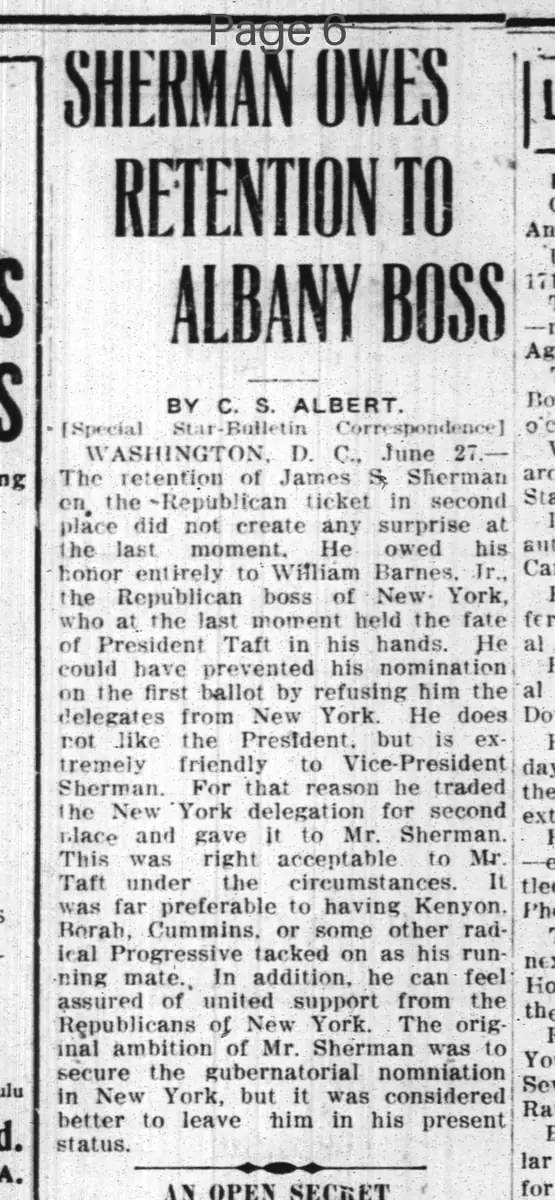
RETENTION TO
ALBANY BOSS
BY C. S. ALBERT.
— [Special
Star-Bulletin Correspondence]
WASHINGTON, D. C., June 27.—
The retention of James S. Sherman
on the Republican ticket in second
place did not create any surprise at
the last moment. He owed his
position entirely to William Barnes, Jr.,
the Republican boss of New York,
who at the last moment held the fate
of President Taft in his hands. He
could have prevented his nomination
on the first ballot by refusing him the
delegates from New York. He does
not like the President, but is ex-
tremely friendly to Vice-President
Sherman. For that reason he traded
the New York delegation for second
place and gave it to Mr. Sherman.
This was right acceptable to Mr.
Taft under the circumstances. It
was far preferable to having Kenyon,
Borah, Cummins, or some other rad-
ical Progressive tacked on as his run-
ning mate. In addition, he can feel
assured of united support from the
Republicans of New York. The orig-
inal ambition of Mr. Sherman was to
secure the gubernatorial nomination
in New York, but it was considered
better to leave him in his present
status.
What sub-type of article is it?
What themes does it cover?
What keywords are associated?
What entities or persons were involved?
Where did it happen?
Story Details
Key Persons
Location
Washington, D. C.; New York
Event Date
June 27
Story Details
James S. Sherman retained his position on the Republican ticket as vice-presidential nominee due to William Barnes Jr., the Republican boss of New York, who traded the New York delegation to support President Taft's nomination in exchange for Sherman's second-place spot, preferring him over radical Progressives like Kenyon, Borah, or Cummins. This ensured united Republican support from New York, despite Sherman's original ambition for the gubernatorial nomination.