Thank you for visiting SNEWPapers!
Sign up free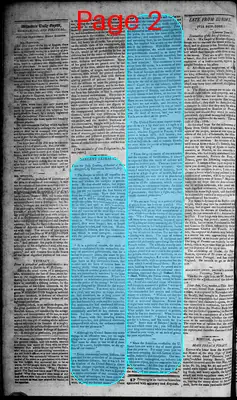
Editorial
August 11, 1808
Alexandria Daily Gazette, Commercial & Political
Alexandria, Virginia
What is this article about?
Excerpts from Ebenezer Mosely's July oration at Newburyport warn of republics' vulnerability to anarchy from lax governance, advocate military preparedness for defense via navy, fortifications, and militia, critique unprotected commerce amid European wars, and decry French revolutionary excesses under a conquering leader.
Clipping
OCR Quality
95%
Excellent
Full Text
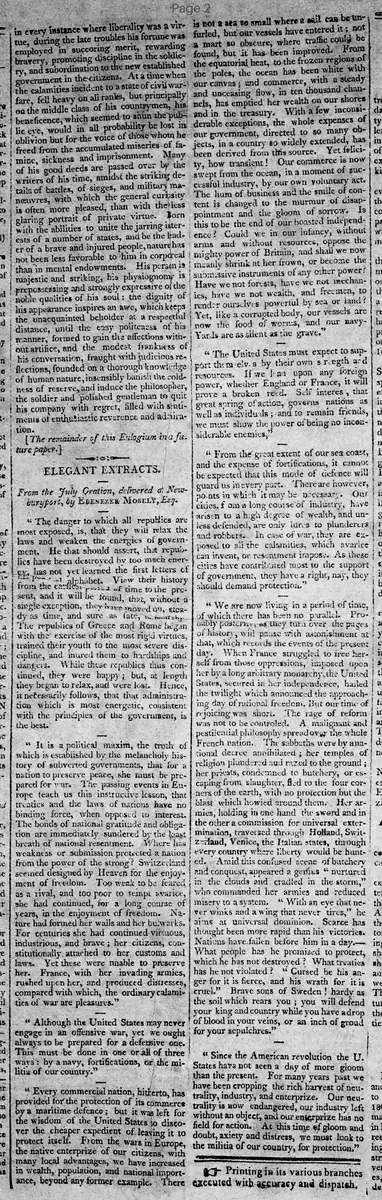
ELEGANT EXTRACTS.
From the July Oration, delivered at Newburyport, by Ebenzer Mosely, Esq.
"The danger to which all republics are most exposed, is, that they will relax the laws and weaken the energies of government. He that should assert, that republics have been destroyed by too much energy, has not alphabet view their history from the earliest period of time to the present, and it will be found, that, without a single exception, they have moved on, steady as time, and sure as fate, to anarchy. The republics of Greece and Rome began with the exercise of the most rigid virtues. They trained their youth to the most severe discipline, and inured them to hardships and dangers. While these republics thus continued, they were happy; but, at length they began to relax, and were lost. Hence, it necessarily follows, that that administration which is most energetic, consistent with the principles of the government, is the best.
"It is a political maxim, the truth of which is established by the melancholy history of subverted governments, that for a nation to preserve peace, she must be prepared for war. The passing events in Europe teach us this instructive lesson, that treaties and the laws of nations have no binding force, when opposed to interest. The bonds of national gratitude and obligation are immediately sundered by the least breath of national resentment. Where has weakness or submission protected a nation from the power of the strong? Switzerland seemed designed by Heaven for the enjoyment of freedom. Too weak to be feared as a rival, and too poor to tempt avarice, she had continued, for a long course of years, in the enjoyment of freedom. Nature had formed her walls and her bulwarks. For centuries she had continued virtuous, industrious, and brave; her citizens, constitutionally attached to her customs and laws. Yet these were unable to preserve her. France, with her invading armies, rushed upon her, and produced distresses, compared with which, the ordinary calamities of war are pleasures."
"Although the United States may never engage in an offensive war, yet we ought always to be prepared for a defensive one. This must be done in one or all of three ways: by a navy, fortifications, or the militia of our country."
"Every commercial nation, hitherto, has provided for the protection of its commerce by a maritime defence; but it was left for the wisdom of the United States to discover the cheaper expedient of leaving it to protect itself. From the wars in Europe, the native enterprize of our citizens, with many local advantages, we have increased in wealth, population, and national importance, beyond any former example. There is not a sea so small where a sail can be unfurled, but our vessels have entered it; not a mart so obscure, where traffic could be found, but it has been improved. From the equatorial heat, to the frozen regions of the poles, the ocean has been white with our canvas; and commerce, with a steady and unceasing flow, in ten thousand channels, has emptied her wealth on our shores and in the treasury. With a few inconsiderable exceptions, the whole expenses of our government, directed to so many objects, in a country so widely extended, has been derived from this source. Yet felicity, how transient! Our commerce is now swept from the ocean, in a moment of successful industry, by our own voluntary act. The hum of business and the smile of content is changed to the murmur of disappointment and the gloom of sorrow. Is this to be the end of our boasted independence? Could we in our infancy, without arms and without resources, oppose the mighty power of Britain, and shall we now meanly shrink at her frown, or become the submissive instruments of any other power? Have we not forests, have we not mechanics, have we not wealth, and freemen, to render ourselves powerful by sea or land? Yet, like a corrupted body, our vessels are now the food of worms, and our navy-yards are as silent as the grave."
"The United States must expect to support themselves by their own strength and resources. If we lean upon any foreign power, whether England or France, it will prove a broken reed. Self interest, that great spring of action, governs nations as well as individuals; and to remain friends, we must show the power of being no inconsiderable enemies."
"From the great extent of our sea coast, and the expense of fortifications, it cannot be expected that this mode of defence will guard us in every part. There are however, points in which it may be necessary. Our cities, from a long course of industry, have arisen to a high degree of wealth, and unless defended, are only lures to plunderers and robbers. In case of war, they are exposed to all the calamities, which avarice can invent, or resentment imposes. As these cities have contributed most to the support of government, they have a right, nay, they should demand protection."
"We are now living in a period of time, of which there has been no parallel. Probably posterity as they turn over the pages of history, will pause with astonishment at that, which records the events of the present day. When France struggled to free herself from those oppressions, imposed upon her by a long arbitrary monarchy, the United States, secured in her independence, hailed the twilight which announced the approaching day of rational freedom. But our time of rejoicing was short. The rage of reform was not to be controlled. A malignant and pestilential philosophy spread over the whole French nation. The sabbaths were by national decree annihilated; her temples of religion plundered and razed to the ground: her priests, condemned to butchery, or escaping from slaughter, fled to the four corners of the earth, with no protection but the blast which howled around them. Her armies, holding in one hand the sword and in the other a commission for universal extermination, traversed through Holland, Switzerland, Venice, the Italian states, through every country where liberty would be hunted. Amid this confused scene of butchery and conquest, appeared a genius "nurtured in the clouds and cradled in the storm," who commanded her armies and reduced misery to a system. "With an eye that never winks and a wing that never tires," he aims at universal dominion. Scarce has thought been more rapid than his victories. Nations have fallen before him in a day. What people has he promised to protect, which he has not destroyed? What treaties has he not violated? "Cursed be his anger for it is fierce, and his wrath for it is cruel." Brave sons of Sweden! hardy as the soil which rears you; you will defend your king and country while you have a drop of blood in your veins, or an inch of ground for your sepulchres."
"Since the American revolution the U. States have not seen a day of more gloom than the present. For many years past we have been cropping the rich harvest of neutrality, industry, and enterprize. Our neutrality is now endangered, our industry left without an object, and our enterprize has no field for action. At this time of gloom and doubt, anxiety and distress, we must look to the militia of our country, for protection."
From the July Oration, delivered at Newburyport, by Ebenzer Mosely, Esq.
"The danger to which all republics are most exposed, is, that they will relax the laws and weaken the energies of government. He that should assert, that republics have been destroyed by too much energy, has not alphabet view their history from the earliest period of time to the present, and it will be found, that, without a single exception, they have moved on, steady as time, and sure as fate, to anarchy. The republics of Greece and Rome began with the exercise of the most rigid virtues. They trained their youth to the most severe discipline, and inured them to hardships and dangers. While these republics thus continued, they were happy; but, at length they began to relax, and were lost. Hence, it necessarily follows, that that administration which is most energetic, consistent with the principles of the government, is the best.
"It is a political maxim, the truth of which is established by the melancholy history of subverted governments, that for a nation to preserve peace, she must be prepared for war. The passing events in Europe teach us this instructive lesson, that treaties and the laws of nations have no binding force, when opposed to interest. The bonds of national gratitude and obligation are immediately sundered by the least breath of national resentment. Where has weakness or submission protected a nation from the power of the strong? Switzerland seemed designed by Heaven for the enjoyment of freedom. Too weak to be feared as a rival, and too poor to tempt avarice, she had continued, for a long course of years, in the enjoyment of freedom. Nature had formed her walls and her bulwarks. For centuries she had continued virtuous, industrious, and brave; her citizens, constitutionally attached to her customs and laws. Yet these were unable to preserve her. France, with her invading armies, rushed upon her, and produced distresses, compared with which, the ordinary calamities of war are pleasures."
"Although the United States may never engage in an offensive war, yet we ought always to be prepared for a defensive one. This must be done in one or all of three ways: by a navy, fortifications, or the militia of our country."
"Every commercial nation, hitherto, has provided for the protection of its commerce by a maritime defence; but it was left for the wisdom of the United States to discover the cheaper expedient of leaving it to protect itself. From the wars in Europe, the native enterprize of our citizens, with many local advantages, we have increased in wealth, population, and national importance, beyond any former example. There is not a sea so small where a sail can be unfurled, but our vessels have entered it; not a mart so obscure, where traffic could be found, but it has been improved. From the equatorial heat, to the frozen regions of the poles, the ocean has been white with our canvas; and commerce, with a steady and unceasing flow, in ten thousand channels, has emptied her wealth on our shores and in the treasury. With a few inconsiderable exceptions, the whole expenses of our government, directed to so many objects, in a country so widely extended, has been derived from this source. Yet felicity, how transient! Our commerce is now swept from the ocean, in a moment of successful industry, by our own voluntary act. The hum of business and the smile of content is changed to the murmur of disappointment and the gloom of sorrow. Is this to be the end of our boasted independence? Could we in our infancy, without arms and without resources, oppose the mighty power of Britain, and shall we now meanly shrink at her frown, or become the submissive instruments of any other power? Have we not forests, have we not mechanics, have we not wealth, and freemen, to render ourselves powerful by sea or land? Yet, like a corrupted body, our vessels are now the food of worms, and our navy-yards are as silent as the grave."
"The United States must expect to support themselves by their own strength and resources. If we lean upon any foreign power, whether England or France, it will prove a broken reed. Self interest, that great spring of action, governs nations as well as individuals; and to remain friends, we must show the power of being no inconsiderable enemies."
"From the great extent of our sea coast, and the expense of fortifications, it cannot be expected that this mode of defence will guard us in every part. There are however, points in which it may be necessary. Our cities, from a long course of industry, have arisen to a high degree of wealth, and unless defended, are only lures to plunderers and robbers. In case of war, they are exposed to all the calamities, which avarice can invent, or resentment imposes. As these cities have contributed most to the support of government, they have a right, nay, they should demand protection."
"We are now living in a period of time, of which there has been no parallel. Probably posterity as they turn over the pages of history, will pause with astonishment at that, which records the events of the present day. When France struggled to free herself from those oppressions, imposed upon her by a long arbitrary monarchy, the United States, secured in her independence, hailed the twilight which announced the approaching day of rational freedom. But our time of rejoicing was short. The rage of reform was not to be controlled. A malignant and pestilential philosophy spread over the whole French nation. The sabbaths were by national decree annihilated; her temples of religion plundered and razed to the ground: her priests, condemned to butchery, or escaping from slaughter, fled to the four corners of the earth, with no protection but the blast which howled around them. Her armies, holding in one hand the sword and in the other a commission for universal extermination, traversed through Holland, Switzerland, Venice, the Italian states, through every country where liberty would be hunted. Amid this confused scene of butchery and conquest, appeared a genius "nurtured in the clouds and cradled in the storm," who commanded her armies and reduced misery to a system. "With an eye that never winks and a wing that never tires," he aims at universal dominion. Scarce has thought been more rapid than his victories. Nations have fallen before him in a day. What people has he promised to protect, which he has not destroyed? What treaties has he not violated? "Cursed be his anger for it is fierce, and his wrath for it is cruel." Brave sons of Sweden! hardy as the soil which rears you; you will defend your king and country while you have a drop of blood in your veins, or an inch of ground for your sepulchres."
"Since the American revolution the U. States have not seen a day of more gloom than the present. For many years past we have been cropping the rich harvest of neutrality, industry, and enterprize. Our neutrality is now endangered, our industry left without an object, and our enterprize has no field for action. At this time of gloom and doubt, anxiety and distress, we must look to the militia of our country, for protection."
What sub-type of article is it?
Military Affairs
Foreign Affairs
War Or Peace
What keywords are associated?
Republican Government
Military Preparedness
Defensive War
Neutrality Policy
Commerce Protection
French Revolution
Napoleonic Conquests
What entities or persons were involved?
Ebenzer Mosely
United States
France
Switzerland
Greece
Rome
Britain
Napoleon
Editorial Details
Primary Topic
Advocacy For Military Preparedness And Defensive Strength In Republics
Stance / Tone
Urgent Call For Energetic Government And Self Reliant Defense Against European Threats
Key Figures
Ebenzer Mosely
United States
France
Switzerland
Greece
Rome
Britain
Napoleon
Key Arguments
Republics Fall To Anarchy From Relaxed Laws And Weak Government
Preparation For War Is Essential To Preserve Peace
Us Commerce Thrives Unprotected But Now Faces Voluntary Ruin
Rely On Own Strength, Not Foreign Powers
Fortify Key Cities Against Plunder
French Revolution Devolved Into Tyranny And Conquest Under A Ruthless Leader
Militia Vital For Protection In Current Gloom