Thank you for visiting SNEWPapers!
Sign up free
Gazette Of The United States, & Philadelphia Daily Advertiser
Philadelphia, Philadelphia County, Pennsylvania
What is this article about?
On September 27, 1797, the College of New Jersey in Princeton held its commencement with prayers, student orations and debates on topics like piety, revolutions, government, and language, followed by awarding Bachelor and Master of Arts degrees to numerous graduates from various states and Curacao.
Clipping
OCR Quality
Full Text
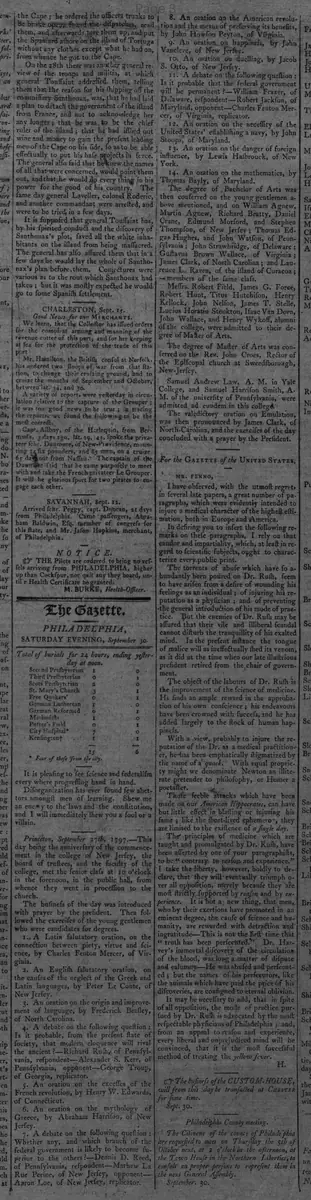
The business of the day was introduced with prayer by the president. Then followed the exercises of the young gentlemen who were candidates for degrees.
1. A Latin salutatory oration, on the connection between piety, virtue and science, by Charles Fenton Mercer, of Virginia.
2. An English salutatory oration, on the causes of the neglect of the Greek and Latin languages, by Peter Le Conte, of New Jersey.
3. An oration on the origin and improvement of language, by Frederick Beasley, of North Carolina.
4. A debate on the following question: Is it probable, from the present state of society, that modern eloquence will rival the ancient? Richard Rush, of Pennsylvania, respondent—Alexander S. Kerr, of Pennsylvania, opponent—George Troup, of Georgia, replicator.
5. An oration on the excesses of the French revolution, by Henry W. Edwards, of Connecticut.
6. An oration on the mythology of Greece, by Abraham Harrison, of New Jersey.
7. A debate on the following question: Whether any, and which branch of the federal government is likely to become superior to the others?—Dennis D. Reed, of Pennsylvania, respondent—Matthew La Rue Perine, of New Jersey, opponent—Aaron Lee, of New Jersey, replicator.
8. An oration on the American revolution and the means of preserving its benefits, by John Howson Peyton, of Virginia.
9. An oration on happiness, by John Vancleve, of New Jersey.
10. An oration on duelling, by Jacob S. Otto, of New Jersey.
11. A debate on the following question: Is it probable that the federal government will be permanent?—William Frazer, of Delaware, respondent—Robert Jackson, of Maryland, opponent—Charles Fenton Mercer, of Virginia, replicator.
12. An oration on the necessity of the United States' establishing a navy, by John Stoops, of Maryland.
13. An oration on the danger of foreign influence, by Lewis Hasbrouck, of New York.
14. An oration on the mathematics, by Thomas Bayly, of Maryland.
The degree of Bachelor of Arts was then conferred on the young gentlemen above mentioned, and on William Agnew, Martin Agnew, Richard Beatty, Daniel Crane, Edmund Morford, and Stephen Thompson, of New Jersey; Thomas Edgar Hughes, and John Watson, of Pennsylvania; John Strawbridge, of Delaware; Gustavus Brown Wallace, of Virginia; James Clark, of North Carolina; and Laurence L. Raven, of the island of Curacoa;—members of the same class.
Messrs. Robert Field, James G. Force, Robert Hunt, Titus Hutchinson, Henry Kellock, John Nelson, James T. Stelle, Lucius Horatio Stockton, Isaac Van Dorn, John Wallace, and Henry Wykoff, alumni of the college, were admitted to their degree of Master of Arts.
The degree of Master of Arts was conferred on the Rev. John Croes, Rector of the Episcopal church at Swedesborough, New-Jersey.
Samuel Andrew Law, A. M. in Yale College, and Samuel Harrison Smith, A. M. of the university of Pennsylvania, were admitted ad eundem in this college.
The valedictory oration on Emulation, was then pronounced by James Clark, of North-Carolina, and the exercises of the day concluded with a prayer by the President.
What sub-type of article is it?
What themes does it cover?
What keywords are associated?
What entities or persons were involved?
Where did it happen?
Story Details
Key Persons
Location
Princeton, College Of New Jersey
Event Date
September 27th, 1797
Story Details
The anniversary commencement at the College of New Jersey featured prayers, orations, and debates by senior class candidates on topics including piety, languages, revolutions, mythology, government, and more, followed by conferral of Bachelor of Arts degrees to the participants and others, Master of Arts to alumni and others, and admissions ad eundem, concluding with a valedictory oration.