Thank you for visiting SNEWPapers!
Sign up free
Foreign News
September 7, 1810
Norfolk Gazette And Publick Ledger
Norfolk, Virginia
What is this article about?
Report dated June 30, 1810, to Emperor Napoleon detailing the military career of ex-General John Sarrazin, from his enlistment in 1786 through campaigns in France, Ireland, Italy, and St. Domingo, ending in his desertion and disgrace.
Clipping
OCR Quality
95%
Excellent
Full Text
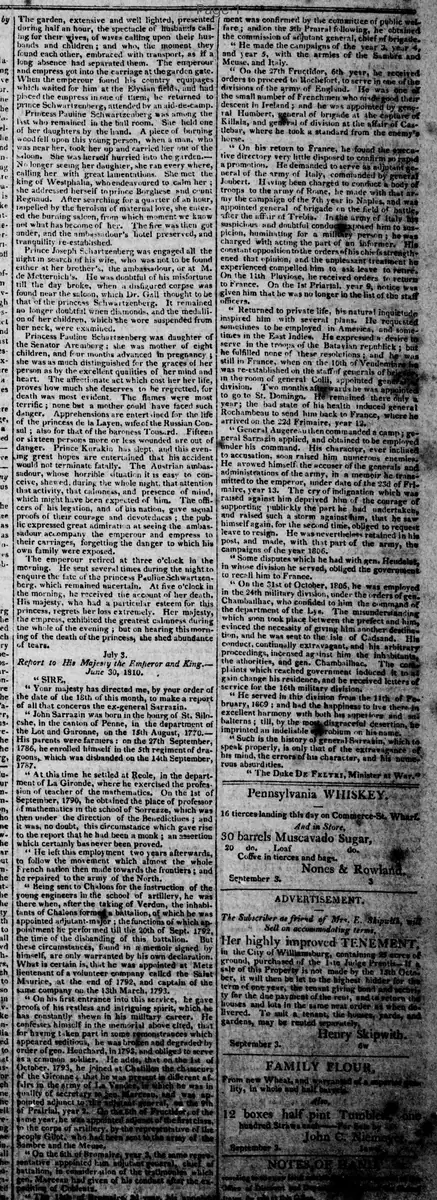
Report to His Majesty the Emperor and King.—
June 30, 1810.
"SIRE,
"Your majesty has directed me, by your order of the date of the 18th of this month, to make a report of all that concerns the ex-general Sarrazin.
"John Sarrazin was born in the bourg of St. Siloce, in the canton of Penne, in the department of the Lot and Garonne, on the 15th August, 1770.—His parents were farmers: on the 27th September, 1786, he enrolled himself in the 5th regiment of dragoons, which was disbanded on the 14th September, 1787.
"At this time he settled at Reole, in the department of La Gironde, where he exercised the profession of teacher of the mathematics. On the 1st of September, 1790, he obtained the place of professor of mathematics in the school of Sorrezze, which was then under the direction of the Benedictines; and it was, no doubt, this circumstance which gave rise to the report that he had been a monk; an assertion which certainly has never been proved.
"He left this employment two years afterwards, to follow the movement which almost the whole French nation then made towards the frontiers; and he repaired to the army of the North.
"Being sent to Chalons for the instruction of the young engineers in the school of artillery, he was there when, after the taking of Verdun, the inhabitants of Chalons formed a battalion, of which he was appointed adjutant-major; the functions of which appointment he performed till the 20th of Sept. 1792, the time of the disbanding of this battalion. But these circumstances, found in a memoir signed by himself, are only warranted by his own declaration. What is certain is, that he was appointed at Metz lieutenant of a volunteer company called the Saint Maurice, at the end of 1792, and captain of the same company on the 13th March, 1793.
"On his first entrance into this service, he gave proofs of his restless and intriguing spirit, which he has constantly shewn in his military Career. He confesses himself in the memorial above cited, that for having taken part in some remonstrances which appeared seditious, he was broken and degraded by order of gen. Houchard, in 1793 and obliged to serve as a common soldier. He adds, that on the 1st of October, 1793, he joined at Chatillon the chasseurs of the Gironde, that he was present in different affairs in the army of La Vendee in which he was in quality of secretary to gen. Canclaux and was appointed adjutant-major of the 15th of Prairial, year 2. And on the 6th of Fructidor of the same year, he was appointed adjutant of the 1st class to the corps of artillery by the representatives of the people who had been sent to the army of the Sambre and the Meuse.
"On the 6th of Brumaire year 3 the same representatives appointed him adjutant-general in consideration of the testimonials which gen. Canclaux had given of his conduct previously. This appointment was confirmed by the committee of public welfare; and on the 8th Prairial following, he obtained the commission of adjutant general chief of brigade.
"He made the Campaigns of the year 4, year 5, with the armies of the Sambre and Meuse, and Italy.
"On the 27th Fructidor, 6th year, he received orders to proceed to Rochefort, to serve in one of the divisions of the army of England. He was one the small number of Frenchmen who made good their descent in Ireland; and he was appointed by general Humbert, general of brigade at the capture of Killala, and general of division at the affair of Castlebar, where he took a standard from the enemy horse.
"On his return to France, he found the executive directory very little disposed to confirm so rapid a promotion. He demanded to serve as adjutant general of the army of Italy, commanded by general Joubert. Having been charged to conduct both or troops to the army of Rome, he made with that army the campaign of the 7th year in Naples and was appointed general of brigade on the field of battle after the affair of Trebia. In the army of Italy his suspicious and doubtful conduct exposed him to suspicion, humiliating for a military person; he was charged with acting the part of an informer. His constant opposition to the orders of his chiefs strengthened that opinion, and the unpleasant treatment he experienced compelled him to ask leave to retire.
On the 11th Pluviose, he received orders to return to France. On the 1st Prairial, year 7 notice was given him that he was no longer in the list of the staff officers.
"Returned to private life, his natural inquietude inspired him with several plans. He requested sometimes to be employed in America, and sometimes in the East Indies. He expressed a desire to serve in the troops of the Batavian republic: but he fulfilled none of these resolutions; and he was still in France, when on the 10th of Vendemiaire, year 8 he was re-established on the staff of generals of brigade in the room of general Colli, appointed general of division. Two months afterwards he was appointed to go to St. Domingo. He remained there only a year; the bad state of his health induced general Rochambeau to send him back to France, where he arrived on the 22d Frimaire, year 12.
"General Augereau then commanded a camp; general Sarrazin applied, and obtained to be employed under his command. His character, ever inclined to accusation, soon raised him numerous enemies. He avowed himself the accuser of the generals and administrations of the army, in a memoir he transmitted to the emperor, under date of the 2d of Frimaire, year 13. The cry of indignation which was raised against him deprived him of the courage of supporting publicly the part he had undertaken and raised such a storm against him, that he saw himself again, for the second time, obliged to request leave to resign. He was nevertheless retained in his post, and made, with that part of the army, the campaigns of the year 1806.
"Some disputes which he had with gen. Heudelet in whose division he served, obliged the government to recall him to France.
"On the 31st of October, 1805, he was employed in the 24th military division, under the orders of gen. Chambarlhac, who confided to him the command of the department of the Lys. The misunderstanding which soon took place between the prefect and him, evinced the necessity of giving him another destination, and he was sent to the isle of Cadzand. His conduct, continually extravagant, and his arbitrary proceedings, incensed against him the inhabitants the authorities, and gen. Chambarlhac. The complaints which reached government induced it to again change his residence, and he received letters of service for the 16th military division.
"He served in this division from the 11th of February, 1809; and had the happiness to live therein in excellent harmony with both his superiors and subordinates; till, by the most disgraceful desertion, he imprinted an indelible opprobrium on his name.
"Such is the history of general Sarrazin, which to speak properly, is only that of the extravagance of his mind, the errors of his character, and his numerous absurdities.
"The Duke de Feltre Minister at War
June 30, 1810.
"SIRE,
"Your majesty has directed me, by your order of the date of the 18th of this month, to make a report of all that concerns the ex-general Sarrazin.
"John Sarrazin was born in the bourg of St. Siloce, in the canton of Penne, in the department of the Lot and Garonne, on the 15th August, 1770.—His parents were farmers: on the 27th September, 1786, he enrolled himself in the 5th regiment of dragoons, which was disbanded on the 14th September, 1787.
"At this time he settled at Reole, in the department of La Gironde, where he exercised the profession of teacher of the mathematics. On the 1st of September, 1790, he obtained the place of professor of mathematics in the school of Sorrezze, which was then under the direction of the Benedictines; and it was, no doubt, this circumstance which gave rise to the report that he had been a monk; an assertion which certainly has never been proved.
"He left this employment two years afterwards, to follow the movement which almost the whole French nation then made towards the frontiers; and he repaired to the army of the North.
"Being sent to Chalons for the instruction of the young engineers in the school of artillery, he was there when, after the taking of Verdun, the inhabitants of Chalons formed a battalion, of which he was appointed adjutant-major; the functions of which appointment he performed till the 20th of Sept. 1792, the time of the disbanding of this battalion. But these circumstances, found in a memoir signed by himself, are only warranted by his own declaration. What is certain is, that he was appointed at Metz lieutenant of a volunteer company called the Saint Maurice, at the end of 1792, and captain of the same company on the 13th March, 1793.
"On his first entrance into this service, he gave proofs of his restless and intriguing spirit, which he has constantly shewn in his military Career. He confesses himself in the memorial above cited, that for having taken part in some remonstrances which appeared seditious, he was broken and degraded by order of gen. Houchard, in 1793 and obliged to serve as a common soldier. He adds, that on the 1st of October, 1793, he joined at Chatillon the chasseurs of the Gironde, that he was present in different affairs in the army of La Vendee in which he was in quality of secretary to gen. Canclaux and was appointed adjutant-major of the 15th of Prairial, year 2. And on the 6th of Fructidor of the same year, he was appointed adjutant of the 1st class to the corps of artillery by the representatives of the people who had been sent to the army of the Sambre and the Meuse.
"On the 6th of Brumaire year 3 the same representatives appointed him adjutant-general in consideration of the testimonials which gen. Canclaux had given of his conduct previously. This appointment was confirmed by the committee of public welfare; and on the 8th Prairial following, he obtained the commission of adjutant general chief of brigade.
"He made the Campaigns of the year 4, year 5, with the armies of the Sambre and Meuse, and Italy.
"On the 27th Fructidor, 6th year, he received orders to proceed to Rochefort, to serve in one of the divisions of the army of England. He was one the small number of Frenchmen who made good their descent in Ireland; and he was appointed by general Humbert, general of brigade at the capture of Killala, and general of division at the affair of Castlebar, where he took a standard from the enemy horse.
"On his return to France, he found the executive directory very little disposed to confirm so rapid a promotion. He demanded to serve as adjutant general of the army of Italy, commanded by general Joubert. Having been charged to conduct both or troops to the army of Rome, he made with that army the campaign of the 7th year in Naples and was appointed general of brigade on the field of battle after the affair of Trebia. In the army of Italy his suspicious and doubtful conduct exposed him to suspicion, humiliating for a military person; he was charged with acting the part of an informer. His constant opposition to the orders of his chiefs strengthened that opinion, and the unpleasant treatment he experienced compelled him to ask leave to retire.
On the 11th Pluviose, he received orders to return to France. On the 1st Prairial, year 7 notice was given him that he was no longer in the list of the staff officers.
"Returned to private life, his natural inquietude inspired him with several plans. He requested sometimes to be employed in America, and sometimes in the East Indies. He expressed a desire to serve in the troops of the Batavian republic: but he fulfilled none of these resolutions; and he was still in France, when on the 10th of Vendemiaire, year 8 he was re-established on the staff of generals of brigade in the room of general Colli, appointed general of division. Two months afterwards he was appointed to go to St. Domingo. He remained there only a year; the bad state of his health induced general Rochambeau to send him back to France, where he arrived on the 22d Frimaire, year 12.
"General Augereau then commanded a camp; general Sarrazin applied, and obtained to be employed under his command. His character, ever inclined to accusation, soon raised him numerous enemies. He avowed himself the accuser of the generals and administrations of the army, in a memoir he transmitted to the emperor, under date of the 2d of Frimaire, year 13. The cry of indignation which was raised against him deprived him of the courage of supporting publicly the part he had undertaken and raised such a storm against him, that he saw himself again, for the second time, obliged to request leave to resign. He was nevertheless retained in his post, and made, with that part of the army, the campaigns of the year 1806.
"Some disputes which he had with gen. Heudelet in whose division he served, obliged the government to recall him to France.
"On the 31st of October, 1805, he was employed in the 24th military division, under the orders of gen. Chambarlhac, who confided to him the command of the department of the Lys. The misunderstanding which soon took place between the prefect and him, evinced the necessity of giving him another destination, and he was sent to the isle of Cadzand. His conduct, continually extravagant, and his arbitrary proceedings, incensed against him the inhabitants the authorities, and gen. Chambarlhac. The complaints which reached government induced it to again change his residence, and he received letters of service for the 16th military division.
"He served in this division from the 11th of February, 1809; and had the happiness to live therein in excellent harmony with both his superiors and subordinates; till, by the most disgraceful desertion, he imprinted an indelible opprobrium on his name.
"Such is the history of general Sarrazin, which to speak properly, is only that of the extravagance of his mind, the errors of his character, and his numerous absurdities.
"The Duke de Feltre Minister at War
What sub-type of article is it?
Military Campaign
Political
What keywords are associated?
General Sarrazin
Military Career
French Revolution
Napoleonic Wars
Desertion
Ireland Invasion
Italy Campaign
What entities or persons were involved?
John Sarrazin
Duke De Feltre
Gen. Houchard
Gen. Canclaux
General Humbert
General Joubert
General Augereau
Gen. Heudelet
Gen. Chambarlhac
General Rochambeau
Where did it happen?
France
Foreign News Details
Primary Location
France
Event Date
June 30, 1810
Key Persons
John Sarrazin
Duke De Feltre
Gen. Houchard
Gen. Canclaux
General Humbert
General Joubert
General Augereau
Gen. Heudelet
Gen. Chambarlhac
General Rochambeau
Outcome
disgraceful desertion and status as ex-general
Event Details
Detailed biographical report on General Sarrazin's military career, including enlistment in 1786, promotions through revolutionary wars, service in Ireland, Italy, St. Domingo, multiple conflicts with superiors, and final desertion in 1809.