Thank you for visiting SNEWPapers!
Sign up free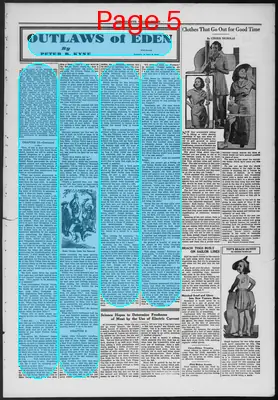
Literary
July 27, 1934
Buckeye Valley News
Buckeye, Maricopa County, Arizona
What is this article about?
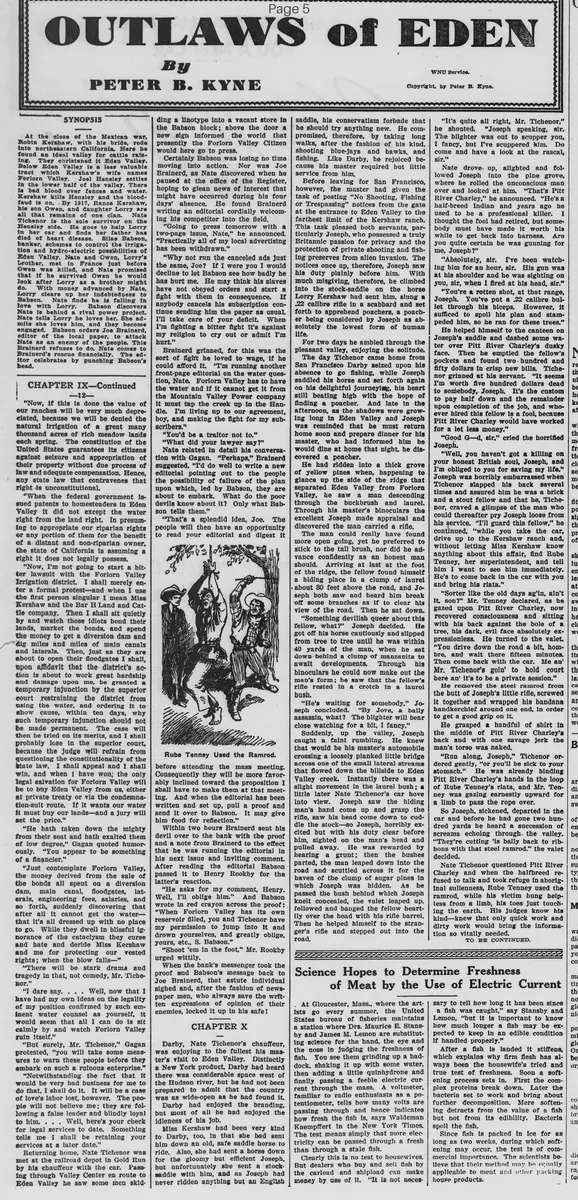
In 'Outlaws of Eden,' Nate Tichenor consults a lawyer on water rights disputes with Forlorn Valley Irrigation District, plans to protest legally. He supports editor Joe Brainerd against rival paper. Returning home, his servant Joseph thwarts an assassination attempt by Pitt River Charley, leading to interrogation.
Clipping
OCR Quality
98%
Excellent
Full Text
OUTLAWS OF EDEN
By WNU Service.
PETER B. KYNE
Copyright, by Peter B. Kyne.
SYNOPSIS
At the close of the Mexican war Robin Kershaw, with his bride, rode into northeastern California. Here he found an ideal valley for cattle raising. They christened it Eden Valley. Below Eden Valley is a less valuable tract which Kershaw's wife names Forlorn Valley. Joel Hensley settles in the lower half of the valley. There is bad blood over fences and water. Kershaw kills Hensley and the blood-feud is on. By 1917, Rance Kershaw, his son Owen, and daughter Lorry are all that remains of one clan. Nate Tichenor is the sole survivor on the Hensley side. He goes to help Lorry in her car and finds her father has died of heart disease. Silas Babson, banker, schemes to control the irrigation and hydro-electric possibilities of Eden Valley. Nate and Owen, Lorry's brother, met in France just before Owen was killed, and Nate promised that if he survived Owen he would look after Lorry as a brother might do.
With money advanced by Nate, Lorry clears up her indebtedness to Babson. Nate finds he is falling in love with Lorry. Babson discovers Nate is behind a rival power project. Nate tells Lorry he loves her. She admits she loves him, and they become engaged. Babson orders Joe Brainerd, editor of the local paper, to attack Nate as an enemy of the people. This Brainerd refuses to do. Nate comes to Brainerd's rescue financially. The editor celebrates by punching Babson's head.
CHAPTER IX-Continued
-12
"Now, if this is done the value of our ranches will be very much depreciated, because we will be denied the natural irrigation of a great many thousand acres of rich meadow lands each spring. The constitution of the United States guarantees its citizens against seizure and appropriation of their property without due process of law and adequate compensation. Hence, any state law that contravenes that right is unconstitutional.
"When the federal government issued patents to homesteaders in Eden Valley it did not except the water right from the land right. In presuming to appropriate our riparian rights or any portion of them for the benefit of a distant and non-riparian owner, the state of California is assuming a right it does not legally possess.
"Now, I'm not going to start a bitter lawsuit with the Forlorn Valley Irrigation district. I shall merely enter a formal protest—and when I use the first person singular I mean Miss Kershaw and the Bar H Land and Cattle company. Then I shall sit quietly by and watch those idiots bond their lands, market the bonds, and spend the money to get a diversion dam and dig miles and miles of main canals and laterals. Then, just as they are about to open their floodgates I shall, upon affidavit that the district's action is about to work great hardship and damage upon me, be granted a temporary injunction by the superior court restraining the district from using the water, and ordering it to show cause, within ten days, why such temporary injunction should not be made permanent. The case will then be tried on its merits, and I shall probably lose in the superior court, because the judge will refrain from questioning the constitutionality of the state law. I shall appeal and I shall win, and when I have won, the only legal salvation for Forlorn Valley will be to buy Eden Valley from us, either at private treaty or via the condemnation-suit route. If it wants our water it must buy our lands—and a jury will set the price."
"He hath taken down the mighty from their seat and hath exalted them of low degree," Gagan quoted humorously. "You appear to be something of a financier."
"Just contemplate Forlorn Valley, the money derived from the sale of the bonds all spent on a diversion dam, main canal, floodgates, laterals, engineering fees, salaries, and so forth, suddenly discovering that after all it cannot get the water—that it's all dressed up with no place to go. While they dwell in blissful ignorance of the cataclysm they curse and hate and deride Miss Kershaw and me for protecting our vested rights; when the blow falls"
"There will be stark drama and tragedy in that, not comedy. Mr. Tichenor."
"I dare say... Well, now that I have had my own ideas on the legality of my position confirmed by such eminent water counsel as yourself, it would seem that all I can do is sit calmly by and watch Forlorn Valley ruin itself."
"But surely, Mr. Tichenor," Gagan protested, "you will take some measures to warn these people before they embark on such a ruinous enterprise."
"Notwithstanding the fact that it would be very bad business for me to do that, I shall do it. It will be a case of love's labor lost, however. The people will not believe me; they are following a false leader and blindly loyal to him... Well, here's your check for legal services to date. Something tells me I shall be retaining your services at a later date."
Returning home, Nate Tichenor was met at the railroad depot in Gold Run by his chauffeur with the car. Passing through Valley Center en route to Eden Valley he saw some men skidding a linotype into a vacant store in the Babson block; above the door a new sign informed the world that presently the Forlorn Valley Citizen would here go to press.
Certainly Babson was losing no time moving into action. Nor was Joe Brainerd, as Nate discovered when he paused at the office of the Register, hoping to glean news of interest that might have occurred during his four days' absence.
He found Brainerd writing an editorial cordially welcoming his competitor into the field.
"Going to press tomorrow with a two-page issue, Nate," he announced. "Practically all of my local advertising has been withdrawn."
"Why not run the canceled ads just the same, Joe? If I were you I would decline to let Babson see how badly he has hurt me. He may think his slaves have not obeyed orders and start a fight with them in consequence. If anybody cancels his subscription continue sending him the paper as usual. I'll take care of your deficit. When I'm fighting a bitter fight it's against my religion to cry out or admit I'm hurt."
Brainerd grinned, for this was the sort of fight he loved to wage, if he could afford it. "I'm running another front-page editorial on the water question, Nate. Forlorn Valley has to have the water and if it cannot get it from the Mountain Valley Power company it must tap the creek up in the Handle. I'm living up to our agreement, boy, and making the fight for my subscribers."
"You'd be a traitor not to."
"What did your lawyer say?"
Nate related in detail his conversation with Gagan. "Perhaps," Brainerd suggested, "I'd do well to write a new editorial pointing out to the people the possibility of failure of the plan upon which, led by Babson, they are about to embark. What do the poor devils know about it? Only what Babson tells them."
"That's a splendid idea, Joe. The people will then have an opportunity to read your editorial and digest it before attending the mass meeting. Consequently they will be more favorably inclined toward the proposition I shall have to make them at that meeting. And when the editorial has been written and set up, pull a proof and send it over to Babson. It may give him food for reflection."
Within two hours Brainerd sent his devil over to the bank with the proof and a note from Brainerd to the effect that he was running the editorial in his next issue and inviting comment.
After reading the editorial Babson passed it to Henry Rookby for the latter's reaction.
"He asks for my comment, Henry. Well, I'll oblige him." And Babson wrote in red crayon across the proof: "When Forlorn Valley has its own reservoir filled, you and Tichenor have my permission to jump into it and drown yourselves, and greatly oblige, yours, etc., S. Babson."
"Shoot 'em in the foot," Mr. Rookby urged wittily.
When the bank's messenger took the proof and Babson's message back to Joe Brainerd, that astute individual sighed and, after the fashion of newspaper men, who always save the written expressions of opinion of their enemies, locked it up in his safe.
CHAPTER X
Darby, Nate Tichenor's chauffeur, was enjoying to the fullest his master's visit to Eden Valley. Distinctly a New York product, Darby had heard there was considerable space west of the Hudson river, but he had not been prepared to admit that the country was as wide-open as he had found it.
Darby had enjoyed the branding, but most of all he had enjoyed the idleness of his job.
Miss Kershaw had been very kind to Darby, too, in that she had sent him down an old, safe saddle horse to ride. Also, she had sent a horse down for the gloomy but efficient Joseph, but unfortunately she sent a stock-saddle with him, and as Joseph had never ridden anything but an English saddle, his conservatism forbade that he should try anything new. He compromised, therefore, by taking long walks, after the fashion of his kind, shooting blue-jays and hawks, and fishing.
Like Darby, he rejoiced because his master required but little service from him.
Before leaving for San Francisco, however, the master had given the task of posting "No Shooting, Fishing or Trespassing" notices from the gate at the entrance to Eden Valley to the farthest limit of the Kershaw ranch. This task pleased both servants, particularly Joseph, who possessed a truly Britannic passion for privacy and the protection of private shooting and fishing preserves from alien invasion. The notices once up, therefore, Joseph saw his duty plainly before him. With much misgiving, therefore, he climbed into the stock-saddle on the horse Lorry Kershaw had sent him, slung a .22 calibre rifle in a scabbard and set forth to apprehend poachers, a poacher being considered by Joseph as absolutely the lowest form of human life.
For two days he ambled through the pleasant valley, enjoying the solitude. The day Tichenor came home from San Francisco Darby seized upon his absence to go fishing, while Joseph saddled his horse and set forth again on his delightful journeying, his heart still beating high with the hope of finding a poacher. And late in the afternoon, as the shadows were growing long in Eden Valley and Joseph was reminded that he must return home soon and prepare dinner for his master, who had informed him he would dine at home that night, he discovered a poacher.
He had ridden into a thick grove of yellow pines when, happening to glance up the side of the ridge that separated Eden Valley from Forlorn Valley, he saw a man descending through the buckbrush and laurel. Through his master's binoculars the excellent Joseph made appraisal and discovered the man carried a rifle.
The man could really have found more open going, yet he preferred to stick to the tall brush, nor did he advance confidently as an honest man should. Arriving at last at the foot of the ridge, the fellow found himself a hiding place in a clump of laurel about 30 feet above the road, and Joseph both saw and heard him break off some branches as if to clear his view of the road. Then he sat down.
"Something devilish queer about this fellow, what?" Joseph decided. He got off his horse cautiously and slipped from tree to tree until he was within 40 yards of the man, when he sat down behind a clump of manzanita to await developments. Through his binoculars he could now make out the man's form; he saw that the fellow's rifle rested in a crotch in a laurel bush.
"He's waiting for somebody," Joseph concluded. "By Jove, a bally assassin, what? The blighter will bear close watching for a bit, I fancy."
Suddenly, up the valley, Joseph caught a faint rumbling. He knew that would be his master's automobile crossing a loosely planked little bridge across one of the small lateral streams that flowed down the hillside to Eden Valley creek. Instantly there was a slight movement in the laurel bush; a little later Nate Tichenor's car hove into view. Joseph saw the hiding man's hand come up and grasp the rifle, saw his head come down to cuddle the stock—so Joseph, horribly excited but with his duty clear before him, sighted on the man's head and pulled away. He was rewarded by hearing a grunt; then the bushes parted, the man leaped down into the road and scuttled across it for the haven of the clump of sugar pines in which Joseph was hidden. As he passed the bush behind which Joseph knelt concealed, the valet leaped up, followed and banged the fellow heartily over the head with his rifle barrel. Then he helped himself to the stranger's rifle and stepped out into the road.
"It's quite all right, Mr. Tichenor," he shouted. "Joseph speaking, sir. The blighter was out to scupper you, I fancy, but I've scuppered him. Do come and have a look at the rascal, sir."
Nate drove up, alighted and followed Joseph into the pine grove, where he rolled the unconscious man over and looked at him. "That's Pitt River Charley," he announced. "He's a half-breed Indian and years ago he used to be a professional killer. I thought the fool had retired, but somebody must have made it worth his while to get back into harness. Are you quite certain he was gunning for me, Joseph?"
"Absolutely, sir. I've been watching him for an hour, sir. His gun was at his shoulder and he was sighting on you, sir, when I fired at his head, sir."
"You're a rotten shot, at that range, Joseph. You've put a .22 calibre bullet through his biceps. However, it sufficed to spoil his plan and stampeded him, so he ran for these trees."
He helped himself to the canteen on Joseph's saddle and dashed some water over Pitt River Charley's dusky face. Then he emptied the fellow's pockets and found two hundred and fifty dollars in crisp new bills. Tichenor grinned at his servant. "It seems I'm worth five hundred dollars dead to somebody, Joseph. It's the custom to pay half down and the remainder upon completion of the job, and whoever hired this fellow is a fool, because Pitt River Charley would have worked for a lot less money."
"Good God, sir," cried the horrified Joseph.
"Well, you haven't got a killing on your honest British soul, Joseph, and I'm obliged to you for saving my life."
Joseph was horribly embarrassed when Tichenor slapped his back several times and assured him he was a brick and a stout fellow and that he, Tichenor, craved a glimpse of the man who could thereafter pry Joseph loose from his service. "I'll guard this fellow," he continued, "while you take the car, drive up to the Kershaw ranch and, without letting Miss Kershaw know anything about this affair, find Rube Tenney, her superintendent, and tell him I want to see him immediately. He's to come back in the car with you and bring his riata."
"Sorter like the old days ag'in, ain't it, son?" Mr. Tenney declared, as he gazed upon Pitt River Charley, now recovered consciousness and sitting with his back against the bole of a tree, his dark, evil face absolutely expressionless. He turned to the valet. "You drive down the road a bit, hombre, and wait there fifteen minutes. Then come back with the car. Me an' Mr. Tichenor's goin' to hold court here an' it's to be a private session."
He removed the steel ramrod from the butt of Joseph's little rifle, screwed it together and wrapped his bandana handkerchief around one end, in order to get a good grip on it.
He grasped a handful of shirt in the middle of Pitt River Charley's back and with one savage jerk the man's torso was naked.
"Run along, Joseph," Tichenor ordered gently, "or you'll be sick to your stomach." He was already binding Pitt River Charley's hands in the loop of Rube Tenney's riata, and Mr. Tenney was gazing earnestly upward for a limb to pass the rope over.
So Joseph, sickened, departed in the car and before he had gone two hundred yards he heard a succession of screams echoing through the valley.
"They're cutting 'is bally back to ribbons with that steel ramrod," the valet decided.
Nate Tichenor questioned Pitt River Charley and when the halfbreed refused to talk and took refuge in aboriginal sullenness, Rube Tenney used the ramrod, while his victim hung helpless from a limb, his toes just touching the earth. His judges knew his kind—knew that only quick work and dirty work would bring the information so vitally needed.
TO BE CONTINUED.
By WNU Service.
PETER B. KYNE
Copyright, by Peter B. Kyne.
SYNOPSIS
At the close of the Mexican war Robin Kershaw, with his bride, rode into northeastern California. Here he found an ideal valley for cattle raising. They christened it Eden Valley. Below Eden Valley is a less valuable tract which Kershaw's wife names Forlorn Valley. Joel Hensley settles in the lower half of the valley. There is bad blood over fences and water. Kershaw kills Hensley and the blood-feud is on. By 1917, Rance Kershaw, his son Owen, and daughter Lorry are all that remains of one clan. Nate Tichenor is the sole survivor on the Hensley side. He goes to help Lorry in her car and finds her father has died of heart disease. Silas Babson, banker, schemes to control the irrigation and hydro-electric possibilities of Eden Valley. Nate and Owen, Lorry's brother, met in France just before Owen was killed, and Nate promised that if he survived Owen he would look after Lorry as a brother might do.
With money advanced by Nate, Lorry clears up her indebtedness to Babson. Nate finds he is falling in love with Lorry. Babson discovers Nate is behind a rival power project. Nate tells Lorry he loves her. She admits she loves him, and they become engaged. Babson orders Joe Brainerd, editor of the local paper, to attack Nate as an enemy of the people. This Brainerd refuses to do. Nate comes to Brainerd's rescue financially. The editor celebrates by punching Babson's head.
CHAPTER IX-Continued
-12
"Now, if this is done the value of our ranches will be very much depreciated, because we will be denied the natural irrigation of a great many thousand acres of rich meadow lands each spring. The constitution of the United States guarantees its citizens against seizure and appropriation of their property without due process of law and adequate compensation. Hence, any state law that contravenes that right is unconstitutional.
"When the federal government issued patents to homesteaders in Eden Valley it did not except the water right from the land right. In presuming to appropriate our riparian rights or any portion of them for the benefit of a distant and non-riparian owner, the state of California is assuming a right it does not legally possess.
"Now, I'm not going to start a bitter lawsuit with the Forlorn Valley Irrigation district. I shall merely enter a formal protest—and when I use the first person singular I mean Miss Kershaw and the Bar H Land and Cattle company. Then I shall sit quietly by and watch those idiots bond their lands, market the bonds, and spend the money to get a diversion dam and dig miles and miles of main canals and laterals. Then, just as they are about to open their floodgates I shall, upon affidavit that the district's action is about to work great hardship and damage upon me, be granted a temporary injunction by the superior court restraining the district from using the water, and ordering it to show cause, within ten days, why such temporary injunction should not be made permanent. The case will then be tried on its merits, and I shall probably lose in the superior court, because the judge will refrain from questioning the constitutionality of the state law. I shall appeal and I shall win, and when I have won, the only legal salvation for Forlorn Valley will be to buy Eden Valley from us, either at private treaty or via the condemnation-suit route. If it wants our water it must buy our lands—and a jury will set the price."
"He hath taken down the mighty from their seat and hath exalted them of low degree," Gagan quoted humorously. "You appear to be something of a financier."
"Just contemplate Forlorn Valley, the money derived from the sale of the bonds all spent on a diversion dam, main canal, floodgates, laterals, engineering fees, salaries, and so forth, suddenly discovering that after all it cannot get the water—that it's all dressed up with no place to go. While they dwell in blissful ignorance of the cataclysm they curse and hate and deride Miss Kershaw and me for protecting our vested rights; when the blow falls"
"There will be stark drama and tragedy in that, not comedy. Mr. Tichenor."
"I dare say... Well, now that I have had my own ideas on the legality of my position confirmed by such eminent water counsel as yourself, it would seem that all I can do is sit calmly by and watch Forlorn Valley ruin itself."
"But surely, Mr. Tichenor," Gagan protested, "you will take some measures to warn these people before they embark on such a ruinous enterprise."
"Notwithstanding the fact that it would be very bad business for me to do that, I shall do it. It will be a case of love's labor lost, however. The people will not believe me; they are following a false leader and blindly loyal to him... Well, here's your check for legal services to date. Something tells me I shall be retaining your services at a later date."
Returning home, Nate Tichenor was met at the railroad depot in Gold Run by his chauffeur with the car. Passing through Valley Center en route to Eden Valley he saw some men skidding a linotype into a vacant store in the Babson block; above the door a new sign informed the world that presently the Forlorn Valley Citizen would here go to press.
Certainly Babson was losing no time moving into action. Nor was Joe Brainerd, as Nate discovered when he paused at the office of the Register, hoping to glean news of interest that might have occurred during his four days' absence.
He found Brainerd writing an editorial cordially welcoming his competitor into the field.
"Going to press tomorrow with a two-page issue, Nate," he announced. "Practically all of my local advertising has been withdrawn."
"Why not run the canceled ads just the same, Joe? If I were you I would decline to let Babson see how badly he has hurt me. He may think his slaves have not obeyed orders and start a fight with them in consequence. If anybody cancels his subscription continue sending him the paper as usual. I'll take care of your deficit. When I'm fighting a bitter fight it's against my religion to cry out or admit I'm hurt."
Brainerd grinned, for this was the sort of fight he loved to wage, if he could afford it. "I'm running another front-page editorial on the water question, Nate. Forlorn Valley has to have the water and if it cannot get it from the Mountain Valley Power company it must tap the creek up in the Handle. I'm living up to our agreement, boy, and making the fight for my subscribers."
"You'd be a traitor not to."
"What did your lawyer say?"
Nate related in detail his conversation with Gagan. "Perhaps," Brainerd suggested, "I'd do well to write a new editorial pointing out to the people the possibility of failure of the plan upon which, led by Babson, they are about to embark. What do the poor devils know about it? Only what Babson tells them."
"That's a splendid idea, Joe. The people will then have an opportunity to read your editorial and digest it before attending the mass meeting. Consequently they will be more favorably inclined toward the proposition I shall have to make them at that meeting. And when the editorial has been written and set up, pull a proof and send it over to Babson. It may give him food for reflection."
Within two hours Brainerd sent his devil over to the bank with the proof and a note from Brainerd to the effect that he was running the editorial in his next issue and inviting comment.
After reading the editorial Babson passed it to Henry Rookby for the latter's reaction.
"He asks for my comment, Henry. Well, I'll oblige him." And Babson wrote in red crayon across the proof: "When Forlorn Valley has its own reservoir filled, you and Tichenor have my permission to jump into it and drown yourselves, and greatly oblige, yours, etc., S. Babson."
"Shoot 'em in the foot," Mr. Rookby urged wittily.
When the bank's messenger took the proof and Babson's message back to Joe Brainerd, that astute individual sighed and, after the fashion of newspaper men, who always save the written expressions of opinion of their enemies, locked it up in his safe.
CHAPTER X
Darby, Nate Tichenor's chauffeur, was enjoying to the fullest his master's visit to Eden Valley. Distinctly a New York product, Darby had heard there was considerable space west of the Hudson river, but he had not been prepared to admit that the country was as wide-open as he had found it.
Darby had enjoyed the branding, but most of all he had enjoyed the idleness of his job.
Miss Kershaw had been very kind to Darby, too, in that she had sent him down an old, safe saddle horse to ride. Also, she had sent a horse down for the gloomy but efficient Joseph, but unfortunately she sent a stock-saddle with him, and as Joseph had never ridden anything but an English saddle, his conservatism forbade that he should try anything new. He compromised, therefore, by taking long walks, after the fashion of his kind, shooting blue-jays and hawks, and fishing.
Like Darby, he rejoiced because his master required but little service from him.
Before leaving for San Francisco, however, the master had given the task of posting "No Shooting, Fishing or Trespassing" notices from the gate at the entrance to Eden Valley to the farthest limit of the Kershaw ranch. This task pleased both servants, particularly Joseph, who possessed a truly Britannic passion for privacy and the protection of private shooting and fishing preserves from alien invasion. The notices once up, therefore, Joseph saw his duty plainly before him. With much misgiving, therefore, he climbed into the stock-saddle on the horse Lorry Kershaw had sent him, slung a .22 calibre rifle in a scabbard and set forth to apprehend poachers, a poacher being considered by Joseph as absolutely the lowest form of human life.
For two days he ambled through the pleasant valley, enjoying the solitude. The day Tichenor came home from San Francisco Darby seized upon his absence to go fishing, while Joseph saddled his horse and set forth again on his delightful journeying, his heart still beating high with the hope of finding a poacher. And late in the afternoon, as the shadows were growing long in Eden Valley and Joseph was reminded that he must return home soon and prepare dinner for his master, who had informed him he would dine at home that night, he discovered a poacher.
He had ridden into a thick grove of yellow pines when, happening to glance up the side of the ridge that separated Eden Valley from Forlorn Valley, he saw a man descending through the buckbrush and laurel. Through his master's binoculars the excellent Joseph made appraisal and discovered the man carried a rifle.
The man could really have found more open going, yet he preferred to stick to the tall brush, nor did he advance confidently as an honest man should. Arriving at last at the foot of the ridge, the fellow found himself a hiding place in a clump of laurel about 30 feet above the road, and Joseph both saw and heard him break off some branches as if to clear his view of the road. Then he sat down.
"Something devilish queer about this fellow, what?" Joseph decided. He got off his horse cautiously and slipped from tree to tree until he was within 40 yards of the man, when he sat down behind a clump of manzanita to await developments. Through his binoculars he could now make out the man's form; he saw that the fellow's rifle rested in a crotch in a laurel bush.
"He's waiting for somebody," Joseph concluded. "By Jove, a bally assassin, what? The blighter will bear close watching for a bit, I fancy."
Suddenly, up the valley, Joseph caught a faint rumbling. He knew that would be his master's automobile crossing a loosely planked little bridge across one of the small lateral streams that flowed down the hillside to Eden Valley creek. Instantly there was a slight movement in the laurel bush; a little later Nate Tichenor's car hove into view. Joseph saw the hiding man's hand come up and grasp the rifle, saw his head come down to cuddle the stock—so Joseph, horribly excited but with his duty clear before him, sighted on the man's head and pulled away. He was rewarded by hearing a grunt; then the bushes parted, the man leaped down into the road and scuttled across it for the haven of the clump of sugar pines in which Joseph was hidden. As he passed the bush behind which Joseph knelt concealed, the valet leaped up, followed and banged the fellow heartily over the head with his rifle barrel. Then he helped himself to the stranger's rifle and stepped out into the road.
"It's quite all right, Mr. Tichenor," he shouted. "Joseph speaking, sir. The blighter was out to scupper you, I fancy, but I've scuppered him. Do come and have a look at the rascal, sir."
Nate drove up, alighted and followed Joseph into the pine grove, where he rolled the unconscious man over and looked at him. "That's Pitt River Charley," he announced. "He's a half-breed Indian and years ago he used to be a professional killer. I thought the fool had retired, but somebody must have made it worth his while to get back into harness. Are you quite certain he was gunning for me, Joseph?"
"Absolutely, sir. I've been watching him for an hour, sir. His gun was at his shoulder and he was sighting on you, sir, when I fired at his head, sir."
"You're a rotten shot, at that range, Joseph. You've put a .22 calibre bullet through his biceps. However, it sufficed to spoil his plan and stampeded him, so he ran for these trees."
He helped himself to the canteen on Joseph's saddle and dashed some water over Pitt River Charley's dusky face. Then he emptied the fellow's pockets and found two hundred and fifty dollars in crisp new bills. Tichenor grinned at his servant. "It seems I'm worth five hundred dollars dead to somebody, Joseph. It's the custom to pay half down and the remainder upon completion of the job, and whoever hired this fellow is a fool, because Pitt River Charley would have worked for a lot less money."
"Good God, sir," cried the horrified Joseph.
"Well, you haven't got a killing on your honest British soul, Joseph, and I'm obliged to you for saving my life."
Joseph was horribly embarrassed when Tichenor slapped his back several times and assured him he was a brick and a stout fellow and that he, Tichenor, craved a glimpse of the man who could thereafter pry Joseph loose from his service. "I'll guard this fellow," he continued, "while you take the car, drive up to the Kershaw ranch and, without letting Miss Kershaw know anything about this affair, find Rube Tenney, her superintendent, and tell him I want to see him immediately. He's to come back in the car with you and bring his riata."
"Sorter like the old days ag'in, ain't it, son?" Mr. Tenney declared, as he gazed upon Pitt River Charley, now recovered consciousness and sitting with his back against the bole of a tree, his dark, evil face absolutely expressionless. He turned to the valet. "You drive down the road a bit, hombre, and wait there fifteen minutes. Then come back with the car. Me an' Mr. Tichenor's goin' to hold court here an' it's to be a private session."
He removed the steel ramrod from the butt of Joseph's little rifle, screwed it together and wrapped his bandana handkerchief around one end, in order to get a good grip on it.
He grasped a handful of shirt in the middle of Pitt River Charley's back and with one savage jerk the man's torso was naked.
"Run along, Joseph," Tichenor ordered gently, "or you'll be sick to your stomach." He was already binding Pitt River Charley's hands in the loop of Rube Tenney's riata, and Mr. Tenney was gazing earnestly upward for a limb to pass the rope over.
So Joseph, sickened, departed in the car and before he had gone two hundred yards he heard a succession of screams echoing through the valley.
"They're cutting 'is bally back to ribbons with that steel ramrod," the valet decided.
Nate Tichenor questioned Pitt River Charley and when the halfbreed refused to talk and took refuge in aboriginal sullenness, Rube Tenney used the ramrod, while his victim hung helpless from a limb, his toes just touching the earth. His judges knew his kind—knew that only quick work and dirty work would bring the information so vitally needed.
TO BE CONTINUED.
What sub-type of article is it?
Prose Fiction
What themes does it cover?
Political
Taxation Oppression
Liberty Freedom
What keywords are associated?
Water Rights
Irrigation District
Legal Protest
Assassination Attempt
Feud
Eden Valley
Forlorn Valley
Pitt River Charley
What entities or persons were involved?
Peter B. Kyne
Literary Details
Title
Outlaws Of Eden
Author
Peter B. Kyne
Subject
Water Rights Dispute And Assassination Attempt In Eden Valley Feud
Form / Style
Serialized Novel Chapter In Prose
Key Lines
"The Constitution Of The United States Guarantees Its Citizens Against Seizure And Appropriation Of Their Property Without Due Process Of Law And Adequate Compensation."
"If It Wants Our Water It Must Buy Our Lands—And A Jury Will Set The Price."
"It's Quite All Right, Mr. Tichenor," He Shouted. "Joseph Speaking, Sir. The Blighter Was Out To Scupper You, I Fancy, But I've Scuppered Him."
"It Seems I'm Worth Five Hundred Dollars Dead To Somebody, Joseph."