Thank you for visiting SNEWPapers!
Sign up free
Literary
July 29, 1790
The New Hampshire Gazette And General Advertiser
Portsmouth, Rockingham County, New Hampshire
What is this article about?
Benjamin Franklin shares a childhood anecdote of overpaying for a whistle, using it as a lifelong metaphor for people who sacrifice too much—time, virtue, health, or freedom—for fleeting ambitions, popularity, wealth, pleasure, or luxury.
Clipping
OCR Quality
98%
Excellent
Full Text
THE WHISTLE
A TRUE STORY.
Written by Dr. Franklin, to his Nephew.
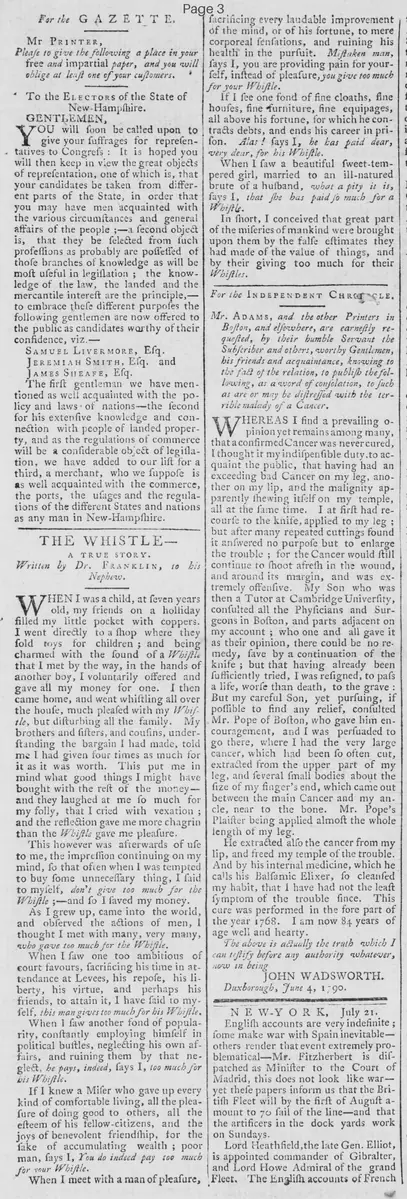
WHEN I was a child, at seven years old, my friends on a holiday filled my little pocket with coppers. I went directly to a shop where they sold toys for children; and being charmed with the sound of a Whistle that I met by the way, in the hands of another boy, I voluntarily offered and gave all my money for one. I then came home, and went whistling all over the house, much pleased with my Whistle, but disturbing all the family. My brothers and sisters, and cousins, understanding the bargain I had made, told me I had given four times as much for it as it was worth. This put me in mind what good things I might have bought with the rest of the money; and they laughed at me so much for my folly, that I cried with vexation; and the reflection gave me more chagrin than the Whistle gave me pleasure.
This however was afterwards of use to me, the impression continuing on my mind, so that often when I was tempted to buy some unnecessary thing, I said to myself, don't give too much for the whistle; -and so I saved my money.
As I grew up, came into the world, and observed the actions of men, I thought I met with many, very many, who gave too much for the Whistle.
When I saw one too ambitious of court favours, sacrificing his time in attendance at Levees, his repose, his liberty, his virtue, and perhaps his friends, to attain it, I have said to myself, this man gives too much for his Whistle.
When I saw another fond of popularity, constantly employing himself in political bustles, neglecting his own affairs, and ruining them by that neglect, he pays, indeed, says I, too much for his Whistle.
If I knew a Miser who gave up every kind of comfortable living, all the pleasure of doing good to others, all the esteem of his fellow-citizens, and the joys of benevolent friendship, for the sake of accumulating wealth; poor man, says I, You do indeed pay too much for your Whistle.
When I meet with a man of pleasure, sacrificing every laudable improvement of the mind, or of his fortune, to mere corporeal sensations, and ruining his health in their pursuit. Mistaken man, says I, you are providing pain for yourself, instead of pleasure, you give too much for your Whistle.
If I see one fond of fine clothes, fine houses, fine furniture, fine equipages, all above his fortune, for which he contracts debts, and ends his career in a prison. Alas! says I, he has paid dear, very dear, for his Whistle.
When I saw a beautiful sweet-tempered girl, married to an ill-natured brute of a husband, what a pity it is, says I, that he has paid so much for a Whistle.
In short, I conceived that great part of the miseries of mankind were brought upon them by the false estimates they had made of the value of things, and by their giving too much for their Whistles.
A TRUE STORY.
Written by Dr. Franklin, to his Nephew.
WHEN I was a child, at seven years old, my friends on a holiday filled my little pocket with coppers. I went directly to a shop where they sold toys for children; and being charmed with the sound of a Whistle that I met by the way, in the hands of another boy, I voluntarily offered and gave all my money for one. I then came home, and went whistling all over the house, much pleased with my Whistle, but disturbing all the family. My brothers and sisters, and cousins, understanding the bargain I had made, told me I had given four times as much for it as it was worth. This put me in mind what good things I might have bought with the rest of the money; and they laughed at me so much for my folly, that I cried with vexation; and the reflection gave me more chagrin than the Whistle gave me pleasure.
This however was afterwards of use to me, the impression continuing on my mind, so that often when I was tempted to buy some unnecessary thing, I said to myself, don't give too much for the whistle; -and so I saved my money.
As I grew up, came into the world, and observed the actions of men, I thought I met with many, very many, who gave too much for the Whistle.
When I saw one too ambitious of court favours, sacrificing his time in attendance at Levees, his repose, his liberty, his virtue, and perhaps his friends, to attain it, I have said to myself, this man gives too much for his Whistle.
When I saw another fond of popularity, constantly employing himself in political bustles, neglecting his own affairs, and ruining them by that neglect, he pays, indeed, says I, too much for his Whistle.
If I knew a Miser who gave up every kind of comfortable living, all the pleasure of doing good to others, all the esteem of his fellow-citizens, and the joys of benevolent friendship, for the sake of accumulating wealth; poor man, says I, You do indeed pay too much for your Whistle.
When I meet with a man of pleasure, sacrificing every laudable improvement of the mind, or of his fortune, to mere corporeal sensations, and ruining his health in their pursuit. Mistaken man, says I, you are providing pain for yourself, instead of pleasure, you give too much for your Whistle.
If I see one fond of fine clothes, fine houses, fine furniture, fine equipages, all above his fortune, for which he contracts debts, and ends his career in a prison. Alas! says I, he has paid dear, very dear, for his Whistle.
When I saw a beautiful sweet-tempered girl, married to an ill-natured brute of a husband, what a pity it is, says I, that he has paid so much for a Whistle.
In short, I conceived that great part of the miseries of mankind were brought upon them by the false estimates they had made of the value of things, and by their giving too much for their Whistles.
What sub-type of article is it?
Essay
What themes does it cover?
Moral Virtue
What keywords are associated?
Whistle
Moral Lesson
False Values
Ambition
Miser
Popularity
Pleasure
Luxury
What entities or persons were involved?
Dr. Franklin
Literary Details
Title
The Whistle
Author
Dr. Franklin
Subject
A True Story
Key Lines
Don't Give Too Much For The Whistle;
This Man Gives Too Much For His Whistle.
You Give Too Much For Your Whistle.
He Has Paid Dear, Very Dear, For His Whistle.
Great Part Of The Miseries Of Mankind Were Brought Upon Them By The False Estimates They Had Made Of The Value Of Things, And By Their Giving Too Much For Their Whistles.