Thank you for visiting SNEWPapers!
Sign up free
The Liberator
Boston, Suffolk County, Massachusetts
What is this article about?
Editorial from Lowell Journal condemns Philadelphia riots, burning of Pennsylvania Hall, and attacks on black residents as manifestations of racial prejudice akin to slavery's spirit, urging reform through public sentiment to end such outrages.
Clipping
OCR Quality
Full Text
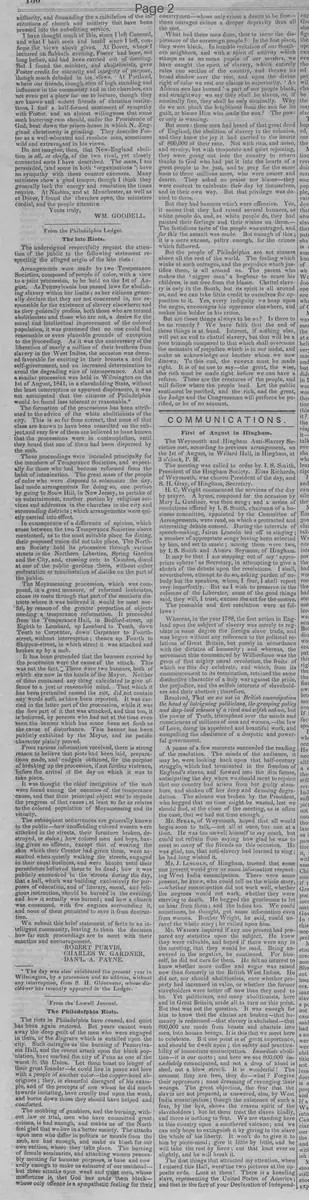
The Philadelphia Riots.
The riots in Philadelphia have ceased, and quiet has been again restored. But years cannot wash away the deep guilt of the men who were engaged in them, or the disgrace which is entailed upon the city. Such outrages as the burning of Pennsylvania Hall, and the recent attack upon the black population, have marked the city of Penn as one of the worst in the Union. Let them boast no longer of their great founder—he could live in peace and love with a people of another color—the copper-hued aborigines; they, in shameful disregard of his example, and of the precepts of one whom he did much towards imitating, have cruelly trod upon the weak, and borne down those they should have helped and comforted.
The mobbing of gamblers, and the burning, without law or trial, men who have committed great crimes, is bad enough, and makes us of the North feel glad that we live in a better society. The attacks upon men who differ in politics or morals from the mob, are bad enough, and make us blush for our own section, where they take place. The burning of female seminaries, and attacking women peaceably meeting for humane purposes, is base and cowardly enough to make us ashamed of our manhood—but these attacks upon weak and quiet men, whose misfortune is, that God has made them black—whose only offence is a sympathetic feeling for their countrymen—whose only crime a desire to be free—these outrages evince a deeper depravity than all the rest.
What had these men done, thus to incur the displeasure of the sovereign people? In the first place they were black. In humble imitation of our Southern neighbors, and with a spirit of activity which stamps us as no mean pupils of our masters, we have caught the spirit of slavery, which entirely rules one section of the country, and throws its broad shadow over the rest, and upon the divine right of color we rest our claims to superiority. An African sun has burned a part of our people black, and straightway we say they shall be slaves, or, if nominally free, they shall be only nominally. Why do we not pluck the brightness from the sun for its guilt, or blame Him who made the sun? The power only is wanting.
But more: these men had heard of that great deed of England, the abolition of slavery in the colonies, and they knew the joy it had carried to the hearts of 800,000 of their race. Not with rum, and noise and revelry, but with temperate and quiet rejoicing, they were going out into the country to return thanks to God who had put it into the hearts of a great people to be just, and to pray for the same boon to three millions more, who were nearer and dearer. They asked no praise nor blame—they were content to celebrate their day by themselves, and in their own way. But that privilege was denied to them.
But they had banners which were offensive. Yes, it seems that they had raised several banners, as white people do, and, as white people do, they had painted their feelings and their wishes on them. The fastidious taste of the people was outraged, and for this the assault was made. But enough of this it is a mere excuse, paltry enough, for the crimes which followed.
But the people of Philadelphia are not sinners above all the rest of the world. The feeling which winks at such outrages, and the prejudice which justifies them, is all around us. The parent who makes the nigger man a bugbear to scare his children, is not free from the blame. Chattel slavery is only in the South, but its spirit is all around us, and we can take little credit to ourselves for opposition to it. Yes, every indignity we heap upon the negro, encourages his oppressor elsewhere, and makes him bolder in his crime.
But are these things always to be so? Is there to be no remedy? We have faith that the end of these things is at hand. Interest, if nothing else, will put an end to chattel slavery, but that will be a poor triumph compared to that which shall overcome the mountain of prejudice which is in our midst, and make us acknowledge our brother whom we now disown. To this end, the people must be made right. It is of no use to say the great, the wise, the rich must be made right before we can have a reform. These are the creatures of the people, and will follow where the people lead. Let the public sentiment be purified, and the rich, and the great the Judge and the Congressman will perforce be purified, or be of no account.
What sub-type of article is it?
What themes does it cover?
What keywords are associated?
Where did it happen?
Story Details
Location
Philadelphia
Story Details
The riots in Philadelphia, including the burning of Pennsylvania Hall and attacks on the black population, have ceased, but the guilt and disgrace remain. The article condemns the mob's actions driven by racial prejudice, influenced by the spirit of slavery, and criticizes the denial of the black community's right to celebrate the abolition of slavery in British colonies. It calls for purifying public sentiment to overcome prejudice and achieve true reform.