Thank you for visiting SNEWPapers!
Sign up free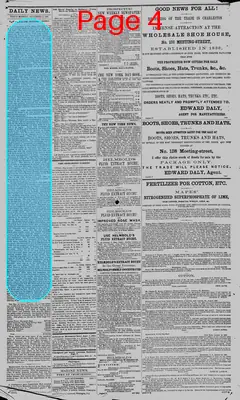
Story
September 8, 1865
The Charleston Daily News
Charleston, Charleston County, South Carolina
What is this article about?
Dr. Russell vividly describes the Great Eastern's failed attempt to lay the Atlantic cable, the cable's snapping, the crew's dismay, and the heroic but unsuccessful effort to retrieve it from the ocean depths, ending with optimism for future success.
Clipping

OCR Quality
95%
Excellent
Full Text
CABLE—DR. RUSSELL'S STORY.
THE Lay of the Last Minstrel, ran about crying 'lost, lost.' Lord Cranston's goblin page, according to the Lay of the Last Minstrel, ran about crying 'lost, lost.' The historiographers of the ill-fated Atlantic cable are given to like melancholy utterances, yet as the goblin lived long enough to change his refrain into 'found, found, found,' so we trust that the luckless wire which is now lying deep bed, will ere long be enabled to indulge in a like change of tune: 'found, found, found.' Dr. Russell's official account of the Great Eastern's voyage, and the abortive attempt to lay the cable, has found its way into the journals—but the public interest in it has been in great measure anticipated by the record of results previously published. The Doctor, however, brings his clever pen into play, and he tells the whole story with the vividness of a real artist, who knows how to invest even the driest scientific technicalities with a melo-dramatic attractiveness that is certain to arrest the public attention. Take for example his description of the snapping of the cable, and its disappearance from mortal eye in the waves of the Atlantic:
'It is not possible' for any words to portray the dismay with which the sight was witnessed and the news heard. It was enough to move to tears! And when a man came aft with a piece of the inner end lashed still to the chain, and one saw the tortured strands—torn wires the lacerated core it is no exaggeration to say that a strange feeling of pity, as though for some sentient creature, mutilated and dragged asunder by brutal force, passed through the hearts of the spectators. But of what use sentimental abstraction, when instant, strenuous, continuous action was demanded? Alas! action! There around lay the placid Atlantic, smiling in the sun, and not a dimple to show where lay so many hopes buried (if cables be as men) till the sea gives up her dead. But there was no blank despair, and if any felt it they suppressed the expression of it, whilst by far the greatest number of those on board were actually animated, not by the loss itself, but by the accidental nature of the occurrence, and felt greater confidence than ever in the laying of the cable. Confidence, under these disheartening circumstances, it seems to us, was heroism itself, and this heroism was not of the abstract, sentimental kind, for straightway—
'After a brief consideration, Mr. Canning, whose presence of mind and self-possession never left him, decided (all but egregious folly it seemed) to seek for the cable in the bottom of the Atlantic to get out the grapnels and drop down to it and pick it up again. Never had alchemist less chance of finding gold buttons in the dross from which he was seeking aurum potabile, or Philosopher's stone. But, then, what would they say in England if not even an attempt, however desperate, had been made? There were men on board who had picked up cables from the Mediterranean full 1400 fathoms down. The weather was beautiful, and if even there were no soundings, and the depth beneath us was matter of confidence, it was settled at last that the Great Eastern should steam ten or twelve miles to windward, eastward of the position in which she was when the cable went down—out with the grapnels and wire rope, and drift down across the course of the track in which the cable was supposed to be lying. Although all utterance of hope was suppressed, and no word of confidence escaped the lips, the mocking shadows of both were treasured in some quiet nook of the fancy. The doctrine of chance could not touch such a contingency as we had to speculate upon. And now they came forth—the grapnels, two five-armed anchors, with flukes sharply curved, and tapering to an oblique toothlike end—the hooks with which the Giant Despair was going to fish from the Great Eastern for a take worth, with all its belongings, more than a million.'
But it was dull, drowsy work, and after all there seems to have been but little real heart in it, for the Doctor goes on to say:
'At first the iron sank but slowly, but soon the momentum of descent increased, so as to lay great stress on the picking-up machinery, which was rendered available to lowering the novel messenger in mysterious caverns beneath. Length after length, over cog-wheel and drum, till the iron, warming with work, heated at last so as to convert the water thrown upon the machinery into clouds of steam. The time passed heavily indeed! All life had died out in the vessel, and no noise was heard except the dull grating of the wire cable over the wheels at the bow.' The most apathetic and indifferent would have sacrificed much to have heard the rumble of the cable again, and have thought and esteemed it the most grateful music in the world. The electrician's room was closed—all their subtle apparatus stood functionless, and cell, zinc and copper threw off superfluous currents in the darkened chamber. The jockeys had run their race and reposed in their iron saddle—the drums beat no more—their long reveille was ended at last in the muffled roll of death—that which had been broken could give no trouble to brakes, and man shunned the region where all these mute witnesses were testifying to the vanity of human wishes. Away flew the wire strands, length after length; ocean was indeed insatiable 'more' and 'more,' cried the daughter of horse leech from the black night of waters, and still the rope descended. One thousand fathoms, fifteen hundred fathoms, two thousand fathoms, hundreds again mounting up, till at last at 5.6 P. M. the strain was diminished, and at 2500 fathoms or 15,000 feet the grapnel reached the bed of the Atlantic, and set to its task of finding and holding the cable. Where that lay was of course beyond human knowledge, but as the ship might feel it that the iron rope might be brought up again, and the cable across it might come up without breaking. But 2500 fathoms! Alas! and so in the darkness of the night—not more gloomy than her errand—the Great Eastern having cleared away one of the great buoys and got it over her bows, was left as a sport to the wind and drifted at the rate of seventy feet a minute down upon the imaginary line beneath which the cable had sunk to useless rest.'
Nevertheless, as the reader already knows, the cable was really 'clutched,' once, twice, thrice—but the 'clutch' did not hold—the strain was too great—and so the great ship had to give it up and return to England, with Mr. Field and all the staff. Dr. Russell adding, 'much strengthened by the conviction that but for the faults in the cable the Old World and the New World would have been ere this united by the Atlantic Telegraph, and animated by the firmest belief in ultimate success.'
The 'faults' alluded to, it is insinuated, were the doings of some malicious employee but the insinuation does not seem to be supported by any coloring of facts.
THE Lay of the Last Minstrel, ran about crying 'lost, lost.' Lord Cranston's goblin page, according to the Lay of the Last Minstrel, ran about crying 'lost, lost.' The historiographers of the ill-fated Atlantic cable are given to like melancholy utterances, yet as the goblin lived long enough to change his refrain into 'found, found, found,' so we trust that the luckless wire which is now lying deep bed, will ere long be enabled to indulge in a like change of tune: 'found, found, found.' Dr. Russell's official account of the Great Eastern's voyage, and the abortive attempt to lay the cable, has found its way into the journals—but the public interest in it has been in great measure anticipated by the record of results previously published. The Doctor, however, brings his clever pen into play, and he tells the whole story with the vividness of a real artist, who knows how to invest even the driest scientific technicalities with a melo-dramatic attractiveness that is certain to arrest the public attention. Take for example his description of the snapping of the cable, and its disappearance from mortal eye in the waves of the Atlantic:
'It is not possible' for any words to portray the dismay with which the sight was witnessed and the news heard. It was enough to move to tears! And when a man came aft with a piece of the inner end lashed still to the chain, and one saw the tortured strands—torn wires the lacerated core it is no exaggeration to say that a strange feeling of pity, as though for some sentient creature, mutilated and dragged asunder by brutal force, passed through the hearts of the spectators. But of what use sentimental abstraction, when instant, strenuous, continuous action was demanded? Alas! action! There around lay the placid Atlantic, smiling in the sun, and not a dimple to show where lay so many hopes buried (if cables be as men) till the sea gives up her dead. But there was no blank despair, and if any felt it they suppressed the expression of it, whilst by far the greatest number of those on board were actually animated, not by the loss itself, but by the accidental nature of the occurrence, and felt greater confidence than ever in the laying of the cable. Confidence, under these disheartening circumstances, it seems to us, was heroism itself, and this heroism was not of the abstract, sentimental kind, for straightway—
'After a brief consideration, Mr. Canning, whose presence of mind and self-possession never left him, decided (all but egregious folly it seemed) to seek for the cable in the bottom of the Atlantic to get out the grapnels and drop down to it and pick it up again. Never had alchemist less chance of finding gold buttons in the dross from which he was seeking aurum potabile, or Philosopher's stone. But, then, what would they say in England if not even an attempt, however desperate, had been made? There were men on board who had picked up cables from the Mediterranean full 1400 fathoms down. The weather was beautiful, and if even there were no soundings, and the depth beneath us was matter of confidence, it was settled at last that the Great Eastern should steam ten or twelve miles to windward, eastward of the position in which she was when the cable went down—out with the grapnels and wire rope, and drift down across the course of the track in which the cable was supposed to be lying. Although all utterance of hope was suppressed, and no word of confidence escaped the lips, the mocking shadows of both were treasured in some quiet nook of the fancy. The doctrine of chance could not touch such a contingency as we had to speculate upon. And now they came forth—the grapnels, two five-armed anchors, with flukes sharply curved, and tapering to an oblique toothlike end—the hooks with which the Giant Despair was going to fish from the Great Eastern for a take worth, with all its belongings, more than a million.'
But it was dull, drowsy work, and after all there seems to have been but little real heart in it, for the Doctor goes on to say:
'At first the iron sank but slowly, but soon the momentum of descent increased, so as to lay great stress on the picking-up machinery, which was rendered available to lowering the novel messenger in mysterious caverns beneath. Length after length, over cog-wheel and drum, till the iron, warming with work, heated at last so as to convert the water thrown upon the machinery into clouds of steam. The time passed heavily indeed! All life had died out in the vessel, and no noise was heard except the dull grating of the wire cable over the wheels at the bow.' The most apathetic and indifferent would have sacrificed much to have heard the rumble of the cable again, and have thought and esteemed it the most grateful music in the world. The electrician's room was closed—all their subtle apparatus stood functionless, and cell, zinc and copper threw off superfluous currents in the darkened chamber. The jockeys had run their race and reposed in their iron saddle—the drums beat no more—their long reveille was ended at last in the muffled roll of death—that which had been broken could give no trouble to brakes, and man shunned the region where all these mute witnesses were testifying to the vanity of human wishes. Away flew the wire strands, length after length; ocean was indeed insatiable 'more' and 'more,' cried the daughter of horse leech from the black night of waters, and still the rope descended. One thousand fathoms, fifteen hundred fathoms, two thousand fathoms, hundreds again mounting up, till at last at 5.6 P. M. the strain was diminished, and at 2500 fathoms or 15,000 feet the grapnel reached the bed of the Atlantic, and set to its task of finding and holding the cable. Where that lay was of course beyond human knowledge, but as the ship might feel it that the iron rope might be brought up again, and the cable across it might come up without breaking. But 2500 fathoms! Alas! and so in the darkness of the night—not more gloomy than her errand—the Great Eastern having cleared away one of the great buoys and got it over her bows, was left as a sport to the wind and drifted at the rate of seventy feet a minute down upon the imaginary line beneath which the cable had sunk to useless rest.'
Nevertheless, as the reader already knows, the cable was really 'clutched,' once, twice, thrice—but the 'clutch' did not hold—the strain was too great—and so the great ship had to give it up and return to England, with Mr. Field and all the staff. Dr. Russell adding, 'much strengthened by the conviction that but for the faults in the cable the Old World and the New World would have been ere this united by the Atlantic Telegraph, and animated by the firmest belief in ultimate success.'
The 'faults' alluded to, it is insinuated, were the doings of some malicious employee but the insinuation does not seem to be supported by any coloring of facts.
What sub-type of article is it?
Historical Event
Disaster
Extraordinary Event
What themes does it cover?
Misfortune
Exploration
Triumph
What keywords are associated?
Atlantic Cable
Great Eastern
Cable Snapping
Grapnel Retrieval
Dr Russell Account
What entities or persons were involved?
Dr. Russell
Mr. Canning
Mr. Field
Where did it happen?
Atlantic Ocean, Aboard The Great Eastern
Story Details
Key Persons
Dr. Russell
Mr. Canning
Mr. Field
Location
Atlantic Ocean, Aboard The Great Eastern
Story Details
Dr. Russell recounts the snapping of the Atlantic cable during laying from the Great Eastern, the crew's emotional response, the desperate attempt to retrieve it using grapnels at depths up to 2500 fathoms, multiple failed clutches, and return to England with renewed confidence in future success despite suspected faults.