Thank you for visiting SNEWPapers!
Sign up free
Literary
April 20, 1849
Carroll Free Press
Carrollton, Carroll County, Ohio
What is this article about?
Philosophical essay arguing for human immortality based on the soul's intellectual and moral powers, divine benevolence, and the need for justice in a future state, contrasting physical mortality with spiritual eternity.
Clipping
OCR Quality
98%
Excellent
Full Text
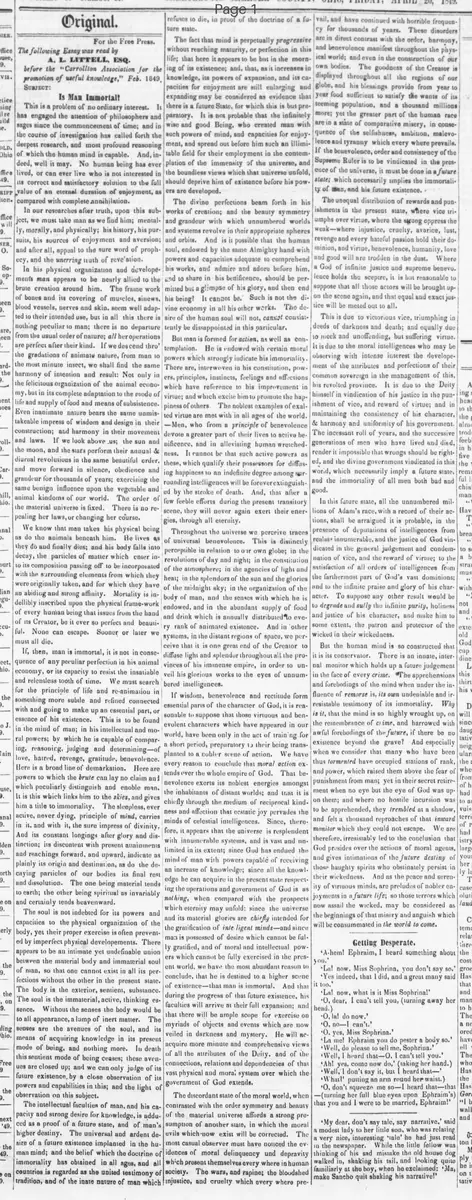
Original.
For the Free Press.
The following Essay was read by A. L. Littell, Esq. before the "Carrollton Association for the promotion of useful knowledge," Feb. 1849,
SUBJECT:
Is Man Immortal?
This is a problem of no ordinary interest. It has engaged the attention of philosophers and sages since the commencement of time; and in the course of investigation has called forth the deepest research, and most profound reasoning of which the human mind is capable. And, indeed, well it may. No human being has ever lived, or can ever live who is not interested in its correct and satisfactory solution to the full value of an eternal duration of enjoyment, as compared with complete annihilation.
In our researches after truth, upon this subject, we must take man as we find him; mentally, morally, and physically; his history, his pursuits, his sources of enjoyment and aversion; and after all, appeal to the sure word of prophecy, and the unerring truth of revelation.
In his physical organization and developments man appears to be nearly allied to the brute creation around him. The frame work of bones and its covering of muscles, sinews, blood vessels, nerves and skin, seem well adapted to their intended use, but in all this there is nothing peculiar to man; there is no departure from the usual order of nature; all her operations are perfect after their kind. If we descend thro' the gradations of animate nature, from man to the most minute insect, we shall find the same harmony of intention and result: Not only in the felicitous organization of the animal economy, but in its complete adaptation to the mode of life and supply of food and means of subsistence.
Even inanimate nature bears the same unmistakable impress of wisdom and design in their construction; and harmony in their movement and laws. If we look above us; the sun and the moon, and the stars perform their annual & diurnal revolutions in the same beautiful order, and move forward in silence, obedience and grandeur for thousands of years; exercising the same benign influence upon the vegetable and animal kingdoms of our world. The order of the material universe is fixed. There is no repealing her laws, or changing her course.
We know that man takes his physical being as do the animals beneath him. He lives as they do and finally dies; and his body falls into decay, the particles of matter which enter into its composition passing off to be incorporated with the surrounding elements from which they were originally taken, and for which they have an abiding and strong affinity. Mortality is indelibly inscribed upon the physical frame-work of every human being that issues from the hand of his Creator, be it ever so perfect and beautiful. None can escape. Sooner or later we must all die.
If, then, man is immortal, it is not in consequence of any peculiar perfection in his animal economy, or its capacity to resist the insatiable and relentless tooth of time. We must search for the principle of life and re-animation in something more subtle and refined connected with and going to make up an essential part, or essence of his existence. This is to be found in the mind of man; in his intellectual and moral powers; by which he is capable of comparing, reasoning, judging and determining—of love, hatred, revenge, gratitude, benevolence.
Here is a broad line of demarkation. Here are powers to which the brute can lay no claim and which peculiarly distinguish and ennoble man. It is this which links him to the skies, and gives him a title to immortality. The sleepless, ever active, never dying, principle of mind, carries in it, and with it, the sure impress of divinity. And its constant longings after glory and distinction; its discontent with present attainments and reachings forward, and upward, indicate as plainly its origin and destination, as do the decaying particles of our bodies its final rest and dissolution. The one being material tends to earth; the other being spiritual as invariably and certainly tends heavenward.
The soul is not indebted for its powers and capacities to the physical organization of the body, yet their proper exercise is often prevented by imperfect physical developments. There appears to be an intimate yet undefinable union between the material body and immaterial soul of man, so that one cannot exist in all its perfections without the other in the present state. The body is the exterior, sentient, substance. The soul is the immaterial, active, thinking essence. Without the senses the body would be to all appearance, a lump of inert matter. The senses are the avenues of the soul, and its means of acquiring knowledge in its present mode of being, and nothing more. In death this sentient mode of being ceases; these avenues are closed up; and we can only judge of its future existence by a close observation of its powers and capabilities in this; and the light of revelation on this subject.
The intellectual faculties of man, and his capacity and strong desire for knowledge, is adduced as a proof of a future state, and of man's higher destiny. The universal and ardent desire of a future existence implanted in the human mind; and the belief which the doctrine of immortality has obtained in all ages, and all countries is regarded as the united testimony of tradition, and of the innate nature of man which refuses to die. in proof of the doctrine of a future state.
The fact that mind is perpetually progressive without reaching maturity, or perfection in this life; that here it appears to be but in the morning of its existence; and that, as it increases in knowledge, its powers of expansion, and its capacities for enjoyment are still enlarging and expanding may be considered as evidence that there is a future State, for which this is but preparatory. It is not probable that the infinitely wise and good Being, who created man with such powers of mind, and capacities for enjoyment, and spread out before him such an illimitable field for their employment in the contemplation of the immensity of the universe, and the boundless views which that universe unfolds, should deprive him of existence before his powers are developed.
The divine perfections beam forth in his works of creation; and the beauty symmetry and grandeur with which unnumbered worlds and systems revolve in their appropriate spheres and orbits. And is it possible that the human soul, endowed by the same Almighty hand with powers and capacities adequate to comprehend his works, and admire and adore before him, and to share in his beneficence, should be permitted but a glimpse of his glory, and then end his being? It cannot be. Such is not the divine economy in all his other works. The desire of the human soul will not, cannot consistently be disappointed in this particular.
But man is formed for action, as well as contemplation. He is endowed with certain moral powers which strongly indicate his immortality. There are interwoven in his constitution, powers, principles, instincts, feelings and affections which have reference to his improvement in virtue; and which excite him to promote the happiness of others. The noblest examples of exalted virtue are met with in all ages of the world. Men who from a principle of benevolence devote a greater part of their lives to active beneficence, and in alleviating human wretchedness. It cannot be that such active powers as these, which qualify their possessors for diffusing happiness to an indefinite degree among surrounding intelligences will be forever extinguished by the stroke of death. And, that after a few feeble efforts during the present transitory scene, they will never again exert their energies, through all eternity.
Throughout the universe we perceive traces of universal benevolence. This is distinctly perceptible in relation to our own globe; in the revolutions of day and night; in the constitution of the atmosphere; in the agencies of light and heat; in the splendors of the sun and the glories of the midnight sky; in the organization of the body of man, and the senses with which he is endowed, and in the abundant supply of food and drink which is annually distributed to every rank of animated existence. And in other systems, in the distant regions of space, we perceive that it is one great end of the Creator to diffuse light and splendor throughout all the provinces of his immense empire, in order to unveil his glorious works to the eyes of unnumbered intelligences.
If wisdom, benevolence and rectitude form essential parts of the character of God, it is reasonable to suppose that those virtuous and benevolent characters which have appeared in our world, have been only in the act of training for a short period, preparatory to their being transplanted to a nobler scene of action. We have every reason to conclude that moral action extends over the whole empire of God. That benevolence exerts its noblest energies amongst the inhabitants of distant worlds; and that it is chiefly through the medium of reciprocal kindness and affection that ecstatic joy pervades the minds of celestial intelligences. Since, therefore, it appears that the universe is resplendent with innumerable systems, and is vast and unlimited in its extent; since God has endued the mind of man with powers capable of receiving an increase of knowledge; since all the knowledge he can acquire in the present state respecting the operations and government of God is as nothing, when compared with the prospects which eternity may unfold: since the universe and its material glories are chiefly intended for the gratification of intelligent minds-and since man is possessed of desire which cannot be fully gratified, and of moral and intellectual powers which cannot be fully exercised in the present world, we have the most abundant reason to conclude, that he is destined to a higher scene of existence-that man is immortal. And that during the progress of that future existence, his faculties will arrive at their full expansion; and that there will be ample scope for exercise on myriads of objects and events which are now veiled in darkness and mystery. He will acquire more minute and comprehensive views of all the attributes of the Deity, and of the connections, relations and dependencies of that vast physical and moral system over which the government of God extends.
The discordant state of the moral world, when contrasted with the order symmetry and beauty of the material universe affords a strong presumption of another state, in which the moral evils which now exist will be corrected. The most casual observer must have noticed the evidences of moral delinquency and depravity which present themselves every where in human society. The wars, and rapine; the bloodshed injustice, and cruelty which every where prevail, and have continued with horrible frequency for thousands of years. These disorders are in direct contrast with the order, harmony, and benevolence manifest throughout the physical world; and even in the construction of our own bodies. The goodness of the Creator is displayed throughout all the regions of our globe, and his blessings provide from year to year food sufficient to satisfy the wants of its teeming population, and a thousand millions more; yet the greater part of the human race are in a state of comparative misery, in consequence of the selfishness, ambition, malevolence and tyranny which every where prevails.
If the benevolence, order and consistency of the Supreme Ruler is to be vindicated in the presence of the universe, it must be done in a future state: which necessarily implies the immortality of man, and his future existence. The unequal distribution of rewards and punishments in the present state, where vice triumphs over virtue, where the strong oppress the weak-where injustice, cruelty, avarice, lust, revenge and every hateful passion hold their dominion, and virtue, benevolence, humanity, love and good will are trodden in the dust. Where a God of infinite justice and supreme benevolence holds the sceptre, it is but reasonable to suppose that all those actors will be brought upon the scene again, and that equal and exact justice will be meted out to all.
This is due to victorious vice, triumphing in deeds of darkness and death; and equally due to meek and unoffending, but suffering virtue. It is due to the moral intelligences who may be observing with intense interest the development of the attributes and perfections of their common sovereign in the management of this, his revolted province. It is due to the Deity himself in vindication of his justice in the punishment of vice, and reward of virtue; and in maintaining the consistency of his character, & harmony and uniformity of his government. The incessant roll of years, and the successive generations of men who have lived and died, render it impossible that wrongs should be righted, and the divine government vindicated in this world, which necessarily imply a future state, and the immortality of all men both bad and good.
In this future state, all the unnumbered millions of Adam's race, with a record of their actions, shall be arraigned it is probable, in the presence of deputations of intelligences from realms innumerable, and the justice of God vindicated in the general judgement and condemnation of vice, and the reward of virtue: to the satisfaction of all orders of intelligences from the farthest part of God's vast dominions: and to the infinite praise and glory of his character. To suppose any other result would be to degrade and sully the infinite purity, holiness and justice of his character, and make him to some extent, the patron and protector of the wicked in their wickedness.
But the human mind is so constructed that it is its own conservator. There is an innate, internal monitor which holds up a future judgement in the face of every crime. The apprehensions and forebodings of the mind when under the influence of remorse is, its own undeniable and irresistible testimony of its immortality. Why is it, that the mind is so highly wrought up, on the remembrance of crime, and harrowed with awful forebodings of the future, if there be no existence beyond the grave? And especially when we consider that many who have been thus tormented have occupied stations of rank and power, which raised them above the fear of punishment from man; yet in their secret retirement when no eye but the eye of God was upon them; and where no hostile incursion was to be apprehended, they trembled at a shadow, and felt a thousand reproaches of that inward monitor which they could not escape. We are therefore, irresistibly led to the conclusion that God presides over the actions of moral agents, and gives intimations of the future destiny of those haughty spirits who obstinately persist in their wickedness. And as the peace and serenity of virtuous minds, are preludes of nobler enjoyments in a future life; so those terrors which now assail the wicked, may be considered as the beginnings of that misery and anguish which will be consummated in the world to come.
For the Free Press.
The following Essay was read by A. L. Littell, Esq. before the "Carrollton Association for the promotion of useful knowledge," Feb. 1849,
SUBJECT:
Is Man Immortal?
This is a problem of no ordinary interest. It has engaged the attention of philosophers and sages since the commencement of time; and in the course of investigation has called forth the deepest research, and most profound reasoning of which the human mind is capable. And, indeed, well it may. No human being has ever lived, or can ever live who is not interested in its correct and satisfactory solution to the full value of an eternal duration of enjoyment, as compared with complete annihilation.
In our researches after truth, upon this subject, we must take man as we find him; mentally, morally, and physically; his history, his pursuits, his sources of enjoyment and aversion; and after all, appeal to the sure word of prophecy, and the unerring truth of revelation.
In his physical organization and developments man appears to be nearly allied to the brute creation around him. The frame work of bones and its covering of muscles, sinews, blood vessels, nerves and skin, seem well adapted to their intended use, but in all this there is nothing peculiar to man; there is no departure from the usual order of nature; all her operations are perfect after their kind. If we descend thro' the gradations of animate nature, from man to the most minute insect, we shall find the same harmony of intention and result: Not only in the felicitous organization of the animal economy, but in its complete adaptation to the mode of life and supply of food and means of subsistence.
Even inanimate nature bears the same unmistakable impress of wisdom and design in their construction; and harmony in their movement and laws. If we look above us; the sun and the moon, and the stars perform their annual & diurnal revolutions in the same beautiful order, and move forward in silence, obedience and grandeur for thousands of years; exercising the same benign influence upon the vegetable and animal kingdoms of our world. The order of the material universe is fixed. There is no repealing her laws, or changing her course.
We know that man takes his physical being as do the animals beneath him. He lives as they do and finally dies; and his body falls into decay, the particles of matter which enter into its composition passing off to be incorporated with the surrounding elements from which they were originally taken, and for which they have an abiding and strong affinity. Mortality is indelibly inscribed upon the physical frame-work of every human being that issues from the hand of his Creator, be it ever so perfect and beautiful. None can escape. Sooner or later we must all die.
If, then, man is immortal, it is not in consequence of any peculiar perfection in his animal economy, or its capacity to resist the insatiable and relentless tooth of time. We must search for the principle of life and re-animation in something more subtle and refined connected with and going to make up an essential part, or essence of his existence. This is to be found in the mind of man; in his intellectual and moral powers; by which he is capable of comparing, reasoning, judging and determining—of love, hatred, revenge, gratitude, benevolence.
Here is a broad line of demarkation. Here are powers to which the brute can lay no claim and which peculiarly distinguish and ennoble man. It is this which links him to the skies, and gives him a title to immortality. The sleepless, ever active, never dying, principle of mind, carries in it, and with it, the sure impress of divinity. And its constant longings after glory and distinction; its discontent with present attainments and reachings forward, and upward, indicate as plainly its origin and destination, as do the decaying particles of our bodies its final rest and dissolution. The one being material tends to earth; the other being spiritual as invariably and certainly tends heavenward.
The soul is not indebted for its powers and capacities to the physical organization of the body, yet their proper exercise is often prevented by imperfect physical developments. There appears to be an intimate yet undefinable union between the material body and immaterial soul of man, so that one cannot exist in all its perfections without the other in the present state. The body is the exterior, sentient, substance. The soul is the immaterial, active, thinking essence. Without the senses the body would be to all appearance, a lump of inert matter. The senses are the avenues of the soul, and its means of acquiring knowledge in its present mode of being, and nothing more. In death this sentient mode of being ceases; these avenues are closed up; and we can only judge of its future existence by a close observation of its powers and capabilities in this; and the light of revelation on this subject.
The intellectual faculties of man, and his capacity and strong desire for knowledge, is adduced as a proof of a future state, and of man's higher destiny. The universal and ardent desire of a future existence implanted in the human mind; and the belief which the doctrine of immortality has obtained in all ages, and all countries is regarded as the united testimony of tradition, and of the innate nature of man which refuses to die. in proof of the doctrine of a future state.
The fact that mind is perpetually progressive without reaching maturity, or perfection in this life; that here it appears to be but in the morning of its existence; and that, as it increases in knowledge, its powers of expansion, and its capacities for enjoyment are still enlarging and expanding may be considered as evidence that there is a future State, for which this is but preparatory. It is not probable that the infinitely wise and good Being, who created man with such powers of mind, and capacities for enjoyment, and spread out before him such an illimitable field for their employment in the contemplation of the immensity of the universe, and the boundless views which that universe unfolds, should deprive him of existence before his powers are developed.
The divine perfections beam forth in his works of creation; and the beauty symmetry and grandeur with which unnumbered worlds and systems revolve in their appropriate spheres and orbits. And is it possible that the human soul, endowed by the same Almighty hand with powers and capacities adequate to comprehend his works, and admire and adore before him, and to share in his beneficence, should be permitted but a glimpse of his glory, and then end his being? It cannot be. Such is not the divine economy in all his other works. The desire of the human soul will not, cannot consistently be disappointed in this particular.
But man is formed for action, as well as contemplation. He is endowed with certain moral powers which strongly indicate his immortality. There are interwoven in his constitution, powers, principles, instincts, feelings and affections which have reference to his improvement in virtue; and which excite him to promote the happiness of others. The noblest examples of exalted virtue are met with in all ages of the world. Men who from a principle of benevolence devote a greater part of their lives to active beneficence, and in alleviating human wretchedness. It cannot be that such active powers as these, which qualify their possessors for diffusing happiness to an indefinite degree among surrounding intelligences will be forever extinguished by the stroke of death. And, that after a few feeble efforts during the present transitory scene, they will never again exert their energies, through all eternity.
Throughout the universe we perceive traces of universal benevolence. This is distinctly perceptible in relation to our own globe; in the revolutions of day and night; in the constitution of the atmosphere; in the agencies of light and heat; in the splendors of the sun and the glories of the midnight sky; in the organization of the body of man, and the senses with which he is endowed, and in the abundant supply of food and drink which is annually distributed to every rank of animated existence. And in other systems, in the distant regions of space, we perceive that it is one great end of the Creator to diffuse light and splendor throughout all the provinces of his immense empire, in order to unveil his glorious works to the eyes of unnumbered intelligences.
If wisdom, benevolence and rectitude form essential parts of the character of God, it is reasonable to suppose that those virtuous and benevolent characters which have appeared in our world, have been only in the act of training for a short period, preparatory to their being transplanted to a nobler scene of action. We have every reason to conclude that moral action extends over the whole empire of God. That benevolence exerts its noblest energies amongst the inhabitants of distant worlds; and that it is chiefly through the medium of reciprocal kindness and affection that ecstatic joy pervades the minds of celestial intelligences. Since, therefore, it appears that the universe is resplendent with innumerable systems, and is vast and unlimited in its extent; since God has endued the mind of man with powers capable of receiving an increase of knowledge; since all the knowledge he can acquire in the present state respecting the operations and government of God is as nothing, when compared with the prospects which eternity may unfold: since the universe and its material glories are chiefly intended for the gratification of intelligent minds-and since man is possessed of desire which cannot be fully gratified, and of moral and intellectual powers which cannot be fully exercised in the present world, we have the most abundant reason to conclude, that he is destined to a higher scene of existence-that man is immortal. And that during the progress of that future existence, his faculties will arrive at their full expansion; and that there will be ample scope for exercise on myriads of objects and events which are now veiled in darkness and mystery. He will acquire more minute and comprehensive views of all the attributes of the Deity, and of the connections, relations and dependencies of that vast physical and moral system over which the government of God extends.
The discordant state of the moral world, when contrasted with the order symmetry and beauty of the material universe affords a strong presumption of another state, in which the moral evils which now exist will be corrected. The most casual observer must have noticed the evidences of moral delinquency and depravity which present themselves every where in human society. The wars, and rapine; the bloodshed injustice, and cruelty which every where prevail, and have continued with horrible frequency for thousands of years. These disorders are in direct contrast with the order, harmony, and benevolence manifest throughout the physical world; and even in the construction of our own bodies. The goodness of the Creator is displayed throughout all the regions of our globe, and his blessings provide from year to year food sufficient to satisfy the wants of its teeming population, and a thousand millions more; yet the greater part of the human race are in a state of comparative misery, in consequence of the selfishness, ambition, malevolence and tyranny which every where prevails.
If the benevolence, order and consistency of the Supreme Ruler is to be vindicated in the presence of the universe, it must be done in a future state: which necessarily implies the immortality of man, and his future existence. The unequal distribution of rewards and punishments in the present state, where vice triumphs over virtue, where the strong oppress the weak-where injustice, cruelty, avarice, lust, revenge and every hateful passion hold their dominion, and virtue, benevolence, humanity, love and good will are trodden in the dust. Where a God of infinite justice and supreme benevolence holds the sceptre, it is but reasonable to suppose that all those actors will be brought upon the scene again, and that equal and exact justice will be meted out to all.
This is due to victorious vice, triumphing in deeds of darkness and death; and equally due to meek and unoffending, but suffering virtue. It is due to the moral intelligences who may be observing with intense interest the development of the attributes and perfections of their common sovereign in the management of this, his revolted province. It is due to the Deity himself in vindication of his justice in the punishment of vice, and reward of virtue; and in maintaining the consistency of his character, & harmony and uniformity of his government. The incessant roll of years, and the successive generations of men who have lived and died, render it impossible that wrongs should be righted, and the divine government vindicated in this world, which necessarily imply a future state, and the immortality of all men both bad and good.
In this future state, all the unnumbered millions of Adam's race, with a record of their actions, shall be arraigned it is probable, in the presence of deputations of intelligences from realms innumerable, and the justice of God vindicated in the general judgement and condemnation of vice, and the reward of virtue: to the satisfaction of all orders of intelligences from the farthest part of God's vast dominions: and to the infinite praise and glory of his character. To suppose any other result would be to degrade and sully the infinite purity, holiness and justice of his character, and make him to some extent, the patron and protector of the wicked in their wickedness.
But the human mind is so constructed that it is its own conservator. There is an innate, internal monitor which holds up a future judgement in the face of every crime. The apprehensions and forebodings of the mind when under the influence of remorse is, its own undeniable and irresistible testimony of its immortality. Why is it, that the mind is so highly wrought up, on the remembrance of crime, and harrowed with awful forebodings of the future, if there be no existence beyond the grave? And especially when we consider that many who have been thus tormented have occupied stations of rank and power, which raised them above the fear of punishment from man; yet in their secret retirement when no eye but the eye of God was upon them; and where no hostile incursion was to be apprehended, they trembled at a shadow, and felt a thousand reproaches of that inward monitor which they could not escape. We are therefore, irresistibly led to the conclusion that God presides over the actions of moral agents, and gives intimations of the future destiny of those haughty spirits who obstinately persist in their wickedness. And as the peace and serenity of virtuous minds, are preludes of nobler enjoyments in a future life; so those terrors which now assail the wicked, may be considered as the beginnings of that misery and anguish which will be consummated in the world to come.
What sub-type of article is it?
Essay
What themes does it cover?
Death Mortality
Religious
Moral Virtue
What keywords are associated?
Immortality
Human Soul
Future State
Divine Justice
Moral Powers
Revelation
Philosophical Argument
What entities or persons were involved?
A. L. Littell, Esq.
Literary Details
Title
Is Man Immortal?
Author
A. L. Littell, Esq.
Subject
Read By A. L. Littell, Esq. Before The "Carrollton Association For The Promotion Of Useful Knowledge," Feb. 1849
Key Lines
This Is A Problem Of No Ordinary Interest. It Has Engaged The Attention Of Philosophers And Sages Since The Commencement Of Time; And In The Course Of Investigation Has Called Forth The Deepest Research, And Most Profound Reasoning Of Which The Human Mind Is Capable.
If, Then, Man Is Immortal, It Is Not In Consequence Of Any Peculiar Perfection In His Animal Economy, Or Its Capacity To Resist The Insatiable And Relentless Tooth Of Time. We Must Search For The Principle Of Life And Re Animation In Something More Subtle And Refined Connected With And Going To Make Up An Essential Part, Or Essence Of His Existence.
The Universal And Ardent Desire Of A Future Existence Implanted In The Human Mind; And The Belief Which The Doctrine Of Immortality Has Obtained In All Ages, And All Countries Is Regarded As The United Testimony Of Tradition, And Of The Innate Nature Of Man Which Refuses To Die.
The Discordant State Of The Moral World, When Contrasted With The Order Symmetry And Beauty Of The Material Universe Affords A Strong Presumption Of Another State, In Which The Moral Evils Which Now Exist Will Be Corrected.
We Are Therefore, Irresistibly Led To The Conclusion That God Presides Over The Actions Of Moral Agents, And Gives Intimations Of The Future Destiny Of Those Haughty Spirits Who Obstinately Persist In Their Wickedness.