Thank you for visiting SNEWPapers!
Sign up free
Editorial
May 8, 1777
The Newport Gazette
Newport, Newport County, Rhode Island
What is this article about?
A satirical dialogue from the Morning Chronicle features a 'Patriot' (A) lamenting British policies and the American war, while a 'Friend of Humanity' (B) defends ministerial influence, British grievances against American rebels, and critiques the Congress's justifications for independence, including the Boston Tea Party and invasion of Canada.
Clipping
OCR Quality
75%
Good
Full Text
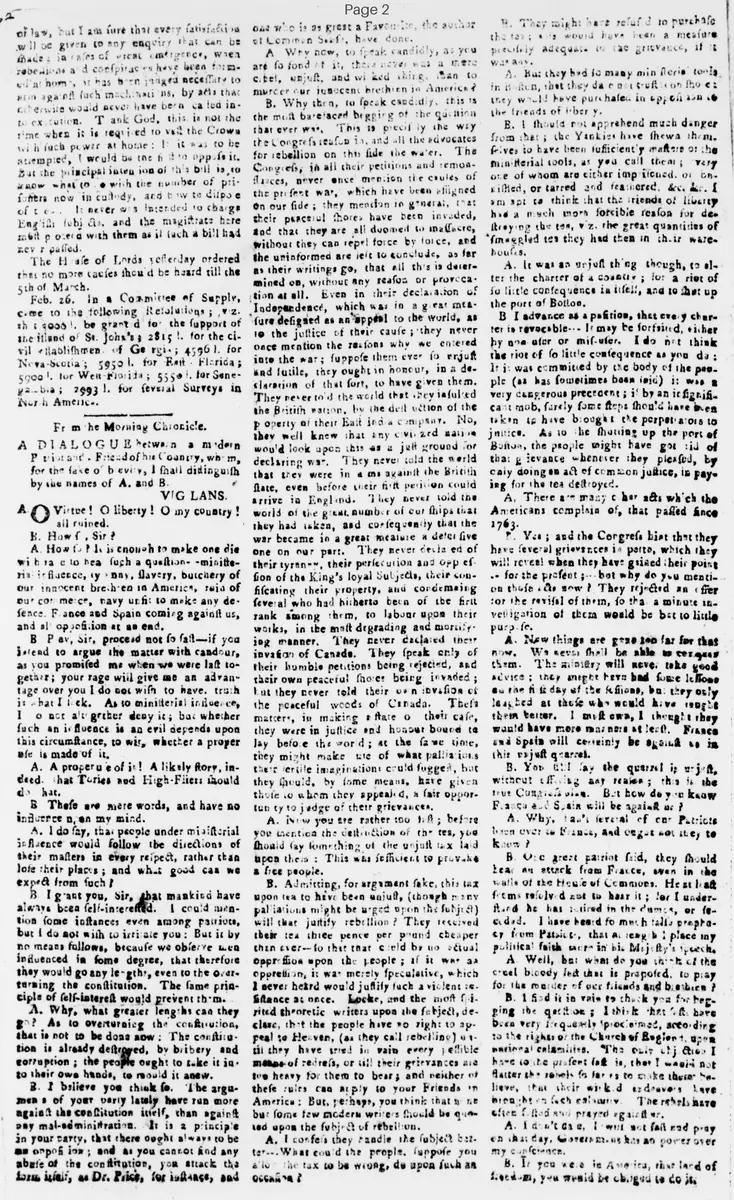
From the Morning Chronicle.
A DIALOGUE between a modern Patriot and Friend of humanity, whom, for the sake of brevity, I shall distinguish by the names of A. and B.
VIGILANS.
A O Virtue! O liberty! O my country! all ruined.
B. How so, Sir?
A. How so? It is enough to make one die with rage to hear such a question--ministerial influence, Toryism, slavery, butchery of our innocent brethren in America, ruin of our commerce, navy unfit to make any defence. France and Spain coming against us, and all opposition at an end.
B Pray, Sir, proceed not so fast--if you intend to argue the matter with candour, as you promised me when we were last together; your rage will give me an advantage over you I do not wish to have. But the truth is that I think. As to ministerial influence. I do not altogether deny it; but whether such an influence is an evil depends upon this circumstance, to wit, whether a proper use is made of it.
A. A proper use of it! A likely story, indeed. that Tories and High-Fliers should do that.
B These are mere words, and have no influence on my mind.
A. I do say, that people under ministerial influence would follow the directions of their masters in every respect, rather than lose their places: and what good can we expect from such ?
B I grant you, Sir, that mankind have always been self-interested. I could mention some instances even among patriots, but I do not wish to irritate you: But it by no means follows, because we observe men influenced in some degree, that therefore they would go any lengths, even to the overturning the constitution. The same principle of self-interest would prevent them.
A. Why, what greater lengths can they go? As to overturning the constitution, that is not to be done now : The constitution is already destroyed, by bribery and corruption ; the people ought to take it in to their own hands, to mould it anew.
B. I believe you think so. The arguments of your party lately have run more against the constitution itself, than against any mal-administration. It is a principle in your party, that there ought always to be an opposition: and as you cannot find any abuse of the constitution, you attack the constitution, as Dr. Price, for instance, and who is as great a Favourer of Rebellion, the author of Common Sense, have done.
A Why now, to speak candidly, as you are so fond of it, there never was a more cruel, unjust, and wicked thing, than to murder our innocent brethren in America?
B. Why then, to speak candidly, this is the most barefaced begging of the question that ever was, This is precisely the way the Congress reasons in, and all the advocates for rebellion on this side the water. The Congress, in all their petitions and remonstrances, never once mention the causes of the present war, which have been assigned on our side : they mention in general, that their peaceful shores have been invaded, and that they are all doomed to massacre, without they can repel force by force, and the uninformed are left to conclude, as far as their writings go, that all this is determined on, without any reason or provocation at all. Even in their declaration of Independence, which was in a great measure designed as an appeal to the world, as to the justice of their cause ; they never once mention the reasons why we entered into the war; suppose them ever so wrong and futile, they ought in honour, in a declaration of that sort, to have given them. They never told the world that they insulted the British nation, by the destruction of the property of their East India company. No, they well knew that any civilized nation would look upon this as a just ground for declaring war. They never told the world that they were in arms against the British state, even before their first petition could arrive in England. They never told the world of the great number of our ships that they had taken, and consequently that the war became in a great measure a defensive one on our part. They never detailed of their tyranny, their persecution and oppression of the King's loyal Subjects, their confiscating their property, and condemning several who had hitherto been of the first rank among them, to labour upon their works, in the most degrading and mortifying manner. They never declared their invasion of Canada. They speak only of their humble petitions being rejected, and their own peaceful shores being invaded ; But they never told their own invasion of the peaceful woods of Canada. These matters, in making a state of their case, they were in justice and honour bound to lay before the world; at the same time, they might make use of what palliatives their fertile imaginations could forge, but they should, by some means, have given those to whom they appealed, a fair opportunity to judge of their grievances.
A. Now you are rather too trifling before you mention the destruction of the tea, you should say something of the unjust tax laid upon them : This was sufficient to provoke a free people.
B. Admitting, for argument sake, this tax upon tea to have been unjust, (though many palliations might be urged upon the subject) will that justify rebellion? They received their tea three pence per pound cheaper than ever--to that that could be no actual oppression upon the people ; if it was an oppression, it was merely speculative, which I never heard would justify such a violent resistance at once. Locke, and the most celebrated theoretic writers upon the subject, declare, that the people have no right to appeal to Heaven, (as they call rebelling) until they have tried in vain every peaceful means of redress, or till their grievances are too heavy for them to bear: and neither of these rules can apply to your Friends in America: But, perhaps, you think that by some few modern writers should be quoted upon the subject of rebellion.
A. I confess they handle the subject better.--What could the people suppose you add the tax to be wrong occasion do upon such an n. They might have refused to purchase the tea; it would have been a measure precisely adequate to the grievance, if it was any.
A. But they had so many ministerial tools in Boston, that they durst not show: they would have purchased in opposition so the friends of liberty.
B. I should not apprehend much danger from that ; the Yankees have shown them. friends to have been sufficiently masters of the ministerial tools, as you call them ; very one of whom are either imprisoned, or tarred, or tarred and feathered. &c. &c. I am apt to think that the friends of liberty had a much more forcible reason for destroying the tea, viz. the great quantities of smuggled tea they had then in their warehouses.
A. It was an unjust thing though, to alter the charter of a country ; for a riot of so little consequence in itself, and to shut up the port of Boston.
B I advance as a position, that every charter is revocable.-- It may be forfeited, either by non-user or mis-user. I do not think the riot of so little consequence as you do : If it was committed by the body of the people (as has sometimes been said) it was a very dangerous precedent ; if by an insignificant mob, surely some steps should have been taken to have brought the perpetrators to justice. As to the shutting up the port of Boston, the people might have got rid of that grievance whenever they pleased, by only doing one act of common justice, in paying for the tea destroyed.
A, There are many charters which the Americans complain of, that passed since 1763.
B. Yes ; and the Congress hint that they have several grievances in part, which they will reveal when they have gained their point .-- for the present ;--but why do you mention those now ? They rejected an offer for the repeal of them, so that a minute investigation of them would be but to little purpose.
A. Now things are gone too far for that now. We never shall be able to conquer them. The ministry will never take good advice : they might have done better some lessons at the first day of the session, but they only last bed at those why would knows thein letter. I avt cwa, I thought they would have more na: nsie at least. France and Spain will certainly be against us in this unjust quarrel.
B. You call the quarrel unjust, without assigning any reason; this is the true Caiaphas vein. B.:t how do you know France and Spain will be against us ?
A. Why. ta.'s several of our Patriots been over to France, and ought not they to know?
B. We are not patriot friend, they should hear any attack from France, even in the walls of the House of Commons. He has bad fcms rafoly d not to bear it : for I under- Aard he has tired in the drama, or leaded. I have heard so much talks proato- cy from Patriot, that at teayb i place iny pulirical faith wor- in bi. Mijty's peech.
A. Well, but what do you th-hci the cruel bloody Lent want is proposed. to play for the mocrder of our friends and brethren ?
B. 1 fad ir in vain to chuck yox for beg- ging the qaciton ; Ithisk hat k. bare besavery frequently proclaimed, acco ding to the rights of the Church of England, upon narinna' calasaities. Ths caiy chjEtreo I have toihe prafert fat is, tharI wagi-d not Aatter sh: reiel, fo far rs to aikc taero- ha- lieve, trat shcir witk.d ardeave's lave broa gh!vy fch caioawrv. The rahrhshara eftee 6.ftadsnd prayed egairdt ur.
A. I d-o't ca e, Iwul mot fail nnd pay en tha: day, Goverrm.ne hay ao porer over my curfcingce.
B. Ir ycu we.e in Ane ica, thne lard of f:eed-m, yau wraid be cbged te do is.
A DIALOGUE between a modern Patriot and Friend of humanity, whom, for the sake of brevity, I shall distinguish by the names of A. and B.
VIGILANS.
A O Virtue! O liberty! O my country! all ruined.
B. How so, Sir?
A. How so? It is enough to make one die with rage to hear such a question--ministerial influence, Toryism, slavery, butchery of our innocent brethren in America, ruin of our commerce, navy unfit to make any defence. France and Spain coming against us, and all opposition at an end.
B Pray, Sir, proceed not so fast--if you intend to argue the matter with candour, as you promised me when we were last together; your rage will give me an advantage over you I do not wish to have. But the truth is that I think. As to ministerial influence. I do not altogether deny it; but whether such an influence is an evil depends upon this circumstance, to wit, whether a proper use is made of it.
A. A proper use of it! A likely story, indeed. that Tories and High-Fliers should do that.
B These are mere words, and have no influence on my mind.
A. I do say, that people under ministerial influence would follow the directions of their masters in every respect, rather than lose their places: and what good can we expect from such ?
B I grant you, Sir, that mankind have always been self-interested. I could mention some instances even among patriots, but I do not wish to irritate you: But it by no means follows, because we observe men influenced in some degree, that therefore they would go any lengths, even to the overturning the constitution. The same principle of self-interest would prevent them.
A. Why, what greater lengths can they go? As to overturning the constitution, that is not to be done now : The constitution is already destroyed, by bribery and corruption ; the people ought to take it in to their own hands, to mould it anew.
B. I believe you think so. The arguments of your party lately have run more against the constitution itself, than against any mal-administration. It is a principle in your party, that there ought always to be an opposition: and as you cannot find any abuse of the constitution, you attack the constitution, as Dr. Price, for instance, and who is as great a Favourer of Rebellion, the author of Common Sense, have done.
A Why now, to speak candidly, as you are so fond of it, there never was a more cruel, unjust, and wicked thing, than to murder our innocent brethren in America?
B. Why then, to speak candidly, this is the most barefaced begging of the question that ever was, This is precisely the way the Congress reasons in, and all the advocates for rebellion on this side the water. The Congress, in all their petitions and remonstrances, never once mention the causes of the present war, which have been assigned on our side : they mention in general, that their peaceful shores have been invaded, and that they are all doomed to massacre, without they can repel force by force, and the uninformed are left to conclude, as far as their writings go, that all this is determined on, without any reason or provocation at all. Even in their declaration of Independence, which was in a great measure designed as an appeal to the world, as to the justice of their cause ; they never once mention the reasons why we entered into the war; suppose them ever so wrong and futile, they ought in honour, in a declaration of that sort, to have given them. They never told the world that they insulted the British nation, by the destruction of the property of their East India company. No, they well knew that any civilized nation would look upon this as a just ground for declaring war. They never told the world that they were in arms against the British state, even before their first petition could arrive in England. They never told the world of the great number of our ships that they had taken, and consequently that the war became in a great measure a defensive one on our part. They never detailed of their tyranny, their persecution and oppression of the King's loyal Subjects, their confiscating their property, and condemning several who had hitherto been of the first rank among them, to labour upon their works, in the most degrading and mortifying manner. They never declared their invasion of Canada. They speak only of their humble petitions being rejected, and their own peaceful shores being invaded ; But they never told their own invasion of the peaceful woods of Canada. These matters, in making a state of their case, they were in justice and honour bound to lay before the world; at the same time, they might make use of what palliatives their fertile imaginations could forge, but they should, by some means, have given those to whom they appealed, a fair opportunity to judge of their grievances.
A. Now you are rather too trifling before you mention the destruction of the tea, you should say something of the unjust tax laid upon them : This was sufficient to provoke a free people.
B. Admitting, for argument sake, this tax upon tea to have been unjust, (though many palliations might be urged upon the subject) will that justify rebellion? They received their tea three pence per pound cheaper than ever--to that that could be no actual oppression upon the people ; if it was an oppression, it was merely speculative, which I never heard would justify such a violent resistance at once. Locke, and the most celebrated theoretic writers upon the subject, declare, that the people have no right to appeal to Heaven, (as they call rebelling) until they have tried in vain every peaceful means of redress, or till their grievances are too heavy for them to bear: and neither of these rules can apply to your Friends in America: But, perhaps, you think that by some few modern writers should be quoted upon the subject of rebellion.
A. I confess they handle the subject better.--What could the people suppose you add the tax to be wrong occasion do upon such an n. They might have refused to purchase the tea; it would have been a measure precisely adequate to the grievance, if it was any.
A. But they had so many ministerial tools in Boston, that they durst not show: they would have purchased in opposition so the friends of liberty.
B. I should not apprehend much danger from that ; the Yankees have shown them. friends to have been sufficiently masters of the ministerial tools, as you call them ; very one of whom are either imprisoned, or tarred, or tarred and feathered. &c. &c. I am apt to think that the friends of liberty had a much more forcible reason for destroying the tea, viz. the great quantities of smuggled tea they had then in their warehouses.
A. It was an unjust thing though, to alter the charter of a country ; for a riot of so little consequence in itself, and to shut up the port of Boston.
B I advance as a position, that every charter is revocable.-- It may be forfeited, either by non-user or mis-user. I do not think the riot of so little consequence as you do : If it was committed by the body of the people (as has sometimes been said) it was a very dangerous precedent ; if by an insignificant mob, surely some steps should have been taken to have brought the perpetrators to justice. As to the shutting up the port of Boston, the people might have got rid of that grievance whenever they pleased, by only doing one act of common justice, in paying for the tea destroyed.
A, There are many charters which the Americans complain of, that passed since 1763.
B. Yes ; and the Congress hint that they have several grievances in part, which they will reveal when they have gained their point .-- for the present ;--but why do you mention those now ? They rejected an offer for the repeal of them, so that a minute investigation of them would be but to little purpose.
A. Now things are gone too far for that now. We never shall be able to conquer them. The ministry will never take good advice : they might have done better some lessons at the first day of the session, but they only last bed at those why would knows thein letter. I avt cwa, I thought they would have more na: nsie at least. France and Spain will certainly be against us in this unjust quarrel.
B. You call the quarrel unjust, without assigning any reason; this is the true Caiaphas vein. B.:t how do you know France and Spain will be against us ?
A. Why. ta.'s several of our Patriots been over to France, and ought not they to know?
B. We are not patriot friend, they should hear any attack from France, even in the walls of the House of Commons. He has bad fcms rafoly d not to bear it : for I under- Aard he has tired in the drama, or leaded. I have heard so much talks proato- cy from Patriot, that at teayb i place iny pulirical faith wor- in bi. Mijty's peech.
A. Well, but what do you th-hci the cruel bloody Lent want is proposed. to play for the mocrder of our friends and brethren ?
B. 1 fad ir in vain to chuck yox for beg- ging the qaciton ; Ithisk hat k. bare besavery frequently proclaimed, acco ding to the rights of the Church of England, upon narinna' calasaities. Ths caiy chjEtreo I have toihe prafert fat is, tharI wagi-d not Aatter sh: reiel, fo far rs to aikc taero- ha- lieve, trat shcir witk.d ardeave's lave broa gh!vy fch caioawrv. The rahrhshara eftee 6.ftadsnd prayed egairdt ur.
A. I d-o't ca e, Iwul mot fail nnd pay en tha: day, Goverrm.ne hay ao porer over my curfcingce.
B. Ir ycu we.e in Ane ica, thne lard of f:eed-m, yau wraid be cbged te do is.
What sub-type of article is it?
War Or Peace
Constitutional
Partisan Politics
What keywords are associated?
American Rebellion
Boston Tea Party
Ministerial Influence
Declaration Of Independence
British Grievances
Tories
Patriot Rhetoric
France Spain Alliance
What entities or persons were involved?
Congress
Dr. Price
Author Of Common Sense
East India Company
France
Spain
Tories
Ministry
Editorial Details
Primary Topic
Defense Of British Actions In The American Revolutionary War
Stance / Tone
Pro British Critique Of American Rebellion
Key Figures
Congress
Dr. Price
Author Of Common Sense
East India Company
France
Spain
Tories
Ministry
Key Arguments
Congress Omitted British Grievances Like Tea Destruction And Canada Invasion In Their Declarations
Tea Tax Was Not Oppressive And Did Not Justify Rebellion Per Locke
American Rebels Protected Smuggled Tea Interests
Charters Are Revocable For Misuse
Patriots' Arguments Attack The Constitution Itself
Self Interest Prevents Total Corruption Of Government