Thank you for visiting SNEWPapers!
Sign up free
The New Hampshire Gazette
Portsmouth, Rockingham County, New Hampshire
What is this article about?
Governor Troup of Georgia protests in a letter to Secretary of War Calhoun the U.S. President's message denying Georgia's claims to Indian lands under the 1802 compact, accusing it of nullifying the treaty and demanding fulfillment or return of lands and funds. Published in National Intelligencer, May 21, 1824.
Clipping
OCR Quality
Full Text
WASHINGTON, MAY 21, 1824.
Gentlemen—I have been requested, by Governor Troup, to hand you the enclosed communication, addressed to the President, through the Secretary of War, for publication. The insertion of it, as soon as you can with convenience find room for it, in the National Intelligencer, will confer a favor.
I am gentlemen, your obedient servant,
EDW. F. TATNALL.
Messrs. Gales & Seaton.
Executive Department, Georgia,
Milledgeville, 24th April, 1824.
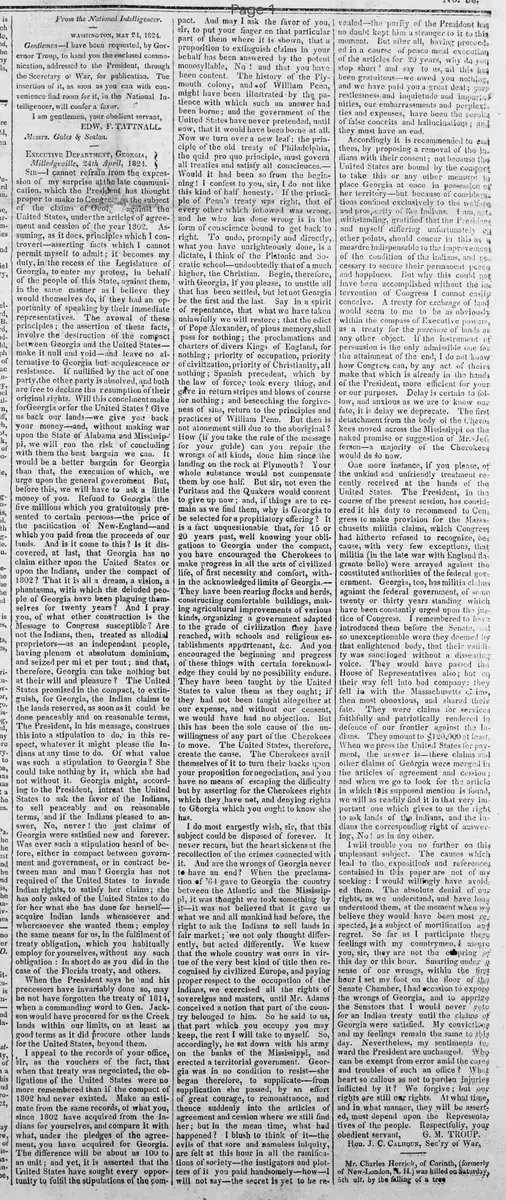
Sir—I cannot refrain from the expression of my surprise at the late communication, which the President has thought proper to make to Congress, on the subject of the claims of Georgia against the United States, under the articles of agreement and cession of the year 1802. Assuming, as it does, principles which I controvert—asserting facts which I cannot permit myself to admit; it becomes my duty, in the recess of the Legislature of Georgia, to enter my protest, in behalf of the people of this State, against them, in the same manner as I believe they would themselves do, if they had an opportunity of speaking by their immediate representatives. The avowal of these principles; the assertion of these facts, involve the destruction of the compact between Georgia and the United States—make it null and void—and leave no alternative to Georgia but acquiescence or resistance. If nullified by the act of one party, the other party is absolved, and both are free to declare the resumption of their original rights. Will this concealment make for Georgia or for the United States? Give us back our lands we give you back your money—and, without making war upon the State of Alabama and Mississippi, we will run the risk of concluding with them the best bargain we can. It would be a better bargain for Georgia than that, the execution of which, we urge upon the general government But, before this, we will have to ask a little money of you. Refund to Georgia the five millions which you gratuitously presented to certain persons—the price of the pacification of New-England—and which you paid from the proceeds of our lands. And is it come to this? Is it discovered, at last, that Georgia has no claim either upon the United States or upon the Indians, under the compact of 1802? That it is all a dream, a vision, a phantasma, with which the deluded people of Georgia have been plaguing themselves for twenty years? And I pray you, of what other construction is the Message to Congress susceptible? Are not the Indians, then, treated as allodial proprietors—as an independent people, having plenum et absolutum dominium, and seized per mi et per tout; and that, therefore, Georgia can take nothing but at their will and pleasure? The United States promised in the compact, to extinguish, for Georgia, the Indian claims to the lands reserved, as soon as it could be done peaceably and on reasonable terms. The President, in his message, construes this into a stipulation to do, in this respect, whatever it might please the Indians at any time to do. Of what value was such a stipulation to Georgia? She could take nothing by it, which she had not without it. Georgia might, according to the President, intreat the United States to ask the favor of the Indians, to sell peaceably and on reasonable terms, 'and if the Indians pleased to answer, No, never! the just claims of Georgia were satisfied now and forever. Was ever such a stipulation heard of before, either in compact between government and government, or in contract between man and man? Georgia has not required of the United States to invade Indian rights, to satisfy her claims; she has only asked of the United States to do for her what she has done for herself—acquire Indian lands whensoever and wheresoever she wanted them; employ the same means for us, in the fulfilment of treaty obligation, which you habitually employ for yourselves, without any such obligation: In short do as you did in the case of the Florida treaty, and others. When the President says he 'and his predecessors have invariably done so, may he not have forgotten the treaty of 1814, when a commanding word to Gen. Jackson would have procured for us the Creek lands within our limits, on at least as good terms as it did procure other lands for the United States, beyond them. I appeal to the records of your office, sir, as the vouchers of the fact, that when that treaty was negociated, the obligations of the United States were no more remembered than if the compact of 1802 had never existed. Make an estimate from the same records, of what you, since 1802 have acquired from the Indians for yourselves, and compare it with what, under the pledges of the agreement, you have acquired for Georgia. The difference will be about as 100 to an unit; and yet, it is asserted that the United States have sought every opportunity to fulfil the stipulations of the compact. And may I ask the favor of you, sir, to put your finger on that particular part of them where it is shown, that a proposition to extinguish claims in your behalf has been answered by the potent monosyllable, No! and that you have been content. The history of the Plymouth colony, and of William Penn, might have been illustrated by the patience with which such an answer had been borne; and the government of the United States have never pretended, until now, that it would have been borne at all. Now we turn over a new leaf; the principle of the old treaty of Philadelphia, the quid pro quo principle, must govern all treaties and satisfy all consciences. Would it had been so from the beginning! I confess to you, sir, I do not like this kind of half honesty. If the principle of Penn's treaty was right, that of every other which followed was wrong, and he who has done wrong is in the form of conscience bound to get back to right. To undo, promptly and directly, what you have unrighteously done, is a dictate. I think of the Platonic and Socratic school—undoubtedly that of a much higher, the Christian. Begin, therefore, with Georgia, if you please, to unsettle all that has been settled, but let not Georgia be the first and the last. Say in a spirit of repentance, that what we have taken unlawfully we will restore; that the edict of Pope Alexander, of pious memory, shall pass for nothing; the proclamations and charters of divers Kings of England, for nothing; priority of occupation, priority of civilization, priority of Christianity, all nothing; Spanish precedent, which by the law of force, took every thing, and gave in return stripes and blows of course for nothing; and beseeching the forgiveness of sins, return to the principles and practices of William Penn. But then is not atonement still due to the aboriginal? How (if you take the rule of the message for your guide) can you repair the wrongs of all kinds, done him since the landing on the rock at Plymouth? Your whole substance would not compensate them by one half. But sir, not even the Puritans and the Quakers would consent to give up now; and, if things are to remain as we find them, why is Georgia to be selected for a propitiatory offering? It is a fact unquestionable, that, for 15 or 20 years past, well knowing your obligations to Georgia under the compact, you have encouraged the Cherokees to make progress in all the arts of civilized life, of first necessity and comfort, within the acknowledged limits of Georgia. They have been rearing flocks and herds, constructing comfortable buildings, making agricultural improvements of various kinds, organizing a government adapted to the grade of civilization they have reached, with schools and religious establishments appurtenant, &c. And you encouraged the beginning and progress of these things with certain foreknowledge they could by no possibility endure. They have been taught by the United States to value them as they ought; if they had not been taught altogether at our expense, and without our consent, we would have had no objection. But this has been the sole cause of the unwillingness of any part of the Cherokees to move. The United States, therefore, create the cause. The Cherokees avail themselves of it to turn their backs upon your proposition for negociation, and you have no means of escaping the difficulty but by asserting for the Cherokees rights which they have not, and denying rights to Georgia which you ought to know she has.
I do most earnestly wish, sir, that this subject could be disposed of forever. It never recurs, but the heart sickens at the recollection of the crimes connected with it. And are the wrongs of Georgia never to have an end? When the proclamation of '64 gave to Georgia the country between the Atlantic and the Mississippi, it was thought we took something by it—it was not believed that it gave us what we and all mankind had before, the right to ask the Indians to sell lands in fair market; we not only thought differently, but acted differently. We knew that the whole country was ours in virtue of the very best kind of title then recognised by civilized Europe, and paying proper respect to the occupation of the Indians, we exercised all the rights of sovereigns and masters, until Mr. Adams conceived a notion that part of the country belonged to him. So he said to us, that part which you occupy you may keep, the rest I will take to myself. So, accordingly, he sat down with his army on the banks of the Mississippi, and erected a territorial government. Georgia was in no condition to resist—she began therefore, to supplicate—from supplication she passed, by an effort of great courage, to remonstrance, and thence suddenly into the articles of agreement and cession where we still find her; but in the mean time, what had happened? I blush to think of it—the evils of that sore and nameless iniquity are felt at this hour in all the ramifications of society—the instigators and plotters of it you paid handsomely—how—I will not say—the secret is yet to be revealed—the purity of the President has no doubt kept him a stranger to it to this moment. But after all, having proceeded in a course of peace meal execution of the articles for 20 years, why do you stop short? and say to us, all this has been gratuitous—we owed you nothing. and we have paid you a great deal; your restlessness and inquietude and importunities, our embarrassments and perplexities and expenses, have been the result of false conceits and hallucinations; and they must have an end. Accordingly it is recommended to end them, by proposing a removal of the Indians with their consent; not because the United States are bound by the compact to take this or any other measure to place Georgia at once in possession of her territory—but because of considerations confined exclusively to the welfare and prosperity of the Indians. I am, notwithstanding, gratified that the President and myself differing unfortunately on other points, should concur in this as a measure indispensable to the improvement of the condition of the Indians, and necessary to secure their permanent peace and happiness. But why this could not have been accomplished without the intervention of Congress I cannot easily conceive. A treaty for exchange of land would seem to me to be as obviously within the compass of Executive powers, as a treaty for the purchase of lands or any other object. If the instrument of persuasion is the only admissible one for the attainment of the end, I do not know how Congress can, by any act of theirs make that which is already in the hands of the President, more efficient for your or our purposes. Delay is certain to follow, and anxious as we are to know our fate, it is delay we deprecate. The first detachment from the body of the Cherokees moved across the Mississippi on the naked promise or suggestion of Mr. Jefferson—a majority of the Cherokees would do so now.
One more instance, if you please, of the unkind and unfriendly treatment recently received at the hands of the United States. The President, in the course of the present session, has considered it his duty to recommend to Congress to make provision for the Massachusetts militia claims, which Congress had hitherto refused to recognize, because, with very few exceptions, that militia (in the late war with England flagrante bello) were arrayed against the constituted authorities of the federal government. Georgia, too, has militia claims against the federal government, of some twenty or thirty years standing which have been constantly urged upon the justice of Congress. I remembered to have introduced them before the Senate, and so unexceptionable were they deemed by that enlightened body, that their validity was sanctioned without a dissenting voice. They would have passed the House of Representatives also; but on their way fell into bad company: they fell in with the Massachusetts claims, then most obnoxious, and shared their fate. They were claims for services faithfully and patriotically rendered in defence of our frontier against the Indians. They amount to $120,000 at least. When we press the United States for payment, the answer is—these claims and other claims of Georgia were merged in the articles of agreement and cession; and when we go to look for the article in which this supposed mention is found, we will as readily find it in that very important one which gives to us the right to ask lands of the Indians, and the Indians the corresponding right of answering, No! as in any other.
I will trouble you no further on this unpleasant subject. The causes which lead to the expositions and references contained in this paper are not of my seeking : I would willingly have avoided them. The absolute denial of our rights, as we understand, and have long understood them, at the moment when we believe they would have been most respected, is a subject of mortification and regret. So far as I participate these feelings with my countrymen, I assure you, sir, they are not the offspring of this day or this hour. Smarting under sense of our wrongs, within the first hour I set my foot on the floor of the Senate Chamber, I had occasion to expose the wrongs of Georgia, and to apprise the Senators that I would never 'vote for an Indian treaty until the claims of Georgia were satisfied. My convictions and my feelings remain the same to this day. Nevertheless, my sentiments toward the President are unchanged. Who can be exempt from error amid the cares and troubles of such an office? What heart so callous as not to pardon injuries inflicted by it? We forgive; but our rights are still our rights. At what time, and in what manner, they will be asserted, must depend upon the Representatives of the people. Respectfully, your obedient servant,
G. M. TROUPE.
Hon. J. C. Calhoun, Sec'ry of War.
What sub-type of article is it?
What themes does it cover?
What keywords are associated?
What entities or persons were involved?
Where did it happen?
Story Details
Key Persons
Location
Georgia, Milledgeville; Washington
Event Date
24th April, 1824
Story Details
Governor Troup protests the U.S. President's message to Congress, which he views as denying Georgia's claims under the 1802 compact for extinguishing Indian titles to reserved lands, arguing it nullifies the agreement and absolves Georgia of obligations, demanding restitution or resumption of rights.