Thank you for visiting SNEWPapers!
Sign up free
Story
September 1, 1889
Wichita Eagle
Wichita, Sedgwick County, Kansas
What is this article about?
Article detailing the manufacturing process of hair cloth using undyeable horse hair from wild horses, bunched and woven individually via a precise loom mechanism.
Clipping
OCR Quality
98%
Excellent
Full Text
How Hair Cloth Is Made.
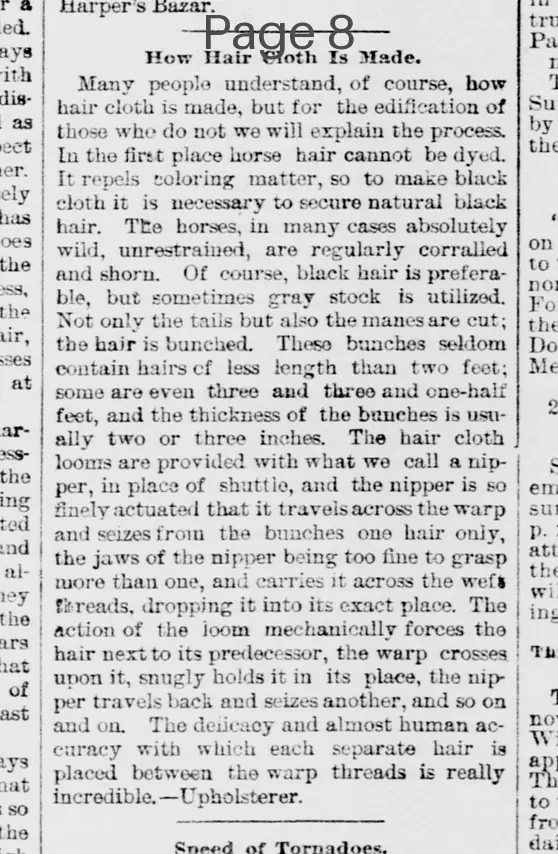
Many people understand, of course, how hair cloth is made, but for the edification of those who do not we will explain the process. In the first place horse hair cannot be dyed. It repels coloring matter, so to make black cloth it is necessary to secure natural black hair. The horses, in many cases absolutely wild, unrestrained, are regularly corralled and shorn. Of course, black hair is preferable, but sometimes gray stock is utilized. Not only the tails but also the manes are cut; the hair is bunched. These bunches seldom contain hairs of less length than two feet; some are even three and three and one-half feet, and the thickness of the bunches is usually two or three inches. The hair cloth looms are provided with what we call a nipper, in place of shuttle, and the nipper is so finely actuated that it travels across the warp and seizes from the bunches one hair only, the jaws of the nipper being too fine to grasp more than one, and carries it across the weft threads, dropping it into its exact place. The action of the loom mechanically forces the hair next to its predecessor, the warp crosses upon it, snugly holds it in its place, the nipper travels back and seizes another, and so on and on. The delicacy and almost human accuracy with which each separate hair is placed between the warp threads is really incredible.—Upholsterer
Many people understand, of course, how hair cloth is made, but for the edification of those who do not we will explain the process. In the first place horse hair cannot be dyed. It repels coloring matter, so to make black cloth it is necessary to secure natural black hair. The horses, in many cases absolutely wild, unrestrained, are regularly corralled and shorn. Of course, black hair is preferable, but sometimes gray stock is utilized. Not only the tails but also the manes are cut; the hair is bunched. These bunches seldom contain hairs of less length than two feet; some are even three and three and one-half feet, and the thickness of the bunches is usually two or three inches. The hair cloth looms are provided with what we call a nipper, in place of shuttle, and the nipper is so finely actuated that it travels across the warp and seizes from the bunches one hair only, the jaws of the nipper being too fine to grasp more than one, and carries it across the weft threads, dropping it into its exact place. The action of the loom mechanically forces the hair next to its predecessor, the warp crosses upon it, snugly holds it in its place, the nipper travels back and seizes another, and so on and on. The delicacy and almost human accuracy with which each separate hair is placed between the warp threads is really incredible.—Upholsterer
What sub-type of article is it?
Curiosity
What keywords are associated?
Hair Cloth
Horse Hair
Weaving Process
Nipper Loom
Black Hair Sourcing
Story Details
Story Details
Explanation of the process for making hair cloth from horse hair, including sourcing black hair from wild horses, bunching it, and weaving it using a specialized loom with a nipper that places individual hairs between warp threads.