Thank you for visiting SNEWPapers!
Sign up free
New National Era
Washington, District Of Columbia
What is this article about?
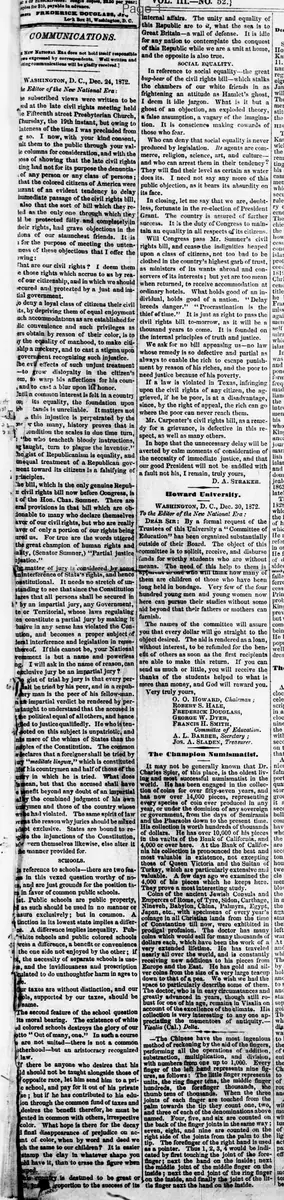
In a letter to the New National Era, D.A. Straker presents arguments for passing Senator Charles Sumner's civil rights bill, emphasizing equal citizenship rights for colored Americans in public accommodations, juries, and schools, while countering objections on state rights and social equality. He highlights the need for full protection against discrimination to uphold Republican principles.
Merged-components note: These two components are sequential in reading order and contain continuous text from the same letter to the editor on civil rights, signed by D. A. STRAKER.
Clipping
OCR Quality
Full Text
To the Editor of the New National Era:
Sir: The subjoined views were written to be
read at the late civil rights meeting held
at the Fifteenth street Presbyterian Church,
Thursday, the 19th instant, but owing to
the lateness of the time I was precluded from
doing so. I now, with your kind consent,
submit them to the public through your valuable
columns for consideration, and with the
purpose of showing that the late civil rights
meeting had not for its purpose the denuncia-
tion of any person or any class of persons;
but that the colored citizens of America were
cognizant of an evident tendency to delay
the immediate passage of the civil rights bill,
also that the sort of bill which they re-
quired as the only one through which they
could be protected fully and completely in
their rights, had grave objections in the
opinions of our staunchest friends. It is
for the purpose of meeting the unten-
ableness of these objections that I offer the
following:
That are our civil rights? I deem them
to be those rights which accrue to us by rea-
son of our citizenship, and in which we should
be secured and protected by a just and im-
partial government.
To deny a loyal class of citizens their civil
rights, by depriving them of equal enjoyment
of such accommodations as are established for
public convenience and such privileges as
others obtain by reason of their color, is to
destroy the equality of manhood, to make citi-
zenship a mockery, and to cast a stigma upon
government recognizing such injustice.
The evil effects of such unjust treatment
are to grow disloyalty in the citizen's
bosom, to warp his affections for his coun-
try, and to cast a blur upon its honor.
Until a common interest is felt in a country
for its equality, the foundation upon
which it stands is unreliable. It matters not
whether this injustice is perpetrated by the
few or the many, history proves that in
either condition the scales in due time turn
against the oppressor. "He who teacheth bloody instructions
is taught, turn to plague the inventor."
The gist of Republicanism is equality, and
unequal treatment of a Republican gov-
ment toward its citizens is a falsifying of
its principles.
The bill, which is the only genuine Repub-
lican civil rights bill now before Congress, is
that of the Hon. Chas. Sumner. There are
several provisions in that bill which are ob-
jectionable to many who declare themselves
in favor of our civil rights, but who are really
in favor of only a portion of our rights being
guaranteed us. For true are the words uttered
by the great champion of human rights and
equality, (Senator Sumner,) "Partial justice
is no justice."
The matter of jury is considered by some
an interference of State's rights, and hence
unconstitutional. It needs no stretch of un-
-derstanding to see that since the Constitution
declares that all persons shall be secured in
their right to trial by an impartial jury, any Government,
State or Territorial, whose laws regulating
juries constitute a partial jury by making it
exclusive in any sense has violated the Con-
stitution, and becomes a proper subject of
Federal interference and legislation in reme-
dy thereof. If this cannot be, your National
Government is but a name and powerless
thing. I will ask in the name of reason, can
an exclusive jury be an impartial jury?.
The gist of trial by jury is that every per-
son shall be tried by his peer, and in a repub-
lic every man is the peer of his fellow-man.
Can an impartial verdict be rendered by per-
-sons taught to understand that the accused is
not the political equal of all others, and hence
entitled to justice qualifiedly. He who is ten-
-cious on this subject is unpatriotic, and
leans more of the whims of States than the
principles of the Constitution. The common
law declares that a foreigner shall be tried by
"meditate linguce," which is constituted
of his countrymen and half of those of the coun-
try in which he is tried. What does
this mean, but that the accused shall have
the benefit beyond any doubt of an impartial
judgment by the combined judgment of his own
countrymen and those of the country whose
law he had violated. The same spirit of law
was the reason why juries should be mixed
and not exclusive. States are bound to re-
spect the injunctions of the Constitution,
govern themselves likewise, else alter it
in the manner provided for.
SCHOOLS.
In reference to schools-there are two fea-
tures in this vexed question worthy of no-
tice, and are just grounds for the position ta-
ken in favor of common public schools.
1st. Public schools are public property.
And as such should be used in no manner or
measure exclusively; but in common. A dis-
tinction in its lowest state implies a differ-
ence. A difference implies inequality. Pub-
lic white schools and public colored schools
express a difference, a benefit or convenience
on the one side not enjoyed by the other; if
not the necessity of separate schools is use-
less, and the invidiousness and proscription
calculated to do unthought-of harm in ages to
come. Our taxes are without distinction, and our
schools, supported by our taxes, should be
the same.
The second feature of the school question
is its moral bearing. The existence of white
and colored schools destroys the glory of our
motto "Out of many, one." In such a course
we are not united-there is not a common
brotherhood-but an aristocracy recognized
by law.
If there be anyone who desires that his
child should not be taught alongside those of
the opposite race, let him send him to a pri-
vate school, and pay for it out of his private
purse; but if he has contributed to his edu-
cation through the common fund of taxes and
desires the benefit therefor, he must be edu-
cated in common with others, irrespective
of color. What hope is there for the decay
and final disappearance of prejudice on ac-
count of color, when by word and deed we
teach the same to our children? It is easier
to stamp the clay in whatever shape you
would have it, than to erase the figure when
dry. The destiny of a nation is great or
small in proportion to the success of it.
INTERNAL AFFAIRS. The unity and equality of
this Republic are to it, what the sea is to
Great Britain-a wall of defense. It is idle
for any nation to contemplate the conquest
of this Republic while we are a unit at home,
and the opposite is also true.
SOCIAL EQUALITY
In reference to social equality--the great
bug-bear of the civil rights bill-which stalks
the chambers of our white friends in as
frightening an attitude as Hamlet's ghost,
I deem it idle jargon. What is it but a
ghost of an objection, an exploded theory,
a false assumption, a vagary of the imagina-
tion. It is conscience making cowards of
those who fear.
Who can deny that social equality is never
produced by legislation. Its agents are com-
merce, religion, science, art, and culture-
and who can arrest them in their tendency?
They will find their level as certain as water
does its. I need not say any more of this
public objection, as it bears its absurdity on
its face.
In closing, let me say that we are, doubt-
less, fortunate in the re-election of President
Grant. The country is assured of further
success. It is the duty of Congress to main-
tain an equality in all respects of its citizens.
Will Congress pass Mr. Sumner's civil
rights bill, and cease the indignities heaped
upon a class of citizens, not too bad to be
clothed in the country's highest garb of trust.
as ministers of its wants abroad and con-
servers of its interests; but yet are too mean
when returned, to receive accommodation at
ordinary hotels. What holds good of an in-
dividual, holds good of a nation. "Delay
breeds danger." "Procrastination is the
thief of time." It is just as right to pass the
civil rights bill to-morrow, as it will be a
thousand years to come. It is founded on
the eternal principles of truth and justice.
We ask for no bill appeasing us-no law
whose remedy is so defective and partial as
always to enable the rich to escape punish-
ment by reason of his riches, and the poor to
need justice because of his poverty.
If a law is violated in Texas, infringing
upon the civil rights of any citizen, the ag-
grieved, if he be poor, is at a disadvantage,
since, by the right of appeal, the rich can go
where the poor can never reach them.
Mr. Carpenter's civil rights bill, as a reme-
dy for a grievance, is defective in this re-
spect, as well as many others.
In hope that the unnecessary delay will be
averted by calm moments of consideration of
the necessity of immediate justice, and that
our good President will not be saddled with
a fault not his, I remain, truly yours,
D. A. STRAKER.
What sub-type of article is it?
What themes does it cover?
What keywords are associated?
What entities or persons were involved?
Letter to Editor Details
Author
D. A. Straker
Recipient
To The Editor Of The New National Era
Main Argument
the letter advocates for the immediate passage of senator charles sumner's civil rights bill as the only genuine measure to fully protect colored citizens' rights to equal public accommodations, impartial juries, and integrated schools, countering objections on state rights, social equality, and partial justice.
Notable Details