Thank you for visiting SNEWPapers!
Sign up free
Daily National Intelligencer
Washington, District Of Columbia
What is this article about?
Extracts of letters from Major General James Wilkinson to Secretary of War John Armstrong, dated August-September 1813 (and one in 1814), detailing strategic military discussions, naval pursuits between Chauncey and Yeo, troop reinforcements, concerns over British movements under Prevost, and plans for operations around Niagara, Kingston, and the St. Lawrence during the War of 1812.
Clipping
OCR Quality
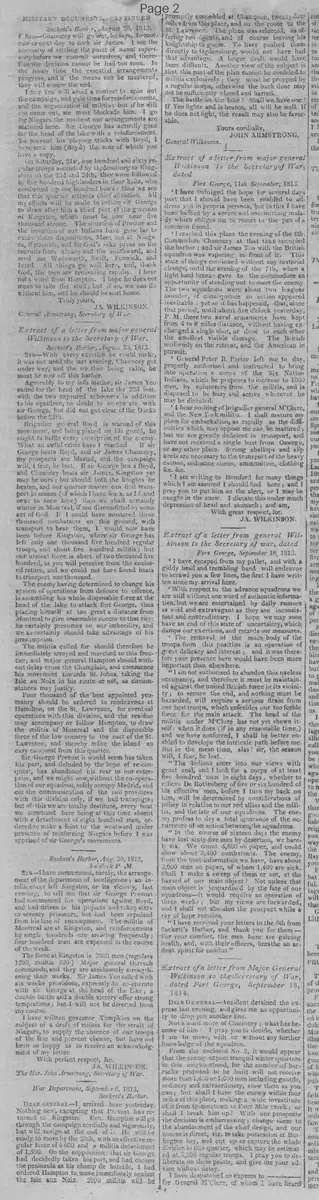
Full Text
Sackett's Harbor, August 20, 1814.
Sir—Chauncey will go out, he says, to-morrow or next day to seek sir James. I see the necessity of settling the point of naval superiority before we commit ourselves, and therefore the decision cannot be had too soon. In the mean time the essential arrangements progress, and if the means can be mustered, they will ensure the end.
I fear Yeo will avoid a contest to spin out the campaign, and gain time for reinforcements, and the organization of militia; but if he will not come out, we must blockade him. I go for Niagara the moment our arrangements are matured here. Sir George has actually gone for the head of the lake with a reinforcement.
To prevent his playing tricks with Boyd, I have sent him (Boyd) the note of which you have a copy.
On Saturday, 21st, one hundred and sixty regular troops ascended by Ogdensburg to Kingston; on the 23d and 24th, they were followed by five hundred highlanders in their kilts, who conducted up one hundred boats: thus we see that this quarter attracts chief attention. All my efforts will be made to induce sir George to draw after him a chief part of the garrison of Kingston, which must be now near five thousand strong. The situation of Proctor and the irruption of our Indians have gone far to excite these dispositions. Meet me at Niagara, if possible, and for God's sake press on the recruits from Albany and the southward, and send me Wadsworth, Swift, Fenwick, and Izard. All things go well here, and, thank God, the men are recovering rapidly. I hear not a word from Hampton. I hope he does not mean to take the sulks; but if so, we can do without him, and he should be sent home.
Truly yours,
JA. WILKINSON.
General Armstrong, Secretary of War.
Extract of a letter from major general Wilkinson to the Secretary of War.
Sackett's Harbor, August 30, 1813.
Sir—With every exertion he could make, it was not until the last evening, Chauncey got under way, and the weather being calm, he must be now off this harbor.
Agreeably to my information, sir James Yeo sailed for the head of the lake the 22d inst. with the two captured schooners in addition to his squadron, no doubt to co-operate with sir George, but did not get clear of the Ducks before the 25th.
Brigadier general Boyd is warned of this movement, and being placed on his guard, he ought to baffle every enterprise of the enemy.
What an awful crisis have I reached. If sir George beats Boyd, and sir James Chauncey, my prospects are blasted, and the campaign will, I fear, be lost. If sir George beats Boyd, and Chauncey beats sir James, Kingston yet may be ours; but should both the knights be beaten, and our quarter master can find transport in season (of which I have fears, as I found next to none here) then we shall certainly winter in Montreal, if not discomfited by some act of God. If I could have mustered three thousand combatants on this ground, with transport to bear them, I would now have been before Kingston, where sir George has left only one thousand five hundred regular troops, and about five hundred militia; but our utmost force is short of two thousand five hundred, as you will perceive from the enclosed return, and we could not have found boats to transport one thousand.
The enemy having determined to change his system of operations from defence to offence, is assembling his whole disposable force at the head of the lake to attack fort George, thus placing himself at too great a distance from Montreal to give seasonable succor to that city: he certainly presumes on our imbecility, and we as certainly should take advantage of his presumption.
The militia called for should therefore be immediately arrayed and marched to this frontier, and major general Hampton should without delay cross the Champlain, and commence his movement towards St. Johns, taking the Isle au Noix in his route or not, as circumstances may justify.
Four thousand of the best appointed yeomanry should be ordered to rendezvous at Hamilton, on the St. Lawrence, for eventual operations with this division, and the residue may accompany or follow Hampton, to draw the militia of Montreal and the disposable force of the low country to the east of the St. Lawrence, and thereby make the island an easy conquest from this quarter.
Sir George Prevost it would seem has taken his part, and deluded by the hope of re-conquest, has abandoned his rear to our enterprise, and we might now, without the co-operation of our squadron, safely occupy Madrid, and cut the communication of the two provinces with this division only, if we had transports; but of this we are totally destitute, every boat we command here being at this time absent with a detachment of eight hundred men, ordered to make a feint to the westward under pretence of reinforcing Niagara before I was apprised of sir George's movements.
Sackett's Harbor, Aug. 30, 1813.
5 o'clock P. M.
Sir—I have commenced, barely, the arrangement of the department of intelligence; an intelligencer left Kingston, or its vicinity, last evening, to tell me that sir George Prevost had commenced his operations against Boyd, and had driven in his piquets and taken sixty or seventy prisoners, but had been repulsed from his line of encampment. The militia of Montreal are at Kingston, and reinforcements by single hundreds are arriving frequently; four hundred men are expected in the course of the week.
The force at Kingston is 2000 men (regulars 1500, militia 500) Major general Darrach commands, and they are assiduously strengthening their works. Sir James Yeo sailed with six weeks provisions, expressly to co-operate with sir George at the head of the lake; a double battle and a double victory offer strong temptations; but I will not be diverted from any course.
I have written governor Tompkins on the subject of a draft of militia for the strait of Niagara, to supply the absence of our troops of the line and prevent clamor, but have not been so happy as to receive an acknowledgment of my letter.
With perfect respect, &c.
JA. WILKINSON
The Hon. John Armstrong, Secretary of War.
War Department, September 6, 1813,
Sackett's Harbor.
Dear general—I arrived here yesterday.
Nothing new, excepting that Prevost has returned to Kingston. Gen. Hampton will go through the campaign cordially and vigorously, but will resign at the end of it. He will be ready to move by the 20th, with an effective regular force of 4000 and a militia detachment of 1,500. On the supposition that sir George had decidedly taken his part, and had chosen the peninsula as his champ de bataille, I had ordered Hampton to move immediately against the Isle aux Noix. 2000 militia will be promptly assembled at Champlain, twenty-four miles from this place, and on the route to the St. Lawrence. The place was selected, as offering two objects, and of course leaving his knightship to guess. To have pushed them directly to Ogdensburg, would not have had that advantage. A larger draft would have been difficult. Another view of the subject is that this part of the plan cannot be confided to militia exclusively: they must be propped by a regular corps, otherwise the back door may not be sufficiently closed and barred.
The battle on the lake! Shall we have one? If Yeo sights and is beaten, all will be well. If he does not sight, the result may also be favorable.
Yours cordially,
JOHN ARMSTRONG
General Wilkinson.
Extract of a letter from major general Wilkinson to the Secretary of War,
dated
Fort George, 11th September, 1813.
I have indulged the hope for several days past that I should have been enabled to address you in propria persona, but in this I have been baffled by a severe and unremitting malady which obliges me to resort to the pen of a common friend.
I reached this place the evening of the 4th. Commodore Chauncey at that time occupied the harbor: and sir James Yeo with the British squadron was vaporing in front of it. This state of things continued without any material change, until the evening of the 7th, when a light land breeze gave to the commodore an opportunity of standing out to meet the enemy. The two squadrons were about two leagues asunder, of consequence an action appeared inevitable: yet so it has happened, that, since that period, until about five o'clock yesterday, P. M. these two naval armaments have kept from 4 to 8 miles distance, without having exchanged a single shot, or done to each other the smallest visible damage. The British uniformly on the retreat, and the American in pursuit.
General Peter B. Porter left me to day, properly authorised and instructed to bring into operation a corps of the Six Nation Indians, which he proposes to increase to 1000 men, by volunteers from the militia, and is disposed to be busy and active wherever he may be directed.
I hear nothing of brigadier general M'Clure, and the New York militia. I shall mature my plans for embarkation, as rapidly as the difficulties which may oppose me can be matured; but we are greatly deficient in transport, and have not received a single boat from Oswego, or any other place. Strong shallops and slip keels are necessary to the transport of the heavy cannon, ordnance stores, ammunition, clothing &c. &c.
I am writing to Bomford for many things which I am assured I should find here: and I pray you to put him on the alert, or I may be caught in the snow. I dictate this under much depression of head and stomach; and am,
With great respect, &c.
JA. WILKINSON.
Extract of a letter from general Wilkinson to the Secretary of war, dated
Fort George, September 16, 1813.
I have escaped from my pallet, and with a giddy head and trembling hand will endeavor to scrawl you a few lines, the first I have written since my arrival here.
With respect to the advance squadrons we are still without one word of authentic information, but we are entertained by daily rumors as wild and extravagant as they are inconsistent and contradictory. I hope we may soon have an end of this state of uncertainty, which damps our exertions, and retards our measures.
The removal of the main body of the troops from this position is an operation of great delicacy and interest: and it was therefore your presence here would have been more important than elsewhere.
I am not authorised to abandon this useless occupancy, and therefore it must be maintained against the united British force in its vicinity; to secure the end, and nothing must be hazarded, will require a serious drain from our best troops, which enfeebles our too feeble force for the main attack. The head of the militia under M'Clure has not yet shewn itself: when it does (if in any reasonable time,) and we have conferred, I shall be better enabled to develope the intricate path before me. But in the mean time, alas! sir, the season will, I fear, be lost.
The Indians enter into our views with great zeal, and I look for a corps of at least five hundred men in eight days. whether to relieve De Rottenberg of five or six hundred of his effective men, before I turn my back on him, will be determined by considerations of policy in relation to our red allies and the militia, and the fate of our squadrons. The enemy profess to day a total ignorance of the occurrence of an action between the squadrons.
In the course of sixteen days the enemy have lost sixty-five men by desertion, we have lost six. We count 4,600 on paper, and could show about 3,400 combatants. The enemy, from the best information we have, have about 3,000 men on paper, of whom 1,400 are sick.
Shall I make a sweep of them or not, at the hazard of our main object? Not unless that main object is jeopardised by the fate of our squadrons—it would require an operation of three weeks; but my views are forwarded, and I shall not abandon the prospect while a ray of hope remains.
I have received your letters to the 6th from Sackett's Harbor, and thank you for them—For your comfort, the men here are gaining health, and, with their officers, breathe an ardent spirit for combat.
Extract of a letter from Major General Wilkinson to the Secretary of War,
dated Fort George, September 18,
1813.
Dear General—Accident detained the express last evening, and gives me an opportunity to drop you another line.
Not a word more of Chauncey; what has become of him? I pray you to decide, whether I am to move, with or without any further knowledge of the squadron.
From the enclosed No. 2, it would appear that the enemy expect tranquil winter quarters in this neighborhood, for the number of barracks proposed to be built will not receive more than 1400 or 1600 men including guards, ordinary and extraordinary, stow them as you can; but shall I have the enemy within four miles of this place, making a wide investiture of it from Queenstown to Four Mile creek; or shall I break him up? With our prospects the decision is embarrassing; change them to the abandonment of the chief design, and our course is direct, viz. to take possession at Burlington bay, and cut up or capture the whole division in this quarter, which may be estimated at 3000 regular troops. I pray you to deliberate on these points, and give me your advice without delay.
I have despatched an express to for General M'Clure, of whom I have heard nothing since my last: but to supply the defect of his silence, the enclosed copy of a communication from a committee of which P. B. Porter is chief, will fully suffice. I have responded in the most courteous terms, making reference to you for your determination on the momentous occasion, as you will perceive from my answer. Now let me entreat you to weigh these propositions, to take into consideration the possible failure of the militia and the substitution in such case of these volunteers; for in the present crisis, we should, if possible, render "assurance doubly sure." The letter of Daniel Rodman (a stranger) is also transmitted for consideration: let me have your answer, and tell me how to act as speedily as possible, I beseech. The boats from Oswego have not arrived.
I am feeble to childhood, but shall look at the troops in battalion on Tuesday.
Truly yours,
JA. WILKINSON.
The Hon. John Armstrong,
Secretary of War.
Fort George, September 18, 1813.
Sir—I am ordered by General Wilkinson to forward the enclosed papers. One, a letter from a committee of three, of which P. B. Porter is the first; and the other a letter from Daniel Redman, the organ of an association of residents in and near Canandaigua.
I have the honor, &c.
H. LEE, jr. Major of Infty.
and aid to Maj. Gen. Wilkinson.
The Hon. J. Armstrong,
Secretary of War.
(To be continued.)
What sub-type of article is it?
What themes does it cover?
What keywords are associated?
What entities or persons were involved?
Where did it happen?
Story Details
Key Persons
Location
Sackett's Harbor, Niagara, Fort George, Kingston
Event Date
August 20, 1814; August 30, 1813; September 6, 1813; September 11, 1813; September 16, 1813; September 18, 1813
Story Details
Series of letters discussing naval superiority on Lake Ontario, British troop movements to Kingston and Niagara, American reinforcements and strategic plans to capture Montreal, concerns over transports and militia, and ongoing pursuit without engagement between American and British squadrons.