Thank you for visiting SNEWPapers!
Sign up free
The Morning Star
Providence, Providence County, Rhode Island
What is this article about?
A crowded temperance meeting in Providence Opera House advocated total abstinence from alcohol. Speakers Charles Webster, William D. Hilton, Thomas Nixon, and E. K. Godfrey highlighted intemperance's societal harms, called for prohibition laws, and urged moral reform. The event featured hymns and ended with the Doxology.
Clipping
OCR Quality
Full Text
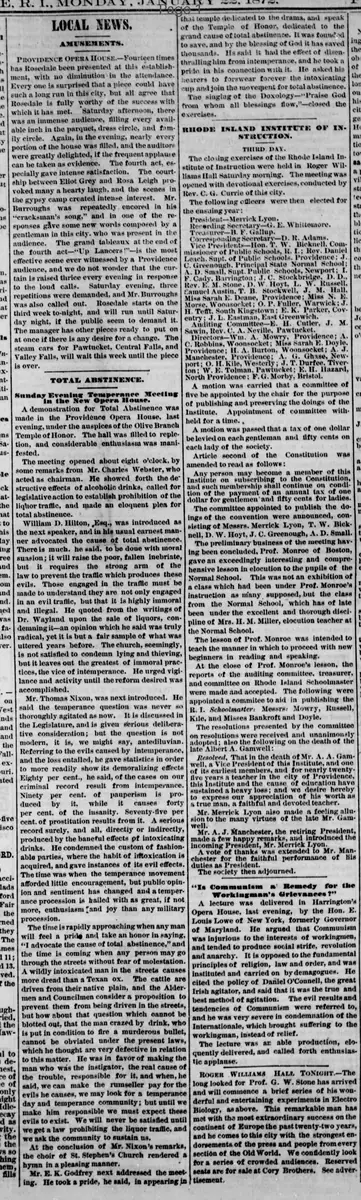
Sunday Evening Temperance Meeting in the New Opera House.
A demonstration for Total Abstinence was made in the Providence Opera House, last evening, under the auspices of the Olive Branch Temple of Honor. The hall was filled to repletion, and considerable enthusiasm was manifested.
The meeting opened about eight o'clock, by some remarks from Mr. Charles Webster, who acted as chairman. He showed forth the destructive effects of alcoholic drinks, called for legislative action to establish prohibition of the liquor traffic, and made an eloquent plea for total abstinence.
William D. Hilton, Esq., was introduced as the next speaker, and in his usual earnest manner advocated the cause of total abstinence. There is much, he said, to be done with moral suasion; it will raise the poor, fallen inebriate, but it requires the strong arm of the law to prevent the traffic which produces these evils. Those engaged in the traffic must be made to understand they are not only engaged in an evil traffic, but that it is highly immoral and illegal. He quoted from the writings of Dr. Wayland upon the sale of liquors, condemning it—an opinion which he said was truly radical, yet it is but a fair sample of what was uttered years before. The church, seemingly, is not satisfied to condemn lying and thieving, but it leaves out the greatest of immoral practices, the vice of intemperance. He urged vigilance and activity until the reform desired was accomplished.
Mr. Thomas Nixon, was next introduced. He said the temperance question was never so thoroughly agitated as now. It is discussed in the Legislature, and is given serious deliberative consideration; but the question is not modern, it is, we might say, antediluvian. Referring to the evils caused by intemperance, and the loss entailed, he gave statistics in order to more readily show its demoralizing effects. Eighty per cent., he said, of the cases on our criminal record result from intemperance. Ninety per cent. of pauperism is produced by it, while it causes forty per cent. of the insanity. Seventy-five per cent. of prostitution results from it. A serious record surely, and all, directly or indirectly, produced by the baneful effects of intoxicating drinks. He condemned the custom of fashionable parties, where the habit of intoxication is acquired, and gave instances of its evil effects. The time was when the temperance movement afforded little encouragement, but public opinion and sentiment has changed and a temperance procession is hailed with as great, if not more, enthusiasm and joy than any military procession. The time is rapidly approaching when any man will feel a pride and take an honor in saying, "I advocate the cause of total abstinence," and the time is coming when any person may go through the streets without fear of molestation. A wildly intoxicated man in the streets causes more dread than a Texan ox. The cattle are driven from their native plain, and the Aldermen and Councilmen consider a proposition to prevent them from being driven in the streets, but how about that question which cannot be blotted out, that the man crazed by drink, who is put in condition to fire a murderous bullet, cannot be obviated under the present laws, which he thought are very defective in relation to this matter. He was in favor of making the man who was the instigator, the real cause of the trouble, responsible for it, and when, he said, we can make the rumseller pay for the evils he causes, we may look for a temperance day and temperance community; but until we make him responsible we must expect these evils to exist. We will never be satisfied until we get a law prohibiting the liquor traffic, and we ask the community to sustain us.
At the conclusion of Mr. Nixon's remarks, the choir of St. Stephen's Church rendered a hymn in a pleasing manner.
Mr. E. K. Godfrey next addressed the meeting. He took a pride, he said, in appearing in that temple dedicated to the drama, and speak of the Temple of Honor, dedicated to the grand cause of total abstinence. It was founded to save, and by the blessing of God it has saved thousands. He said it had the effect of disenthraling him from intemperance, and he took a pride in his connection with it. He asked his hearers to forswear forever the intoxicating cup and join the movement for total abstinence.
The singing of the Doxology—"Praise God from whom all blessings flow,"—closed the exercises.
What sub-type of article is it?
What themes does it cover?
What keywords are associated?
What entities or persons were involved?
Where did it happen?
Story Details
Key Persons
Location
Providence Opera House
Event Date
Last Evening
Story Details
A temperance demonstration under the Olive Branch Temple of Honor featured speeches advocating total abstinence, highlighting alcohol's destructive effects on crime, pauperism, insanity, and prostitution, and calling for prohibition laws to hold liquor sellers responsible.