Thank you for visiting SNEWPapers!
Sign up free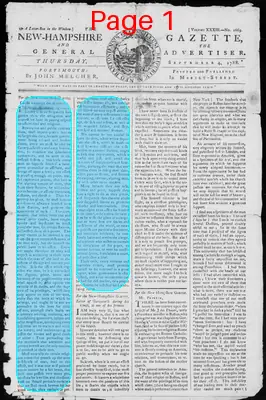
Letter to Editor
September 4, 1788
The New Hampshire Gazette And General Advertiser
Portsmouth, Rockingham County, New Hampshire
What is this article about?
A letter to the New-Hampshire Gazette urges respect for civil and religious offices to maintain societal order, warning that revolutions and selfish doctrines erode this duty, leading to divisions and neglect of public institutions like asylums.
Clipping
OCR Quality
95%
Excellent
Full Text
For the New-Hampshire Gazette.
On the Respect due to Office.
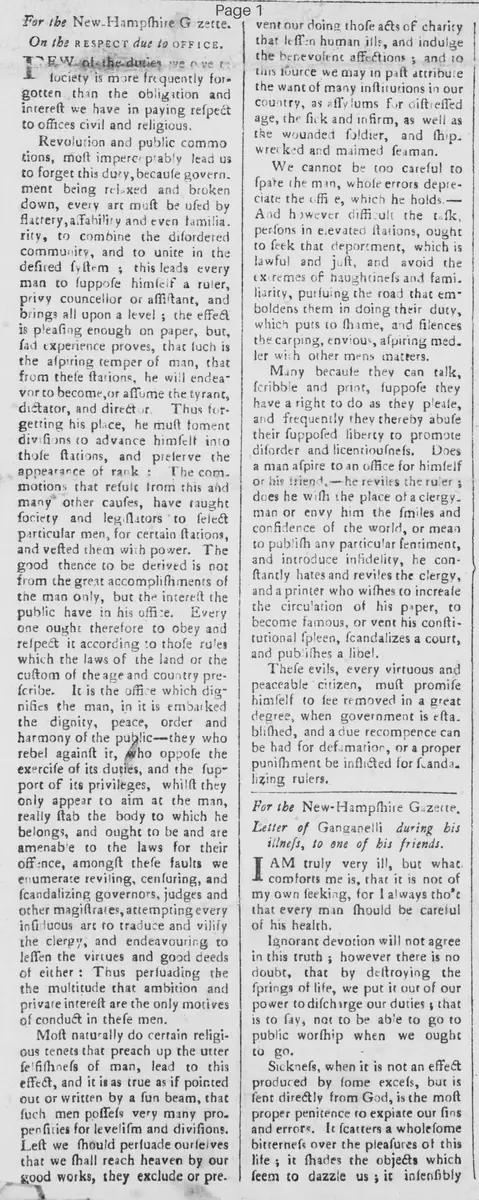
Few of the duties we owe to society is more frequently forgotten than the obligation and interest we have in paying respect to offices civil and religious. Revolutions and public commotions most imperceptibly lead us to forget this duty, because government being relaxed and broken down, every art must be used by flattery, affability and even familiarity, to combine the disordered community, and to unite in the desired system: this leads every man to suppose himself a ruler, privy councellor or assistant, and brings all upon a level; the effect is pleasing enough on paper, but, sad experience proves, that such is the aspiring temper of man, that from these tarsions he will endeavor to become, or assume the tyrant, dictator, and director. Thus forgetting his place, he must foment divisions to advance himself into those stations, and preserve the appearance of rank: The commotions that result from this and many other causes, have taught society and legislators to select particular men, for certain stations, and vested them with power. The good thence to be derived is not from the great accomplishments of the man only, but the interest the public have in his office. Every one ought therefore to obey and respect it according to those rules which the laws of the land or the custom of the age and country prescribe. It is the office which dignifies the man. in it is embarked the dignity, peace, order and harmony of the public--they who rebel against it, who oppose the exercise of its duties, and the support of its privileges, whilst they only appear to aim at the man, really stab the body to which he belongs, and ought to be and are amenable to the laws for their offence, amongst these faults we enumerate reviling, censuring, and scandalizing governors, judges and other magistrates, attempting every insidious art to traduce and vilify the clergy, and endeavouring to lessen the virtues and good deeds of either : Thus persuading the multitude that ambition and private interest are the only motives of conduct in these men. Most naturally do certain religious tenets that preach up the utter selfishness of man, lead to this effect, and it is as true as if pointed out or written by a sun beam, that such men possess very many propensities for levelism and divisions. Lest we should persuade ourselves that we shall reach heaven by our good works, they exclude or prevent our doing those acts of charity that lessen human ills, and indulge the benevolent affections ; and to this source we may in part attribute the want of many institutions in our country, as asylums for distressed age, the sick and infirm, as well as the wounded soldier, and ship-wrecked and maimed seaman. We cannot be too careful to spare the man, whose errors depreciate the office which he holds.-- And however difficult the task, persons in elevated stations, ought to seek that deportment, which is lawful and just, and avoid the extremes of haughtiness and familiarity, pursuing the road that emboldens them in doing their duty, which puts to shame, and silences the carping, envious, aspiring meddler with other mens matters. Many because they can talk, scribble and print, suppose they have a right to do as they please, and frequently they thereby abuse their supposed liberty to promote disorder and licentiousness. Does a man aspire to an office for himself or his friend,--he reviles the ruler ; does he wish the place of a clergyman or envy him the smiles and confidence of the world, or mean to publish any particular sentiment, and introduce infidelity, he constantly hates and reviles the clergy, and a printer who wishes to increase the circulation of his paper, to become famous, or vent his constitutional spleen, scandalizes a court, and publishes a libel. These evils, every virtuous and peaceable citizen, must promise himself to see removed in a great degree, when government is established, and a due recompence can be had for defamation, or a proper punishment be inflicted for slandering rulers.
On the Respect due to Office.
Few of the duties we owe to society is more frequently forgotten than the obligation and interest we have in paying respect to offices civil and religious. Revolutions and public commotions most imperceptibly lead us to forget this duty, because government being relaxed and broken down, every art must be used by flattery, affability and even familiarity, to combine the disordered community, and to unite in the desired system: this leads every man to suppose himself a ruler, privy councellor or assistant, and brings all upon a level; the effect is pleasing enough on paper, but, sad experience proves, that such is the aspiring temper of man, that from these tarsions he will endeavor to become, or assume the tyrant, dictator, and director. Thus forgetting his place, he must foment divisions to advance himself into those stations, and preserve the appearance of rank: The commotions that result from this and many other causes, have taught society and legislators to select particular men, for certain stations, and vested them with power. The good thence to be derived is not from the great accomplishments of the man only, but the interest the public have in his office. Every one ought therefore to obey and respect it according to those rules which the laws of the land or the custom of the age and country prescribe. It is the office which dignifies the man. in it is embarked the dignity, peace, order and harmony of the public--they who rebel against it, who oppose the exercise of its duties, and the support of its privileges, whilst they only appear to aim at the man, really stab the body to which he belongs, and ought to be and are amenable to the laws for their offence, amongst these faults we enumerate reviling, censuring, and scandalizing governors, judges and other magistrates, attempting every insidious art to traduce and vilify the clergy, and endeavouring to lessen the virtues and good deeds of either : Thus persuading the multitude that ambition and private interest are the only motives of conduct in these men. Most naturally do certain religious tenets that preach up the utter selfishness of man, lead to this effect, and it is as true as if pointed out or written by a sun beam, that such men possess very many propensities for levelism and divisions. Lest we should persuade ourselves that we shall reach heaven by our good works, they exclude or prevent our doing those acts of charity that lessen human ills, and indulge the benevolent affections ; and to this source we may in part attribute the want of many institutions in our country, as asylums for distressed age, the sick and infirm, as well as the wounded soldier, and ship-wrecked and maimed seaman. We cannot be too careful to spare the man, whose errors depreciate the office which he holds.-- And however difficult the task, persons in elevated stations, ought to seek that deportment, which is lawful and just, and avoid the extremes of haughtiness and familiarity, pursuing the road that emboldens them in doing their duty, which puts to shame, and silences the carping, envious, aspiring meddler with other mens matters. Many because they can talk, scribble and print, suppose they have a right to do as they please, and frequently they thereby abuse their supposed liberty to promote disorder and licentiousness. Does a man aspire to an office for himself or his friend,--he reviles the ruler ; does he wish the place of a clergyman or envy him the smiles and confidence of the world, or mean to publish any particular sentiment, and introduce infidelity, he constantly hates and reviles the clergy, and a printer who wishes to increase the circulation of his paper, to become famous, or vent his constitutional spleen, scandalizes a court, and publishes a libel. These evils, every virtuous and peaceable citizen, must promise himself to see removed in a great degree, when government is established, and a due recompence can be had for defamation, or a proper punishment be inflicted for slandering rulers.
What sub-type of article is it?
Ethical Moral
Persuasive
Reflective
What themes does it cover?
Morality
Politics
Religion
What keywords are associated?
Respect To Office
Civil Authority
Religious Clergy
Government Order
Moral Duty
Social Harmony
Levelism
Defamation Punishment
What entities or persons were involved?
New Hampshire Gazette
Letter to Editor Details
Recipient
New Hampshire Gazette
Main Argument
society must respect civil and religious offices to preserve order and harmony, as disrespect undermines authority and leads to divisions; individuals should obey laws and customs regarding these offices rather than criticizing or familiarizing with officials.
Notable Details
Revolutions Lead To Forgetting Respect For Offices
Office Dignifies The Man
Religious Tenets Promote Selfishness And Levelism
Lack Of Institutions Like Asylums Attributed To Such Views
Criticism Of Rulers, Clergy, And Courts As Abuses Of Liberty