Thank you for visiting SNEWPapers!
Sign up free
Literary
November 16, 1860
Watertown Republican
Watertown, Jefferson County, Dodge County, Wisconsin
What is this article about?
A wealthy bachelor hires housekeeper Mary Smith, mistaking her for a widow with children. He falls in love despite prejudices. During his smallpox illness, she nurses him selflessly. She reveals she's unmarried, her 'children' are siblings. They marry and have their own children, overcoming family biases.
Merged-components note: Continuation of the short story 'Light Reading. My Housekeeper.' across two components.
Clipping
OCR Quality
98%
Excellent
Full Text
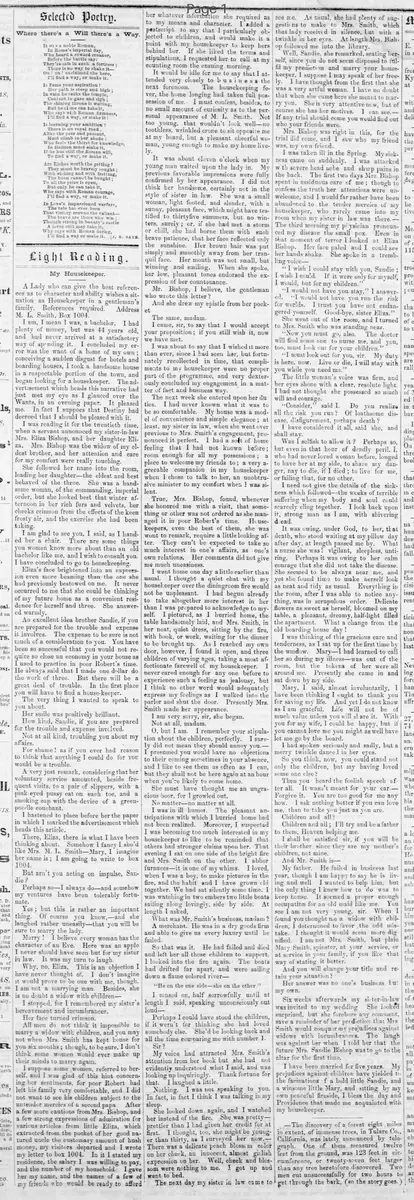
Light Reading.
My Housekeeper.
A Lady who can give the best references as to character and ability wishes a situation as Housekeeper in a gentleman's family. References required. Address M. L. Smith. Box 1004.
I am, I mean I was, a bachelor. I had plenty of money, but was 44 years old, and had never arrived at a satisfactory way of spending it. I concluded my error was the want of a home of my own; conceiving a sudden disgust for hotels and boarding houses, I took a handsome house in a respectable portion of the town, and began looking for a housekeeper. The advertisement which heads this narrative had just met my eye as I glanced over the Wants, in an evening paper. It pleased me. In fact I suppose that Destiny had decreed that I should be pleased with it. I was reading it for the twentieth time, when a servant announced my sister-in-law Mrs. Eliza Bishop, and her daughter Eliza. Mrs. Bishop was the widow of my eldest brother, and her attention and care for my comfort were really touching. She followed her name into the room leading her daughter—the eldest and best behaved of the three. She was a handsome woman, of the commanding, imperial order, but she looked best that winter afternoon in her rich furs and velvets, her cheeks crimson from the effects of the keen frosty air, and the exercise she had been taking.
I am glad to see you, I said, as I handed her a chair. There are some things you women know more about than an old bachelor like me, and I wish to consult you. I have concluded to go to housekeeping.
Eliza's face brightened into an expression even more beaming than the one she had previously bestowed on me. It never occurred to me that she could be thinking of my future home as a convenient residence for herself and three. She answered warmly,
An excellent idea brother Sandie, if you are prepared for the trouble and expense it involves. The expense to be sure is not much of a consideration to you. You have been so successful that you would not require so close an economy in your house as I used to practice in poor Robert's time. He always said that I made one dollar do the work of three. But there will be a great deal of trouble. In the first place you will have to find a house-keeper.
The very thing I wanted to speak to you about.
Her smile was positively brilliant.
How kind, Sandie, if you are prepared for the trouble and expense involved.
Not at all kind, troubling you about my affairs.
For shame! as if you ever had reason to think that anything I could do for you would be a trouble.
A very just remark, considering that her voluntary service amounted, beside frequent visits, to a pair of slippers, with a pink eyed pussy cat on each toe, and a smoking cap with the device of a green-poodle couchant.
I hastened to place before her the paper in which I marked the advertisement which heads this article.
There, Eliza, there is what I have been thinking about. Somehow I fancy I sho'd like Mrs. M. L. Smith—Mary, I imagine her name is; I am going to write to box 1004.
But arn't you acting on impulse, Sandie?
Perhaps so—I always do—and somehow my ventures have been tolerably fortunate.
Yes; but this is rather an important thing. Of course you know,—and she laughed rather uneasily—that you will be sure to marry the lady.
Marry! I believe every woman has the character of an Eve. Here was an apple I never should have seen but for my sister in law. It was my turn to laugh.
Why, no, Eliza. This is an objection I have never thought of. I don't imagine it would prove to be one with me, though. I am not a marrying man. Besides, she is no doubt a widow with children—
I stopped, for I remembered my sister's bereavement and incumbrances.
Her face turned crimson.
All men do not think it impossible to marry a widow with children, and you may not when Mrs. Smith has kept house for you six months; though, to be sure, I don't think some women would ever make up their minds to marry again.
I suppose some women, referred to herself, and I was glad of this hint concerning her sentiments, for poor Robert had left his family very comfortable, and I did not want to see his children subject to the untender mercies of a second papa. After a few more cautions from Mrs. Bishop, and a few strong expressions of admiration for various articles from little Eliza, which extracted from the pocket of her good natured uncle the customary amount of bush money, my visitors departed and I wrote my letter to box 1004. In it I stated my residence, the salary I was willing to pay, and the number of my household. I gave her my name, and the names of a few of my friends who would be ready to afford
ve information she required as to my means and character. I added a postscript to say that I particularly objected to children, and would make it a point with my housekeeper to keep hers behind her. If she liked the terms and stipulations, I requested her to call at my counting room the ensuing morning.
It would be idle for me to say that I attended very closely to business the next forenoon. The housekeeping fever, the home longing had taken full possession of me. I must confess, besides, to no small amount of curiosity as to the personal appearance of M. L. Smith. Not too young, that wouldn't look well—no toothless, wrinkled crone to sit opposite me at my board, but a pleasant cheerful woman, young enough to make my home lively.
It was about eleven o'clock when my young man waited upon the lady in. My previous favorable impressions were fully confirmed by her appearance. I did not think her handsome, certainly not in the style of sister in law. She was a small woman, light footed, and slender, with a sunny, pleasant face, which might have testified to thirty-five summers, but no winters, surely; or, if she had met a storm or chill, she had borne them with such brave patience, that her face reflected only the sunshine. Her brown hair was put simply and smoothly away from her tranquil face. Her mouth was not small, but winning and smiling. When she spoke, her low, pleasant tones endorsed the expression of her countenance.
Mr. Bishop, I believe, the gentleman who wrote this letter?
And she drew my epistle from her pocket
The same, madam.
I came, sir, to say that I would accept your proposition; if you still wish it, now we have met.
I was about to say that I wished it more than ever, since I had seen her, but fortunately recollected in time, that compliments to my housekeeper were no proper part of the programme, and very dexterously concluded my engagement in a matter of fact and business way.
The next week she entered upon her duties. I had never known what it was to be so comfortable. My house was a model of convenience and simple elegance; at least, my sister in law, when she went over previous to Mrs. Smith's engagement, pronounced it perfect. I had a set of home feeling that I had not known before; room enough for all my possessions; a place to welcome my friends to; a very agreeable companion in my housekeeper when I chose to talk to her, an unobtrusive minister to my comfort when I was silent.
True, Mrs. Bishop, found, whenever she honored me with a visit, that something or other was not ordered as she managed it in poor Robert's time. House-keepers, even the best of them, she was wont to remark, require a little looking after. They can't be expected to take so much interest in one's affairs, as one's own relations. Her comments did not give me much uneasiness.
I went home one day a little earlier than usual. I thought a quiet chat with my housekeeper over the diningroom fire would not be unpleasant. I had begun already to take altogether more interest in her than I was prepared to acknowledge to myself. I pictured, as I hurried home, the table handsomely laid, and Mrs. Smith, in her neat, quiet dress, sitting by the fire, with book, or work, waiting for the dinner to be brought up. As I reached my own door, however, I found it open, and three children of varying ages, taking a most affectionate farewell of my housekeeper. I never cared enough for any one before to experience such a feeling as jealousy, but I think no other word would adequately express my feelings as I walked into the parlor and shut the door. Presently Mrs. Smith made her appearance.
I am very sorry, sir, she began.
Not at all, madam.
O, but I am. I remember your stipulation about the children, perfectly. I surely did not mean they should annoy you.— I presumed you would have no objections to their coming sometimes in your absence, and I like to see them as often as I can, but they shall not be here again at an hour when you're likely to come home.
She must have thought me an ungracious boor, for I growled out,
No matter—no matter at all.
I was in ill humor. The pleasant anticipations with which I hurried home had not been realized. Moreover, I suspected I was becoming too much interested in my housekeeper to like to be reminded that others had stronger claims upon her. That evening I sat on one side of the bright fire and Mrs. Smith on the other. I abhor furnaces—it is one of my whims. I loved, when I was a boy, to make pictures in the fire, and the habit and I have grown old together. We had sat silently some time. I was watching in two embers two little boats sailing along lovingly, side by side. At length I asked,
What was Mr. Smith's business, madam?
A merchant. He was in a dry goods firm and able to give us every luxury until he failed.
So that was it. He had failed and died and left her all those children to support.
I looked into the fire again. The boats had drifted far apart, and were sailing down a flame colored river—
"He on the one side—she on the other
I mused on, half sorrowfully until at length I said, speaking unconsciously out loud—
Perhaps I could have stood the children if it weren't for thinking she had loved somebody else. She'd be looking back and all the time comparing me with number 1.
Sir?
My voice had attracted Mrs. Smith's attention from her book but she had not evidently understood what I said, and was looking up inquiringly. Thank fortune for that. I laughed a little.
Nothing. I was not speaking to you.
In fact, in fact I think I was talking in my sleep.
She looked down again, and I watched her instead of the fire. She was pretty— prettier than I had given her credit for at first. I thought, too, she might be younger than thirty, as I surveyed her now.— There was a delicate peach blossom color on her cheek, an innocent, almost girlish expression on her. Well, cheek and blossom were nothing to me. I got up and went to bed.
The next day my sister in law came to see me. As usual, she had plenty of suggestions to make to Mrs. Smith, which that lady received in silence, but with a twinkle in her eyes. At length Mrs. Bishop followed me into the library.
Well, Sandie, she remarked, seating herself, since you do not seem disposed to fulfill my prediction and marry your housekeeper, I suppose I may speak of her freely. I have thought from the first that she was a very artful woman. I have no doubt that when she came here she meant to marry you. She is very attentive now, but of course she has her motives. I can see.— If any trial should come you would find out who your friends were.
Mrs Bishop was right in this, for the trial did come, and I saw who my friend was, my own friend.
I was taken ill in the Spring. My sickness came on suddenly. I was attacked with severe head ache and sharp pains in the back. The first two days Mrs. Bishop spent in assiduous care of me; though to confess the truth her attentions were unwelcome, and I would far rather have been abandoned to the tender mercies of my housekeeper, who rarely came into my room when my sister in law was there.— The third morning my physician pronounced my disease the small pox. Even in that moment of terror I looked at Eliza Bishop. Her face paled and I could see her hands shake. She spoke in a trembling voice—
"I wish I could stay with you, Sandie I wish I could. If it were only for myself, I would, but for my children."
"I would not have you stay," I answered. "I would not have you run the risk for worlds. I trust you have not endangered yourself. Good-bye, sister Eliza."
She went out of the room, and I turned to Mrs. Smith who was standing near.
"Now you must go, also. The doctor will find some one to nurse me, and you, too, must look out for your children."
"I must look out for you, sir. My duty is here, now. Live or die, I will stay with you while you need me."
The little woman's voice was firm, and her eyes shone with a clear, resolute light. I had not thought she possessed so much will and courage.
"Consider," said I. Do you realize all the risk you run? Of loathsome disease, disfigurement, perhaps death?
I have considered it all, said she, and shall stay.
Was I selfish to allow it? Perhaps so, but even in that hour of deadly peril, I, who had never loved woman before, longed to have her at my side, to share my danger, nay to die, if I died; to live for me, or failing that, for no other.
I need not give the details of the sickness which followed—the weeks of terrible suffering when my body and soul could scarcely cling together. I look back upon it, strong man as I am, with shivering dread.
It was owing, under God, to her, that death, who stood waiting at my pillow day after day, at length passed me by. What a nurse she was! vigilant, sleepless, untiring. Perhaps it was owing to her calm courage that she did not take the disease She seemed to be always near me, and yet she found time to make herself look as neat and tidy as usual. Everything in the room, after I was able to notice anything, was in scrupulous order. Delicate flowers as sweet as herself, bloomed on my table, a pleasant, dreamy, half-light filled the apartment. What a change from the old boarding house day!
I was thinking of this gracious care and tenderness, as I sat up for the first time by the window. Mary—I had learned to call her so during my illness—was out of the room, but the tokens of her were all around me. Presently she came in and sat down by my side.
Mary, I said, almost involuntarily, I have been thinking I ought to thank you for saving my life. And yet I do not know as I am grateful. Life will not be of much value unless you will share it. With you for my wife, I could be happy, but if you cannot love me you might as well have let me go by the board.
I had spoken seriously and sadly, but a merry twinkle danced in her eyes.
So you think, now, you could stand not only the children, but my having loved some one else?
Then you heard the foolish speech after all. It wasn't meant for your ear.— Forgive it. You are too good for me any how. I ask nothing better if you can love me, than to take you just as you are.
Children and all?
Children and all; I'll try and be a father to them, Heaven helping me.
I shall be satisfied sir, if you will be their brother since they are my mother's children, not mine.
And Mr. Smith is—
My father. He failed in business last year, though I am happy to say he is living and well. I wanted to help him, but the only thing I knew how to do was to keep house. It seemed a proper enough occupation for an old maid like me. You see I am not very young, sir. When I found you thought me a widow with children, I determined to favor the odd mistake. I thought it would seem more dignified. I am not Mrs. Smith, but plain Mary Smith, spinster, at your service, or at service in your family, if you like that way of stating it better.
And you will change your title and retain your situation?
Her answer was no one's business but my own.
Six weeks afterwards my sister-in-law was invited to my wedding She looked surprised, but she forebore any comment, save a reminder of her prediction that Mrs Smith would conquer my prejudices against widows with incumbrances. The laugh was against her when I told her that the future Mrs. Sandie Bishop was to go to the altar for the first time.
I have been married for five years. My prejudices against children have yielded to the fascinations of a bold little Sandie, and a winsome little Mary, and sitting by my own peaceful fireside, I bless the day and Providence that made me acquainted with my housekeeper.
My Housekeeper.
A Lady who can give the best references as to character and ability wishes a situation as Housekeeper in a gentleman's family. References required. Address M. L. Smith. Box 1004.
I am, I mean I was, a bachelor. I had plenty of money, but was 44 years old, and had never arrived at a satisfactory way of spending it. I concluded my error was the want of a home of my own; conceiving a sudden disgust for hotels and boarding houses, I took a handsome house in a respectable portion of the town, and began looking for a housekeeper. The advertisement which heads this narrative had just met my eye as I glanced over the Wants, in an evening paper. It pleased me. In fact I suppose that Destiny had decreed that I should be pleased with it. I was reading it for the twentieth time, when a servant announced my sister-in-law Mrs. Eliza Bishop, and her daughter Eliza. Mrs. Bishop was the widow of my eldest brother, and her attention and care for my comfort were really touching. She followed her name into the room leading her daughter—the eldest and best behaved of the three. She was a handsome woman, of the commanding, imperial order, but she looked best that winter afternoon in her rich furs and velvets, her cheeks crimson from the effects of the keen frosty air, and the exercise she had been taking.
I am glad to see you, I said, as I handed her a chair. There are some things you women know more about than an old bachelor like me, and I wish to consult you. I have concluded to go to housekeeping.
Eliza's face brightened into an expression even more beaming than the one she had previously bestowed on me. It never occurred to me that she could be thinking of my future home as a convenient residence for herself and three. She answered warmly,
An excellent idea brother Sandie, if you are prepared for the trouble and expense it involves. The expense to be sure is not much of a consideration to you. You have been so successful that you would not require so close an economy in your house as I used to practice in poor Robert's time. He always said that I made one dollar do the work of three. But there will be a great deal of trouble. In the first place you will have to find a house-keeper.
The very thing I wanted to speak to you about.
Her smile was positively brilliant.
How kind, Sandie, if you are prepared for the trouble and expense involved.
Not at all kind, troubling you about my affairs.
For shame! as if you ever had reason to think that anything I could do for you would be a trouble.
A very just remark, considering that her voluntary service amounted, beside frequent visits, to a pair of slippers, with a pink eyed pussy cat on each toe, and a smoking cap with the device of a green-poodle couchant.
I hastened to place before her the paper in which I marked the advertisement which heads this article.
There, Eliza, there is what I have been thinking about. Somehow I fancy I sho'd like Mrs. M. L. Smith—Mary, I imagine her name is; I am going to write to box 1004.
But arn't you acting on impulse, Sandie?
Perhaps so—I always do—and somehow my ventures have been tolerably fortunate.
Yes; but this is rather an important thing. Of course you know,—and she laughed rather uneasily—that you will be sure to marry the lady.
Marry! I believe every woman has the character of an Eve. Here was an apple I never should have seen but for my sister in law. It was my turn to laugh.
Why, no, Eliza. This is an objection I have never thought of. I don't imagine it would prove to be one with me, though. I am not a marrying man. Besides, she is no doubt a widow with children—
I stopped, for I remembered my sister's bereavement and incumbrances.
Her face turned crimson.
All men do not think it impossible to marry a widow with children, and you may not when Mrs. Smith has kept house for you six months; though, to be sure, I don't think some women would ever make up their minds to marry again.
I suppose some women, referred to herself, and I was glad of this hint concerning her sentiments, for poor Robert had left his family very comfortable, and I did not want to see his children subject to the untender mercies of a second papa. After a few more cautions from Mrs. Bishop, and a few strong expressions of admiration for various articles from little Eliza, which extracted from the pocket of her good natured uncle the customary amount of bush money, my visitors departed and I wrote my letter to box 1004. In it I stated my residence, the salary I was willing to pay, and the number of my household. I gave her my name, and the names of a few of my friends who would be ready to afford
ve information she required as to my means and character. I added a postscript to say that I particularly objected to children, and would make it a point with my housekeeper to keep hers behind her. If she liked the terms and stipulations, I requested her to call at my counting room the ensuing morning.
It would be idle for me to say that I attended very closely to business the next forenoon. The housekeeping fever, the home longing had taken full possession of me. I must confess, besides, to no small amount of curiosity as to the personal appearance of M. L. Smith. Not too young, that wouldn't look well—no toothless, wrinkled crone to sit opposite me at my board, but a pleasant cheerful woman, young enough to make my home lively.
It was about eleven o'clock when my young man waited upon the lady in. My previous favorable impressions were fully confirmed by her appearance. I did not think her handsome, certainly not in the style of sister in law. She was a small woman, light footed, and slender, with a sunny, pleasant face, which might have testified to thirty-five summers, but no winters, surely; or, if she had met a storm or chill, she had borne them with such brave patience, that her face reflected only the sunshine. Her brown hair was put simply and smoothly away from her tranquil face. Her mouth was not small, but winning and smiling. When she spoke, her low, pleasant tones endorsed the expression of her countenance.
Mr. Bishop, I believe, the gentleman who wrote this letter?
And she drew my epistle from her pocket
The same, madam.
I came, sir, to say that I would accept your proposition; if you still wish it, now we have met.
I was about to say that I wished it more than ever, since I had seen her, but fortunately recollected in time, that compliments to my housekeeper were no proper part of the programme, and very dexterously concluded my engagement in a matter of fact and business way.
The next week she entered upon her duties. I had never known what it was to be so comfortable. My house was a model of convenience and simple elegance; at least, my sister in law, when she went over previous to Mrs. Smith's engagement, pronounced it perfect. I had a set of home feeling that I had not known before; room enough for all my possessions; a place to welcome my friends to; a very agreeable companion in my housekeeper when I chose to talk to her, an unobtrusive minister to my comfort when I was silent.
True, Mrs. Bishop, found, whenever she honored me with a visit, that something or other was not ordered as she managed it in poor Robert's time. House-keepers, even the best of them, she was wont to remark, require a little looking after. They can't be expected to take so much interest in one's affairs, as one's own relations. Her comments did not give me much uneasiness.
I went home one day a little earlier than usual. I thought a quiet chat with my housekeeper over the diningroom fire would not be unpleasant. I had begun already to take altogether more interest in her than I was prepared to acknowledge to myself. I pictured, as I hurried home, the table handsomely laid, and Mrs. Smith, in her neat, quiet dress, sitting by the fire, with book, or work, waiting for the dinner to be brought up. As I reached my own door, however, I found it open, and three children of varying ages, taking a most affectionate farewell of my housekeeper. I never cared enough for any one before to experience such a feeling as jealousy, but I think no other word would adequately express my feelings as I walked into the parlor and shut the door. Presently Mrs. Smith made her appearance.
I am very sorry, sir, she began.
Not at all, madam.
O, but I am. I remember your stipulation about the children, perfectly. I surely did not mean they should annoy you.— I presumed you would have no objections to their coming sometimes in your absence, and I like to see them as often as I can, but they shall not be here again at an hour when you're likely to come home.
She must have thought me an ungracious boor, for I growled out,
No matter—no matter at all.
I was in ill humor. The pleasant anticipations with which I hurried home had not been realized. Moreover, I suspected I was becoming too much interested in my housekeeper to like to be reminded that others had stronger claims upon her. That evening I sat on one side of the bright fire and Mrs. Smith on the other. I abhor furnaces—it is one of my whims. I loved, when I was a boy, to make pictures in the fire, and the habit and I have grown old together. We had sat silently some time. I was watching in two embers two little boats sailing along lovingly, side by side. At length I asked,
What was Mr. Smith's business, madam?
A merchant. He was in a dry goods firm and able to give us every luxury until he failed.
So that was it. He had failed and died and left her all those children to support.
I looked into the fire again. The boats had drifted far apart, and were sailing down a flame colored river—
"He on the one side—she on the other
I mused on, half sorrowfully until at length I said, speaking unconsciously out loud—
Perhaps I could have stood the children if it weren't for thinking she had loved somebody else. She'd be looking back and all the time comparing me with number 1.
Sir?
My voice had attracted Mrs. Smith's attention from her book but she had not evidently understood what I said, and was looking up inquiringly. Thank fortune for that. I laughed a little.
Nothing. I was not speaking to you.
In fact, in fact I think I was talking in my sleep.
She looked down again, and I watched her instead of the fire. She was pretty— prettier than I had given her credit for at first. I thought, too, she might be younger than thirty, as I surveyed her now.— There was a delicate peach blossom color on her cheek, an innocent, almost girlish expression on her. Well, cheek and blossom were nothing to me. I got up and went to bed.
The next day my sister in law came to see me. As usual, she had plenty of suggestions to make to Mrs. Smith, which that lady received in silence, but with a twinkle in her eyes. At length Mrs. Bishop followed me into the library.
Well, Sandie, she remarked, seating herself, since you do not seem disposed to fulfill my prediction and marry your housekeeper, I suppose I may speak of her freely. I have thought from the first that she was a very artful woman. I have no doubt that when she came here she meant to marry you. She is very attentive now, but of course she has her motives. I can see.— If any trial should come you would find out who your friends were.
Mrs Bishop was right in this, for the trial did come, and I saw who my friend was, my own friend.
I was taken ill in the Spring. My sickness came on suddenly. I was attacked with severe head ache and sharp pains in the back. The first two days Mrs. Bishop spent in assiduous care of me; though to confess the truth her attentions were unwelcome, and I would far rather have been abandoned to the tender mercies of my housekeeper, who rarely came into my room when my sister in law was there.— The third morning my physician pronounced my disease the small pox. Even in that moment of terror I looked at Eliza Bishop. Her face paled and I could see her hands shake. She spoke in a trembling voice—
"I wish I could stay with you, Sandie I wish I could. If it were only for myself, I would, but for my children."
"I would not have you stay," I answered. "I would not have you run the risk for worlds. I trust you have not endangered yourself. Good-bye, sister Eliza."
She went out of the room, and I turned to Mrs. Smith who was standing near.
"Now you must go, also. The doctor will find some one to nurse me, and you, too, must look out for your children."
"I must look out for you, sir. My duty is here, now. Live or die, I will stay with you while you need me."
The little woman's voice was firm, and her eyes shone with a clear, resolute light. I had not thought she possessed so much will and courage.
"Consider," said I. Do you realize all the risk you run? Of loathsome disease, disfigurement, perhaps death?
I have considered it all, said she, and shall stay.
Was I selfish to allow it? Perhaps so, but even in that hour of deadly peril, I, who had never loved woman before, longed to have her at my side, to share my danger, nay to die, if I died; to live for me, or failing that, for no other.
I need not give the details of the sickness which followed—the weeks of terrible suffering when my body and soul could scarcely cling together. I look back upon it, strong man as I am, with shivering dread.
It was owing, under God, to her, that death, who stood waiting at my pillow day after day, at length passed me by. What a nurse she was! vigilant, sleepless, untiring. Perhaps it was owing to her calm courage that she did not take the disease She seemed to be always near me, and yet she found time to make herself look as neat and tidy as usual. Everything in the room, after I was able to notice anything, was in scrupulous order. Delicate flowers as sweet as herself, bloomed on my table, a pleasant, dreamy, half-light filled the apartment. What a change from the old boarding house day!
I was thinking of this gracious care and tenderness, as I sat up for the first time by the window. Mary—I had learned to call her so during my illness—was out of the room, but the tokens of her were all around me. Presently she came in and sat down by my side.
Mary, I said, almost involuntarily, I have been thinking I ought to thank you for saving my life. And yet I do not know as I am grateful. Life will not be of much value unless you will share it. With you for my wife, I could be happy, but if you cannot love me you might as well have let me go by the board.
I had spoken seriously and sadly, but a merry twinkle danced in her eyes.
So you think, now, you could stand not only the children, but my having loved some one else?
Then you heard the foolish speech after all. It wasn't meant for your ear.— Forgive it. You are too good for me any how. I ask nothing better if you can love me, than to take you just as you are.
Children and all?
Children and all; I'll try and be a father to them, Heaven helping me.
I shall be satisfied sir, if you will be their brother since they are my mother's children, not mine.
And Mr. Smith is—
My father. He failed in business last year, though I am happy to say he is living and well. I wanted to help him, but the only thing I knew how to do was to keep house. It seemed a proper enough occupation for an old maid like me. You see I am not very young, sir. When I found you thought me a widow with children, I determined to favor the odd mistake. I thought it would seem more dignified. I am not Mrs. Smith, but plain Mary Smith, spinster, at your service, or at service in your family, if you like that way of stating it better.
And you will change your title and retain your situation?
Her answer was no one's business but my own.
Six weeks afterwards my sister-in-law was invited to my wedding She looked surprised, but she forebore any comment, save a reminder of her prediction that Mrs Smith would conquer my prejudices against widows with incumbrances. The laugh was against her when I told her that the future Mrs. Sandie Bishop was to go to the altar for the first time.
I have been married for five years. My prejudices against children have yielded to the fascinations of a bold little Sandie, and a winsome little Mary, and sitting by my own peaceful fireside, I bless the day and Providence that made me acquainted with my housekeeper.
What sub-type of article is it?
Prose Fiction
What themes does it cover?
Love Romance
Friendship
Moral Virtue
What keywords are associated?
Bachelor Housekeeper
Romantic Misunderstanding
Smallpox Illness
Family Prejudices
Marriage Proposal
Widow Mistake
Literary Details
Title
My Housekeeper
Key Lines
"I Must Look Out For You, Sir. My Duty Is Here, Now. Live Or Die, I Will Stay With You While You Need Me."
"So You Think, Now, You Could Stand Not Only The Children, But My Having Loved Some One Else?"
"And Mr. Smith Is— My Father. He Failed In Business Last Year, Though I Am Happy To Say He Is Living And Well."
I Have Been Married For Five Years. My Prejudices Against Children Have Yielded To The Fascinations Of A Bold Little Sandie, And A Winsome Little Mary, And Sitting By My Own Peaceful Fireside, I Bless The Day And Providence That Made Me Acquainted With My Housekeeper.